
Google Tag Manager (GTM) Training: Mastering Data Analytics in Singapore for 2026

Updated: Sep 23
What if you could deploy every marketing pixel and tracking event your business needs without ever waiting on a developer for help? Most PMEBs in Singapore feel the frustration of delayed campaigns and inaccurate GA4 reporting because they lack direct access to their website's data layer. It is a common bottleneck that stalls strategic growth and often leaves professionals fearing they might accidentally break the site code while trying to fix tracking errors.
Professional google tag manager (gtm) training is the strategic solution that bridges the gap between marketing vision and technical reality. By mastering this tool, you gain full control over your conversion tracking and data accuracy, allowing you to make informed decisions based on facts rather than guesswork. You will also discover how to leverage SSG funding to make this high-value upskilling more accessible for your career development.
In this article, we examine how to bypass technical gatekeepers, optimise your measurement strategy, and secure a professional certification that commands respect in the APAC region. We also preview the latest 2026 updates, including visual tagging and server-side optimisations that are currently redefining the industry standard for data privacy and performance.
Key Takeaways
Take full control of your marketing tech stack by mastering the container concept to deploy pixels without waiting for developers.
Ensure your GA4 reporting is flawless by undergoing formal google tag manager (gtm) training to eliminate the risks of "dirty data" common in self-taught methods.
Optimise website performance and user experience by learning how to consolidate scripts to improve page load speeds.
Follow a professional roadmap from audit to advanced deployment to future-proof your data strategy for the 2026 landscape.
Leverage SSG funding and SkillsFuture Credits in Singapore to gain a WSQ-accredited certification that boosts your professional credibility.
Table of Contents
What is Google Tag Manager (GTM) Training and Why is it Essential in 2026?
Professional google tag manager (gtm) training is a structured programme designed to help you deploy marketing pixels and tracking scripts without writing a single line of manual code. It focuses on mastering a Tag Management System to bridge the gap between high-level marketing strategy and technical execution. In the 2026 landscape, the focus has shifted from simple data collection to true data intelligence. Your tracking must now be precise, privacy-compliant, and capable of handling complex user journeys across multiple platforms.
Privacy-first tracking is now the industry standard. Modern training addresses critical areas like consent management and server-side tagging to ensure your data remains accurate while respecting user privacy regulations. By becoming a GTM specialist, you position yourself as a vital link in any digital marketing team, translating business goals into measurable technical events that drive growth.
To better understand the core concepts of this platform, watch this helpful tutorial:
The Strategic Advantage for PMEBs
For Professionals, Managers, Executives, and Businessmen (PMEBs) in Singapore, GTM mastery is a career-defining skill. It reduces departmental friction by removing the "developer bottleneck." You no longer need to wait weeks for a technical team to install a simple conversion tag. This independence enables real-time marketing agility, allowing you to launch and optimise campaigns the moment they are ready. In the competitive APAC market, positioning GTM as a core competency is essential for those eyeing senior marketing roles that require deep data literacy.
GTM as the Foundation for GA4 Success
Basic GA4 implementations often fail or provide "dirty data" without a robust GTM setup. Because GA4 is built on an event-based tracking model, you need a sophisticated container to capture specific user interactions like button clicks, form submissions, or video views. By enrolling in comprehensive google tag manager (gtm) training, you learn to link your tags directly to Marketing Analytics with GA4 for holistic insights. This foundation ensures that every marketing dollar spent is tracked with precision, providing the clarity needed for modern analytics frameworks.
How GTM Training Simplifies Your Digital Marketing Tech Stack
Managing a modern marketing stack often feels like juggling too many balls at once. Every new platform, from LinkedIn to Meta, requires its own tracking script. Without google tag manager (gtm) training, your website code quickly becomes a cluttered mess of disjointed snippets. GTM introduces the "container" concept, where a single piece of code acts as a master key. Once this container is installed, you can deploy, update, or remove tags from a centralised dashboard without touching the underlying source code again.
This consolidation does more than just tidy up your workspace; it significantly reduces website latency. Traditional hard-coded tags load synchronously, which can stall your page rendering and frustrate users. GTM tags load asynchronously, meaning they won't block other elements from appearing. This improves page load speeds, which is a critical factor for both user experience and SEO rankings in Singapore's competitive digital market.
You gain a unified control panel for all your third-party tools. Whether you're managing Google Ads conversion tracking, LinkedIn Insight Tags, or Meta Pixels, everything lives in one place. If you've ever worried about "breaking the site," GTM's version control is your safety net. You can create different workspaces for team members and preview changes in a secure environment before they go live. If an error occurs, you can revert to a previous version with a single click.
Mastering the Data Layer
The Data Layer serves as the "translator" between your website's complex backend and your marketing tools. Professional google tag manager (gtm) training teaches you how to leverage this layer to capture high-value information like transaction values, currency types, and unique user IDs. By using the Data Layer as a middleman, you prevent your tracking from breaking every time your website’s design changes. The Data Layer is the essential repository for clean, structured data that ensures your analytics tools receive consistent information across every session.
Triggers and Variables: The Logic of Tracking
Effective tracking requires understanding the "When" and the "What" of user behaviour. Triggers define the conditions under which a tag fires, such as a specific button click or a form submission. Variables provide the specific data points needed, like the URL of the page or the title of a video being viewed. You can track scroll depth and video engagement with surgical precision, allowing you to identify high-value customer segments based on their actual engagement levels. To build this technical confidence, many professionals start with a structured digital marketing strategy programme to see how these tools fit into a larger business objective.
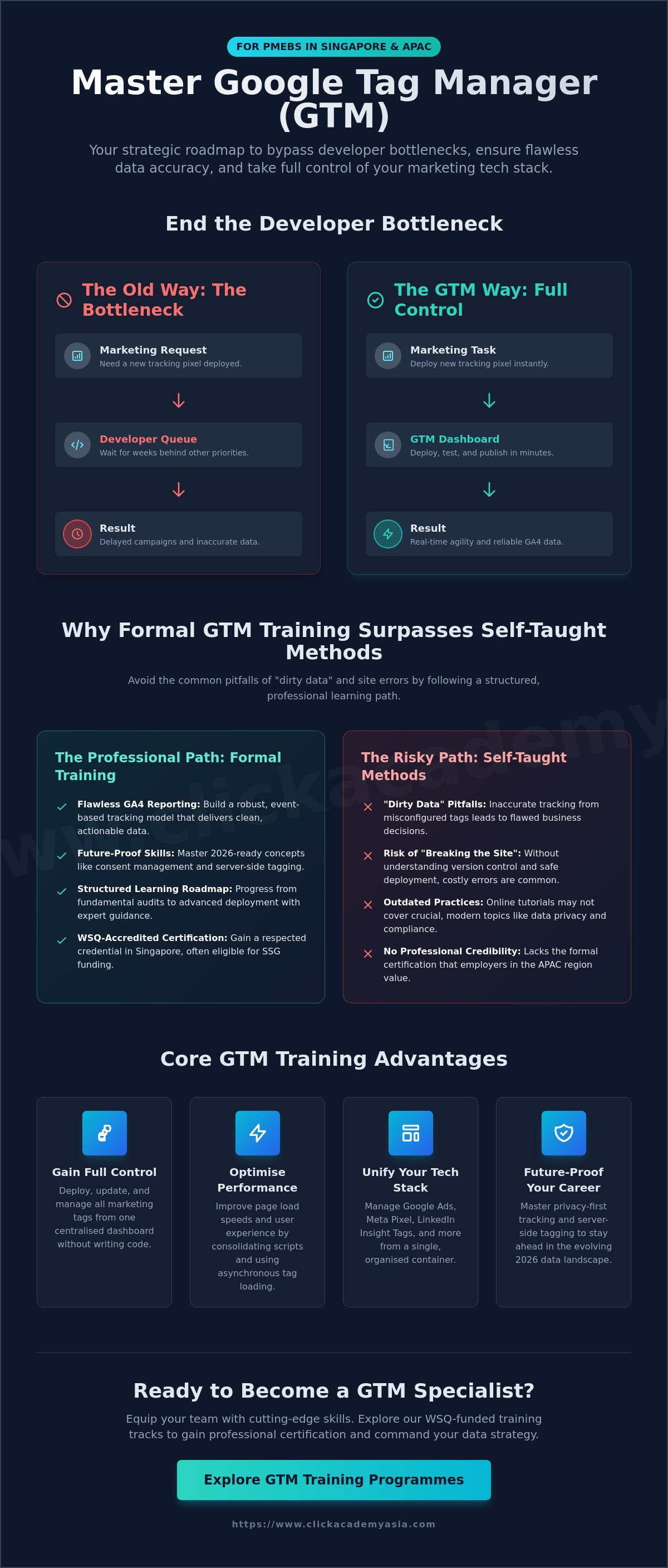
Why Formal GTM Training Surpasses Self-Taught Methods
Many PMEBs initially wonder if they can simply learn the platform through free YouTube tutorials or help articles. While these resources offer a basic introduction, they rarely prepare you for the complexities of real-world site architectures or custom tracking requirements. Without formal google tag manager (gtm) training, you risk populating your GA4 reports with "dirty data" caused by unverified implementation methods. Free content often provides a "happy path" that doesn't account for the unique technical hurdles of your specific business website.
A mentor-led environment is essential for mastering the critical troubleshooting skills that separate a novice from an expert. When a standard trigger refuses to fire or a variable returns "undefined," having an experienced practitioner to guide you through the debugging process is invaluable. In Singapore, the WSQ framework provides an additional layer of security by ensuring your curriculum meets a national standard of excellence. This structured approach guarantees that you aren't just learning a tool, but mastering a standardised methodology that is recognised across the APAC region.
The Dangers of Incorrect Tag Implementation
Flawed tracking inevitably leads to flawed business decisions. If your tags are double-counting conversions or missing key user events, your marketing attribution models will be fundamentally broken. This creates a significant financial cost when you allocate marketing budgets based on inaccurate ROI data. Professional debugging and QA skills are often the most undervalued part of formal training, yet they are what prevent you from making expensive mistakes in your digital advertising spend.
Hands-on Practice vs. Passive Learning
Passive learning through a screen cannot replace the experience of working in a live sandbox. In a professional workshop, you engage with real-world case studies that mirror the actual challenges faced by Singaporean businesses. This hands-on approach builds the technical confidence required to manage enterprise-level GTM accounts without the fear of breaking the site code. You also gain the unique networking value of learning alongside other local PMEBs, allowing you to share insights and best practices within the Singapore business ecosystem. Building these connections with peers who are also navigating digital transformation can be just as beneficial as the technical curriculum itself.
A Step-by-Step Roadmap to Mastering Google Tag Manager
Mastering a complex tool requires more than just memorising button locations. It demands a systematic approach that moves from foundational stability to advanced strategic deployment. High-quality google tag manager (gtm) training provides this roadmap, ensuring you don't just "install" tags, but build a robust data architecture that scales with your business needs. For PMEBs in Singapore, following a structured implementation checklist is the fastest way to transition from technical uncertainty to data-driven leadership.
Success in GTM is built on a cycle of planning, execution, and rigorous validation. Before publishing any changes, you must ensure your tracking logic aligns with your broader business objectives. This progression allows you to move beyond basic page-view tracking into the realm of sophisticated data visualisation and predictive modelling.
Step 1: The Audit and Foundational Setup
Your journey begins with a thorough audit of your existing tracking environment. You must identify old, hard-coded tags that need migration to the GTM container to prevent duplicate firing and data inflation. For multi-national or multi-site brands, setting up a scalable account structure is vital for maintaining long-term clarity. Establishing strict naming conventions (e.g., [Platform] - [Action] - [Location]) ensures your container remains organised and manageable as your marketing stack grows more complex.
Step 2: Implementing Advanced Event Tracking
Once your foundation is secure, you can begin building custom triggers for non-standard user interactions that off-the-shelf solutions often miss. This includes tracking file downloads, specific form field errors, or complex AJAX-based submissions. By integrating GTM with professional data visualisation tools, you can transform these raw events into executive-level reports that drive board-room decisions. Advanced google tag manager (gtm) training also shows you how to use these data points to fuel predictive analytics, helping you anticipate customer behaviour before it happens.
Step 3: Debugging and Governance
The final stage of mastery involves ensuring that your data remains untainted through strict governance. You must become proficient with the GTM Debugger and Tag Assistant to verify the firing sequence of every tag across different browser environments. Setting up granular user permissions and "Publish" workflows prevents accidental errors that could disrupt your entire tracking ecosystem. The "Preview" mode is a marketer’s best friend because it allows you to simulate user behaviour and verify data accuracy in a safe environment before a single tag goes live. To start building these technical skills today, consider exploring our WSQ-funded analytics courses to gain hands-on experience with these essential tools.
Elevating Your Career with WSQ-Accredited GTM Training in Singapore
Securing a competitive edge in the APAC digital economy requires more than just high-level strategic thinking. It demands the technical ability to execute that strategy with precision. For PMEBs in Singapore, google tag manager (gtm) training is the bridge that connects visionary marketing with measurable results. Obtaining a WSQ-certified qualification does not just add a line to your CV; it signals to employers that you possess a standardised, high-level competency in data governance and technical deployment.
As we move through 2026, the demand for professionals who can manage complex tracking environments independently continues to rise. Companies are no longer looking for generalists. They want specialists who can ensure data integrity in a privacy-first world. Mastering GTM positions you as a data-driven leader capable of guiding a brand through the technical nuances of modern analytics.
Maximising SSG Funding and SkillsFuture Credits
Financial barriers to high-level upskilling are significantly reduced through Singapore's robust support ecosystem. Singapore Citizens and Permanent Residents can access substantial SSG funding to offset a large portion of their course fees. Those aged 40 and above benefit even further from the Mid-Career Enhanced Subsidy (MCES), which makes advanced technical education highly accessible. Individuals can also utilise their SkillsFuture Credits to cover remaining out-of-pocket costs.
Corporate leaders and HR managers should look into the SkillsFuture Enterprise Credit (SFEC) to claim additional training grants for their teams. With the significant GTM updates released in June 2026, including new visual tagging and server-side capabilities, this is the critical year to utilise remaining training balances. Investing in your team’s technical literacy now prevents the costly "dirty data" errors that plague unoptimised GA4 setups.
The ClickAcademy Asia Difference: Expert Mentorship
We believe that education should be grounded in real-world professional experience rather than abstract theory. Our google tag manager (gtm) training is led by practitioners who have managed complex deployments for global industry leaders. This mentorship ensures you learn the practical nuances of the platform, from advanced event tracking to sophisticated debugging techniques. Our programme is designed to integrate seamlessly with the wider WSQ Digital Marketing Strategy framework, providing a holistic path to professional mastery.
By joining our workshops, you enter a community of future-ready marketing leaders in Singapore. You will gain the confidence to manage enterprise-level accounts and the credibility that comes with a recognised WSQ qualification. This is your opportunity to stop being a bystander in technical discussions and start leading them.
Mastering Google Tag Manager is no longer optional for professionals who want to lead in a data-centric market. By bypassing the developer bottleneck, ensuring GA4 accuracy, and leveraging generous SSG funding, you can future-proof your career and drive tangible business growth. Take control of your marketing tech stack and join the ranks of Singapore’s most elite digital practitioners.
Equip your team with cutting-edge skills by exploring our WSQ-funded training tracks today.



Comments