
Predictive Analytics in Marketing Course: 5 Common Myths Debunked for 2026

Updated: Sep 11
Your marketing career doesn't require a PhD in mathematics to survive the AI revolution of 2026. While the global predictive analytics market is projected to reach USD 25.99 billion this year according to The Business Research Company, you might feel that a predictive analytics in marketing course is only for data scientists. It is easy to feel overwhelmed by complex GA4 datasets or the fear that your budget is being wasted on poorly targeted campaigns.
We understand that the shift toward data-heavy strategy feels daunting, especially when you are trying to balance evolving privacy regulations with campaign performance. The good news is that mastering these tools is about strategic leadership, not just crunching numbers. You can learn to accurately forecast ROI and lead your team with absolute confidence without ever writing a single line of code.
This article debunks five persistent myths that hold marketers back from essential career progression. You will discover how to secure a WSQ-certified credential that future-proofs your role and turns big data into actionable wins. Let's clear the fog and show you how to dominate the Singapore landscape with practical, practitioner-led insights.
Key Takeaways
Stop viewing data as a hurdle and start using historical patterns to forecast consumer behaviour with precision.
Realise that a predictive analytics in marketing course focuses on strategic decision-making rather than requiring you to learn complex coding or Python.
Explore how cloud-native tools have democratised data, allowing smaller teams to gain a competitive edge through targeted micro-insights.
Use our 2026 checklist to verify that your chosen training is WSQ-certified and prioritises real-world application over abstract theory.
Prepare to lead your marketing department with the ability to accurately predict campaign results and secure your professional future.
Table of Contents
What Exactly is a Predictive Analytics in Marketing Course?
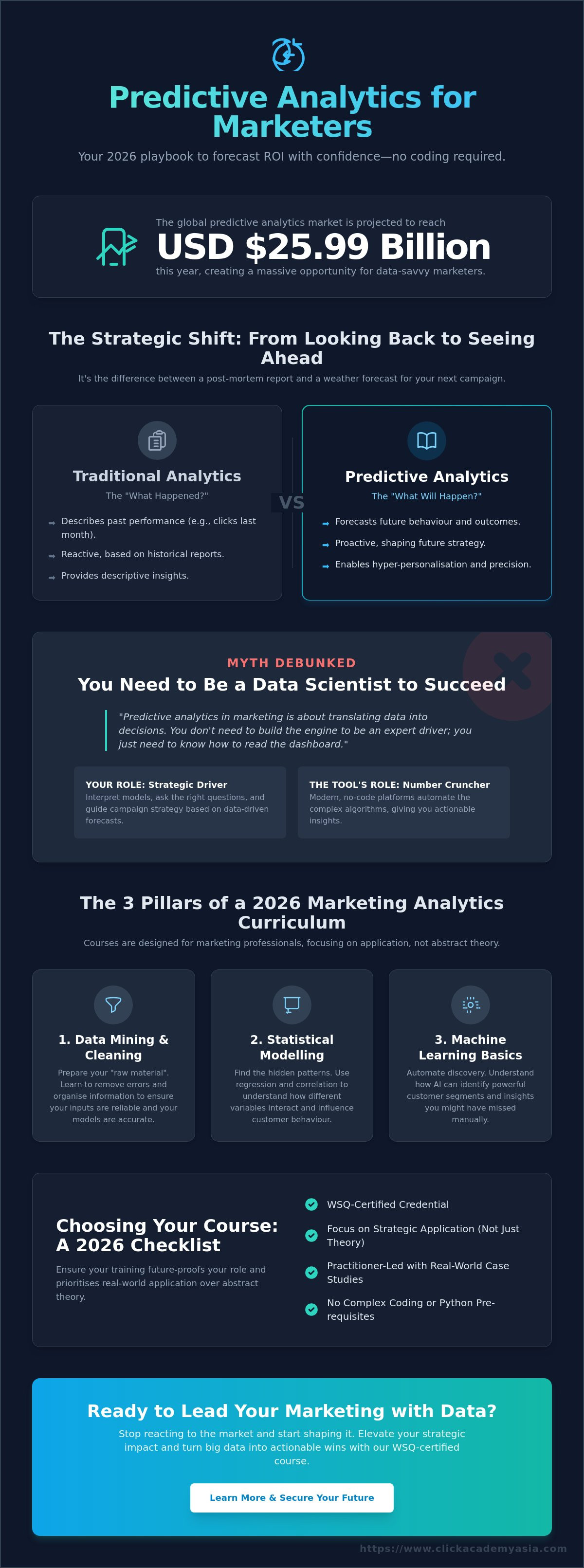
At its heart, a predictive analytics in marketing course teaches you how to look at the past to see the future. While traditional analytics tells you how many people clicked a link last month, predictive analytics uses that historical data to forecast how they will behave next month. It's the difference between reading a post-mortem report and holding a weather forecast for your next campaign. You aren't just looking at spreadsheets; you're learning to spot the subtle signals that indicate a customer is about to churn or is ready to upgrade.
To understand the technical foundation, it helps to look at What is Predictive Analytics? and how it applies across different industries. For a marketer, the focus isn't on writing the algorithms. Instead, it's about interpreting the models these algorithms produce to make smarter business decisions. A modern curriculum focuses on the "so what" of the data, empowering you to lead strategy rather than getting lost in the code.
To better understand this concept, watch this helpful video:
The Core Components of a 2026 Marketing Analytics Curriculum
Modern courses focus on three main pillars that turn raw data into strategic assets. First, you'll cover data mining and cleaning. This is where you prepare your "raw material" by removing errors and organising information so it's actually useful. Without clean data, even the best models will fail. You'll learn how to ensure your inputs are reliable and representative.
Next comes statistical modelling. This sounds intimidating, but it's simply using regression and correlation to find patterns in how variables interact. Finally, you'll touch on machine learning basics. In a marketing context, this is about how AI automates the discovery of customer insights, identifying segments you might have missed manually. These components are designed specifically for marketing professionals, ensuring the technical depth remains relevant to your daily work.
Why Traditional Marketing Skills are No Longer Enough
The days of "gut-feeling" marketing are fading fast, especially in a data-saturated Singapore market. Relying on intuition alone often leads to wasted spend and missed opportunities. Predictive insights allow for hyper-personalisation at scale, ensuring you're reaching the right person with the right message at the exact moment they need it. This precision is what separates high-growth brands from those struggling to keep up.
Mastering these tools is no longer optional for those who want to lead. A key part of this journey is understanding marketing analytics with GA4, which serves as a foundational skill for any modern professional. By moving from descriptive to predictive analytics, you stop reacting to the market and start shaping it. This shift ensures your strategies are proactive, measurable, and, most importantly, profitable.
Myth 1: You Need to be a Data Scientist to Succeed
Don't let the sight of complex algorithms scare you away from enrolling in a predictive analytics in marketing course. Many professionals think they must master Python or R before they can even touch a dataset. In reality, the most successful data-driven marketers in Singapore are often those who haven't written a single line of code in years. Your value isn't found in the mechanics of the software, but in your ability to steer the strategy.
Strategic Insight: Predictive analytics in a marketing context is about translating data into decisions. You don't need to build the engine to be an expert driver; you just need to know how to read the dashboard to reach your destination.
Modern tools like Google BigQuery and the Databricks Data Intelligence Platform have removed the technical barriers that once restricted this field to IT departments. Your "Domain Expertise"—knowing your audience and local market trends—is far more valuable than knowing how to build a model from scratch. A quality course focuses on teaching you how to ask the right questions so the data actually serves your specific business goals. If you're ready to bridge this gap, our WSQ Marketing Analytics & Insights module is designed specifically for practitioners, not programmers.
Strategic Thinking vs. Technical Execution
As a Marketing Lead, you need to understand the output of a model more than the algorithm itself. You serve as the "Translator" between the technical team and the boardroom, ensuring that raw findings are converted into profitable strategies. Understanding the "so what" of a forecast allows you to allocate budgets with precision. Predictive analytics is a tool for strategic empowerment rather than a technical burden that slows you down.
Tools That Make Analytics Accessible
The rise of no-code platforms in 2026 has democratised how we handle forecasting across the region. Instead of wrestling with complex spreadsheets, you can now use automated dashboards that highlight trends and irregularities instantly. Mastering marketing data visualization is the key to this transition. It allows you to present complex insights to stakeholders in a way that is clear, persuasive, and designed to win immediate buy-in for your next campaign.
Myth 2: Predictive Analytics is Only for Global Giants
It's a common mistake to assume that predictive power is a luxury reserved for the Fortune 500. While global giants have massive data lakes, cloud-native predictive analytics solutions saw a 50% adoption surge between 2024 and 2026, largely driven by small and medium enterprises. You don't need a multi-million dollar infrastructure when platforms like Google BigQuery and SAP Analytics Cloud offer scalable, pay-as-you-go models. This shift means that even a localised boutique or a regional B2B firm can leverage the same forecasting techniques used by industry leaders.
Enrolling in a predictive analytics in marketing course is often the first step for SME leaders to realise their existing data is a goldmine. You don't need billions of rows of information to find value. If you have a customer list and basic transaction history, you have enough to start predicting future behaviours. For businesses with limited budgets, the ROI of these insights is actually higher because every dollar saved through better targeting has a larger impact on the bottom line.
Practical Applications for Singaporean SMEs
Local businesses can see immediate wins by applying predictive models to three key areas. Lead scoring allows you to stop chasing every query and use models to identify which prospects are most likely to convert today. Inventory forecasting helps you reduce overheads by predicting seasonal demand shifts so you don't overstock. Finally, churn prediction helps you spot the red flag behaviours that suggest a client is about to switch to a competitor, allowing you to intervene with a proactive offer before they leave.
Busting the "Big Data" Requirement
The phrase "Big Data" has done a lot of damage by making smaller players feel inadequate. In reality, "Smart Data" is far more valuable than sheer volume. You can run highly effective predictive models on a database of just a few thousand contacts. It's about the quality of the signals you track rather than the size of your server. If you can track how a few thousand people interact with your site, you can predict what the next ten thousand will do.
Small-scale budget optimisation relies heavily on understanding which touchpoints actually drive sales. This is where marketing attribution modelling training becomes essential. When you combine attribution with predictive insights, you stop looking at what worked last year and start investing in what will work tomorrow. This level of precision is exactly what allows Singaporean SMEs to punch well above their weight in a competitive digital space. A predictive analytics in marketing course gives you the framework to turn these small datasets into significant strategic advantages.
Selecting Your Predictive Analytics Training: A 2026 Checklist
Finding the right predictive analytics in marketing course is about more than just checking a box on your CV. You need a programme that bridges the gap between abstract data science and the practical realities of a busy marketing department. In a market where technology evolves every few months, your training must be as agile as the tools you'll be using. Use this checklist to ensure your investment pays off in tangible career growth and higher campaign ROI.
WSQ Accreditation: Does the course meet the national standards for excellence in Singapore?
Practitioner-Led Instruction: Are the trainers actually managing campaigns, or are they purely academic?
Modern Tool Integration: Does the curriculum include GA4 and the latest AI-driven predictive modules?
Hands-On Projects: Will you leave with a portfolio of work or just a stack of notes?
Community Access: Does the provider offer networking opportunities within the professional marketing community?
The Importance of WSQ and SSG Funding
In Singapore, WSQ certification is a powerful indicator of quality and relevance. It tells employers that your skills are aligned with the national framework for professional excellence. Beyond the prestige, these courses are often eligible for SSG (SkillsFuture Singapore) funding. This means you can use your SkillsFuture Credit to offset your course fees, making it easier to secure a high-value credential without a heavy financial burden. Always verify that your training provider is recognised by the WSG (Workforce Singapore) to ensure your certification carries the weight it deserves.
Furthermore, organizations like Trainetics Academy play a vital role in the local ecosystem by offering comprehensive educational programs that help professionals stay competitive in a rapidly changing market.
Practical vs. Theoretical Learning Models
Avoid the trap of "Video-Only" courses that lack real-time feedback. You need interactive workshops where you can ask questions and troubleshoot data sets with an expert. The most effective programmes include "Capstone Projects," which are intensive, hands-on assignments that simulate real-world business challenges. These projects are essential for building a portfolio that proves you can generate data-driven wins. Additionally, check if the training prepares you for official Google or Meta certifications, as these are globally recognised benchmarks of expertise.
Choosing a course that prioritises practitioner-led training ensures you learn the nuances of the trade that textbooks often miss. If you're ready to master the tools that define the future of our industry, take a look at our WSQ Marketing Analytics & Insights programme today.
Elevate Your Strategic Impact with ClickAcademy Asia
Choosing ClickAcademy Asia means partnering with a premier destination for executive digital education in Singapore. We don't just teach the status quo; we shape the future of professional expertise by empowering you to be truly "Future-Ready." Our predictive analytics in marketing course is designed to move you beyond theory and into the driver's seat of your career. By joining us, you become part of an elite community of trained professionals spanning over 30 countries.
We offer a unique blend of intensive, interactive workshops and long-term certification pathways. This structure ensures that you don't just learn a tool; you master a discipline. Whether you are looking to lead a data-driven team or accurately forecast your next campaign's performance, our programmes provide the structured, supportive environment you need to succeed.
Why ClickAcademy Asia is the Right Choice for PMEBs
Our trainers aren't just academics reading from a script. They are industry veterans who have executed high-level strategies for major global brands and know exactly what works in the current market. We focus on "How-To" guidance and practical insights that you can implement on Monday morning. Our curriculum is built to bridge the gap between complex data sets and real-world marketing ROI, ensuring you see tangible results from your training immediately.
Learn from practitioners who have managed multi-million dollar budgets.
Gain hands-on experience with the latest AI-integrated analytics tools.
Secure a WSQ-certified credential that is recognised by industry leaders.
Access a networking community that supports your long-term career growth.
Take the Next Step in Your Professional Evolution
We've moved from debunking myths about math genius requirements to exploring the strategic power of a modern predictive analytics in marketing course. The path to becoming a certified marketing specialist in 2026 is clear. It's about seizing the opportunity to lead with data rather than following the crowd. Securing a WSQ-certified credential isn't just about adding a line to your CV; it's about future-proofing your impact in an AI-driven world.
Don't let the complexity of data hold your career back any longer. Join the ranks of leaders who are already using predictive insights to dominate their industries. Enrol in a WSQ Marketing Analytics course today and start your journey toward strategic mastery.
Secure Your Strategic Advantage in 2026
The transition from reactive reporting to proactive forecasting is no longer a luxury reserved for data scientists or global tech giants. You've seen that the real power of data lies in strategic interpretation rather than complex coding. By focusing on "Smart Data" and asking the right questions, you can turn your marketing department into a predictive growth engine that anticipates consumer needs before they arise.
Enrolling in a predictive analytics in marketing course provides the structured framework you need to lead this change with confidence. Look for training that prioritises hands-on workshops and real-world projects over abstract theory. When you master the ability to forecast campaign ROI and customer lifetime value, you aren't just improving your metrics; you're securing your seat at the strategic table.
ClickAcademy Asia brings over 10 years of experience in executive education to help you navigate this evolving landscape. As a WSQ-certified training provider, we offer programmes that are eligible for SSG funding, ensuring high-level expertise remains accessible for all professionals in Singapore. Future-proof your career with ClickAcademy Asia’s WSQ-certified marketing courses and start shaping the future of your industry today. You have the vision; we have the tools to help you reach it.
Frequently Asked Questions
Is predictive analytics the same as artificial intelligence?
Predictive analytics is a specific application of data analysis, while artificial intelligence is the broader technology that often powers it. Think of AI as the engine and predictive analytics as the navigation system that tells you where the car is going. While predictive models often use machine learning, a subset of AI, to improve their accuracy, they focus specifically on forecasting future outcomes based on historical patterns.
What are the prerequisites for a predictive analytics in marketing course?
Most participants only need a foundational understanding of digital marketing and basic data literacy to enrol. You don't need a background in advanced statistics or computer science to succeed in a predictive analytics in marketing course. Familiarity with platforms like Google Analytics (GA4) is helpful, but the curriculum is designed to guide marketing professionals through the strategic application of these tools from scratch.
How long does it typically take to complete a WSQ-certified analytics course?
A WSQ-certified analytics course usually takes between two to three days of intensive, practitioner-led training. These sessions are designed to be concise yet comprehensive, allowing busy PMEBs in Singapore to gain high-value skills without taking significant time away from their roles. The focus is on rapid skill acquisition and practical application that you can use immediately in your campaigns.
Can I use SkillsFuture Credit for marketing analytics training at ClickAcademy Asia?
Yes, you can use your SkillsFuture Credit to offset the fees for eligible WSQ-certified courses at ClickAcademy Asia. Since we are a registered training provider, Singapore Citizens and Permanent Residents can access SSG funding to make professional development more affordable. It's a practical way to use your available credits to secure a credential that's recognised by the WSG for career progression.
Will I need to learn how to code in Python or R for this course?
No, you won't need to learn Python or R to master the strategic side of marketing analytics. Modern tools and no-code platforms handle the technical execution, allowing you to focus on interpreting the results. A predictive analytics in marketing course prioritises teaching you how to build a data-driven strategy and ask the right questions rather than teaching you how to write complex code.
How does predictive analytics help in reducing customer churn?
Predictive analytics identifies the specific behavioural "red flags" that occur before a customer decides to leave. By analysing historical data, the model can flag at-risk accounts, allowing you to intervene with a personalised retention offer or a proactive service call. This shift from reactive to proactive service can significantly lower churn rates and protect your long-term revenue.
What is the difference between descriptive and predictive analytics?
Descriptive analytics looks at the past to explain what happened, while predictive analytics looks forward to forecast what will happen. If descriptive analytics is your rear-view mirror, predictive analytics is your high-beam headlights. One tells you that a campaign failed last month; the other tells you which segments are likely to engage with your next campaign before you even launch it.
Is a marketing analytics course suitable for small business owners?
This type of training is highly suitable for small business owners who need to maximise every dollar of their marketing budget. You don't need "Big Data" to see results; even small datasets can reveal micro-insights that help you target your most profitable customers. Learning to predict consumer behaviour allows SMEs in Singapore to compete effectively with much larger brands by being more precise and agile.


Comments