
Marketing Attribution Modelling Training: A 2026 Guide to Measuring ROI

Updated: Aug 7
What if the channel you're about to cut is actually the one driving all your sales? It's a common fear for marketers who see their social campaigns driving massive awareness, only for GA4 to credit a direct search at the final second. You know your strategy is working across multiple touchpoints, but without the right framework, you're left with data silos and an inability to track the full path to purchase.
This guide will help you move beyond simplistic models and master the tools needed to credit every interaction accurately. By undertaking professional marketing attribution modeling training, you'll learn how to implement a hybrid approach that combines multi-touch attribution with marketing mix modelling. We'll show you how to navigate the 2026 measurement landscape and provide confident reports to your stakeholders.
Attribution isn't about finding the 'perfect' model; it's about choosing the framework that best reflects your unique customer journey.
We'll start by breaking down why attribution matters more than ever in a privacy-first world. You'll also learn how to compare core models and follow a five-step roadmap for implementation. Finally, we'll discuss how WSQ-certified credentials in Singapore can help you future-proof your career while delivering the ROI clarity your business demands.
Key Takeaways
Identify why the traditional 'last click' model fails and how to track fragmented journeys that span 10 or more digital touchpoints.
Evaluate the strengths of multi-touch frameworks; compare Time Decay and Position-Based models to choose the best fit for your business goals.
Develop a resilient measurement strategy that respects user privacy and remains effective despite the shift away from third-party cookies.
Follow a structured five-step roadmap to audit your current tech stack and define clear conversion goals for more accurate ROI reporting.
Learn how professional marketing attribution modeling training bridges the gap between raw data collection and strategic budget optimisation.
Table of Contents
What is Marketing Attribution and Why Does it Matter in 2026?
Comparing the Core Attribution Models: Which is Right for You?
Navigating Attribution Challenges in a Privacy-First Era
Implementing Your Attribution Framework: A 5-Step Roadmap
Mastering the Future: Why Marketing Attribution Modelling Training is Essential
What is Marketing Attribution and Why Does it Matter in 2026?
Before we can fix your measurement strategy, we need to agree on a definition. What is Marketing Attribution? At its simplest, it's the science of identifying which marketing touchpoints contribute to a conversion and assigning value to each. In the past, this was easy. A user saw an ad, clicked, and bought. Today, the reality is far messier.
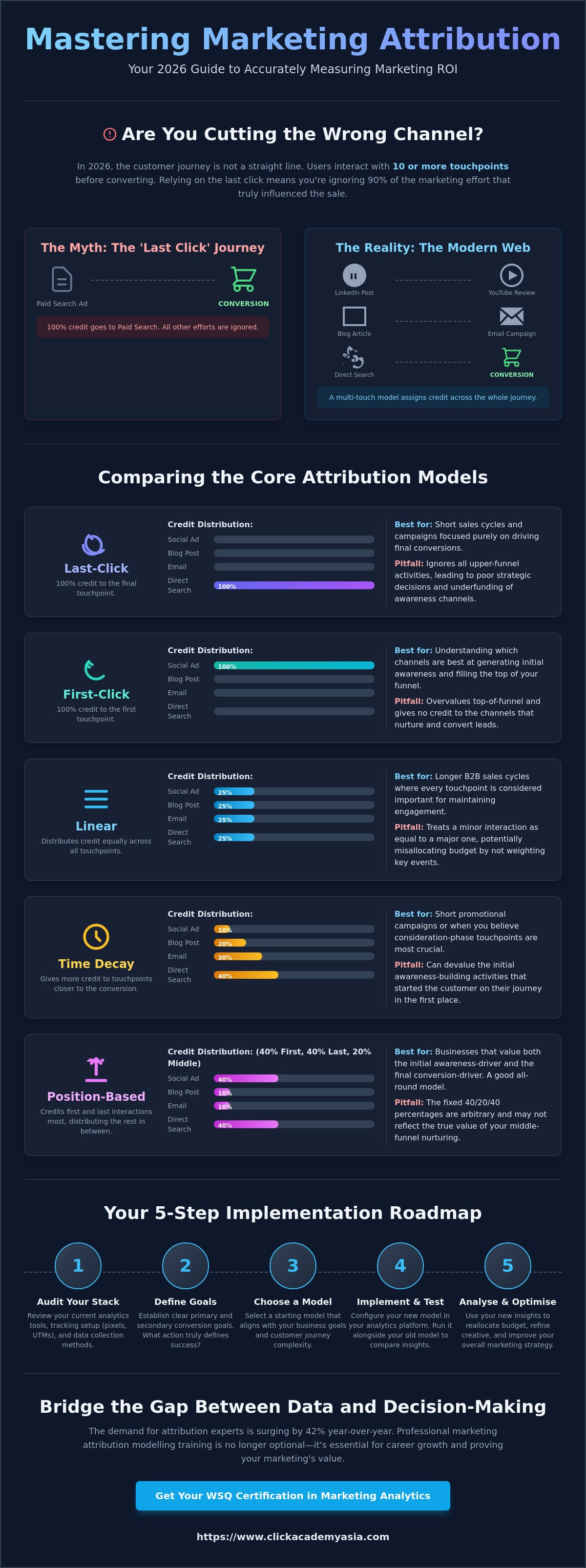
The modern customer journey isn't a straight line; it's a web. Research suggests users often interact with 10 or more channels before making a purchase. They might see a LinkedIn post on their commute, watch a YouTube review at lunch, and finally convert after a branded search on their laptop. If you only look at the final click, you're ignoring the 90% of the effort that actually moved the needle.
To better understand how these complex paths work, watch this helpful video:
Inaccurate measurement leads to expensive mistakes. When you don't have a clear view of the full journey, you likely end up over-investing in bottom-of-funnel tactics while starving the awareness campaigns that fed them. This transition from 'gut-feel' marketing to precise data-driven decision-making is why marketing attribution modeling training has become a non-negotiable skill for digital leaders. With the demand for attribution experts surging by 42% year-over-year, the ability to prove ROI is now a major career differentiator.
The Evolution of Attribution Modelling
Attribution has moved far beyond the 'Last Click' era of the early 2010s. We've shifted from simple rules-based models to sophisticated, AI-assisted algorithmic systems. In 2026, the complexity of cross-device tracking and privacy regulations means that old-school methods simply don't hold up. Modern models now use machine learning to analyse millions of data points, identifying patterns that a human eye would miss. This shift allows marketers to credit 'dark' social interactions and top-of-funnel video views that were previously invisible.
Key Terminology for Modern Marketers
To navigate this space, you need to speak the language. A touchpoint is any interaction a user has with your brand. The lookback window determines how far back in time we should search for those interactions. Your conversion path is the sequence of these events leading to a goal.
You'll also hear about heuristic versus probabilistic modelling. Heuristic models follow fixed rules, like giving 40% credit to the first and last touch. Probabilistic modelling uses statistical techniques to estimate the impact of channels where direct tracking isn't possible. Tools like Google Analytics 4 (GA4) now rely heavily on these data-driven approaches to fill in the gaps left by missing cookies. For professionals in Singapore, mastering these tools through WSQ Marketing Analytics & Insights training ensures your reporting is grounded in global best practices and marketing attribution modeling training standards.
Comparing the Core Attribution Models: Which is Right for You?
Selecting the right framework isn't about finding a universal truth. It's about choosing the lens that best reflects your customer's behaviour. If you sell low-cost impulse items, a simple model might suffice. However, for B2B services or high-ticket retail, you need a more nuanced view to understand how different marketing attribution models impact your bottom line.
The choice often comes down to your sales cycle length. A short cycle of two days requires a different approach than a six-month enterprise deal. By aligning your model with your business reality, you stop guessing and start investing where it actually counts.
Single-Touch vs. Multi-Touch Attribution (MTA)
First-touch attribution is excellent for identifying which top-of-funnel channels attract new eyeballs. It tells you exactly where your brand awareness begins. But it fails to show what actually closed the deal, often undervaluing the hard work of your sales team or email marketing. Last-touch is the opposite; it makes your branded search ads look like heroes while ignoring the social media and content marketing that did the heavy lifting.
Multi-Touch Attribution (MTA) solves this by spreading credit across the entire journey. Common heuristic models include:
Linear: Gives equal credit to every interaction. It's fair but often overvalues minor touchpoints that didn't truly influence the lead.
Time Decay: Gives more credit to touchpoints closer to the sale. This is a solid choice for short, highly competitive sales cycles.
Position-Based (U-Shaped): Focuses on the "handshake" and the "close" by giving 40% credit to both the first and last touch. The remaining 20% is split among the middle interactions.
If you're struggling to decide which of these fits your specific KPIs, specialised marketing attribution modeling training can help you audit your business needs and implement the right framework.
Algorithmic and Data-Driven Modelling
Data-driven attribution is the use of historical data to assign credit dynamically. Unlike the fixed rules of heuristic models, algorithmic systems use machine learning to calculate the actual contribution of each channel. It looks at what happened when a specific touchpoint was present versus when it was missing to determine its true value.
Google's made this the default in GA4 because it removes human bias from the equation. It adapts as user behaviour changes, making it the most resilient option for modern digital marketing. This shift ensures that your budget's allocated based on objective performance rather than outdated assumptions. Mastering these automated systems through marketing attribution modeling training allows you to interpret these complex reports and turn raw data into a clear strategic advantage.
Navigating Attribution Challenges in a Privacy-First Era
The most frequent question I hear from marketers is how we can track anything in a world without cookies. It is a valid concern. With the shift in Google Chrome to a user-choice model for third-party cookies and the continued impact of iOS 14+ privacy features, the data we used to rely on is becoming thinner. Regulatory changes, including new privacy laws in states like Indiana and Kentucky as of January 2026, mean that a "privacy-first" approach is no longer optional. It is the new baseline for every campaign you run.
To stay ahead, you must embrace conversion modelling. This is where AI and machine learning step in to fill the gaps left by users who opt out of tracking. By analysing historical trends and aggregated data, these models can predict conversion paths with high accuracy without needing to follow an individual's every move. This transition requires a mindset shift from tracking people to measuring patterns, which is a core pillar of modern marketing attribution modeling training.
Your most valuable asset in this landscape is your first-party data. Information you collect directly through your CRM, email sign-ups, and loyalty programs is immune to browser-level blocking. By grounding your attribution in data you actually own, you create a resilient measurement stack that won't crumble every time a tech giant updates their privacy settings.
The Rise of Cookieless Tracking Solutions
Server-side tracking is one of the most effective ways to maintain data accuracy today. Instead of relying on a user's browser to send a "pixel" hit to Facebook or Google, the data is sent directly from your server. This bypasses many ad-blockers and browser restrictions. You should also implement Enhanced Conversions in your Google Ads account; this hashed first-party data helps match customers more accurately while staying compliant with GDPR and other regional laws.
Before you scale your next campaign, use this checklist to audit your tracking setup:
Verify your Consent Management Platform (CMP): Ensure it is correctly blocking tags until a user gives permission.
Implement Server-Side Tagging: Move away from purely browser-based tracking where possible.
Enable Enhanced Conversions: Use hashed email addresses to recover lost conversion data.
Audit your Lookback Windows: Ensure they align with the reduced data retention periods in modern browsers.
Overcoming the 'Dark Social' Gap
Dark social refers to the vast amount of web traffic that comes from private channels like WhatsApp, Slack, or direct email. Because these interactions don't carry tracking parameters, they often appear as "Direct" traffic in your analytics, making it impossible to credit the original source. This is where qualitative data becomes your best friend. A simple "How did you hear about us?" field on your lead forms can reveal high-value touchpoints that your digital tools missed entirely.
The secret is to combine this qualitative feedback with your quantitative models. If your analytics says a lead came from a direct search, but the customer says they heard about you on a niche podcast, you have the evidence needed to justify your podcast spend. Integrating these human insights into a technical framework is a skill we focus on heavily during marketing attribution modeling training, ensuring your reporting reflects the full human experience of your brand.
Implementing Your Attribution Framework: A 5-Step Roadmap
Theory is only useful if it leads to action. Now that you understand the models, it is time to build a framework that actually works for your business. This isn't a one-time setup; it's a strategic process that aligns your marketing spend with genuine customer intent. Following a structured approach is the best way to ensure your marketing attribution modeling training translates into measurable business growth.
Step 1: Define your conversion goals. Distinguish between macro-conversions, like a completed sale, and micro-conversions, such as a whitepaper download. Both are essential for mapping the full journey.
Step 2: Audit your tech stack. Ensure your CRM, ad platforms, and GA4 are fully integrated. If your data isn't flowing between these systems, your attribution will be incomplete.
Step 3: Choose your starting model. Match the model to your sales cycle. If your customers take weeks to decide, a position-based model is usually a better starting point than last-click.
Step 4: Run a Model Comparison report. Use your analytics tool to compare how different models shift credit. You'll often find that certain channels are much more valuable than you previously thought.
Step 5: Continuously optimise. Attribution data should dictate your budget shifts. If a channel consistently shows high value in a time-decay model but low value in last-click, it's time to re-evaluate its role in your strategy.
Configuring Attribution in GA4
Google Analytics 4 has simplified the setup process, but you still need to be intentional. Navigate to the Admin section, then under Data Display, select Attribution Settings. Here, you can choose your reporting attribution model. Most 2026 professionals opt for Data-Driven, as it uses machine learning to assign credit dynamically based on your specific account history.
The Model Comparison tool is your secret weapon for finding undervalued channels. It allows you to see side-by-side how your ROI changes when you move away from last-click bias. For a deeper dive into these technical configurations, check out our guide on Marketing Analytics with GA4.
Common Implementation Pitfalls to Avoid
One of the biggest mistakes is the "set and forget" mentality. Attribution isn't a static setting; it requires regular review as your marketing mix evolves. You must also avoid over-optimising for channels that only drive the last click. If you cut the budget for awareness campaigns because they don't "convert" directly, you'll soon find your conversion funnel drying up at the bottom.
Cross-device tracking is another critical area. In 2026, users switch between phones, tablets, and laptops constantly. If your framework can't stitch these sessions together, you're only seeing a fraction of the truth. To master these complexities and avoid costly setup errors, consider joining our WSQ Marketing Analytics & Insights course to get hands-on experience with real-world data sets and professional marketing attribution modeling training.
Mastering the Future: Why Marketing Attribution Modelling Training is Essential
A sophisticated tech stack is only as effective as the strategist behind the screen. While AI can model data and GA4 can assign credit, it takes a human expert to translate those insights into a winning business case. Mastering the "why" behind the numbers allows you to defend your budget with confidence and pivot your strategy before wasted spend accumulates. This strategic depth is exactly what you gain through dedicated marketing attribution modeling training.
The professional benefits are equally compelling. With the global market for attribution modelling projected to exceed $6 billion by 2031, the demand for experts who can navigate this complexity is at an all-time high. Becoming a certified specialist doesn't just improve your current campaigns; it significantly increases your value in the job market. It positions you as a data-literate leader who can bridge the gap between technical analytics and high-level commercial outcomes.
The ClickAcademy Asia Advantage
Our approach to marketing attribution modeling training goes beyond theoretical slides. We focus on practical application through mentor-led workshops and hands-on sessions using real-world data. The curriculum is WSQ-certified, ensuring that every module meets the rigorous standards required for professional excellence in Singapore. You won't just learn about frameworks; you will practice implementing them.
We pride ourselves on our partnerships with global industry leaders, providing you with clear pathways to Google certifications alongside our core units. This blend of regional leadership and international best practices ensures your skills are relevant both locally and on a global stage. Our instructors are seasoned consultants who bring years of experience into the classroom, helping you solve the specific measurement challenges your business faces today.
Accessing SSG and SkillsFuture Funding
Professional development in Singapore is highly accessible thanks to robust government support. Individual learners can use their SkillsFuture Credit to offset the costs of our marketing courses, making it easier than ever to future-proof your career. This ensures that high-level expertise remains within reach for ambitious professionals looking to level up their analytical skills.
For organisations, SSG subsidies are available for corporate group training, allowing entire teams to align their measurement frameworks under a unified strategy. This is a cost-effective way to break down data silos and ensure every department is reporting ROI using the same rigorous standards. If you are ready to take control of your data and prove the true value of your marketing efforts, Explore our WSQ Digital Marketing Strategy & Planning course to begin your journey toward mastery.
Take Control of Your Marketing ROI in 2026
Mastering the modern customer journey requires a shift from tracking individuals to measuring patterns. You now have the roadmap to move beyond misleading last-click data and embrace a hybrid measurement strategy that survives the cookieless era. Grounding your decisions in data-driven frameworks ensures your budget is always working where it matters most.
The ability to accurately credit touchpoints is no longer just a technical skill; it is a strategic necessity for any leader looking to secure their budget. By investing in professional marketing attribution modeling training, you gain the clarity needed to turn complex GA4 reports into actionable business intelligence. This expertise allows you to communicate value to stakeholders with absolute confidence.
Ready to lead your team with data-driven precision? Empower your career with our WSQ Marketing Analytics & Insights course. Our WSQ-certified training is taught by industry-leading practitioners and qualifies for SSG funding, ensuring you gain practical skills grounded in real-world experience. Take the next step toward becoming a certified expert and start proving the true value of every marketing dollar you spend.
Frequently Asked Questions
What is the best marketing attribution model for a small business?
The best model for a small business is often the Position-Based or U-Shaped model because it credits both the initial discovery and the final conversion. While last-click is simpler, it ignores the awareness campaigns that are vital for growing a smaller brand. By giving 40% credit to the first and last touchpoints, you ensure your budget supports both lead generation and closing.
How does GA4 handle data-driven attribution compared to Universal Analytics?
Google Analytics 4 uses machine learning to analyse each conversion path and assign credit dynamically, whereas Universal Analytics relied heavily on fixed, rules-based models. This algorithmic approach in GA4 is more accurate because it looks at how the presence of specific touchpoints increases the probability of a sale. It adapts to your specific account data rather than applying a "one size fits all" rule.
Can I track offline sales using digital marketing attribution models?
You can track offline sales by integrating your CRM data with your digital analytics platform using unique identifiers like hashed email addresses or loyalty programme IDs. This allows you to close the loop between an online ad click and an in-store purchase. Many businesses also use custom promo codes or "upload offline conversions" features in ad platforms to maintain a unified view of the journey.
How much does professional marketing attribution modelling training cost?
The investment for marketing attribution modeling training depends on the depth of the curriculum and the level of certification provided. While prices vary across the industry, professionals in Singapore can often offset costs through SSG subsidies and SkillsFuture Credit for WSQ-certified courses. This makes high-level analytical training accessible for both individuals and corporate teams looking to upskill.
Is marketing attribution still possible after the death of third-party cookies?
Attribution remains possible by shifting focus toward first-party data and server-side tracking to bypass browser-level restrictions. While third-party cookies are declining, tools like Enhanced Conversions and AI-driven conversion modelling help fill the gaps. The key is to rely on data you own, such as email sign-ups and CRM records, to build a resilient measurement framework.
What is the difference between heuristic and algorithmic attribution models?
Heuristic models use pre-defined, static rules to assign value, such as giving 100% of the credit to the first click. Algorithmic models use statistical analysis and machine learning to determine the actual impact of each touchpoint based on historical performance. Algorithmic models are generally more precise as they account for the unique complexities of your specific customer journey.
How long does it take to see results after implementing a new attribution model?
You should expect to see actionable insights within 30 to 90 days after implementation, as this allows your model to collect enough data to identify significant patterns. This window is necessary to account for your typical sales cycle and to ensure you aren't making decisions based on seasonal outliers. Consistency is vital for your marketing attribution modeling training to yield reliable strategic shifts.
Are there any WSQ-certified courses for marketing analytics in Singapore?
Yes, Singapore offers several WSQ-certified options, including the WSQ Marketing Analytics & Insights course, which covers attribution strategy in depth. These courses are designed for practical application and are taught by industry-leading practitioners. Because they are aligned with national standards, they also qualify for various government funding schemes to support professional development.


Comments