
Marketing Analytics with GA4: A Strategic Guide for 2026 Professionals

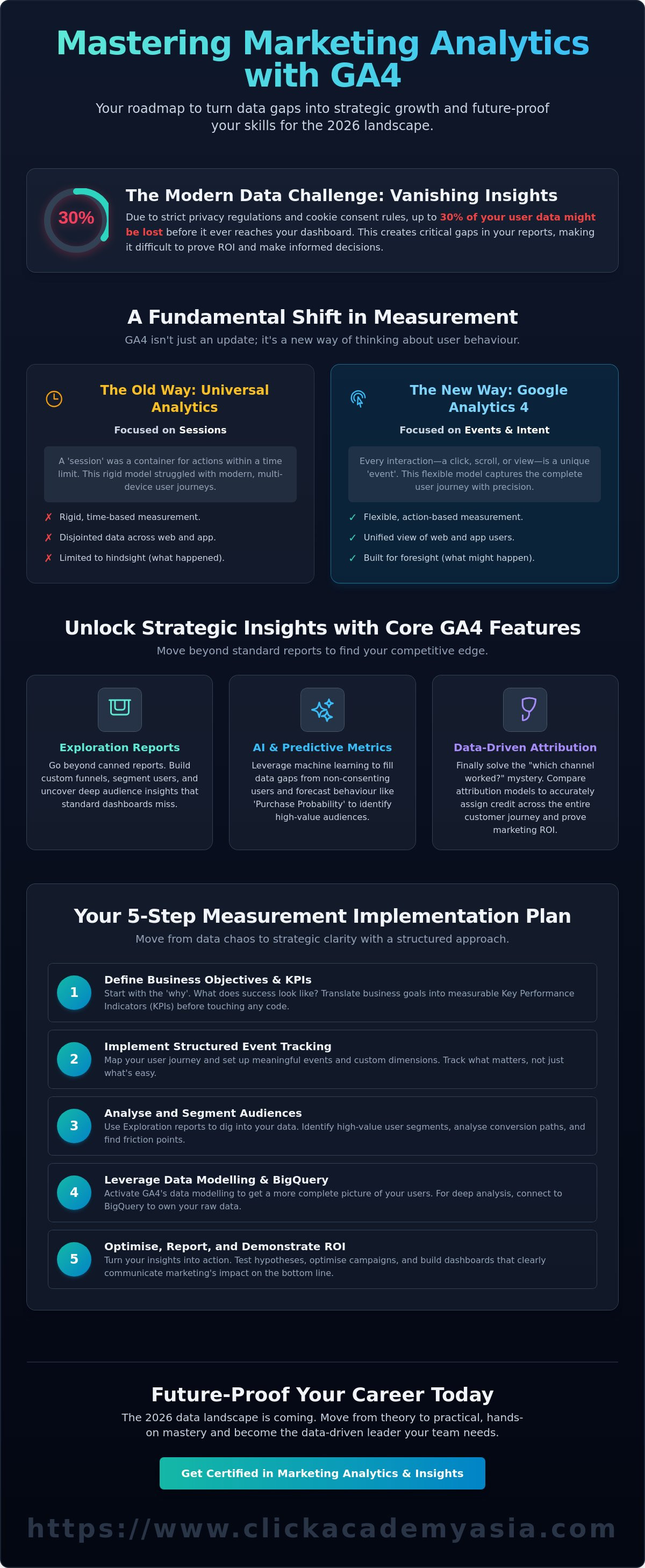
Did you know that up to 30% of your measurable user data could be vanishing before it even reaches your dashboard? According to Calibrate Analytics (April 2026), this is the reality for many businesses navigating strict privacy regulations and cookie consent hurdles. You're likely feeling the pressure to demonstrate clear ROI while grappling with the June 2026 data retention changes and the complex reality of multi-touch journeys. It's frustrating to see gaps in your reports when your stakeholders are demanding precise, data-backed strategies.
This guide will show you how to master marketing analytics with ga4 to bridge those gaps and reclaim your narrative. We'll help you turn raw event data into a sophisticated strategy engine that anticipates human intent rather than just counting clicks. You'll learn how to build a robust measurement plan, leverage new AI Assistant traffic insights, and use modeled data to regain your competitive edge. By the end of this article, you'll have the roadmap needed to secure professional certification and lead your team with absolute confidence.
Key Takeaways
Shift your perspective from tracking simple sessions to analysing human intent through the GA4 event-driven model.
Master marketing analytics with ga4 by using Exploration reports to uncover deep-dive audience insights that standard dashboards often miss.
Solve the "which channel worked" mystery by comparing Data-Driven Attribution with traditional models to accurately measure ROI.
Implement a structured five-step measurement plan to eliminate data clutter and focus on metrics that impact your bottom line.
Future-proof your career against 2026 privacy regulations and data retention shifts by moving from theory to practical, hands-on mastery.
Table of Contents
What is Marketing Analytics with GA4 and Why Does it Matter?
To truly understand your audience, you must first grasp what analytics is in the context of modern business: the discovery, interpretation, and communication of meaningful patterns in data. In the past, marketers focused on how many people visited a site. Today, marketing analytics with ga4 allows us to look deeper, focusing on the intent behind every interaction. This shift is vital for any professional looking to justify their marketing spend in a world where user journeys are no longer linear or predictable.
By treating every touchpoint as a unique event, you can see how a user moves from a social media ad to a blog post and finally to a conversion. This granular view is exactly what modern strategy requires to succeed. To see how this data connects to larger ecosystems like Salesforce, watch this helpful video:
The Event-Driven Model Explained
Universal Analytics relied on "sessions," which were essentially buckets of time. If a user stepped away for 30 minutes, the session ended. GA4 discards this rigid structure in favour of an event-driven model. Every action, whether it's a button click, a video view, or a page scroll, is recorded as an event. This provides a much clearer picture of how people actually use your digital assets. It also allows for seamless cross-platform tracking. You can now see a customer's journey across both your mobile app and your website within a single property, providing a unified view of the user experience.
Moving from Hindsight to Foresight
Traditional analytics told you what happened yesterday. GA4 is built to predict what might happen tomorrow. With the 2026 privacy standards requiring stricter cookie consent, up to 30% of your data might be missing. GA4 uses advanced machine learning and data modelling to fill these gaps. It provides "observed" data for those who consent and "modelled" data for those who don't. This predictive capability turns your dashboard from a history book into a strategic compass, allowing you to identify high-value users before they even convert.
In this guide, we will move beyond the basics of marketing analytics with ga4. We'll focus on creating a robust measurement plan, implementing advanced tracking, and extracting insights that drive ROI. If you are looking to formalise these skills, our WSQ Marketing Analytics & Insights course provides the hands-on training needed to lead in this new era. Our goal is to equip you with the strategy, implementation skills, and deep insight required to future-proof your career.
Core GA4 Features for Strategic Marketing Insight
Mastering marketing analytics with ga4 requires moving beyond the standard reporting snapshots. While the default dashboards offer a quick health check, strategic leadership demands a deeper look into custom dimensions and metrics. These allow you to track business-specific KPIs, such as "author name" for content performance or "membership level" for e-commerce, ensuring your data reflects your unique goals rather than generic templates.
Data ownership is another critical pillar for 2026 professionals. By integrating GA4 with BigQuery, you move your data into a secure, cloud-based warehouse. This is essential for enterprise-level analysis, as it bypasses the standard interface's sampling limits and allows you to join your analytics with CRM data. Having this level of control ensures your strategy is built on a foundation of raw, uncompromised information.
If you're looking to bridge the gap between basic usage and expert-level execution, our Google Analytics (GA4) Training provides the practical framework to master these advanced configurations.
Predictive Metrics and AI-Powered Insights
One of the most significant strategic benefits of GA4 is its ability to forecast user behaviour. Using machine learning, the platform calculates predictive metrics like "purchase probability" and "churn probability." This isn't just theory; it's a tool for immediate action. For a quick win, you can create "predictive audiences" of users likely to buy in the next seven days and sync them directly with your Google Ads campaigns to optimise your bidding strategy.
The "Insights" feature also acts as a digital mentor, automatically flagging anomalies in your data. If your conversion rate suddenly drops in Singapore or your traffic from a specific campaign spikes unexpectedly, GA4 alerts you. This shift from manual monitoring to automated detection allows you to spend less time finding problems and more time solving them.
The Analysis Hub: Exploration Reports
The "Explore" section is where high-level strategy is born. Unlike standard reports, Explorations allow you to build custom visualisations that answer specific business questions. You should prioritise these three techniques:
Funnel Exploration: Use this to visualise the exact steps users take toward a goal. It identifies where friction occurs, allowing you to fix drop-off points in your checkout or lead-gen forms.
Path Exploration: This discovers the actual routes users take through your site. It often reveals unexpected behaviours, such as users looping back to a FAQ page because your primary sales copy is unclear.
Segment Overlap: This tool helps you understand multi-channel behaviour. You can see how many users interact with both your SEO and SEM efforts, helping you justify a more integrated search strategy.
By focusing on these sophisticated tools, you transform your role from a reporter of past events into a strategist who shapes future outcomes. This proactive approach is the hallmark of a professional who truly understands how to leverage data for growth.
Analysing the Customer Journey: Attribution and ROI
The question every marketing lead asks is simple: "Which channel actually drove this sale?" In the past, we often relied on Last Click attribution, which is like giving a striker all the credit for a goal while ignoring the midfielder's perfect assist. When you master marketing analytics with ga4, you move away from these oversimplified views and begin to see the full value of your marketing mix.
Attribution is the process of assigning credit for conversions to various ads, clicks, and factors along a user's path to completing a goal.
GA4 solves the multi-touch puzzle by using sophisticated identity spaces. It stitches together interactions across different devices using User-IDs, Google Signals, and device IDs. This means if a customer in Singapore browses your site on their phone during a commute but finally buys on a laptop at home, you can attribute that success correctly. To complete the picture, you can also import offline conversion data, such as in-store purchases or phone enquiries, to ensure no part of the journey remains hidden. This level of clarity is the only way to truly optimise your digital marketing strategy.
Mastering Data-Driven Attribution
Data-Driven Attribution (DDA) is the default model in GA4, and for good reason. It uses machine learning to analyse both converting and non-converting paths to understand how different touchpoints influence outcomes. This is a massive leap forward for SEO and Content Marketing, which often act as early-stage assists rather than final clicks. To see this in action, head to the Advertising section and use the Model Comparison report. This tool allows you to compare DDA against Last Click side-by-side, revealing exactly how much credit your brand-building efforts deserve.
Measuring Cross-Channel Success
Success in 2026 depends on the synergy between your channels. You might find that your Social Media ads aren't driving direct sales but are significantly boosting the performance of your SEM campaigns. To keep this data clean, you must be disciplined with UTM parameters. Standardising your naming conventions ensures that your reports can accurately categorise traffic sources without messy unassigned buckets. Be aware that as of June 15, 2026, Google Signals no longer controls data collection for Google Ads. You must now manage these signals through Consent Mode settings, specifically the ad_storage signal, to maintain accurate cross-channel tracking while staying compliant with privacy regulations.
Building a Measurement Plan: 5 Steps to Implementation
Most marketers rush into the technical setup without a clear roadmap, which often results in a cluttered account full of redundant data. To truly succeed with marketing analytics with ga4, you must adopt a plan before you tag mindset. This ensures that every event you track is tied directly to a business outcome rather than just being noise in your dashboard.
A Measurement Plan is a document that outlines your business objectives and translates them into specific digital interactions you can track and analyse.
Securing stakeholder buy-in is the most overlooked part of this process. You need to sit down with your sales leads and department heads to agree on what success looks like before you open Google Tag Manager. When everyone agrees on the metrics that matter, your reports become a shared source of truth rather than a point of contention. This strategic alignment is what separates a professional analyst from someone who just looks at charts.
If you want to build these frameworks with expert guidance, our WSQ Marketing Analytics & Insights course provides a hands-on environment to perfect your planning skills.
Defining Business Objectives and KPIs
To translate a business goal into a measurable event, you must identify the specific digital action that proves a user has moved closer to that objective. For example, if your goal is brand engagement, a video start event might be your primary indicator. It's vital to differentiate between macro-conversions, such as a completed purchase, and micro-conversions, like a newsletter signup or a 50% scroll depth. Both are important, but they serve different parts of your strategy.
We recommend using a simple measurement matrix to keep your team focused:
Business Objective: Increase lead quality for the sales team.
KPI: Number of high-value form submissions.
GA4 Event:generate_lead.
Custom Parameter:service_type or budget_range.
Technical Implementation and Governance
Google Tag Manager is essential for maintaining a clean setup because it acts as a middleman between your site and your analytics. It allows you to deploy tracking codes without constantly needing developer support, which keeps your site speed high and your data collection organised. However, a set and forget approach is dangerous. You should schedule quarterly data audits to check for broken tags or duplicate events that could be inflating your numbers.
Privacy governance is another critical pillar, especially for businesses operating in Singapore. You must ensure your implementation complies with PDPA regulations by correctly configuring your consent mode settings. GA4 offers robust tools to help with this, including data redaction and specific retention periods. By building privacy into your measurement plan from day one, you protect your brand's reputation and ensure your data remains reliable for the long term.
Mastering GA4: Professional Upskilling for the 2026 Landscape
Mastering the technical interface of GA4 is only half the battle for modern marketers. To lead a department in 2026, you need to bridge the gap between knowing where the buttons are and knowing why to press them. marketing analytics with ga4 is a strategic discipline that requires a mentor-led approach to truly master. At ClickAcademy Asia, we don't just teach you how to use the software; we focus on the business logic that drives tangible growth.
Our approach combines high-level consultancy insights with practical, hands-on training. This ensures you aren't just memorising features but are learning how to solve real-world marketing challenges. Whether you're struggling to reconcile old UA data or trying to predict future purchase behaviour, our curriculum is designed to turn those pain points into professional strengths. We're invested in your career growth, helping you future-proof your skills in an increasingly automated industry.
Why Hands-On Training Beats Self-Study
Watching online tutorials might help you navigate a dashboard, but it rarely prepares you for the complexities of a multi-touch customer journey. In a structured workshop, you engage with real-world case studies and receive immediate feedback from expert mentors. This interactive environment is where you move from being a "user" who pulls reports to a "strategist" who interprets intent. You'll learn to spot the nuances in data that AI might miss, giving you a distinct advantage in your organisation.
The networking opportunities within a professional cohort are equally vital. In Singapore, our classes bring together PMEBs from diverse industries, allowing you to share best practices and solve problems collectively. These connections often last long after the course ends, providing a supportive community as you implement your new measurement plans. You'll gain the confidence to lead data-driven discussions in the boardroom, backed by the authority of practical experience.
Navigating WSQ and SSG Support
Professional development should be accessible to everyone looking to excel. In Singapore, the government provides significant support through SSG funding, which drastically reduces the out-of-pocket costs for PMEBs. You can utilise your SkillsFuture Credit to fund your marketing analytics with ga4 journey, making it a cost-effective way to gain elite-level skills. This financial support ensures that high-quality, industry-relevant education is within reach for every ambitious professional.
Obtaining a WSQ Statement of Attainment is a powerful way to validate your expertise. This certification is recognised by employers across Singapore and the wider region as a mark of practical mastery. It proves that you've met rigorous national standards and possess the skills to drive digital transformation. If you're ready to take the next step in your career, Explore our WSQ Marketing Analytics & Insights course today and start leading with data.
Lead Your Team with Data-Driven Confidence
The shift toward an event-driven model isn't just a technical update; it's a fundamental change in how we understand human intent. By moving away from "Last Click" attribution and embracing predictive insights, you can finally prove the real value of your multi-channel efforts. Success in 2026 requires more than just looking at dashboards. It demands a robust measurement plan and the strategic confidence to act on the data you see.
Mastering marketing analytics with ga4 is the most effective way to protect your career against privacy shifts and browser restrictions. As an Official Google Partner training academy, ClickAcademy Asia provides the mentorship you need to bridge the gap between theory and practical application. Our expert mentors bring real-world agency experience to every session, ensuring you leave with actionable skills you can use immediately.
Don't let technical complexity hold your strategy back. Master Marketing Analytics with our WSQ-certified GA4 training and take advantage of SSG-funded programmes to future-proof your expertise. You have the roadmap and the tools. Now it's time to step into your role as a strategic leader with absolute certainty. You've got this.
Frequently Asked Questions
How is GA4 different from Universal Analytics for marketing reporting?
GA4 uses an event-based model that treats every interaction as a distinct data point, whereas Universal Analytics relied on sessions and pageviews. This allows for a much more flexible reporting structure that tracks user behaviour across web and app platforms simultaneously. It's designed to give you a unified view of the customer journey rather than fragmented, session-based snapshots.
Can I still use GA4 effectively without being a data scientist?
You don't need a degree in data science to excel at marketing analytics with ga4 because the interface is built for marketers. The platform uses machine learning to surface automated insights, which flag significant trends or anomalies for you. While the "Explore" section allows for deep dives, the standard reports provide plenty of actionable data for daily decision-making.
What are the most important marketing KPIs to track in GA4 for 2026?
Focus on predictive metrics like "Purchase Probability" and "Churn Probability" alongside traditional conversion events. Engaged sessions and engagement rate are also critical because they measure how effectively your content holds attention. Tracking these helps you move beyond vanity metrics to understand which actions actually lead to long-term revenue and customer loyalty.
How does GA4 handle user privacy and cookie-less tracking?
GA4 uses data modelling and Consent Mode to fill in gaps when users opt out of tracking. This means the platform can still provide a reliable overview of your traffic even without traditional cookies. It's a privacy-first approach that ensures you stay compliant with global regulations while maintaining a clear picture of your overall marketing performance.
Is BigQuery integration necessary for small to medium-sized businesses?
BigQuery isn't strictly necessary for every small business, but it's highly recommended due to the 2026 data retention updates. Since granular historical data in GA4 will be limited to a rolling 37-month window starting June 1, 2026, BigQuery allows you to store and own your data indefinitely. It's a strategic move for any brand that relies on long-term year-on-year performance analysis.
How long does it take to become proficient in GA4 marketing analytics?
Most professionals can grasp the basics in a few weeks, but reaching strategic proficiency usually takes a more structured approach. A intensive two-day WSQ course can fast-track this process by focusing on real-world applications. The goal isn't just to learn the tool but to understand how to turn those numbers into a profitable, long-term marketing strategy.
Are there government subsidies for GA4 training in Singapore?
Yes, there are significant government subsidies available in Singapore for eligible PMEBs. Programmes like our marketing analytics with ga4 training are SSG-funded and can often be paid for using your SkillsFuture Credit. This makes high-level professional development highly accessible for those looking to upskill and future-proof their expertise in the digital economy.
What is the difference between a session and an event in GA4?
A session is a group of user interactions within a given timeframe, whereas an event is a single, specific action like a click or a download. In GA4, everything is an event, and a session is simply triggered by a `session_start` event. This shift allows for much more granular tracking of exactly what a user does during their visit.


Comments