
Remote Team Leadership & Management: Mastering Strategic Oversight in Singapore (2026)
- ClickAcademy Asia

- 20 hours ago
- 11 min read
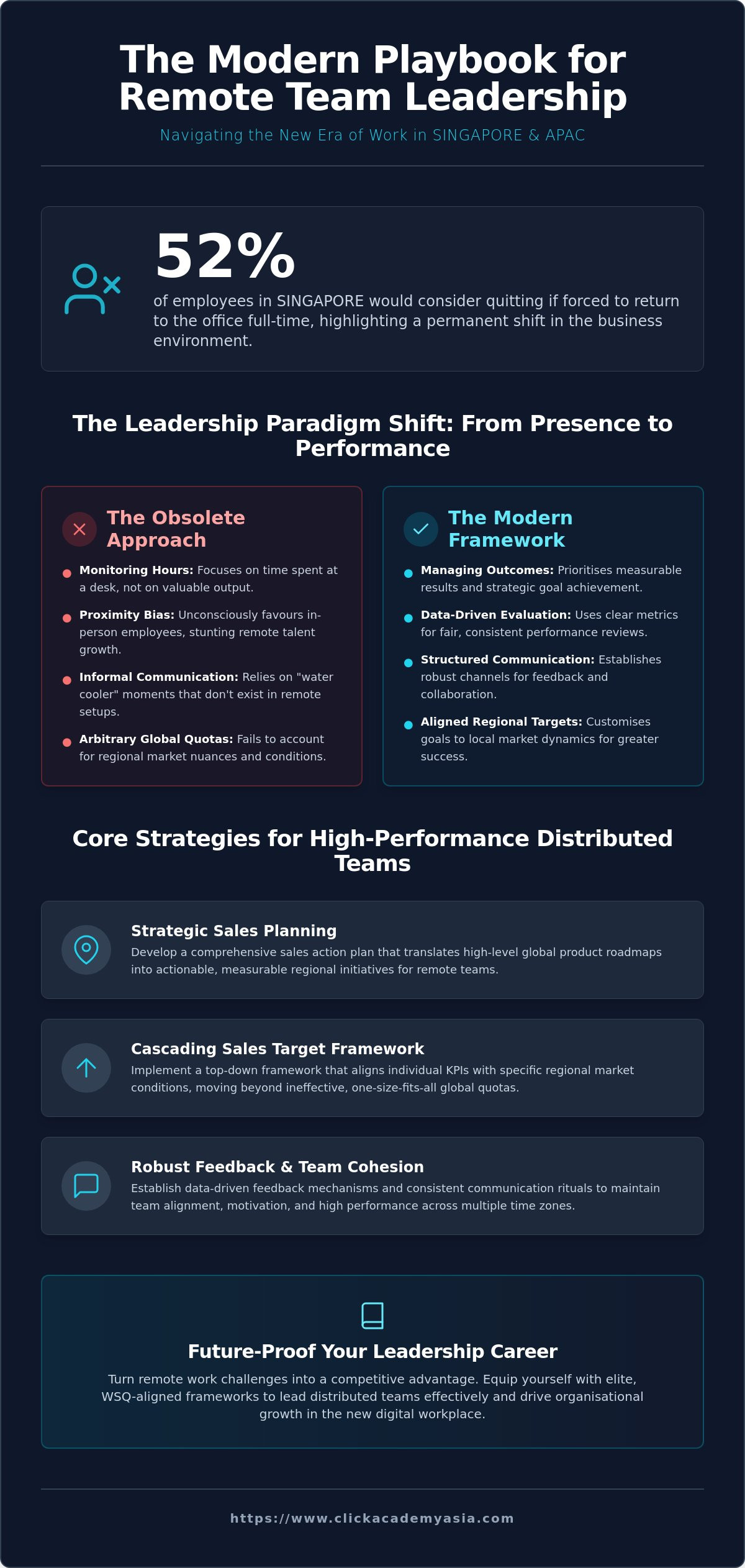
Did you know that 52% of employees in SINGAPORE would consider quitting if they were forced to return to the office full-time? This isn't a temporary trend. It's a permanent transformation of the APAC business environment, especially with the mandatory Tripartite Guidelines on Flexible Work Arrangement Requests now in effect. You've likely felt the strain of losing team cohesion or the difficulty of tracking performance across different time zones. Mastering Remote Team Leadership & Management is the only way to ensure regional targets stay aligned with global strategy without sacrificing productivity.
We'll show you how to implement AI-driven leadership skills and strategic frameworks that empower high-performing distributed teams. In this guide, we'll preview actionable sales plans and robust feedback mechanisms that turn logistical hurdles into a competitive advantage. You'll also learn how to leverage SSG-funded [Internal Link: ClickAcademy Asia Sales/Marketing courses] to bridge the digital skills gap and lead your organisation toward a more resilient, flexible future.
Table of Contents
Defining Remote Team Leadership & Management in the Modern Singaporean Context
Essential Strategies for Managing High-Performance Distributed Sales Teams
Designing a Cascading Sales Target Framework for Global Markets
Overcoming Geographic Barriers: Feedback Mechanisms and Team Cohesion
Upskilling for the Future: ClickAcademy Asia’s Remote Leadership Programme
Defining Remote Team Leadership & Management in the Modern Singaporean Context
Remote leadership is a structured approach to guiding teams across geographical boundaries using data-driven frameworks. In the SINGAPORE business ecosystem, this discipline has evolved far beyond simple video conferencing. It's now defined as the ability to synchronise distributed talent through strategic sales planning, ensuring that every team member remains productive regardless of their physical location. Leaders must master Remote Team Leadership & Management to bridge the gap between high-level corporate goals and the daily realities of a dispersed workforce.
The traditional mindset of monitoring hours spent at a desk is officially obsolete. Modern managers in APAC now focus on managing outcomes, a shift accelerated by the 2024 Tripartite Guidelines on Flexible Work Arrangement Requests. This requires a sophisticated understanding of What is a Virtual Team and how to align global product roadmaps with specific regional initiatives. Without a structured framework, regional targets often drift away from the global strategy, leading to inefficiencies and missed opportunities.
To better understand the core principles of leading from a distance, watch this helpful video:
The Evolution of Distributed Teams in APAC
SINGAPORE continues to solidify its position as the premier regional hub for remote sales operations. For PMEBs, the stability of hybrid work models has become a critical factor in career progression and talent retention. Recent data shows that 52% of employees in SINGAPORE would consider leaving their roles if required to return to the office full-time [External Link: local statistic/industry study]. This preference has forced a total rethink of how we build professional networks and maintain corporate culture across borders. Successful leaders use this geographic flexibility to tap into diverse talent pools while maintaining a central strategic command from SINGAPORE.
Why Traditional Management Fails in Virtual Environments
Standard management techniques often crumble when the physical office disappears. The primary culprit is the breakdown of informal communication channels, those "water cooler" moments where vital information is often exchanged. This leads to proximity bias, where managers subconsciously favour team members they see in person, which unfairly skews regional performance appraisals and stunts the growth of remote talent. The WSQ framework serves as the essential antidote to this fragmented oversight. By adopting a standardised, skills-based approach to Remote Team Leadership & Management, organisations can ensure fair evaluation and consistent output across every time zone.
Essential Strategies for Managing High-Performance Distributed Sales Teams
Managing high-performance sales teams from a SINGAPORE headquarters requires more than just a shared Slack channel. It demands a comprehensive sales action plan specifically designed for remote execution, where every milestone is explicitly defined and measurable. This level of Remote Team Leadership & Management ensures that the distance between a manager in SINGAPORE and a representative in Jakarta or Sydney doesn't lead to strategic drift. You've got to move beyond checking in and start building structures that facilitate independent success.
Sales Operations plays a vital role here by providing the infrastructure needed for this oversight. They act as the engine room, ensuring that CRM data is accurate and that cross-regional alignment is maintained through synchronised organisational sales cycles. Without these cycles, teams often find themselves out of sync with global launches or regional promotions. Implementing Effective Remote Leadership Strategies involves building these rigid structures so that creativity and sales hustle can flourish within them.
Translating Product Roadmaps into Regional Initiatives
A global product roadmap is merely a suggestion until it's translated into regional initiatives that resonate with local APAC markets. Core product messaging that works in Western markets often falls flat in the diverse business cultures of Southeast Asia. You must identify client profile variations across different territories to ensure your remote sales reps are targeting the right stakeholders. It's about adapting the value proposition to fit local pain points while keeping the brand identity intact.
Synchronising marketing and sales becomes significantly more complex in a remote setup. When teams don't share a physical office, the hand-off from lead generation to sales closing can become fragmented. Leaders must establish clear protocols for lead qualification and feedback loops to ensure marketing efforts are actually supporting the sales team's regional targets. This synchronicity is the hallmark of a mature remote sales operation.
Implementing Territory-Specific Sales Plans
Setting realistic expectations requires a deep dive into global market analysis rather than relying on arbitrary quotas. For instance, emerging markets may present unique challenges like varying digital maturity or different regulatory landscapes. Effective Remote Team Leadership & Management involves adjusting KPIs to reflect these local realities while still driving toward global objectives. You can't expect the same sales cycle speed in every territory.
Managing these nuances is a core component of modern Sales Leadership. By focusing on territory-specific plans, you empower your remote staff to act with autonomy while remaining tethered to the broader corporate strategy. This balance is what separates high-performing distributed teams from those that merely survive the remote transition. It allows PMEBs to maintain high standards of excellence regardless of where their desk is located.
Designing a Cascading Sales Target Framework for Global Markets
A major pitfall in Remote Team Leadership & Management is the application of rigid, top-down quotas that ignore regional nuances. To lead effectively from SINGAPORE, you need a cascading framework that flows from global strategy down to local execution. This isn't just about picking numbers. It's about building a transparent system where remote staff feel their targets are both fair and achievable within their specific market context.
Follow these four steps to build your framework:
Step 1: Conduct a thorough global market analysis. Determine the actual potential of each region by looking at historical data and current demand before assigning numbers.
Step 2: Align individual KPIs with regional conditions. Avoid arbitrary global quotas. A rep in an emerging market might need different milestones than one in a mature market.
Step 3: Establish clear documentation. Every member of your distributed team must understand how their targets were calculated to ensure total transparency and buy-in.
Step 4: Use product trend analysis. Don't wait for the end of the quarter. Adjust targets in real-time based on shifting market signals and product adoption rates.
Evaluating Regional Market Potential
Setting targets from a central office in SINGAPORE requires a deep understanding of local economic climates, competitor density, and regulatory hurdles. When you force a "one size fits all" target on a remote team, you're essentially fast-tracking them toward burnout and resentment. Data-driven target setting is the foundation of trust in distributed teams, as it proves that leadership values local reality over boardroom theory. By taking the time to analyse these factors, you ensure that your Remote Team Leadership & Management remains grounded in reality.
Performance Tracking Across Distributed Regions
Visibility is the currency of remote management. Choosing the right CRM tools is non-negotiable for maintaining oversight across time zones. However, you must differentiate between output metrics, such as revenue closed, and activity metrics, like calls made. While activity is a lead indicator, focusing too heavily on it can lead to micromanagement. Developing Essential Skills for Remote Leaders helps you use predictive analytics to anticipate regional sales slumps before they become crises. This proactive stance allows you to provide support exactly when your remote team needs it most, turning potential failures into coaching opportunities.
Overcoming Geographic Barriers: Feedback Mechanisms and Team Cohesion
Geographic distance shouldn't lead to a breakdown in communication or a loss of corporate identity. For leaders in SINGAPORE, the challenge lies in maintaining a pulse on teams spread across different time zones without resorting to micromanagement. Effective Remote Team Leadership & Management requires a deliberate shift toward structured communication that prioritises clarity over constant presence. You need systems that allow for both rapid pivots and long-term strategic alignment while keeping PMEBs engaged and motivated.
One common objection is that remote teams lack a cohesive culture. This is usually a symptom of neglecting "structured socialisation." Rather than forced virtual happy hours, focus on creating shared rituals and collaborative problem-solving sessions that build genuine trust. Actionable adjustment proposals for evolving market conditions should be part of this dialogue. This ensures that every team member feels their voice contributes to the regional strategy, which is vital for maintaining morale in a distributed environment.
Designing Robust Feedback Loops
The secret to high-performing distributed teams is the balance between synchronous and asynchronous feedback. Routine updates and data reporting should happen asynchronously to respect different time zones. Save your synchronous time for deep-dive performance reviews that focus on career growth and strategic hurdles. To stay ahead of the curve, modern leaders are now integrating AI-driven sentiment analysis tools to monitor team morale through digital communication patterns. This allows you to catch signs of burnout or disengagement before they impact your SINGAPORE operations, providing a level of oversight that traditional methods simply cannot match.
Refining Sales Plans with Real-Time Data
Data is the primary tool for overcoming the "out of sight, out of mind" trap. By utilising [Internal Link: https://www.clickacademyasia.com/post/marketing-analytics-with-ga4-a-strategic-guide-for-2026-professionals on Data-driven insights], you can implement a "short-term sales plan" refinement process. This involves creating formal proposals for plan adjustments that include clear implementation guidelines and success metrics. Regional managers must have the autonomy to execute these refinements based on their local market signals. They shouldn't have to wait for every minor approval from headquarters in SINGAPORE when the data clearly indicates a need for a pivot.
This level of agility and strategic oversight is exactly what we teach in our advanced professional development tracks. If you're ready to enhance your ability to lead across borders, you should explore our leadership training options to ensure your management style is ready for the demands of 2026.
Upskilling for the Future: ClickAcademy Asia’s Remote Leadership Programme
Leading a distributed team is no longer a soft skill; it's a technical discipline that requires a specific set of strategic frameworks. ClickAcademy Asia offers the definitive Remote Team Leadership & Management programme designed specifically for the SINGAPORE business environment. This isn't a passive learning experience. We utilise a practical, workshop-based approach that forces you to build the actual sales action plans and feedback loops your organisation needs right now. You'll walk away with a toolkit of AI-driven leadership skills that are immediately applicable to your daily operations.
The long-term career value of becoming a certified remote leader in the APAC region cannot be overstated. As businesses continue to decentralise, the demand for PMEBs who can maintain strategic oversight across borders will only intensify. By mastering these competencies, you're not just solving today's logistical hurdles. You're future-proofing your career and positioning yourself as a vital asset in a globalised economy where agility is the primary currency of success.
Maximising SSG Funding and SkillsFuture Credits
Upskilling shouldn't be a financial burden for SINGAPOREANS and Permanent Residents. Through the SSG funding framework, eligible individuals can claim up to 70% in subsidies for our Remote Team Leadership & Management course. If you're self-sponsored, you can use your SkillsFuture Credits to offset the remaining out-of-pocket expenses, making elite executive education highly accessible. This ensures that every professional has the opportunity to adapt to the 2026 work landscape without significant personal investment.
For organisations, company-sponsored enrollment is equally streamlined. Sponsoring your team members through the Enhanced Training Support for SMEs allows you to build a robust leadership pipeline while leveraging government support. This strategic investment in your human capital ensures your managers are equipped with WSQ-aligned skills that meet national standards. For a deeper look at how these certifications fit into the broader professional ecosystem, check out our guide on [Internal Link: https://clickacademyasia.com/post/mastering-the-2026-landscape-wsq-digital-marketing-courses-in-singapore].
Why Choose ClickAcademy Asia?
Since 2011, CLICKACADEMY ASIA has served as a premier training destination for professionals across APAC. We're official partners with major global platforms and certifying bodies, which acts as a recurring signature of quality for every programme we deliver. Our focus is squarely on executive education that prioritises practical mastery over abstract theory. We don't just teach you the status quo; we give you the tools to shape the future of professional expertise in your industry.
Our trainers are industry practitioners who bring real-world experience from leading regional sales and marketing operations. This ensures that the insights you gain are grounded in the actual challenges faced by modern SINGAPORE companies. Don't let your leadership skills stagnate in a rapidly evolving technological landscape. You can enrol in the Remote Team Leadership & Management programme today and start leading your distributed team with the confidence and strategic clarity they deserve.
Master Strategic Oversight in the Distributed Economy
Mastering Remote Team Leadership & Management is no longer optional for PMEBs in SINGAPORE. It requires a deliberate shift from traditional oversight to outcome-based frameworks that align regional hustle with global strategy. By implementing cascading sales targets and robust feedback loops, you ensure your team remains cohesive and productive across every time zone. This strategic alignment is what separates high-performing organisations from those struggling to adapt to the hybrid era.
ClickAcademy Asia has been headquartered in SINGAPORE since 2011, delivering expert-led workshops that bridge the gap between theory and practical mastery. Our WSQ-certified curriculum ensures you're learning to national standards, with up to 70% SSG funding available to make this transformation achievable for every leader. Equip your team with cutting-edge remote leadership skills by exploring our WSQ-funded training tracks today.
The future of work is hybrid, and those who lead with agility will define the next era of APAC business excellence. We're here to help you navigate this evolution with confidence and strategic clarity. Your journey toward becoming a certified remote leader starts now.
Frequently Asked Questions
How does the WSQ Remote Team Leadership & Management course benefit my career?
It provides a recognised certification in one of the most sought-after skills in the APAC region. By mastering this discipline, PMEBs can demonstrate their ability to manage distributed teams effectively, which is essential for senior leadership roles in 2026. This programme focuses on practical frameworks that help you synchronise talent and hit regional targets while maintaining strategic oversight from your base in SINGAPORE.
Can I use SkillsFuture Credits for this leadership programme in Singapore?
Yes, SINGAPOREANS can utilise their SkillsFuture Credits to offset the out-of-pocket costs of this programme. This makes it highly accessible for individual PMEBs looking to upskill independently. Since the course is part of the WSQ framework, it meets stringent national standards for quality and relevance in the modern business ecosystem, ensuring your learning is grounded in real-world application rather than just theory.
What are the main challenges of managing a remote sales team in APAC?
The primary hurdles include maintaining team cohesion across diverse cultures and tracking performance without resorting to micromanagement. Many leaders struggle with the breakdown of informal communication and proximity bias in appraisals. Addressing these requires a structured approach to Remote Team Leadership & Management that prioritises outcomes over physical presence and leverages data to ensure cross-regional alignment.
How much SSG funding is available for company-sponsored employees?
Company-sponsored employees who are SINGAPOREANS or Permanent Residents can receive up to 70% SSG funding. This significant subsidy is designed to encourage organisations to invest in their human capital and build a resilient, flexible workforce. It's an excellent way for HR decision-makers to future-proof their leadership pipeline while managing training budgets effectively, especially when adapting to the mandatory flexible work guidelines in SINGAPORE.
Is this course suitable for non-IT sales managers?
Absolutely, the frameworks taught are universal and apply to any industry where talent is distributed. Whether you are in retail, finance, or manufacturing, the principles of cascading sales targets and data-driven oversight remain the same. The programme is designed for any professional looking to master the complexities of leading teams across geographic boundaries and synchronising regional initiatives with global product roadmaps.
What practical tools will I learn to track remote team performance?
You'll learn to leverage modern CRM systems and AI-driven sentiment analysis to monitor both output and morale. The course covers how to differentiate between activity metrics and actual results, ensuring you have clear visibility into your team's progress. These practical tools are essential for implementing a successful Remote Team Leadership & Management strategy that avoids the pitfalls of proximity bias and fragmented oversight.


Comments