
Content Repurposing Strategy Workshop: The 2026 Checklist for Modern Marketers
- ClickAcademy Asia

- May 28
- 11 min read
Updated: 7 days ago
Ninety-five per cent of B2B marketers are now using AI-powered applications to fuel their output, yet content burnout remains at an all-time high in 2026. If you're spending weeks on a single long-form report only for it to disappear after one post, you aren't just losing time; you're losing potential revenue. This content repurposing strategy workshop is designed to fix that cycle by treating every piece of content as a high-value asset rather than a one-off task.
We understand that maintaining a consistent presence across TikTok, LinkedIn, and email can feel like an impossible juggling act, especially with the zero-click reality of modern search. You need a way to increase your organic reach without doubling your workload. This guide promises to equip you with a repeatable framework to transform your existing library into a multi-platform engine.
In this checklist, we'll analyse how to break down complex assets into short-form videos and social snippets while staying compliant with the latest EU AI Act transparency rules. You'll learn how to optimise your production workflow to reduce time spent on creation and focus more on strategic distribution.
Key Takeaways
Stop the "content treadmill" by shifting your mindset from simple recycling to creating strategic multipliers that work across every channel.
Learn how to conduct a rigorous content audit to identify "Evergreen Heroes" by analysing your data from the past two years.
Apply a structured content repurposing strategy workshop to deconstruct one core asset into five to ten distinct, high-impact insights.
Match your source content to the 2026 dominance of short-form video by using a custom repurposing matrix for TikTok, Reels, and Shorts.
Discover how WSQ-certified training can help you move past DIY limitations to build a scalable, professional content engine in Singapore.
Table of Contents
Why Every Content Strategy in 2026 Needs a Repurposing Workshop
The Content Audit Checklist: Sifting for Gold in Your Archives
The Repurposing Matrix: Matching Assets to High-Impact Formats
Running Your Internal Strategy Workshop: A Step-by-Step Checklist
Scaling Your Workflow with Professional Training
Why Every Content Strategy in 2026 Needs a Repurposing Workshop
Most marketing teams in Singapore are trapped on a content treadmill that never stops. You spend days crafting a brilliant whitepaper or a deep-dive article, post it once to LinkedIn, and then watch it vanish into the digital abyss. This cycle isn't just exhausting; it's a massive waste of your creative capital. Creating from scratch every single day is a failing model that leads to burnout and a plummeting return on investment.
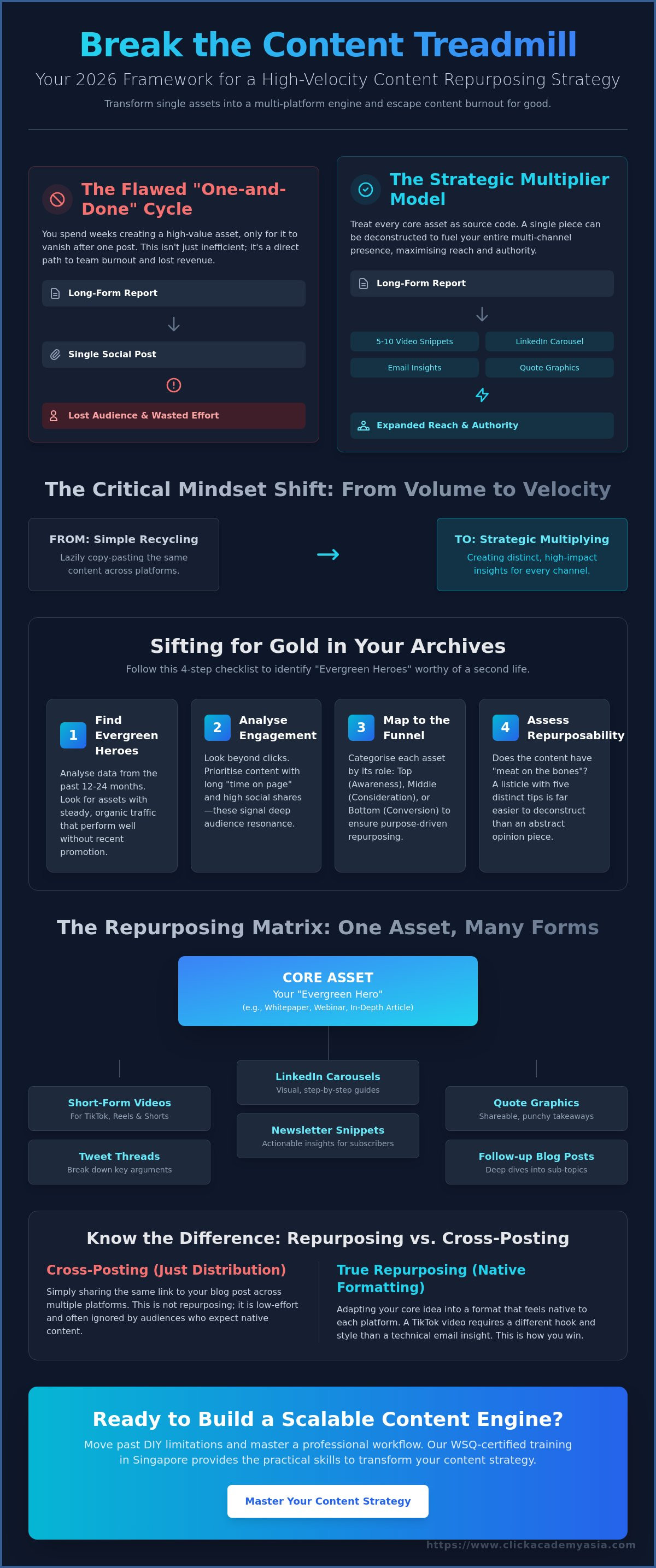
Strategic repurposing is the only way to break this cycle. It isn't about lazy copy-pasting or dumping the same link across five platforms. Instead, it's about treating your high-value assets as "source code" that can be compiled into different formats for different audiences. This approach is a fundamental pillar of modern Content marketing, ensuring your best ideas get the visibility they actually deserve.
To see how a streamlined workflow can transform your daily output, watch this helpful video on high-frequency posting:
In 2026, the "Rule of Seven" has evolved. Because of the zero-click reality and fragmented attention spans, your audience needs to encounter your message in multiple formats before it sticks. Research shows that 90 per cent of marketers report a positive return on investment from video content. By hosting a content repurposing strategy workshop, you can ensure your team knows exactly how to extract that value without starting from zero every Monday morning.
The Shift from Volume to Velocity
Modern SEO success is no longer about how many articles you publish; it's about the velocity of your assets. Velocity measures how much reach and engagement you can squeeze out of a single piece of work. When you dominate multiple formats, you build massive brand authority. You aren't just a blog; you're a TikTok insight, a LinkedIn carousel, and a punchy newsletter. This mental shift turns your content library into a scalable engine that grows your organic reach while reducing your total production time.
Repurposing vs. Cross-Posting: Knowing the Difference
We need to be clear: sharing a link to a blog post on LinkedIn is not repurposing. That's just distribution. True repurposing requires native formatting. A TikTok video requires a different storytelling hook than a technical email. You should focus on "Atomic Content," which involves breaking your big ideas into small, potent pieces that stand alone. Mastering these workflows is a core focus of the WSQ Content Marketing Strategy course, where we move beyond theory into practical, real-world application.
The Content Audit Checklist: Sifting for Gold in Your Archives
Before you begin your content repurposing strategy workshop, you must identify which assets actually deserve a second life. Not every blog post or video is a candidate for recycling. You need to mine your archives for "Evergreen Heroes"—those pieces of content that continue to drive value long after their initial publish date. Follow this four-step checklist to find your best candidates.
Step 1: Identify your Evergreen Heroes. Pull data from the last 12 to 24 months. Look for assets that maintain steady traffic levels without recent promotion.
Step 2: Analyse engagement metrics beyond clicks. High click-through rates are great, but long "time on page" and social shares indicate deep resonance. These are the ideas people want to hear more about.
Step 3: Map assets to the 2026 marketing funnel. Categorise your content into Top of Funnel (awareness), Middle of Funnel (consideration), or Bottom of Funnel (conversion). This ensures your repurposed content serves a specific business goal.
Step 4: Assess repurposability. Does the asset have clear sub-points or "meat" on the bones? A listicle with five distinct tips is much easier to break down than a singular, abstract opinion piece.
Using GA4 to Identify Repurposing Candidates
Google Analytics 4 is your best friend when sifting through archives. Use the "Pages and screens" report to spot content that has high intent but declining traffic. This is often a sign of "content decay," where the information is still valuable but the format or SEO needs a refresh. You can find more detail on this in our guide to marketing analytics with GA4.
Don't ignore your "Hidden Gems." These are pages with low overall traffic but exceptionally high conversion rates. These assets are often perfect for a content repurposing strategy workshop because they already prove they can sell; they just need a louder megaphone through different channels.
The Qualitative Audit: What Still Resonates?
Data tells you what happened, but a qualitative audit tells you why. Review your top performers for outdated statistics or old branding. In 2026, consumer trust is tied to accuracy and authenticity. If a post from 2024 uses data that is now irrelevant, it needs an update before it hits TikTok or LinkedIn.
According to the Content Marketing Institute, the goal is always to provide relevant and valuable content. Ask yourself if the core message still aligns with your 2026 business objectives. If you've shifted your service focus, even a high-traffic post might not be worth the effort. To master these analytical skills, consider exploring a WSQ Marketing Analytics & Insights course to turn your raw data into a clear roadmap.
The Repurposing Matrix: Matching Assets to High-Impact Formats
Strategy without a map is just guesswork. A repurposing matrix allows your team to visualise how one "Evergreen Hero" identified in your audit becomes ten different social assets. This systematic approach is a core outcome of a professional content repurposing strategy workshop, turning abstract ideas into a concrete production schedule.
In 2026, short-form video is the undisputed king of engagement. Platforms like TikTok, Instagram Reels, and YouTube Shorts aren't just for entertainment; they are where 84 per cent of all consumers now prefer to discover brand stories. Your matrix should prioritise these high-impact formats to ensure your message reaches the widest possible audience across every major channel.
Don't let the technical shift to video intimidate your team. Use AI-powered tools to assist in format translation, such as turning a webinar transcript into a series of punchy social "nuggets." While 80 per cent of marketers use AI for content creation, your human oversight ensures your brand voice remains authentic and compliant with 2026 transparency regulations like the EU AI Act.
From Long-Form Blog to Short-Form Video
A 2,000-word pillar article is a goldmine for video scripts. The secret lies in extracting the "hook", which is that one provocative question or surprising statistic that stops the scroll in the first three seconds. You must script for the platform's native style while maintaining your professional authority. Mastering this delicate balance is a key module in our WSQ Content Marketing Strategy training, where we provide the frameworks to bridge the gap between text and video.
The Podcast-to-Everything Pipeline
One audio episode can easily fuel a month of marketing. Start by turning the core insights into five unique LinkedIn posts that spark conversation and drive engagement. Then, use the transcript to generate an SEO-optimised FAQ section for your website, helping you capture high-intent search traffic from AI-powered search engines. In 2026, the rise of "Video Podcasts" means you should always record your audio sessions to provide visual assets for YouTube and Reels simultaneously. This pipeline ensures your experts are seen and heard exactly where your audience spends their time.
Running Your Internal Strategy Workshop: A Step-by-Step Checklist
Planning is essential, but the real magic happens during the execution of your content repurposing strategy workshop. This is the moment where your marketing team moves from high-level theory to granular production. By following a structured checklist, you can ensure that every hour spent in the workshop results in weeks of scheduled, high-impact content.
Start your pre-workshop phase by gathering the audit data we discussed in the previous sections. You shouldn't try to tackle your entire archive at once. Instead, define one "Source Asset", perhaps a top-performing webinar or a pillar blog post, to be the sole focus of the session. This keeps the team focused and prevents the overwhelm that often kills creative momentum during long meetings.
Phase 1 (The Breakdown): Deconstruct your source asset into five to ten core insights. Each insight should be a standalone "atomic" idea that provides value without needing the full context of the original piece.
Phase 2 (The Mapping): Assign each insight to a specific platform. Don't just pick channels; identify the audience persona on that channel. A LinkedIn professional digests information differently than a TikTok viewer.
Phase 3 (The Production Plan): Set a clear roadmap for execution. Assign tasks to designers and editors, set firm deadlines, and choose your tools, whether you're using Canva for graphics or CapCut for short-form video.
Post-Workshop: Review your final content calendar and set specific KPIs for these repurposed assets. This allows you to measure their performance against the original pillar and justify the workshop time.
Facilitation Tips for Marketing Leads
Managing a creative team requires more than just a timer. To avoid "Idea Fatigue," keep the session under two hours and use collaborative tools like Miro or FigJam to make the mapping phase visual and interactive. Encourage "Format-First" thinking by asking your team, "How would a Redditor read this?" or "What would make a Reels user stop scrolling?" This approach forces them to step out of a corporate mindset and into the shoes of the platform user.
The "One-to-Many" Execution Checklist
The technical hand-off is often where strategies fail. Ensure your designers have a clear brief that includes consistent SEO keywords across all formats to maintain brand cohesion. Every repurposed asset should link back to your original pillar to build topical authority. This internal linking strategy is vital for advanced sem strategies that aim to dominate search engine results pages through a cluster-based approach.
Ready to lead your team to content mastery? You can gain the skills to facilitate these sessions and more by enrolling in our WSQ Digital Marketing Strategy & Planning programme today.
Scaling Your Workflow with Professional Training
While the steps outlined in this guide provide a solid foundation for your first content repurposing strategy workshop, many teams find that a DIY approach eventually hits a ceiling. Scaling a multi-channel engine requires more than just a checklist; it demands a structured framework that can withstand shifting algorithms and evolving platform psychologies. Professional training bridges the gap between a one-off session and a sustainable, high-velocity marketing operation.
For professionals in Singapore, enrolling in WSQ digital marketing courses ensures your skills are aligned with industry-recognised standards. These programmes move beyond surface-level tips to provide a deep understanding of content architecture. By mastering these standards, you transform your team from content creators into strategic assets capable of driving measurable growth.
Leveraging SkillsFuture for Team Upskilling
Upskilling your team doesn't have to be a heavy financial burden. Most of our workshops are eligible for SSG funding, making professional development accessible for businesses of all sizes. When pitching a workshop to your HR or Department Head, focus on the tangible ROI. Content marketing generates over three times as many leads as outbound marketing while costing 62 per cent less. A future-ready, multi-skilled team reduces the need for expensive external agencies and keeps your production agile and in-house.
The ClickAcademy Asia Advantage
At ClickAcademy Asia, we pride ourselves on a mentor-led, practical approach that prioritises real-world application over abstract theory. Our WSQ modules are designed to be "no fluff" experiences where you spend less time listening and more time doing. You'll work through the exact frameworks used by global industry leaders to optimise their reach and engagement.
We invite you to view our upcoming course dates for the WSQ Content Marketing Strategy programme. Join a professional content repurposing strategy workshop led by experts and refine your team’s execution for the 2026 landscape. Let's build your multi-platform engine together.
Future-Proof Your Content Engine
You've seen how identifying your "Evergreen Heroes" and matching them to high-impact formats like short-form video can transform your marketing output. By implementing a structured content repurposing strategy workshop, you stop the exhausting cycle of creating from scratch and start building a sustainable, multi-channel engine. This shift from volume to velocity ensures your best ideas reach the widest possible audience without doubling your workload.
Mastering these frameworks is essential for any professional looking to navigate the 2026 digital landscape with confidence. ClickAcademy Asia has empowered learners in over 30 countries since 2011 through practical sessions taught by industry practitioners. Our programmes are WSQ certified and SSG funded, providing you with a gold-standard education that is both accessible and immediately applicable to your business goals.
Optimise your content ROI with our WSQ Content Marketing Strategy course. You have the checklist and the roadmap. It's time to lead your team toward long-term success and measurable growth.
Frequently Asked Questions
What is a content repurposing strategy workshop?
A content repurposing strategy workshop is a structured team session where you deconstruct a single "pillar" asset into multiple smaller pieces tailored for different platforms. Instead of just sharing a link, your team actively brainstorms how to turn one webinar or whitepaper into ten or twenty social posts, videos, and newsletters. It's a strategic shift from creating new content daily to maximising the reach of your existing high-performing work.
Can I use AI to help with my content repurposing strategy?
You can and should use AI to streamline your repurposing efforts, as 95 per cent of B2B marketers are already using AI-powered applications in 2026. Tools can quickly transcribe audio or summarise long articles into punchy scripts for short-form video. However, you must ensure all output is human-reviewed to maintain brand authenticity and comply with regulations like the EU AI Act, which requires transparency for AI-generated content.
How often should I run a repurposing workshop for my team?
We recommend running a content repurposing strategy workshop at least once a month to keep your social media calendar full and relevant. If your team produces large, complex reports less frequently, a quarterly deep-dive session might suffice. The goal is to ensure your "Evergreen Heroes" are always being worked into your distribution schedule so that no valuable insight goes to waste.
Is repurposing content bad for SEO or considered duplicate content?
Repurposing is not bad for SEO and is rarely flagged as duplicate content because you are changing the format and context of the information. Turning a blog post into a video script or an infographic provides a different user experience, which search engines actually reward. By linking these assets back to your original pillar page, you strengthen your topical authority and improve your chances of appearing in AI-powered search summaries.
Which platforms are best for repurposed content in 2026?
Short-form video platforms like TikTok, Instagram Reels, and YouTube Shorts are the highest-ROI channels in 2026. For professional B2B content, LinkedIn remains the premier space for carousels and thought-leadership snippets derived from longer reports. You should also consider your owned media, such as email newsletters, where repurposed content can drive direct engagement without relying on social algorithms.
What are the best tools for managing a repurposing workflow?
For video clipping and captioning, tools like Repurpose Lite offer affordable solutions for under $20 per month. Design teams typically rely on Canva for social graphics, while project management is best handled through platforms like Notion or Monday.com to track the hand-off between strategists and creators. Collaborative whiteboards like Miro are also excellent for the initial mapping phase of your workshop.
How do I measure the ROI of my repurposed content?
You measure ROI by comparing the total engagement and lead generation of the repurposed assets against the initial cost of producing the source content. Since content marketing costs 62 per cent less than outbound methods, you should see a significant decrease in your "cost per lead" as you scale. Use GA4 to track how many conversions originate from these micro-assets compared to your traditional long-form pages.


Comments