
Advanced CDP Use Cases: 2026 Singapore Marketer Guide
- ClickAcademy Asia

- 2 minutes ago
- 12 min read
By 2026, the cost of acquiring a new customer in Singapore's saturated digital market has climbed so high that traditional broad-stroke advertising is now a significant drain on resources. You likely feel the pressure of fragmented data silos across your various platforms, making it nearly impossible to measure true multi-touch attribution or justify your spend. Many PMEBs find themselves stuck with expensive tech stacks that don't talk to each other, leading to missed opportunities and rising customer acquisition costs. If you're looking to bridge this gap, enrolling in a high-impact marketing analytics course singapore professionals trust is the first step toward mastering your data ecosystem.
We understand that the shift toward first-party data and strict PDPA compliance can feel overwhelming. This guide offers a clear roadmap for CDP activation, showing you how to leverage unified data to drive measurable ROI and hyper-personalisation specifically for the Singaporean business landscape. You'll discover how to move beyond simple data storage to create a dynamic intelligence loop that improves customer retention. We are going to break down advanced use cases and team upskilling programmes, ensuring your marketing team is ready to handle the complexities of modern marketing technology with confidence.
Table of Contents
Why Data Unification is the New Competitive Standard in Singapore
The digital landscape in Singapore has reached a tipping point. The deprecation of third-party cookies isn't just a technical hurdle; it's a fundamental change in how we understand our customers. In the APAC region, first-party data dominance is the new reality. Organisations that rely on rented audiences are seeing their ROI plummet as tracking becomes less reliable. This is where a Customer Data Platform (CDP) becomes a strategic necessity rather than a luxury.
By 2026, compliance with the Personal Data Protection Act (PDPA) has evolved from a legal checklist into an operational discipline. Singaporean companies face significant financial penalties for breaches, reaching up to 10% of annual turnover for large firms. This regulatory pressure makes data unification critical. You can't protect what you can't see, and you can't govern data that lives in ten different silos. Navigating this shift requires more than just buying software. It demands a deep understanding of how to architect these systems. This is why a marketing analytics course singapore leaders recommend is vital. It equips PMEBs with the skills to transition from being data collectors to strategic insight drivers.
The Cost of Fragmented Customer Journeys
Disjointed touchpoints are expensive. When your digital ads don't know what your CRM knows, you waste budget on customers who have already converted. Fragmented journeys create friction. If a customer receives an "exclusive offer" for a product they bought yesterday, trust erodes instantly. Sales and marketing teams often operate on different versions of the truth. This leads to internal misalignment and missed revenue targets. Data silos don't just slow you down; they actively drive up your customer acquisition costs in a market where every dollar counts.
Bridging the Gap Between Data and Strategy
Executives need a unified source of truth to make informed decisions. The goal is to move toward a Customer Intelligence Loop where data informs action, and action generates more data in a continuous cycle. For marketing managers, mastering this loop isn't just about technical proficiency. It's about professional credibility. By learning to unify data through a marketing analytics course singapore professionals can prove their impact on the bottom line with measurable precision. Leveraging WSQ frameworks for this upskilling ensures your training is grounded in industry standards while remaining cost-effective through SSG funding.
Defining Advanced Customer Data Platform (CDP) Use Cases
Advanced CDP use cases in 2026 go far beyond simple list segmentation. They are characterised by real-time, AI-driven activation that closes the feedback loop in seconds. This level of agility is non-negotiable within Singapore's digital economy, where high internet penetration and consumer expectations demand immediate relevance. When you can respond to a customer's intent while they are still on your site, you move from passive observation to active influence.
Foundational vs. Advanced CDP Activation
Most organisations begin with foundational data collection. This involves ingesting data from CRMs and websites to create a single view of the customer. However, the true value lies in the transition from batch processing to real-time orchestration. Advanced activation requires specific technical prerequisites, including server-side tracking and pre-configured machine learning models. To bridge the gap between basic reporting and strategic execution, many PMEBs find that a marketing analytics course singapore professionals recommend is the most efficient way to upskill their teams. These programmes provide the hands-on experience needed to manage complex data flows without getting lost in technical debt.
By 2026, the rise of Agentic CDPs has changed the game. These platforms serve as autonomous hubs where AI agents manage customer engagement based on predictive intent. This shift directly improves bottom-line metrics. By automating high-value interactions, you can significantly increase Customer Lifetime Value (CLV) while simultaneously lowering Customer Acquisition Cost (CAC) through more efficient ad spend. If you want to master these high-level frameworks, consider looking into WSQ Marketing Analytics & Insights training to sharpen your strategic edge.
The Role of Identity Resolution in 2026
Accurate activation relies entirely on identity resolution. In 2026, the industry has moved from relying on fragile hashed emails toward robust, authenticated identity layers. This approach maintains persistent profiles across multiple devices and platforms, even as privacy regulations tighten. This is the only way to achieve true multi-touch attribution. Without a clear identity layer, your marketing analytics will remain fragmented and unreliable. Mastering identity resolution ensures that every touchpoint is accounted for, allowing you to justify your marketing spend with absolute clarity. This technical mastery is a core component of a modern marketing analytics course singapore leaders use to future-proof their marketing departments.
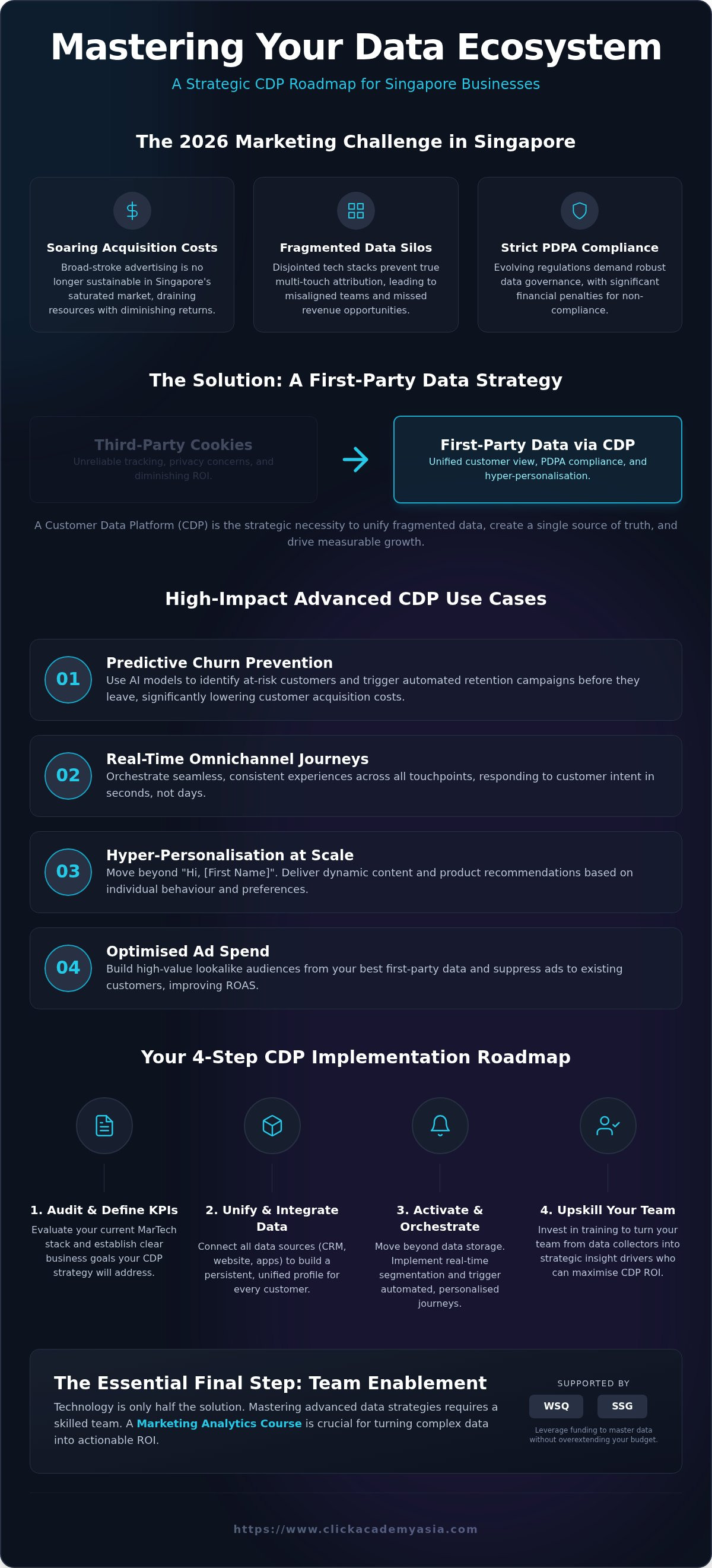
5 High-Impact Advanced CDP Use Cases for Modern Teams
According to the Singapore Digital Economy Report, digitalisation and AI adoption are accelerating across all sectors to fuel regional growth. To capitalise on this, PMEBs must move beyond basic reporting. Implementing these five advanced use cases allows your team to drive measurable ROI in a crowded market.
Predictive Churn Prevention: Utilise machine learning to identify at-risk customers by flagging "exit" behaviours before they lapse.
Hyper-Personalised Omnichannel Journeys: Ensure consistent messaging whether a customer is browsing your mobile app from any location or visiting your physical store.
Lookalike Audience Optimisation: Feed high-value segment data back into SEM and Social Media platforms to find leads that mirror your best customers.
Online-to-Offline (O2O) Attribution: Connect digital engagement to physical visits, proving the impact of online spend on in-store revenue.
AI-Driven Dynamic Pricing: Adjust offers and discounts in real-time based on a customer's loyalty tier and purchase history.
Predictive Analytics and Behavioural Forecasting
Modern CDPs leverage historical data to predict future purchase intent with high accuracy. By applying a Next Best Action (NBA) framework, you can automate marketing responses that meet the customer exactly where they are in their journey. This removes the guesswork from your strategy. Predictive analytics serves as a vital tool for proactive retention by identifying patterns before they lead to customer loss. Mastering these forecasting techniques is a primary focus of a marketing analytics course singapore corporate leaders use to upskill their digital departments.
Advanced Personalisation and Journey Orchestration
Real-time journey orchestration allows you to trigger notifications based on immediate site behaviour. For example, if a user abandons a high-value cart, the system can deploy an SMS or email offer within seconds. Equally important is the ability to suppress existing customers from acquisition campaigns. This simple move saves significant budget by not paying for clicks from people who are already converted. Consistent storytelling across the entire funnel ensures that your brand message remains coherent. To execute these complex workflows effectively, teams often benefit from marketing analytics course singapore training that covers the practical application of WSQ-certified data strategies.
Implementing Your CDP Strategy: A Roadmap for Singaporean Businesses
Implementing a CDP in Singapore requires more than a simple software subscription. It demands a structured approach to bridge the gap between technical capability and strategic execution. Many PMEBs fail because they rush into vendor selection before auditing their internal readiness. To avoid these pitfalls, enrolling your department leads in a marketing analytics course singapore leaders trust ensures the roadmap is built on a foundation of practical expertise.
Step 1: Audit your existing MarTech stack. Identify where data is leaking and which silos are preventing a unified customer view.
Step 2: Define specific business KPIs. Establish clear goals, such as reducing churn by 5% or increasing CLV, before looking at vendor features.
Step 3: Establish a cross-functional Data Taskforce. Break down the walls between IT and Marketing to ensure data governance and strategic alignment.
Step 4: Pilot high-impact use cases. Start with "quick wins" like suppressing existing customers from acquisition ads to demonstrate immediate ROI.
Step 5: Invest in a marketing analytics course singapore professionals recommend. Continuous upskilling ensures your team can manage the platform independently without relying on external agencies.
Selecting the Right Use Cases for ROI
Prioritising your use cases is essential for maintaining momentum. We recommend a "crawl-walk-run" approach to CDP maturity. Start with low-effort, high-impact tasks like basic segmentation. As your team gains confidence, move toward the predictive models discussed in previous sections. In Singapore's competitive local market, agility is your greatest asset. By focusing on use cases that solve immediate pain points, you create a self-funding model for further digital transformation. To lead this transformation effectively, equip your team with the skills found in our WSQ Marketing Analytics & Insights programme.
Governance and Compliance in the PDPA Era
Data privacy is an operational discipline that can't be ignored. Singaporean marketers have a responsibility to protect consumer data, especially with financial penalties for breaches reaching up to 10% of annual turnover. A CDP simplifies this by providing centralised consent management. It ensures that when a customer opts out on your website, that preference is reflected across all your marketing channels instantly. Maintaining high standards of data ethics isn't just about avoiding fines; it's about protecting your brand reputation. Using a unified platform makes it easier to audit your data flows and remain compliant with evolving SSG and PDPA regulations.
Mastering CDP Strategy through WSQ-Certified Training Programmes
Software is only as effective as the person operating it. Many Singaporean firms invest six-figure sums into advanced MarTech stacks only to see them underutilised due to a lack of internal expertise. This investment in software must be matched by an equal investment in human capital. By enrolling your team in a marketing analytics course singapore professionals trust, you ensure that the complex data flows and predictive models we've discussed are managed by experts who understand the strategic "why" behind the technical "how".
The WSQ framework offers a gold standard for professional development in the local ecosystem. For PMEBs, these programmes provide a structured pathway to lead digital transformation with confidence. Because these courses are designed in collaboration with industry leaders, the curriculum remains agile and relevant to the 2026 landscape. Additionally, SkillsFuture Singapore (SSG) funding significantly lowers the barrier to entry. As of August 2026, SMEs can receive up to 70% subsidy under the Enhanced Training Support for SMEs (ETSS). Singapore Citizens aged 40 and over benefit from up to 90% coverage via the Mid-Career Enhanced Subsidy. Beyond subsidies, the SkillsFuture Enterprise Credit (SFEC) provides an additional S$10,000 to offset up to 90% of out-of-pocket expenses for qualifying programmes.
Bridging the Talent Gap in Digital Marketing
The demand for data-literate marketing professionals in Singapore has never been higher. Organisations are no longer looking for generalists; they need specialists who can navigate identity resolution and real-time orchestration. ClickAcademy Asia courses provide the hands-on experience required to master these disciplines. By working through real-world scenarios, you gain the practical mastery needed to drive ROI from day one. Official certifications from global platforms and local bodies build immediate professional credibility, positioning you as a vital asset in any forward-thinking marketing department.
Future-Proofing Your Marketing Career in 2026
Adopting a mindset of continuous upskilling is the only way to remain competitive. As we move toward the "agentification" of CDPs, the role of the marketer shifts from manual execution to strategic oversight. Mastering foundational tools through a marketing analytics course singapore leaders recommend supports your overall CDP success by ensuring your data inputs are clean and actionable. ClickAcademy Asia stands as your premier partner for this journey, offering the regional expertise across APAC needed to turn data into a sustainable competitive advantage. Equip your team with these skills today to lead the next era of marketing excellence.
Leading the Future of Data-Driven Marketing in Singapore
The shift toward first-party data and unified intelligence isn't just a trend; it's the standard for business survival in Singapore. By mastering advanced CDP use cases like predictive analytics and real-time orchestration, you move from reacting to market changes to actively shaping customer behaviour. This transition requires a strategic roadmap that prioritises high-impact wins while maintaining strict PDPA compliance. Each step you take toward data maturity strengthens your brand's resilience in an increasingly complex digital economy.
Success in 2026 depends on treating continuous learning as a core business function. Investing in a marketing analytics course singapore professionals trust ensures your team is ready to turn complex data into actionable insights. Our WSQ-certified and SSG-funded programmes offer expert-led workshops and official industry certifications designed specifically for PMEBs. By bridging the gap between technical tools and strategic execution, you position your organisation as a leader in the APAC region.
Take the first step toward future-proofing your organisation and lead your department with the confidence that only practical mastery can provide. We are here to support your growth as you navigate the next era of marketing excellence.
Frequently Asked Questions
What is the primary difference between a CDP and a CRM for advanced use cases?
A CRM focuses on managing direct relationships and sales pipelines for known customers through manual entries or basic integrations. In contrast, a CDP unifies data from every touchpoint, including anonymous web behaviour and offline interactions. For advanced use cases, a CDP enables real-time orchestration across all channels, whereas a CRM typically acts as a static database. Understanding these architectural differences is a core component of a marketing analytics course singapore professionals use to refine their MarTech strategies.
Can a CDP help reduce my Customer Acquisition Cost (CAC) in Singapore?
Yes, it reduces CAC by optimising ad spend through high-precision targeting and real-time suppression. By removing existing customers from acquisition campaigns, you stop wasting budget on people who have already converted. Additionally, lookalike audience modelling based on high-value segments allows you to find new leads that mirror your best customers. This level of efficiency is essential in Singapore’s competitive digital landscape, where media costs continue to rise and every dollar must drive measurable ROI.
How much does it typically cost to implement an enterprise-grade CDP in 2026?
Implementation costs vary based on data volume, the number of integrations, and chosen architectural models like composable or warehouse-native. While software licensing is a factor, businesses must also budget for internal upskilling and data governance. Rather than focusing solely on the price of the platform, leaders should evaluate the total cost of ownership. Investing in a marketing analytics course singapore helps your team manage the implementation internally, potentially saving on expensive external consultancy fees while ensuring long-term platform mastery.
What happens if our current data is "messy" before we start a CDP project?
Messy data is a common challenge, but it shouldn't stop your progress toward unification. Most modern CDPs include tools for data cleansing and transformation during the ingestion process. However, you must conduct a thorough data audit to identify gaps and inconsistencies before deployment. Establishing a clear data schema ensures that the "garbage in, garbage out" cycle is broken. Practical training helps PMEBs learn how to standardise naming conventions and validate data streams for long-term accuracy and reliability.
Is it possible to integrate a CDP with my existing Google Analytics 4 (GA4) setup?
Integration with GA4 is highly recommended for a complete view of the customer journey. You can feed GA4 event data into your CDP to enrich user profiles with granular web behaviour. Conversely, the CDP can push unified segments back into GA4 for advanced analysis or into Google Ads for remarketing. This bidirectional flow allows you to close the feedback loop and execute hyper-personalised campaigns based on a comprehensive understanding of user intent across all digital touchpoints.
How do WSQ-certified courses help my team manage a Customer Data Platform?
WSQ-certified courses provide a structured, industry-validated curriculum that focuses on practical application rather than just theory. They equip your team with the technical skills needed to handle identity resolution, audience segmentation, and real-time activation. Because these programmes are aligned with the SkillsFuture Singapore (SSG) framework, they are also highly cost-effective for local businesses. This ensures your staff can master the platform's complexities while your organisation benefits from significant fee subsidies and training grants for workforce transformation.
Which department should "own" the CDP: IT or Marketing?
While IT often manages the technical infrastructure and data security, Marketing should drive the strategic application and use cases. A collaborative "Data Taskforce" involving both departments is the most effective model for ownership. This cross-functional approach ensures that IT provides a robust data foundation while Marketing focuses on delivering customer value and ROI. Clear communication between these teams prevents silos and ensures the CDP serves broader business objectives rather than becoming a purely technical IT project.
Are there specific Singapore government grants available for CDP implementation?
Singaporean businesses can leverage several grants to support their digital transformation. The Enterprise Development Grant (EDG) often covers projects related to core capabilities and market access, including advanced data systems. For upskilling, the SkillsFuture Enterprise Credit (SFEC) provides S$10,000 to offset out-of-pocket expenses for qualifying training. When combined with SSG course fee subsidies of up to 70% or 90%, these grants make it much more accessible for local firms to implement and master advanced CDP strategies.


Comments