
2026 Channel Partner Marketing Guide for Singapore PMEBs
- ClickAcademy Asia

- 2 minutes ago
- 11 min read
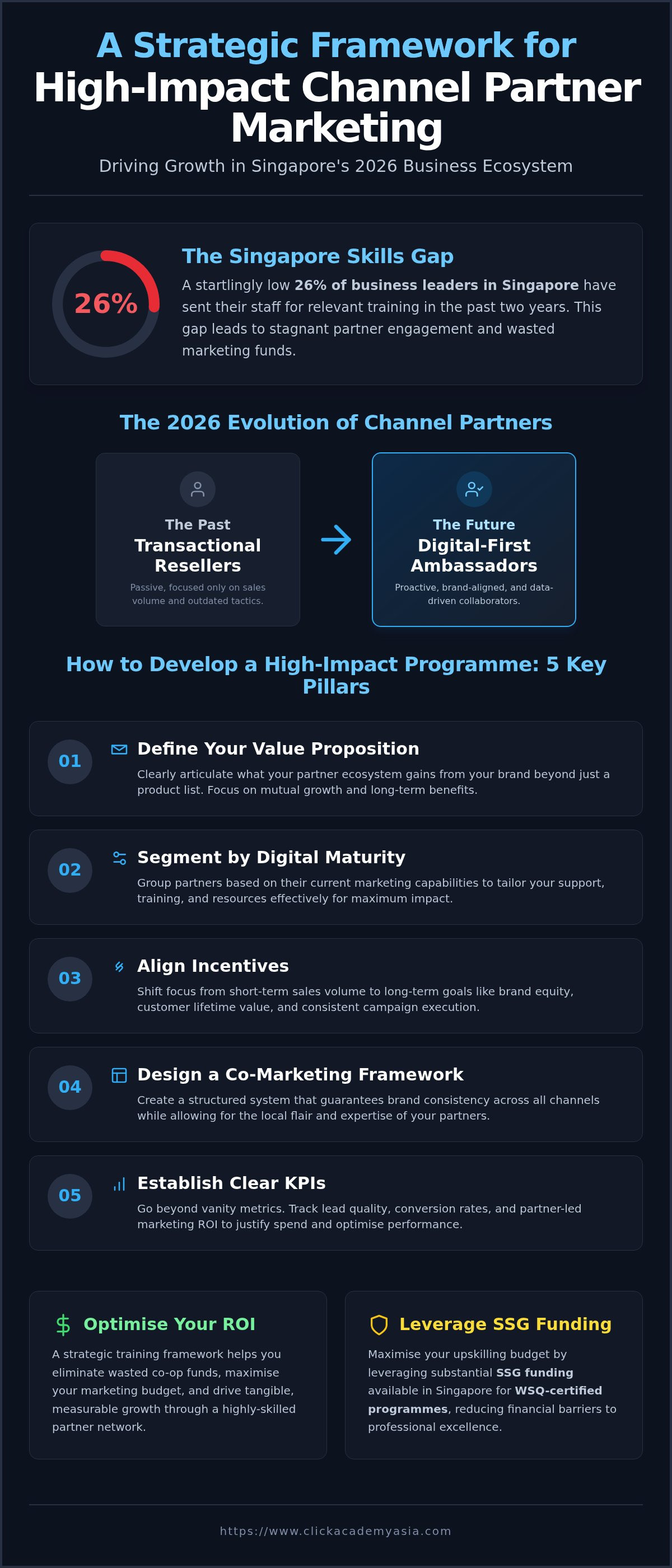
Did you know that only 26% of business leaders in Singapore have sent their staff for relevant training in the past two years? This startling statistic explains why many PMEBs face stagnant partner engagement and wasted co-op marketing funds. If you've noticed a lack of digital maturity across your network, investing in channel partner marketing training is the most effective way to bridge the skills gap and drive growth.
It's time to stop settling for underperforming campaigns and start building a future-ready workforce. This guide shows you how to master a strategic framework for high-impact programmes. We'll help you align your corporate strategy with partner execution through actionable insights and practical mastery that goes beyond simple theory.
We'll explore a clear roadmap for partner enablement that leverages WSQ-certified courses and substantial SSG funding available in 2026. You'll discover how to drive tangible ROI from your partner-led marketing while positioning your organisation as a leader in the APAC region. Let's look at how to transform your channel relationships into high-performing, data-driven collaborations.
Table of Contents
The Evolution of Channel Partner Marketing in Singapore for 2026
How to Develop a High-Impact Channel Partner Marketing Programme
Comparing Channel Marketing Training Models: WSQ vs. Global Certifications
Step-by-Step Implementation: Upskilling Your Channel Management Team
Optimising ROI with WSQ-Certified Digital Marketing Training
The Evolution of Channel Partner Marketing in Singapore for 2026
The traditional Marketing channel model has undergone a radical transformation. By 2026, Singaporean partners have transitioned from passive resellers to digital-first brand ambassadors. This shift is driven by a B2B2C landscape where customers expect seamless digital experiences across every touchpoint. If your partners aren't equipped to represent your brand online, your market share is at risk.
Singapore's business ecosystem is uniquely competitive. With social media penetration expected to reach 90.6% by late 2026, the battle for attention happens on LinkedIn, TikTok, and private communities. A sophisticated approach to partner enablement is no longer optional. It's the baseline for survival. Generic sales training that focuses only on "closing the deal" is insufficient. Modern channel success requires a deep understanding of content strategy, lead attribution, and digital performance metrics.
Effective channel partner marketing training bridges the gap between corporate vision and partner execution. It empowers your network to move beyond transactional relationships. When partners understand how to leverage micro-creators and "dark social" channels, they become true extensions of your marketing team. This collaborative model ensures that co-op funds aren't wasted on outdated tactics that no longer resonate with savvy Singaporean buyers.
Navigating the APAC Channel Landscape
Singapore serves as the strategic heart of the APAC region. While global standards provide a foundation, success here depends on localised marketing strategies that respect regional nuances. You can't simply export a Western playbook and expect it to work in Southeast Asia. To become a digital marketing specialist in the channel space by 2026, you must master the art of hyper-personalisation. This involves understanding local search behaviours and the specific platforms where your target audience spends their time. Practical mastery of these regional factors is what separates high-growth firms from the rest.
The Role of Continuous Learning for PMEBs
Upskilling is the ultimate competitive advantage for Singaporean firms. In a volatile market, the ability to pivot and adopt new technologies determines your longevity. Professional certification does more than just build skills; it builds partner trust. When your channel managers are certified experts, they command respect and can lead partners more effectively. ClickAcademy Asia helps PMEBs and corporate leaders navigate these shifts through structured, result-driven education. By prioritising channel partner marketing training that is grounded in real-world experience, you ensure your team is ready to shape the future of professional expertise rather than just reacting to it.
How to Develop a High-Impact Channel Partner Marketing Programme
Successful channel marketing in Singapore requires moving beyond a "one-size-fits-all" mentality. You've seen the recent market shifts; now you must build the engine that drives growth. High-impact channel partner marketing training is the foundation of this engine. It's about empowering your partners with the same digital sophistication you expect from your internal team.
Define your value proposition: Clearly articulate what your partner ecosystem gains from your brand beyond just a product list.
Segment by digital maturity: Group partners based on their current marketing capabilities to tailor your support effectively.
Align incentives: Shift focus from short-term sales volume to long-term brand equity and customer lifetime value.
Design a co-marketing framework: Create a structured system that guarantees brand consistency while allowing for local partner flair.
Establish clear KPIs: Track lead quality, conversion rates, and partner-led marketing ROI to justify your spend.
Defining Strategic Goals and Partner Personas
Selecting the right partners is a strategic exercise in persona building. You aren't just looking for volume; you're looking for alignment. Create a mutual success roadmap that outlines how both parties will scale over the next three years. Initiatives like the Partnerships for Capability Transformation (PACT) show how the Singapore government supports these collaborative growth models. Integrating channel partner marketing training into your onboarding ensures new partners are immediately productive and aligned with your vision.
Co-Marketing and Content Standardisation
Consistency is the greatest challenge in a distributed network. Develop a "marketing-in-a-box" toolkit that provides ready-to-use assets, but don't stop there. You must ensure technical SEO and content marketing standards are upheld by every partner. Using WSQ frameworks allows you to standardise these outputs across your entire network. It's a quick win that turns your partners into a cohesive marketing machine. Developing these internal capabilities is easier when you upskill your channel management team through certified tracks that focus on practical application rather than just theory.
Comparing Channel Marketing Training Models: WSQ vs. Global Certifications
Deciding on the right channel partner marketing training requires a clear-eyed evaluation of your business objectives. While global proprietary certificates provide universal frameworks, they often miss the tactical nuances of the local ecosystem. For PMEBs in Singapore, the choice between local accreditation and global prestige isn't binary. It's about finding the right mix that drives both competence and ROI.
The Strategic Advantage of WSQ-Certified Training
WSQ-certified programmes are built on a foundation of practical application rather than just theory. They align directly with Singaporean industry standards, ensuring your team masters the skills most relevant to the local market. The financial benefits are equally compelling. Under the Enhanced Training Support for SMEs (ETSS), eligible companies can receive up to 90% subsidies for Singapore Citizens and Permanent Residents. Even large corporations benefit from baseline subsidies of up to 70%.
Beyond fee subsidies, the SSG framework offers Absentee Payroll (AP) funding, allowing you to claim $4.50 per hour for each employee attending training. This significantly lowers the barrier to continuous learning. Starting in the second half of 2026, the new SkillsFuture Enterprise Credit (SFEC) digital wallet will further simplify this by allowing immediate cost offsetting at the point of transaction. These intensive, facilitator-led workshops provide a supportive environment where leaders can solve real-world challenges alongside expert mentors.
Global Certifications: When Do They Make Sense?
Global certifications are highly effective when used as specialised building blocks. Integrating Google Ads Search Certification or Google Analytics (GA4) Training into your partner enablement plan sets a technical benchmark for your entire network. This is vital for multinational channel teams that need a common language across the APAC region. A hybrid model often works best, where the strategic heavy lifting is done through WSQ Digital Marketing Strategy & Planning, and specific technical skills are validated through global partners.
This tiered approach ensures your channel managers possess both the strategic depth to lead and the technical knowledge to audit partner performance. By leveraging the prestige of global certifying bodies alongside the practical rigour of local frameworks, you position your organisation as a leader in professional expertise. This dual-track strategy is the hallmark of a future-ready workforce that can navigate any technological shift. ClickAcademy Asia provides the bridge between these two worlds, offering both WSQ-certified tracks and official Google certifications.
Step-by-Step Implementation: Upskilling Your Channel Management Team
Moving from a strategic framework to a functional programme requires a disciplined approach to execution. You've seen how the Singaporean ecosystem has evolved; now you must ensure your team's capabilities match that pace. High-impact channel partner marketing training isn't a one-off event. It's a structured process that aligns your team's expertise with your 2026 revenue objectives. This implementation phase starts with a clear-eyed look at your current internal skills.
Tangible ROI is the ultimate validator for any upskilling initiative. By late 2026, you should be tracking specific metrics such as the Cost of Acquisition (CPA) from partner-led campaigns and the speed of partner onboarding. When your channel managers can audit a partner's digital strategy effectively, you'll see a direct correlation in traffic growth across your network. This data-backed approach transforms training from a perceived cost centre into a vital strategic investment.
Conduct a skills audit: Pinpoint exactly where your channel managers lack digital proficiency, specifically in areas like SEO and data analytics.
Select targeted modules: Don't settle for generic courses; choose specific tracks like WSQ Search Engine Optimization (SEO) or WSQ Marketing Analytics & Insights.
Secure leadership buy-in: Present a business case that shows how certified skills reduce co-op fund wastage and improve partner engagement.
Measure performance impact: Establish a baseline before training begins so you can track improvements in partner-generated revenue.
Executing a Training Needs Analysis (TNA)
A Training Needs Analysis (TNA) is a tool for ensuring every dollar spent on training targets a specific revenue-driving skill. It helps you identify if your managers need help with technical SEM or high-level content strategy. By following a structured path, your staff can transition into a digital marketing specialist role. This professional growth keeps your team motivated and ensures your organisation remains competitive in the broader APAC region. It's about building a team that doesn't just manage partners but actively leads them toward digital excellence.
Leveraging Government Grants for Corporate Training
Navigating the SSG funding landscape shouldn't be a hurdle for your HR department. In 2026, the Enhanced Training Support for SMEs (ETSS) remains a cornerstone for cost-effective upskilling. HR teams should use the revamped MySkillsFuture portal to identify eligible WSQ modules and streamline the subsidy claim process. This ensures your channel partner marketing training delivers world-class certifications without straining your corporate budget. By combining these grants with the SkillsFuture Enterprise Credit (SFEC), you can achieve a sophisticated training programme with minimal out-of-pocket expenses.
Ready to bridge the skills gap in your organisation? Equip your team with WSQ-certified marketing skills to drive your channel strategy forward today.
Optimising ROI with WSQ-Certified Digital Marketing Training
Maximising the return on your partner programmes requires more than just a generous co-op budget. It demands a team that can translate high-level strategy into measurable digital performance. By investing in channel partner marketing training, you're building a future-ready workforce capable of navigating the complexities of the 2026 landscape. This long-term value manifests in higher partner retention, more efficient lead generation, and a significant reduction in wasted marketing spend.
ClickAcademy Asia’s WSQ Digital Marketing Strategy & Planning course is specifically designed to transform these results. It moves beyond basic concepts to focus on the practical application of advanced tools. For example, your team will learn how to turn raw data from Google Analytics (GA4) into actionable insights that help partners optimise their local campaigns. This ability to provide data-driven guidance builds a culture of continuous improvement across both your sales and marketing departments.
From Theory to Mastery: The ClickAcademy Approach
Busy executives don't have time for passive, lecture-heavy learning. Our intensive bootcamps are designed for PMEBs who need to gain practical mastery quickly. We pair you with expert mentors who have shaped the future of professional expertise in the APAC region. This mentor-led education ensures you aren't just learning a curriculum; you're solving real-world business challenges. If you're looking to upskill an entire department, we offer bespoke corporate training tailored to your specific channel ecosystem and revenue goals.
Final Checklist for Channel Marketing Success
Before you finalise your 2026 strategy, ensure your framework is robust enough to handle the digital shifts we've discussed. Use this checklist to verify your readiness:
Review partner enablement: Does your current framework provide partners with the digital tools they need to act as brand ambassadors?
Audit skills alignment: Is your team's channel partner marketing training roadmap aligned with the latest WSQ standards and SSG requirements?
Verify funding eligibility: Have you confirmed your eligibility for the 2026 SkillsFuture Enterprise Credit (SFEC) to offset training costs?
Set performance benchmarks: Do you have clear KPIs in place to measure the impact of training on your partner-led ROI?
The path to market leadership starts with a commitment to excellence. Taking the next step is simple. You can book a strategic consultation to discuss your corporate training needs and discover how our WSQ-certified tracks can future-proof your channel operations.
Future-Proof Your Channel Strategy for 2026
The transition from transactional sales to digital-first brand advocacy is the defining shift for Singaporean channel leaders. Success in this new environment requires more than just high-level vision; it demands practical mastery of digital tools and performance metrics. By building a roadmap for enablement, you can eliminate co-op fund wastage and ensure your partners are truly aligned with your brand equity goals.
Investing in structured channel partner marketing training is the most direct path to achieving these results. You don't have to navigate this transformation alone. Our WSQ-certified programmes and official Google certifications provide a robust framework for professional excellence, backed by substantial SSG funding to keep your corporate upskilling cost-effective. Our expert facilitators bring real-world APAC experience to every session, ensuring your team learns from mentors who understand the regional market.
It's time to lead your organisation into a new era of partner collaboration. Equip your team with future-ready skills through WSQ-funded training tracks at ClickAcademy Asia and start driving tangible ROI from your network today. Your journey toward a more agile, tech-savvy workforce starts with a single step.
Frequently Asked Questions
What is the difference between channel sales and channel marketing training?
Channel sales training focuses on the transactional aspect of closing deals through partners, whereas channel partner marketing training equips your team to build brand equity and generate demand across the network. Sales training often covers negotiation and pipeline management. In contrast, marketing training focuses on digital strategy, content standardisation, and technical SEO. This ensures partners don't just sell products but act as sophisticated brand ambassadors in the digital space.
How does SSG funding work for channel partner marketing programmes in Singapore?
SSG funding provides substantial subsidies for WSQ-certified courses to reduce the financial burden on Singaporean firms. SMEs can receive up to 90% funding for Singapore Citizens and Permanent Residents, while large corporations are eligible for up to 70%. Additionally, the Absentee Payroll (AP) scheme allows employers to claim $4.50 per hour for staff training. From late 2026, the SFEC digital wallet will further simplify immediate cost offsetting at the point of transaction.
Can individual PMEBs use SkillsFuture Credit for ClickAcademy Asia courses?
Individual Singaporeans can utilise their SkillsFuture Credit to offset out-of-pocket expenses for any SSG-funded course at ClickAcademy Asia. This applies to both the initial credit and the subsequent top-ups provided by the government. It's a strategic way for PMEBs to invest in their own professional growth without significant personal expense. This flexibility ensures that upskilling remains accessible to leaders looking to future-proof their careers in a rapidly changing market.
What are the core modules of a WSQ Digital Marketing Strategy & Planning course?
The WSQ Digital Marketing Strategy & Planning course covers essential pillars of modern marketing leadership. Key modules include digital marketing landscape analysis, strategic planning frameworks, and performance measurement. Participants learn to develop integrated campaigns that span SEO, social media, and content marketing. The curriculum is designed for practical mastery, ensuring you can apply these strategic insights directly to your channel partner management and broader corporate objectives.
How long does it take to complete a channel marketing certification?
Most WSQ-certified modules are designed as intensive bootcamps that typically span two to three full days. This structure is ideal for busy PMEBs who need to gain high-impact skills without long absences from the office. While the classroom component is concise, the practical application and assessment ensure you achieve a deep understanding of the material. This efficient format allows your team to return to work with immediately actionable insights.
Are these training programmes suitable for B2B and B2C companies?
The frameworks taught in channel partner marketing training are highly adaptable to both B2B and B2C business models. Whether you are managing a network of retail distributors or a complex B2B reseller ecosystem, the principles of digital enablement remain the same. The training focuses on universal challenges such as brand consistency, lead attribution, and partner engagement. This versatility ensures your marketing team can drive growth regardless of your specific route to market.
Do I need prior marketing experience to enrol in advanced WSQ modules?
While prior experience is beneficial, it isn't always a strict requirement for many WSQ modules. These courses are designed to cater to PMEBs from various backgrounds, including sales and general management. The curriculum starts with foundational strategic concepts before moving into technical implementation. This logical progression ensures that even those new to digital marketing can gain the confidence and skills needed to lead their partner networks effectively.
How can I measure the ROI of channel partner marketing training?
ROI can be measured by tracking specific performance metrics before and after the training period. Key indicators include improvements in partner-led lead quality, higher conversion rates, and a reduction in CPA for co-marketing campaigns. Additionally, look for qualitative wins like increased partner engagement and better brand consistency across your network. These tangible results demonstrate how certified skills directly contribute to your organisation's long-term revenue growth and market resilience in Singapore.


Comments