
Thailand E-commerce Guide for Singapore Professionals 2026
- ClickAcademy Asia

- 2 minutes ago
- 11 min read
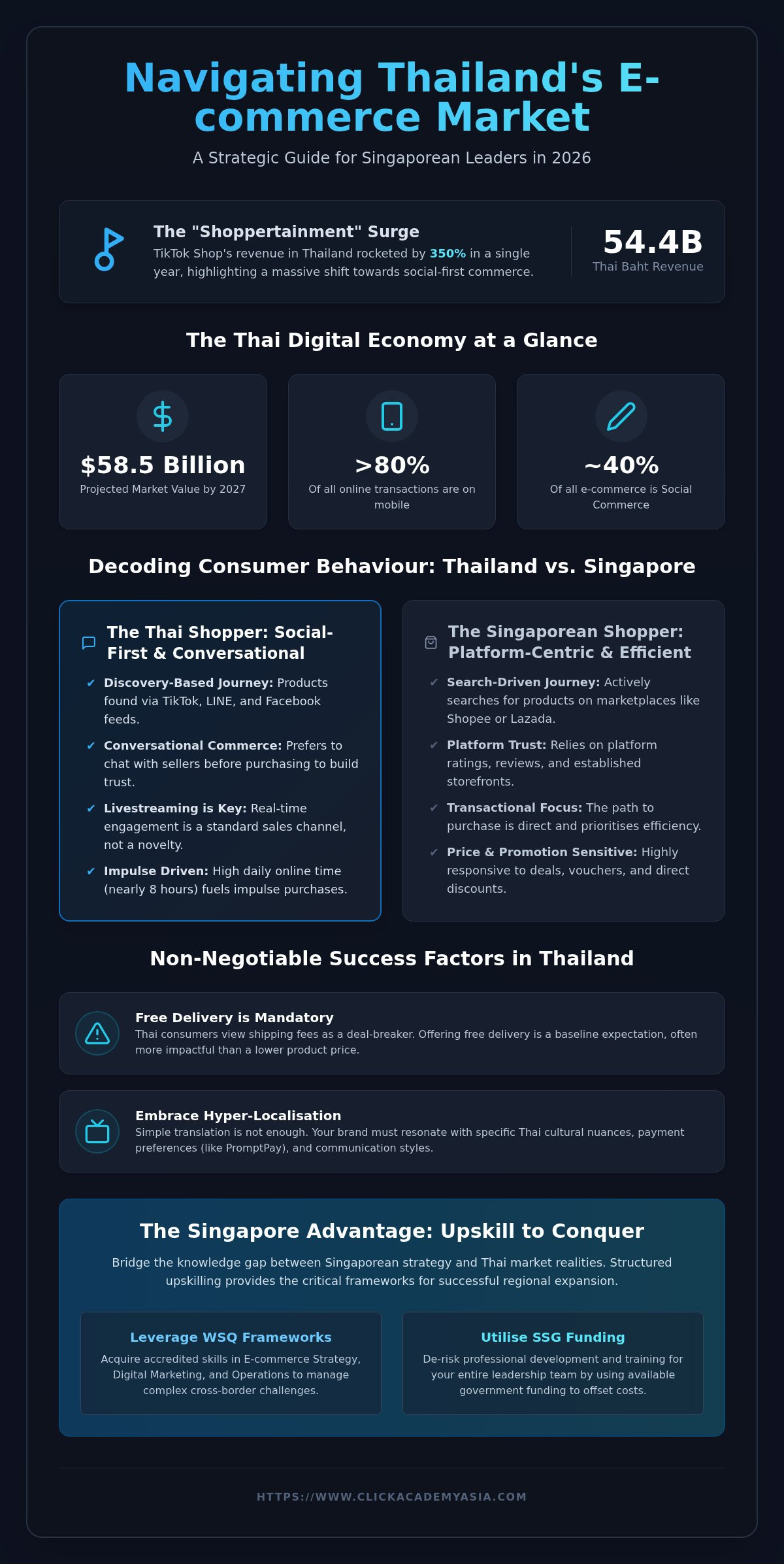
Did you know that TikTok Shop's revenue in Thailand surged by 350% in a single year to hit 54.4 billion baht? For many Singapore professionals, the prospect of expanding into this vibrant market feels like a high-stakes gamble. You've likely felt the pressure to scale across the APAC region while worrying that your current digital strategies might fall flat against Thailand's unique "shoppertainment" culture and complex payment standards.
Successfully navigating e-commerce in thailand requires more than just a localised website; it demands a deep dive into a mobile-first ecosystem where social interaction drives nearly every transaction. This guide provides a definitive roadmap for Singaporean leaders looking to conquer the Thai market in 2026. We'll explore shifting consumer behaviour, the shift toward PromptPay as the primary payment method, and how structured upskilling through WSQ-certified programmes can de-risk your regional expansion strategy.
Table of Contents
Understanding the Thai E-commerce Landscape in 2026
Thailand's digital economy has matured into a sophisticated, "Social-First" ecosystem that commands billions in annual revenue. It's no longer just an emerging market; it's a critical pillar for Singaporean PMEBs managing diverse regional portfolios. This rapid evolution is anchored by the Thailand 4.0 initiative, which has successfully modernised the nation's digital infrastructure and connectivity. Today, over 70% of Thai consumers prefer online shopping over traditional brick-and-mortar retail, marking a permanent shift in the retail environment. This preference is particularly strong in urban centres like Bangkok, where high-speed internet penetration is nearly universal.
For professionals in Singapore, navigating e-commerce in thailand requires a deep understanding of how these structural changes affect consumer intent. The Thailand's economic landscape has proven resilient, with digital adoption rates that frequently outpace its regional neighbours. This makes the kingdom an essential destination for firms looking to scale their APAC operations effectively.
To better understand the regulatory environment and how it shapes the market, watch this helpful video:
Market Maturity and Growth Drivers
The market is currently on a trajectory to reach a projected value of $58.5 billion by 2027. In 2026, we are witnessing the full impact of a tech-savvy, youthful population that views mobile devices as their primary interface with the world. Mobile commerce now accounts for more than 80% of all online transactions in the country. Key sectors like fashion, electronics, and personal care remain the top-performing categories, but niche segments in health and wellness are gaining significant ground. These categories thrive because they align with the impulse-buying habits of a population that spends an average of nearly eight hours online daily.
The Singapore-Thailand Digital Corridor
Singaporean professionals can leverage our geographic and economic proximity to build a robust digital corridor. Cross-border e-commerce has grown to account for 30% of total sales, offering a direct path for Singaporean brands to reach Thai households. However, success in this corridor isn't automatic. You'll need to master specific regional strategies, which is why enrolling in a WSQ Digital Marketing Strategy & Planning programme is a vital step for any leader navigating e-commerce in thailand for the first time. These courses provide the framework needed to manage complex regional expansions while utilising SSG funding to offset costs.
Decoding Thai Consumer Behaviour: Social Commerce and Mobile Dominance
If you think a well-optimised marketplace storefront is enough to win, you're missing the heartbeat of the Thai digital economy. While Singaporeans typically follow a platform-centric journey on Shopee or Lazada, Thai consumers lean heavily into a discovery-based, "Social-First" model. Platforms like LINE, TikTok, and Facebook aren't just for scrolling; they are the primary interfaces for product discovery and transaction. Insights into the e-commerce market in Thailand show that social commerce accounts for nearly 40% of all transactions, a stark contrast to the search-driven habits common in Singapore.
By 2026, livestreaming has transitioned from a marketing gimmick to a standard sales channel. Thai shoppers expect high-energy, real-time engagement where they can ask questions and receive instant gratification. There's also a powerful psychological trigger you cannot ignore: free delivery. In this market, shipping fees are often viewed as a deal-breaker. Offering "Free Shipping" isn't a perk; it's a non-negotiable consumer expectation that often outweighs a lower base price. Successful navigating e-commerce in thailand requires a shift from passive listing to active, social engagement.
The Rise of Conversational Commerce
Thai shoppers value the human element. They prefer chatting with sellers via LINE or Facebook Messenger before completing a purchase. This "Conversational Commerce" builds the trust necessary to move a prospect through the sales funnel. If your team cannot provide immediate, culturally nuanced responses, your conversion rates will suffer. Trust is the currency of the Thai digital market, and it's minted through dialogue. You must integrate responsive, chat-based customer service into your core operations to capture this demand.
Mobile-First UX and Engagement
Desktop experiences are an afterthought in Thailand. Since a vast majority of online sales occur on smartphones, your entire digital presence must be designed for the small screen first. Short-form video content on TikTok Shop has become the dominant driver for impulse purchases, triggering immediate action through "shoppertainment." To stay competitive while navigating e-commerce in thailand, your brand's visual language must align with these local preferences. Developing a robust WSQ Content Marketing Strategy can help your team create the high-impact, mobile-optimised content that Thai consumers crave.
Navigating Payments and Logistics: From PromptPay to Last-Mile Delivery
Execution is often where regional expansions stumble. Success in navigating e-commerce in thailand hinges on your ability to bridge the gap between a digital order and a physical delivery seamlessly. Thailand's payment infrastructure has undergone a massive transformation, with PromptPay emerging as the undisputed gold standard for cashless transactions. With an impressive 97% of the population now banked, digital payment adoption has reached a critical tipping point, moving the market away from traditional cash-heavy models that once hindered scale.
For Singaporean PMEBs, understanding this shift is vital for operational efficiency. Thai consumers expect a frictionless checkout experience that mirrors their daily habits. According to recent Thailand e-commerce market trends, these payment efficiencies are driving higher average order values as trust in digital systems grows. By 2026, real-time tracking and delivery transparency have become the baseline, not a premium feature.
The Local Payment Landscape
Implementing QR-based payments is a strategic necessity to mirror local shopping habits. We are witnessing a steady decline in Cash on Delivery (COD) as secure digital wallets and instant bank transfers gain traction. While COD still exists, the shift toward pre-payment reduces the risk of returns and improves cash flow. However, Singaporean professionals must remain vigilant about managing currency fluctuations and cross-border transaction fees effectively to protect their margins when repatriating profits.
Operational Logistics and Supply Chain
Thailand's diverse geography, ranging from the dense urban corridors of Bangkok to rural highland provinces, makes the "Last Mile" a significant hurdle. Selecting regional logistics partners that possess deep local infrastructure knowledge is essential for maintaining consistent service levels. Local warehousing has become a non-negotiable requirement to meet the "Next Day" delivery expectations that now dominate the Bangkok Metropolitan Region.
The PromptPay-Logistics Sync is the strategic integration of instant payment verification with automated warehouse dispatch triggers that serves as the key to reducing cart abandonment in 2026.
To master these operational complexities, leaders should consider the E-commerce Strategy & Operations programme. This WSQ-certified course, eligible for SSG funding, provides the practical framework needed to build a resilient supply chain and payment stack. By upskilling your team, you ensure that your expansion into the Thai market is grounded in operational excellence rather than guesswork.
Strategic Challenges and Operational Excellence in Thailand
A common objection among Singaporean leaders is that the Thai market is too culturally distinct to manage remotely. While the nuances of "shoppertainment" and conversational commerce are real, they don't necessitate a permanent physical presence for every decision-maker. Instead, navigating e-commerce in thailand effectively requires a shift toward hyper-localisation. This goes far beyond literal translation; it involves adapting your brand's voice, visual assets, and customer journey to align with Thai sensibilities and social norms.
Regulatory compliance is another critical pillar of operational excellence. You must ensure your digital infrastructure respects Thailand's Personal Data Protection Act (PDPA), which shares similarities with Singapore's PDPC but has its own specific enforcement triggers. Mastering Advanced Keyword Research Strategies is essential here, as it allows you to identify the specific linguistic patterns and search intents that drive Thai consumers to act, ensuring your marketing spend isn't wasted on misaligned messaging.
Building a Localised Digital Presence
Trust is the foundation of the Thai digital experience. Securing a .co.th domain and utilising local hosting are small but vital steps that signal your commitment to the market and improve local SEO performance. Thai search behaviour often differs from Singaporean patterns; it is frequently more descriptive and social-led. To build brand authority quickly, consider these tactical moves:
Partner with local Key Opinion Leaders (KOLs): These influencers act as cultural bridges, providing the social proof that Thai consumers require before committing to a new brand.
Optimise for local hosting: Reduced latency is critical for a mobile-first population that expects instant page loads during livestreaming events.
Adapt visual assets: Ensure your creative content reflects Thai lifestyle aesthetics rather than just recycling Singaporean campaigns.
Risk Mitigation and Regulatory Compliance
Managing cross-border logistics involves more than just shipping; you must navigate VAT and import duties to protect your margins. Currently, the VAT rate in Thailand is 7%, a rate confirmed to stay in effect until 30 September 2026. Foreign businesses must also be aware of the THB 1.8 million annual revenue threshold for VAT registration when providing electronic services to Thai customers. By aligning your data privacy standards with both Singaporean and Thai regulations, you create a resilient operational framework for navigating e-commerce in thailand that survives regional market shifts.
Ready to lead your team through these complexities? Equip your leadership with the tools for success by enrolling in our WSQ E-commerce Strategy & Operations programme today.
Upskilling for Regional Success: The Singapore Advantage
Success in a market as dynamic as Thailand isn't just about deploying the right software; it's about the people behind the screens. While we've mapped out the intricacies of "shoppertainment" and PromptPay integration, the real competitive edge for Singaporean firms lies in their ability to adapt and learn. Continuous upskilling serves as the primary solution to navigating e-commerce in thailand, ensuring that your regional strategy remains as agile as the consumers you're trying to reach. This proactive approach transforms market uncertainty into a structured roadmap for growth.
Singaporean PMEBs have a unique advantage through the WSQ framework, which provides a structured pathway to gain accredited regional skills. By leveraging SSG funding, corporate teams can significantly de-risk their learning journey, allowing them to focus on the tangible application of knowledge rather than just theoretical concepts. ClickAcademy Asia acts as your strategic mentor in this process, bridging the gap between Singaporean business standards and Thai market realities. We don't just teach the status quo; we help you shape the future of your professional expertise.
Leveraging WSQ-Funded Training Tracks
The WSQ Digital Marketing Framework is specifically designed to help leaders apply high-level strategies to regional management challenges. Unlike traditional academic degrees that often lag behind industry shifts, these practical, "how-to" workshops focus on real-world execution. In 2026, maximising your SkillsFuture credits for professional upskilling is a smart fiscal move that prepares your leadership for APAC-wide expansion. You'll learn to optimise campaigns for local search intent, manage cross-border operations, and navigate complex regulatory environments with confidence. This commitment to practical mastery is the hallmark of a successful regional leader.
Equipping Your Team for 2026
HR decision-makers should prioritise regional e-commerce certifications to ensure their workforce remains future-proof and competitive. Having a team that understands APAC-wide digital strategy is a "Quick Win" that accelerates market entry and reduces costly operational errors. When your staff can speak the language of social commerce and data privacy, your brand authority grows faster across the region. Empower your career or your team by enrolling in a ClickAcademy Asia programme today. It's the most effective way to begin mastering the art of navigating e-commerce in thailand while securing a long-term competitive advantage.
Actionable Next Steps:
Hyper-localise: Move beyond translation to cultural adaptation in all creative assets.
Integrate PromptPay: Ensure your payment stack mirrors Thai cashless habits to reduce friction.
Adopt Social Commerce: Prioritise TikTok Shop and LINE as primary sales channels.
Upskill with WSQ: Use SSG funding to equip your team with accredited regional expertise.
Future-Proof Your Regional Strategy for 2026
Successfully navigating e-commerce in thailand requires a strategic shift from simple market entry to deep cultural and operational integration. You've seen how social commerce and mobile-first UX define the Thai consumer journey; meanwhile, PromptPay has become the non-negotiable standard for transaction security. By combining these local insights with a robust operational framework, your brand can thrive in this multi-billion dollar ecosystem. The transition from a Singapore-centric model to a regional one is a significant milestone that demands practical, hands-on expertise.
ClickAcademy Asia is here to support your growth through our WSQ-certified modules taught by industry practitioners with deep regional APAC experience. Eligible Singaporeans can benefit from up to 70-90% SSG funding, significantly reducing the cost of high-level professional development. It is time to equip your team with regional expertise through our WSQ-funded E-commerce Strategy courses at ClickAcademy Asia. The opportunity for Singaporean professionals in Thailand is immense; we look forward to helping you lead your next successful expansion with confidence and skill.
Frequently Asked Questions
Is navigating e-commerce in Thailand feasible for Singaporean SMEs in 2026?
Navigating e-commerce in thailand is highly feasible for Singaporean SMEs in 2026 due to the robust digital corridor and streamlined cross-border logistics. SMEs can leverage global marketplaces and social platforms to reach Thai consumers without a heavy physical footprint. Success relies on understanding local nuances like conversational commerce and mobile-first trends. Upskilling through WSQ-certified programmes ensures your team has the strategic tools to manage these regional operations efficiently and avoid common entry pitfalls.
What are the most popular e-commerce platforms in Thailand for 2026?
Shopee remains the dominant marketplace with 66% usage; however, TikTok Shop has rapidly ascended to the number two spot by revenue in 2025. Lazada continues to be a major player; while LINE serves as the primary hub for conversational commerce. Unlike Singapore's platform-centric model; the Thai market is fragmented across social and traditional marketplaces. A multi-channel strategy is essential for capturing diverse consumer segments across these high-traffic digital ecosystems and social discovery feeds.
How does PromptPay work for international merchants?
PromptPay functions as a real-time; QR-based payment system that is deeply integrated into Thai consumer habits. International merchants typically access this network through regional payment aggregators that facilitate cross-border settlement and currency conversion. This system has processed an average of 74 million daily transactions as of early 2026. Integrating this into your checkout process is vital for reducing cart abandonment; as it mirrors the cashless preferences of the 97% banked Thai population.
Do I need a local Thai business entity to sell online in Thailand?
You don't strictly need a local Thai entity to sell cross-border; but establishing one offers significant advantages for long-term growth. A local entity allows you to register a .co.th domain; which boosts SEO rankings and instils greater trust among Thai consumers. It also simplifies the process of managing local VAT registration and hiring local customer service teams for conversational commerce. For many Singaporean PMEBs; a hybrid model using local distributors is a common starting point.
What are the main differences between Singaporean and Thai online shoppers?
Singaporean shoppers are generally search-driven and platform-loyal; whereas Thai consumers prioritise social discovery and "shoppertainment." Thai shoppers expect a high level of interaction; often chatting with sellers via LINE or Facebook before completing a transaction. While Singaporeans value efficiency and price; Thai consumers are heavily influenced by livestreaming and influencer endorsements. Understanding these psychological triggers is a core component of successfully navigating e-commerce in thailand for any regional manager looking to scale operations.
Can I use SSG funding for courses that teach regional e-commerce strategy?
Yes; Singaporean PMEBs can utilise SSG funding for WSQ-certified courses that focus on regional e-commerce and digital marketing strategies. Eligible individuals can receive up to 70-90% funding; making it a cost-effective way to acquire the skills needed for APAC expansion. ClickAcademy Asia offers several programmes; including E-commerce Strategy & Operations; that are specifically designed to help professionals master the complexities of markets like Thailand while leveraging local government support and accredited frameworks.
What is the role of TikTok Shop in the Thai e-commerce market?
TikTok Shop has revolutionised the Thai market by pioneering "impulse-based" commerce through short-form video and live shopping. It grew its registered revenue by 350% year-on-year in 2025; reaching 54.4 billion baht. The platform's AI-driven entertainment triggers immediate purchases; making it a dominant force for fashion and beauty categories. For Singaporean brands; TikTok Shop provides a direct channel to engage with Thailand's massive social media user base of 56.6 million people through interactive content.
How does the Thai PDPA affect my digital marketing strategy?
Thailand's Personal Data Protection Act (PDPA) requires businesses to obtain explicit consent before collecting or using consumer data for marketing. This affects your digital strategy by mandating transparent data handling and secure storage practices for Thai customers. Aligning your operations with both Singapore's PDPC and the Thai PDPA ensures regulatory compliance and builds consumer trust. Failure to comply can result in significant fines; making data privacy a critical pillar of your regional operational and marketing framework.


Comments