
Training for Sales Teams to Leverage Marketing Content: A 2026 Singapore Guide
- ClickAcademy Asia

- 2 hours ago
- 11 min read
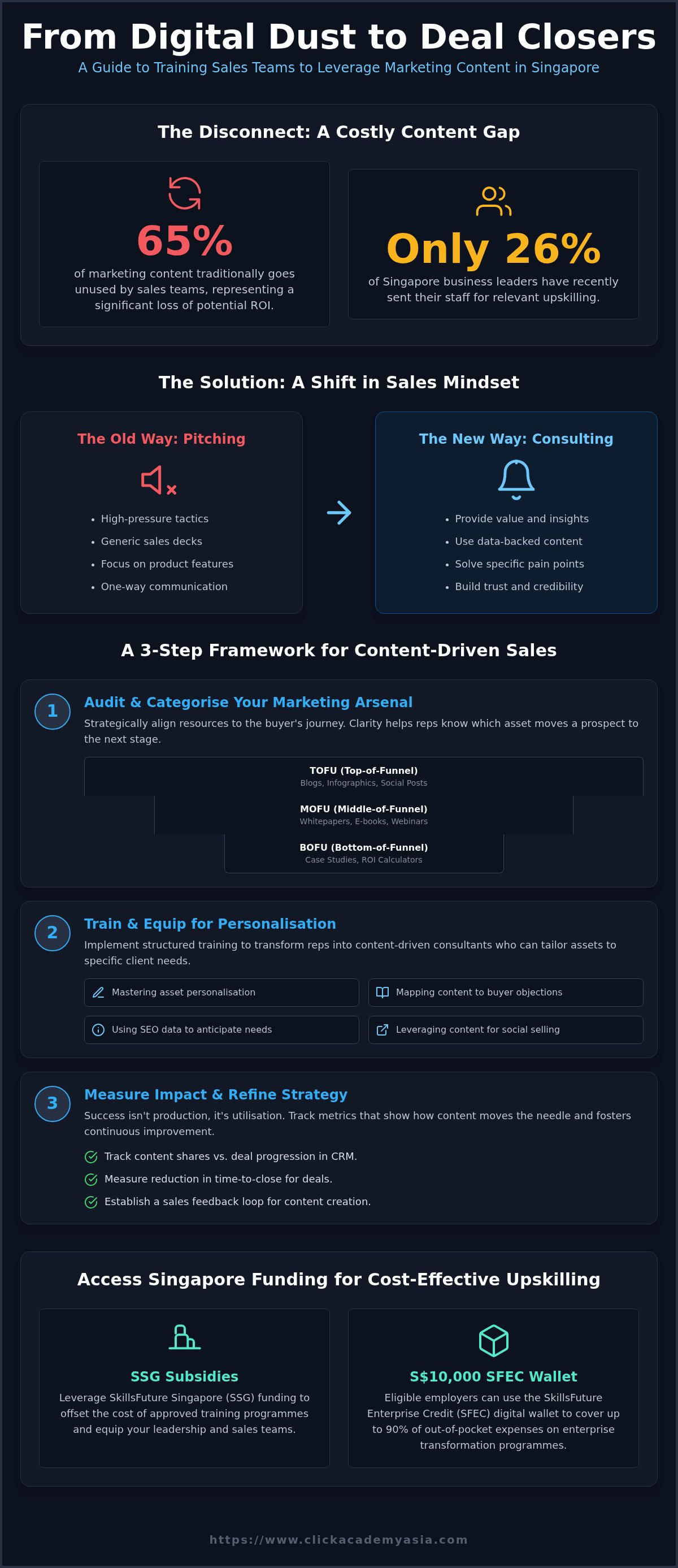
Most companies treat marketing content strictly as a lead generation tool, yet they're missing its most powerful function: acting as tactical ammunition for the closing stages of a deal. It's a common frustration in Singapore's competitive market where only 26% of business leaders have sent their staff for relevant training recently. You've likely invested thousands of S$ into high-quality whitepapers and case studies, only to watch them gather digital dust while your reps struggle to find relevant assets. Implementing specialized training for sales teams to leverage marketing content is the bridge that turns these wasted resources into revenue-driving tools.
We'll help you transform your sales force into trusted, content-driven consultants who know exactly when to deploy the right asset. This 2026 guide outlines the path to unified brand messaging and shorter deal cycles through structured upskilling. We'll also explore how to access the latest SWDA funding and the S$10,000 SFEC digital wallet to offset your corporate overhead. By the end of this article, you'll have a clear roadmap to future-proof your team's skills while maximizing the ROI of every piece of content your marketing team produces.
Table of Contents
Defining Training for Sales Teams to Leverage Marketing Content
Content-led sales enablement acts as the vital bridge between marketing production and sales execution. It's no longer enough to just create high-quality assets. Companies must implement structured training for sales teams to leverage marketing content to ensure these resources actually reach the buyer at the right moment. Without this alignment, even the most sophisticated marketing materials remain invisible to the very people they were designed to influence.
Industry studies reveal a staggering "Content Gap" where approximately 65% of marketing content traditionally goes unused by sales teams. This disconnect often stems from a lack of awareness or a failure to understand how specific assets fit into the buyer's journey. In Singapore's fast-paced corporate environment, this inefficiency represents a significant loss of potential ROI on content production and a missed opportunity to engage prospects effectively.
To stay competitive, Singaporean PMEBs are shifting from high-pressure "pitching" to a "consulting" mindset. Modern buyers in 2026 demand expert insights and data-backed solutions before they even commit to an initial discovery call. Understanding What is Content Marketing? is the first step in this evolution; it's about providing value rather than just selling a product. When sales reps act as consultants, they use content to educate, build trust, and solve problems rather than just pushing for a signature.
The Role of Content in the Modern Singapore Sales Cycle
In the APAC region, case studies and whitepapers have become "silent sellers" that build credibility when the rep isn't in the room. The traditional cold call is being replaced by content-led social selling, where reps share relevant insights on platforms like LinkedIn to attract prospects. Sales content leverage is the tactical deployment of marketing assets to resolve specific buyer objections and build trust during the decision-making process. It allows reps to maintain a professional presence throughout the entire cycle.
Key Metrics: Measuring the Impact of Content-Driven Sales
Success isn't just about how much content is produced, but how it's utilized. Forward-thinking firms track content shares against deal progression within their CRM to see which assets actually move the needle. By pre-empting frequently asked questions with marketing assets, teams can significantly reduce the time-to-close. Establishing a sales feedback loop ensures that marketing creates what the field actually needs, maximizing the ROI of every S$ spent on production while fostering a culture of continuous improvement.
Auditing Your Marketing Arsenal for Sales Readiness
Before your reps can deploy assets effectively, you must understand the strength of your current library. Effective training for sales teams to leverage marketing content begins with knowing exactly what tools are in your shed. This isn't a mere inventory check; it's a strategic alignment of resources to the buyer journey. You should categorize every existing asset into Top-of-Funnel (TOFU), Middle-of-Funnel (MOFU), and Bottom-of-Funnel (BOFU) stages. This clarity helps reps identify which piece of content will move a specific prospect to the next stage.
Identify your 'Sales-Ready' assets immediately. These are high-impact tools like localized case studies, ROI calculators tailored to Singaporean business costs, and competitive battlecards. For a national sales force, a centralized content hub is non-negotiable. If a rep can't find a whitepaper in thirty seconds, they won't use it. Additionally, evaluate the 'shelf-life' of your content. In 2026, using data from even three years ago can signal a lack of industry awareness. Investing in this level of strategic alignment often requires professional upskilling, which can be supported through SkillsFuture Singapore (SSG) funding to ensure your leadership and sales teams are equipped for the task.
Mapping Content to Buyer Objections
Construct a matrix that links specific marketing blogs to common sales hurdles. By leveraging advanced keyword research strategies, your sales team can gain deep insights into what buyers are searching for. This SEO data allows reps to anticipate customer pain points before the first call even happens. It transforms the sales process from a reactive pitch into a proactive consultation. If you're looking to bridge this gap, our WSQ Content Marketing Strategy course provides the practical framework you need.
The Feedback Loop: Sales Informing Marketing Production
The best content marketing programmes in Singapore aren't built in a vacuum; they're fueled by real-world prospect questions. Train your sales reps to report 'content gaps' whenever they encounter an objection not addressed by your current library. Monthly 'Smarketing' syncs are essential for aligning asset production with actual sales needs. This ensures your marketing team isn't just producing content for the sake of it, but creating the specific ammunition your sales force needs to win.
Choosing the Best Training Framework: WSQ vs. Traditional Workshops
While digital platforms offer convenience, passive e-learning often lacks the depth required for complex behavioral changes in a sales environment. Successful training for sales teams to leverage marketing content requires active engagement rather than just clicking through slides. Practitioner-led workshops provide a dynamic environment where sales reps can practice deploying assets in real-time scenarios. This hands-on approach ensures that the knowledge isn't just understood; it's internalized for immediate application in high-stakes negotiations.
For Singaporean enterprises, the WSQ (Workforce Skills Qualifications) framework offers a distinct advantage. It provides a standardized benchmark for skills, ensuring that every team member operates at a recognized level of professional excellence. When evaluating your options, our guide on selecting high-level training provides a clear blueprint for identifying programs that offer genuine strategic value rather than just theoretical concepts.
PMEBs benefit significantly from peer-to-peer learning in a classroom setting. Sharing experiences with other professionals helps sales reps see how content-led strategies work across different industries. This collaborative environment fosters a deeper understanding of sales and marketing alignment, helping teams move beyond siloed operations and toward a unified front that drives revenue growth.
The WSQ Digital Marketing Strategy Advantage
Corporate leaders in Singapore prioritize WSQ-accredited modules because they offer a measurable ROI and rigorous assessment. These certifications are not just badges; they represent a commitment to national standards of excellence. For individual professionals, earning a recognized certification is a powerful tool for career progression within the local market. A structured framework ensures that your team's upskilling aligns with the broader goals of Singapore's digital economy, making it an essential component of any training for sales teams to leverage marketing content.
Practitioner-Led vs. Theory-Based Training
Theory is useful, but execution is what drives revenue. Learning from practitioners who actively manage marketing for global brands ensures the curriculum remains grounded in reality. These experts help teams move beyond "AI fluff" to focus on real-world sales applications that actually close deals; to discover how specialized AI tools can enhance your marketing assets, read more. ClickAcademy Asia bridges the gap between marketing theory and sales reality, providing the tactical knowledge your team needs to thrive in the 2026 business landscape.
How to Train Sales Teams to Personalise Marketing Assets
Effective personalisation is the difference between a trusted advisor and a nuisance. When implementing training for sales teams to leverage marketing content, you must move beyond the "send and pray" method. Your reps require a repeatable workflow to ensure every asset they share feels like a bespoke solution rather than a mass-produced brochure. This precision requires a shift in mindset from broad distribution to surgical application.
Step 1: Identify the prospect’s specific industry pain point. In Singapore's 2026 business climate, generic outreach is ignored. Reps must research the prospect's recent company news or industry shifts before reaching out.
Step 2: Select the marketing asset that provides a data-backed solution. If a prospect is struggling with lead quality, send the specific case study on conversion optimization, not a general company overview.
Step 3: Craft a "Contextual Wrapper." This is the personalised email or LinkedIn message that introduces the content. It explains exactly why this asset is relevant to their current situation.
Step 4: Follow up with a specific question. Instead of asking "Did you see this?", ask "How does the ROI framework on page four align with your current budget planning for next quarter?"
Social Selling Techniques for Singaporean PMEBs
LinkedIn has evolved into a primary search engine for B2B buyers in Singapore. Training your PMEBs to optimise their profiles to act as content hubs is essential. Instead of a resume, their profile should showcase authority by sharing insights from WSQ digital marketing courses and industry reports that reflect their expertise. The "Give before you Ask" philosophy is the cornerstone of digital-first selling. By consistently providing value through shared assets, reps build the social capital needed to secure high-value meetings.
Customising Content for High-Value Outreach
High-performing reps don't just share a 20-page whitepaper; they pull specific, punchy stats to create hooks. Training should focus on identifying "nuggets" of information that can be extracted into a quick LinkedIn post or a short video snippet. Using video snippets from marketing webinars is an excellent way to re-engage cold leads with a personal touch. While individual personality is encouraged, maintaining brand consistency ensures the message remains professional. If you want to master these workflows, explore our Sales Leadership training to empower your team with practical, practitioner-led strategies.
Securing SSG Funding for Your Sales Enablement Programme
Investing in training for sales teams to leverage marketing content is a strategic move that carries a surprisingly low net cost for Singaporean businesses. As of 2026, the funding landscape remains highly supportive under the oversight of the Skills and Workforce Development Agency (SWDA). Small and Medium-sized Enterprises (SMEs) can access up to 90% in course fee subsidies through the Enhanced Training Support for SMEs. Large organizations aren't left behind; they remain eligible for up to 70% funding for their workforce upskilling initiatives.
A significant update for the second half of 2026 is the transition of the SkillsFuture Enterprise Credit (SFEC) to a digital wallet model. Eligible companies now receive a S$10,000 credit that provides an immediate offset of training expenses, drastically improving cash flow compared to older reimbursement models. To qualify, your firm needs at least three Singaporean or Permanent Resident employees earning a minimum of S$750 monthly. This credit can be used alongside existing subsidies to further reduce the corporate overhead of your sales enablement programs.
Corporate HR departments can also tap into Absentee Payroll (AP) funding to compensate for the time staff spend in training. For 2026, the AP rate is S$4.50 per hour, capped at S$100,000 per organization annually. This ensures that while your team is mastering how to turn content into revenue through specialized training for sales teams to leverage marketing content, the impact on daily operations is financially mitigated. Individual PMEBs can also utilize their personal SkillsFuture Credit for specialized modules, allowing for a flexible, blended approach to professional development.
Navigating the WSQ Certification Pathway
Enrolling your team in ClickAcademy Asia’s accredited modules is a straightforward process designed for busy professionals. Our WSQ-certified courses focus on practical mastery rather than just theory. The assessment process ensures that every participant can actually apply what they've learned in a real-world sales environment. We recommend integrating our guide on marketing analytics with GA4 into your curriculum. This helps sales reps understand lead quality and data-driven insights, making them more effective consultants.
Maximising ROI with Future-Ready Skills
Positioning continuous learning as a core value acts as a powerful retention tool for your top sales talent. In a market where 37% of workers cite growth opportunities as a primary motivator, providing high-level certifications builds loyalty. The long-term value of a unified sales and marketing strategy far outweighs the initial time investment. It creates a cohesive brand voice that resonates with modern buyers. Equipping your team with the skills to turn content into revenue through ClickAcademy Asia is the final step in future-proofing your business. Reach out to our consultancy team to begin your transformation into a content-driven sales powerhouse.
Empowering Your Sales Force for the 2026 Economy
Transforming your sales force into a consultative powerhouse is no longer a luxury; it's a strategic necessity in Singapore's evolving market. By bridging the gap between content production and tactical execution, your reps can move beyond generic pitches to provide high-value, data-backed solutions. Implementing structured training for sales teams to leverage marketing content ensures that your existing marketing arsenal actually drives revenue rather than gathering digital dust.
With significant SSG funding and the S$10,000 SFEC digital wallet available in 2026, the barrier to workforce transformation has never been lower. As an Official Google Certification Partner, we provide the practical, practitioner-led workshops your team needs to master these future-ready skills. It's time to align your brand messaging and shorten your sales cycles through measurable upskilling. Equip your team with WSQ-funded sales and marketing training at ClickAcademy Asia to stay ahead of the competition. Take the lead in your industry by turning your marketing assets into tactical ammunition for your sales force today.
Frequently Asked Questions
What is the best type of training for sales teams to leverage marketing content?
The most effective training for sales teams to leverage marketing content is practitioner-led, hands-on workshops rather than passive e-learning. These sessions allow reps to practice the "contextual wrapper" technique and role-play objections using real-world marketing assets. By focusing on practical mastery, your team learns to deploy case studies and whitepapers as tactical ammunition, ensuring they act as consultants rather than mere order-takers in the 2026 landscape.
How much SSG funding can Singaporean companies receive for sales training in 2026?
In 2026, Singaporean Small and Medium-sized Enterprises (SMEs) can receive up to 90% in course fee subsidies under the Enhanced Training Support for SMEs (ETSS). Large organizations are eligible for up to 70% funding. Additionally, eligible companies can utilize the S$10,000 SkillsFuture Enterprise Credit (SFEC) digital wallet to offset out-of-pocket expenses immediately, significantly reducing the financial barrier to high-level sales and marketing upskilling.
Can PMEBs use SkillsFuture Credit for ClickAcademy Asia courses?
Yes, Singaporean PMEBs can utilize their individual SkillsFuture Credit to enroll in WSQ-certified modules at ClickAcademy Asia. This is a popular option for professionals looking to future-proof their careers independently or for companies that want to supplement corporate-funded training. Since these courses are accredited under the national WSQ framework, they meet rigorous standards of excellence and provide recognized certifications that enhance long-term career progression.
How long does a typical WSQ Digital Marketing Strategy course take?
A typical WSQ Digital Marketing Strategy & Planning course is structured as an intensive two-day practitioner-led workshop. This compact format is designed to respect the busy schedules of sales and marketing professionals while providing enough depth for practical mastery. The curriculum moves quickly from high-level strategic frameworks to granular tactical applications, ensuring that participants leave with a clear roadmap they can implement in their daily sales cadences immediately.
What is the difference between sales enablement and marketing content leverage?
Sales enablement is the overarching strategy of providing reps with the tools, technology, and coaching they need to sell effectively. In contrast, marketing content leverage is a specific tactical subset of enablement. It focuses on the precise deployment of marketing assets to resolve buyer objections and build trust. While enablement sets the stage, content leverage provides the actual "ammunition" used during the consultative selling process to move prospects through the funnel.
Is online e-learning more effective than in-person workshops for sales teams?
While e-learning offers convenience, in-person or virtual instructor-led workshops are generally more effective for sales teams. Sales is a performance-based discipline that requires real-time feedback and role-playing. Practitioner-led sessions allow for peer-to-peer learning and the immediate application of concepts to current deal cycles. This interactive environment is crucial for mastering the nuances of social selling and personalizing content for high-value Singaporean prospects.
How do I measure the success of a sales content training programme?
Success should be measured through a combination of CRM data and qualitative feedback. Track metrics such as the frequency of content shares, deal velocity, and the reduction in time-to-close for deals where marketing assets were utilized. Additionally, monitor "Smarketing" feedback loops where sales reps report on the relevance of existing assets. A successful training for sales teams to leverage marketing content program results in a unified brand voice and higher conversion rates.
Which marketing assets are most effective for sales outreach?
Bottom-of-funnel (BOFU) assets usually yield the highest impact for sales outreach. Localized case studies that feature Singaporean success stories build immediate credibility, while ROI calculators provide the data-backed proof required for final approval. Competitive battlecards are also vital, as they empower reps to handle objections with confidence. The goal is to provide assets that act as "silent sellers" when the rep isn't in the room.



Comments