
Co-Marketing Campaign Best Practices: A 2026 Strategic Checklist for Singapore Professionals
- ClickAcademy Asia
- 16 hours ago
- 11 min read
Would you risk a S$1 million fine or 10% of your annual turnover just to share a lead list with a partner? In Singapore's 2026 regulatory environment, many PMEBs feel the pressure of balancing ambitious growth with strict PDPA compliance and new MAS digital advertising guidelines. It's frustrating to watch promising collaborations dissolve because you haven't mastered the latest co-marketing campaign best practices. You aren't alone if you're finding it harder to cut through the noise, especially with the local digital advertising market now exceeding S$2.45 billion.
This guide provides a definitive 2026 strategic checklist to help you execute high-ROI partnerships within the Singapore business ecosystem. We'll move beyond simple brand fit to look at technical synergy and data-driven execution. You'll discover a structured framework for vetting partners, actionable steps for leveraging the creator economy, and how to apply WSQ-standardised skills to lead these high-stakes initiatives with confidence. By the end, you'll have a clear roadmap to turn shared audiences into sustainable revenue streams.
Table of Contents
Understanding Co-Marketing Dynamics in the Singapore Business Ecosystem
The Partner Vetting Checklist: Essential Co-Marketing Campaign Best Practices
Execution Roadmap: Best Practices for High-Impact Joint Campaigns
Navigating Compliance and Measuring Partnership ROI in Singapore
Future-Proofing Your Strategy with WSQ-Funded Marketing Training
Understanding Co-Marketing Dynamics in the Singapore Business Ecosystem
Co-marketing is a strategic alliance where two or more non-competing brands collaborate to reach a shared audience. In the local context, this means partnering with an organisation that serves the same Singaporean PMEB demographic but doesn't steal your market share. By Understanding Co-Marketing as a promotional partnership rather than a product development one, you can expand your reach without the heavy lifting of solo lead generation. It's distinct from co-branding, which focuses on creating a new, joint product; co-marketing is about joint promotion of existing offerings to a combined database.
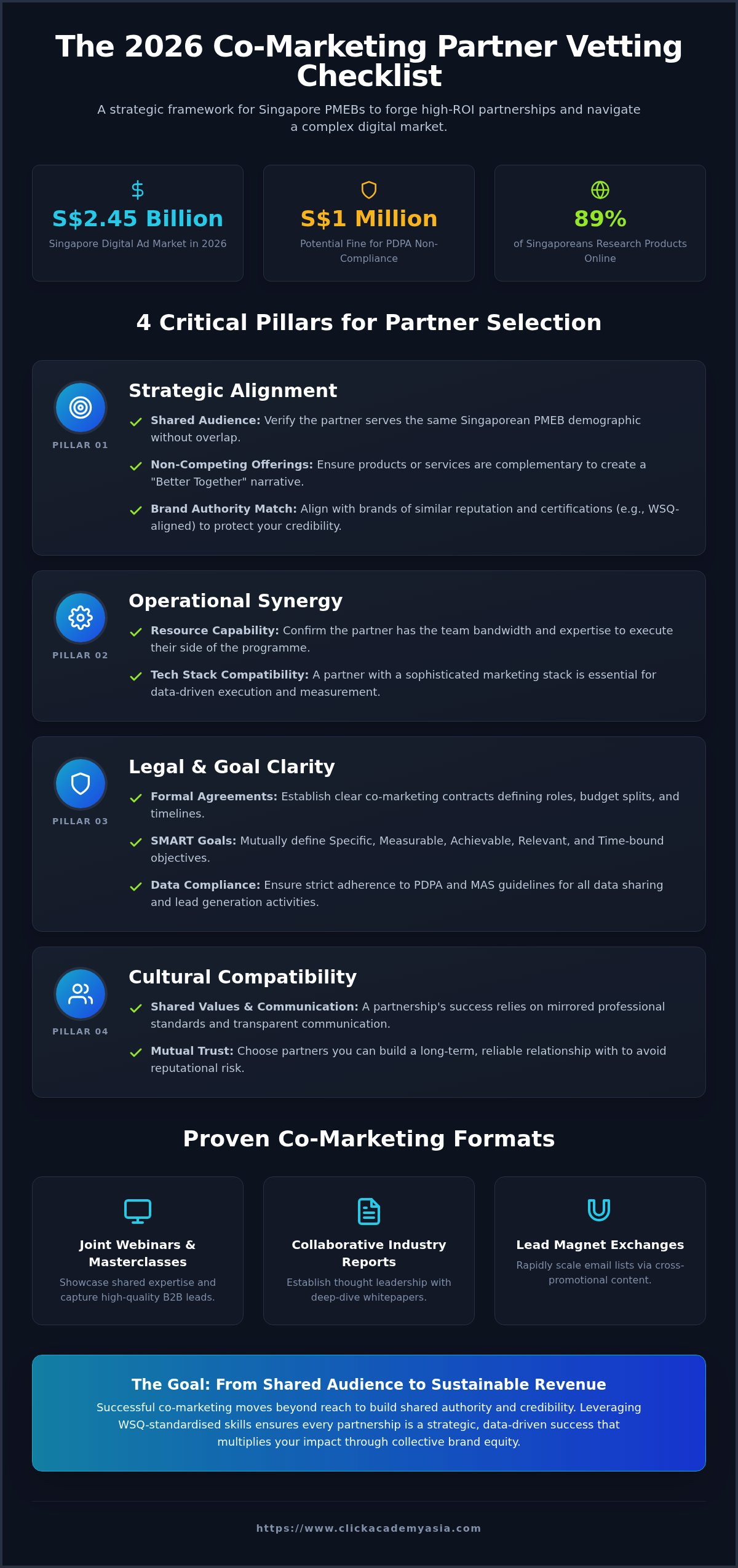
In 2026, the digital advertising market in Singapore has reached S$2.45 billion, accounting for 71% of total ad spend. This saturation has driven customer acquisition costs to record highs, making co-marketing campaign best practices essential for survival. When two respected brands join forces, they create a "Better Together" narrative that resonates deeply with discerning local consumers. Since 89% of Singaporeans research products online before purchasing, a dual endorsement from two trusted entities provides the social proof needed to convert high-intent prospects.
The Strategic Advantage for Singapore Brands
Trust is the primary currency in the local business ecosystem. By aligning with a partner who already possesses a strong reputation, you gain immediate access to high-intent segments through a warm endorsement. This isn't just about visibility; it's about credibility. In a high-cost environment like Singapore, sharing the burden of content production and media spend allows you to execute premium campaigns that would be budget-prohibitive alone. Aligning with established market leaders also helps smaller firms build regional authority, positioning them as vital players in the APAC landscape.
Common Co-Marketing Formats for 2026
The formats you choose must align with the professional habits of your target PMEBs. In 2026, several collaborative models have proven particularly effective for local engagement:
Joint Webinars and Masterclasses: These are ideal for B2B sectors, providing a platform to showcase shared expertise while capturing high-quality leads.
Collaborative Industry Reports: Deep-dive whitepapers focused on the Singapore economy or specific sector trends establish both partners as thought leaders.
Lead Magnet Exchanges: Cross-promotional social media campaigns where partners host each other's gated content can rapidly scale email lists.
Successful execution requires a firm grasp of co-marketing campaign best practices to ensure both parties receive equitable value. When you combine resources, you don't just double your reach; you multiply your impact through shared data and collective brand equity.
The Partner Vetting Checklist: Essential Co-Marketing Campaign Best Practices
Choosing the right partner is the most critical decision you'll make for your brand's growth. In Singapore's tight-knit business community, a mismatched alliance doesn't just waste your budget; it risks your hard-earned reputation. Adhering to co-marketing campaign best practices ensures that your collaboration is grounded in data rather than intuition. You must verify that your partner serves the same PMEB demographic without being a direct competitor. For example, a corporate health insurer and a leadership training provider often share the same HR decision-maker audience. Following established Partner Marketing Best Practices provides a safety net for your shared investments.
Brand authority alignment is equally vital for long-term success. If your organisation prides itself on WSQ-aligned excellence, partnering with a brand that lacks similar certifications can dilute your perceived value. Ensure your partner has the resource capability to deliver. Do they have the team bandwidth to manage their half of the programme? A partner with a sophisticated marketing stack is far more valuable than one relying on manual spreadsheets. Trust is hard-earned, so ensure your partner's cultural values and communication styles mirror your own professional standards.
Objective Criteria for Partner Selection
Move beyond vanity metrics. A brand might have 50,000 followers, but if their engagement rate is below 1%, they won't drive the conversions you need. In 2026, Singaporean consumers are highly research-oriented; they look for authentic endorsements from leaders they respect. Evaluate potential partners based on these objective markers:
Engagement Quality: Look for meaningful comments and shares from local users rather than just "likes."
Historical Success: Ask for "Better Together" case studies or evidence of previous partnership ROI.
Technical Maturity: Confirm they use modern tools like GA4 to track joint campaign attribution accurately.
Assessing these factors helps you maintain co-marketing campaign best practices while protecting your bottom line. If your team needs to refine their vetting skills, consider upskilling through strategic marketing training to build a more robust selection framework.
The "Red Flag" Checklist
Some warning signs are non-negotiable. If a potential partner has a history of poor customer service or negative local reviews on Google or Glassdoor, stay away. This "brand rub" can be toxic for your own image. Be wary of partners who are unwilling to sign formal co-marketing agreements. In a market where PDPA fines can reach S$1 million, a lack of legal documentation is a massive liability. Finally, avoid companies with outdated digital presences. If their website isn't optimised for mobile, which accounts for 72% of Singapore's web traffic in 2026, they'll likely drag down your campaign's performance.
Execution Roadmap: Best Practices for High-Impact Joint Campaigns
Once you've vetted your partner, the real work begins with a structured roadmap. High-impact joint campaigns don't happen by accident; they require a meticulous approach to co-marketing campaign best practices to ensure mutual benefit. You must start by defining SMART goals tailored to the Singapore market. Are you chasing brand awareness amongst local SMEs or driving sales conversions for a new SaaS product? Drafting a formal Co-Marketing Agreement is non-negotiable, as it clearly outlines deliverables, timelines, and budget splits. This document acts as your single source of truth, preventing the friction that often arises from mismatched expectations. Incorporating expert co-marketing campaign best practices at this stage ensures your strategy is grounded in proven industry standards.
Step 1: Setting Clear KPIs and Attribution
Both teams must agree on a shared tracking framework using GA4 and UTM parameters to avoid attribution disputes later. Defining what constitutes a "qualified lead" is essential, as expectations can vary significantly between industries. Joint ROI is achieved when both partners see a measurable uplift in high-intent leads that exceeds the combined cost of the individual resource investment. By establishing these benchmarks early, you ensure both marketing teams are incentivised to push for the same outcomes rather than working in silos.
Step 2: Content Creation and Brand Voice Alignment
Your content strategy must weave a "Better Together" story that feels seamless across all assets. Establish a shared visual identity so that joint webinars or whitepapers don't look like a disjointed patchwork of logos. Use parallel construction in your copy to highlight the complementary strengths of both brands. This level of professional polish is expected by Singaporean executives who value cohesive, high-quality information. Ensure all content, from social snippets to deep-dive reports, maintains a tone that is authoritative yet accessible to your shared PMEB audience.
Step 3: Launch and Real-Time Optimisation
A successful launch requires precise coordination across multiple channels to maximise impact. You should optimise your distribution by:
Coordinating launch dates across email newsletters and LinkedIn to create a "surround sound" effect.
Monitoring performance in real-time to adjust SEM bids or social messaging if initial engagement is low.
Activating internal champions within both organisations to amplify reach through organic sharing.
This multi-channel approach ensures you're leveraging co-marketing campaign best practices to cut through the noise of the S$2.45 billion local digital ad market. Real-time adjustments allow you to pivot quickly, ensuring that every dollar of your shared budget is working toward your joint objectives.
Navigating Compliance and Measuring Partnership ROI in Singapore
Data privacy isn't just a legal hurdle; it's a cornerstone of consumer trust in the local market. In 2026, 84% of Singaporean consumers prioritise brands with transparent data usage policies. Failing to implement co-marketing campaign best practices regarding data handling can lead to catastrophic consequences, including fines of up to S$1 million or 10% of annual turnover for PDPA breaches. You must ensure all joint lead generation activities involve explicit, informed consent from the very first touchpoint. Trust is earned through transparency.
Once leads are captured, your data sharing protocols must be ironclad. Use secure, encrypted methods to transfer lead information between partners rather than relying on unencrypted spreadsheets or email attachments. This technical diligence protects your prospects and your brand reputation. After the campaign concludes, a rigorous post-mortem analysis is essential. Reviewing what worked allows you to refine your co-marketing campaign best practices, transforming a one-off collaboration into a repeatable, high-performance growth engine for your organisation.
PDPA Best Practices for Co-Marketing
Implementing clear, un-ticked boxes for third-party data sharing is now a non-negotiable standard. You shouldn't bury these permissions in fine print; they need to be prominent to meet both PDPA requirements and the latest MAS digital advertising guidelines. Creating a joint privacy policy addendum specifically for the campaign duration provides a legal safety net for both parties. It's also wise to ensure both partners have appointed Data Protection Officers (DPOs) who can verify that all joint activities remain compliant with evolving local regulations.
Calculating the Total Value of Partnership (TVP)
Measuring success requires moving beyond surface-level vanity metrics like social media impressions or webinar attendance. You need to track actual revenue contribution through a full-funnel measurement framework. Factor in "Soft ROI" such as brand equity gains and high-quality backlink profiles that boost your long-term search authority. Compare the Cost Per Lead (CPL) of your joint efforts against your solo digital advertising spend to justify the collaboration. Ultimately, identifying the long-term customer lifetime value (LTV) from partnership-sourced leads tells the true story of your success.
To master these complex regulatory and analytical requirements, you can upskill your team with WSQ Marketing Analytics & Insights training to ensure every partnership is backed by data-driven confidence. Using GA4 to its full potential allows you to see exactly which partner touchpoints are driving the most value.
Future-Proofing Your Strategy with WSQ-Funded Marketing Training
Success in collaborative ventures isn't a matter of luck; it's a result of rigorous strategic planning. As we've explored, the technical demands of 2026 require more than just a surface-level "brand fit." To truly master co-marketing campaign best practices, your team needs a structured approach to campaign architecture and cross-channel risk management. The WSQ Digital Marketing Strategy & Planning course serves as the industry gold standard, equipping PMEBs with the strategic frameworks necessary to lead complex, multi-brand initiatives without wasting precious resources.
Continuous upskilling is your primary defence against market saturation and rising acquisition costs. Singaporean businesses are in a unique position to leverage SSG funding, which significantly offsets the cost of high-level professional development. By investing in certified training, you ensure your marketing department isn't just following trends but is actively shaping the future of the local ecosystem. This proactive stance is what separates regional market leaders from those struggling to maintain partnership ROI in an increasingly crowded digital space.
Bridging the Skills Gap for Partnership Managers
The WSQ framework provides a standardised language that simplifies multi-brand collaboration across different sectors. It eliminates the ambiguity often found in joint ventures by providing clear, measurable competencies for every stage of the marketing funnel. Beyond technical execution, mastering the "Psychology of Selling" allows your partnership managers to influence both potential collaborators and joint audiences with greater precision. To prove the tangible value of these efforts, your team should utilise WSQ Marketing Analytics & Insights training to provide the granular ROI data that corporate leaders demand in 2026.
Leveraging SSG Funding for Corporate Growth
HR leaders play a pivotal role in this organisational transformation by using government grants to upskill entire departments simultaneously. A WSQ-certified team carries immense weight when pitching to high-tier global partners; it signals a commitment to international standards of excellence. This prestige often becomes the deciding factor when a global brand chooses a local partner in the APAC region. Your next step involves enrolling your team in a dedicated bootcamp to master co-marketing campaign best practices and secure your competitive edge. Investing in your people is the most sustainable way to future-proof your marketing results.
Lead the Future of Collaborative Marketing in Singapore
Mastering co-marketing campaign best practices is no longer optional in a market where customer acquisition costs are soaring. You've learned that successful partnerships in 2026 hinge on rigorous partner vetting, ironclad PDPA compliance, and a unified content strategy that resonates with the discerning PMEB audience. By moving beyond vanity metrics and focusing on full-funnel attribution, you can transform shared audiences into sustainable revenue streams. High-impact collaborations require more than just a good brand fit; they demand technical precision and strategic foresight.
Equip your team with the strategic frameworks needed for partnership success. As a Google-certified training partner, ClickAcademy Asia offers a WSQ-certified curriculum with up to 70% SSG funding available for eligible organisations. Explore our WSQ-funded Digital Marketing Strategy & Planning courses today.
The digital landscape is shifting, but with the right skills, your organisation is ready to thrive. Take the first step toward partnership mastery and lead your brand into a new era of collaborative growth. Your journey toward future-proof expertise starts with a commitment to continuous learning and practical application.
Frequently Asked Questions
What is the difference between co-marketing and co-branding?
Co-marketing focuses on the joint promotion of existing products to a shared audience, while co-branding involves creating a new, combined product or service. For Singaporean PMEBs, co-marketing is often more agile as it doesn't require intensive product development. By following co-marketing campaign best practices, you can leverage a partner’s reach to generate leads quickly without the long-term commitment or complexity of a joint venture.
How do we ensure PDPA compliance during a joint lead generation campaign in Singapore?
You must secure explicit, informed consent from all participants through clear, un-ticked checkboxes on your lead capture forms. These forms should explicitly name the partner organisation receiving the data for the specific campaign. Both parties should have a joint privacy addendum and ensure their Data Protection Officers (DPOs) have reviewed the workflow. This diligence prevents PDPA breaches that could result in fines of up to S$1 million.
How should we split the budget for a co-marketing campaign?
A 50/50 split is standard when both brands contribute equal effort and audience reach. If one partner has a significantly larger database, the other might take on a larger portion of the media spend or content production costs. Every budget detail, from ad spend to freelancer fees, should be documented in your Co-Marketing Agreement to ensure transparency and prevent financial friction during the campaign execution.
What are the most common mistakes to avoid in co-marketing partnerships?
Choosing a partner with a mismatched audience or poor reputation is a frequent error that dilutes your brand authority. Another common pitfall is failing to establish clear attribution, which leads to disputes over lead ownership. Many brands also ignore co-marketing campaign best practices by neglecting to sign formal agreements. These oversights can result in wasted resources and potential brand damage in Singapore’s highly research-oriented professional market.
Can we use SSG funding for training specifically focused on digital marketing strategy?
Absolutely. SSG funding covers up to 70% of the cost for WSQ-certified courses such as Digital Marketing Strategy & Planning. This initiative allows Singaporean professionals and PMEBs to master strategic collaboration and partnership management at a fraction of the full fee. Upskilling through these frameworks ensures your team is equipped with the latest industry standards to drive high-ROI joint initiatives with confidence.
How do I find the right co-marketing partner in my industry?
Focus on non-competing brands that share your target PMEB demographic. For instance, a luxury travel specialist like Azia booking might partner with an international health insurance provider to reach shared high-intent audiences. Use LinkedIn to audit potential partners for high engagement rates and professional brand alignment. Look for organisations that already demonstrate technical maturity in their digital presence, as this indicates they have the bandwidth to execute their half of the programme effectively.
What metrics are most important for measuring co-marketing success?
Move beyond vanity metrics like "likes" and focus on Cost Per Lead (CPL) and revenue conversion rates. Tracking Customer Lifetime Value (LTV) from partnership-sourced leads is vital for understanding long-term ROI. Use GA4 and UTM parameters to accurately attribute every conversion to the correct partner. This data-driven approach allows you to prove the tangible value of the collaboration to your stakeholders and refine your strategy.
Is a formal legal agreement necessary for a short-term co-marketing campaign?
A formal agreement is non-negotiable, regardless of the campaign's duration. It must clearly define deliverables, timelines, and data-sharing protocols to protect both organisations. In Singapore, where regulatory compliance is strictly enforced, a written contract ensures that both parties adhere to PDPA and MAS guidelines. Relying on informal arrangements is a significant risk that could lead to legal disputes or severe financial penalties for your business.