
Technical SEO Training for Developers: Bridging the Gap in 2026

Updated: Aug 7
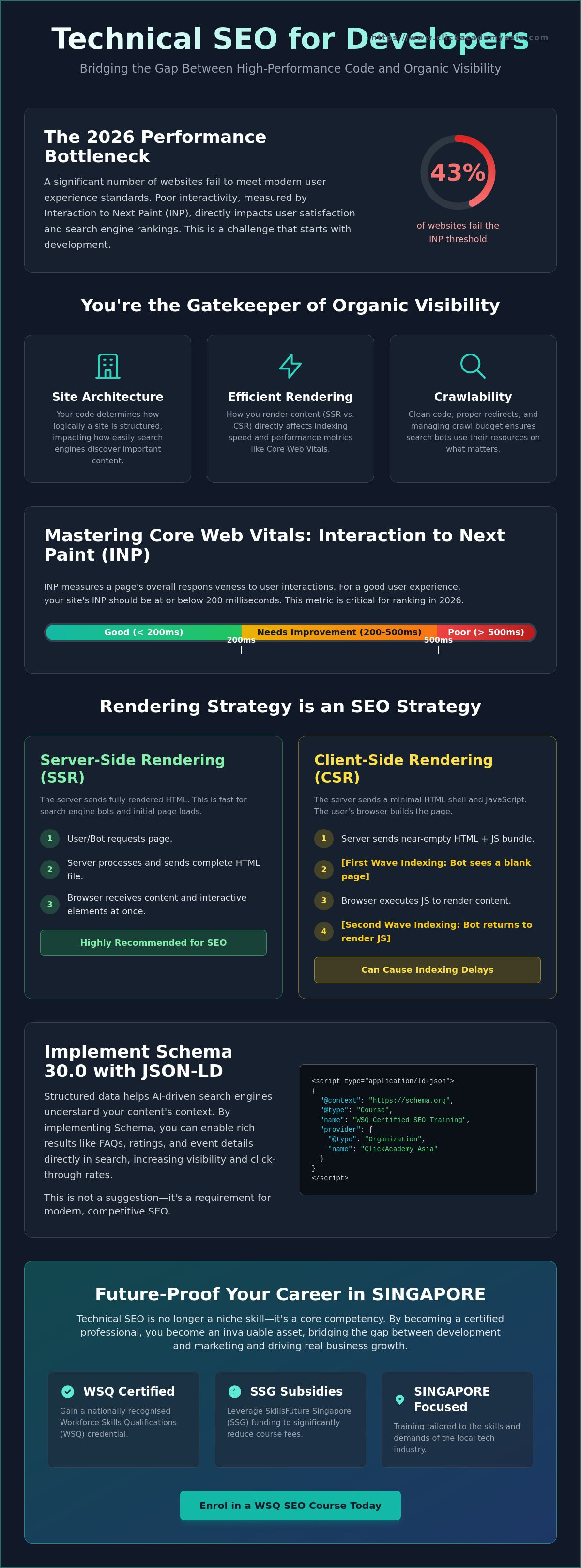
Did you know that 43% of websites in 2026 still fail the Interaction to Next Paint (INP) threshold of 200 milliseconds? For many developers, SEO feels like a series of vague, shifting requirements handed down by a marketing team that doesn't quite understand how the stack works. It's frustrating to build a clean application only to be told it isn't "search friendly" or to worry that a routine deployment might accidentally break the site's rankings.
You're right to feel there's a disconnect between code and visibility. This article shows you how to bridge that gap through professional technical seo training for developers. You'll learn how to integrate high-performance SEO into your existing development workflow and master the latest standards like Schema 30.0. We'll look at how to optimise for Core Web Vitals effectively and how a WSQ certification can future-proof your career by turning SEO into a core software quality skill.
Key Takeaways
Learn why developers are the true gatekeepers of organic visibility by mastering site architecture, crawlability, and efficient rendering.
Get a clear breakdown of 2026 Core Web Vitals thresholds, specifically focusing on how to optimise for the Interaction to Next Paint (INP) metric.
Master the implementation of Schema 30.0 using JSON-LD to help AI-driven search engines accurately interpret your content and site structure.
Discover how technical seo training for developers bridges the communication gap with marketing teams and prevents ranking drops during deployments.
Find out how to leverage SSG subsidies for WSQ-certified SEO courses in SINGAPORE to gain professional credentials and future-proof your career.
Table of Contents
Why Technical SEO is a Core Competency for Modern Developers
Mastering the Fundamentals: Crawlability, Indexability, and Rendering
Advanced Performance Metrics: Core Web Vitals for Developers
A Developers Checklist for Structured Data and Schema
Future-Proofing Your Career with WSQ SEO Training in SINGAPORE
Why Technical SEO is a Core Competency for Modern Developers
In 2026, the digital landscape has shifted away from simple keyword placement toward high-performance architecture. Technical SEO is the foundation of Search Engine Optimization (SEO), focusing on the backend infrastructure that makes a site accessible and understandable to search engines. As a developer, you are the true gatekeeper of organic search success because every line of code you write directly impacts how a bot crawls and indexes your work.
To better understand how these technical elements fit into the bigger picture, watch this helpful video:
Mastering these concepts through specialised technical seo training for developers allows you to build sites that don't just look good but actually rank. By prioritising site speed, clean rendering, and logical internal linking from the start, you ensure that your projects have the best possible chance of reaching users. This proactive approach saves hours of debugging and prevents the frustration of having to refactor code after a site has already gone live.
The Evolving Role of the Technical SEO Professional
We are seeing a rapid rise in the "SEO Engineer" role within global tech firms. These professionals bridge the gap between pure engineering and organic growth strategy. When you understand the technical requirements of modern search, you reduce friction during cross-departmental sprints and ensure your deployments don't accidentally tank the site's visibility. Building it right the first time is always more efficient than trying to patch a leaky site later; it makes you an invaluable asset to any product team.
Bridging the Communication Gap with Marketing Teams
One of the biggest pain points in any tech company is the "vague" SEO requirement that lacks technical clarity. When you have the right technical seo training for developers, you can translate high-level marketing goals into actionable technical tickets. You'll be able to establish a common language around concepts like crawling, indexing, and rendering. This shared understanding allows for better collaboration and more robust site health monitoring. Instead of conflicting priorities, you and the marketing team can work together to build a high-performance product that dominates the search results.
Mastering the Fundamentals: Crawlability, Indexability, and Rendering
Search engine bots have finite resources. This is known as the "Crawl Budget." When you write inefficient code or leave legacy redirect chains in place, you force bots to waste time on low-value pages. As a result, your most important content might never be discovered. Understanding how to manage this budget is a vital part of technical seo training for developers, as it ensures your server resources are used to index the pages that actually drive business value.
Think of robots.txt and XML sitemaps as the primary rules of engagement between your server and the web. While robots.txt tells bots where they shouldn't go, sitemaps act as a roadmap for discovery. You must also master the use of canonical tags to prevent duplicate content issues. This is especially important when dealing with tracking parameters or faceted navigation filters that can create thousands of unique but redundant URLs, confusing search engines and diluting your site's authority.
Server-Side vs. Client-Side Rendering for SEO
Google uses a two-wave indexing process for modern web applications. First, it scrapes the initial HTML response. Later, when rendering resources become available, it processes the JavaScript to see the full page. If your core content only exists after the client-side script executes, you risk significant delays in visibility. Using Server-Side Rendering (SSR) or Static Site Generation (SSG) ensures that your content is present in that first wave. This provides a much smoother path for indexing and avoids the "blank page" problem that often plagues heavy React or Vue applications.
If you're looking to master these complex architectures and build more resilient applications, exploring a WSQ Search Engine Optimisation (SEO) course is a great way to gain practical, hands-on experience with rendering strategies.
Optimising Site Architecture and URL Patterns
Logical URL structures are easier for bots to traverse and for users to understand. You should avoid deep directory nesting and ensure that your URL patterns are consistent across the entire application. Handling pagination and infinite scroll correctly is also essential; without proper implementation, search bots may fail to "click" through to older content. When moving or deleting pages, always use 301 redirects rather than 302s to pass ranking signals correctly. This prevents the creation of redirect chains that frustrate users and waste your crawl budget.
Advanced Performance Metrics: Core Web Vitals for Developers
By 2026, Google's ranking systems have evolved to prioritise real-world user experience over theoretical lab scores. Core Web Vitals are no longer optional "nice-to-haves"; they are critical software quality requirements. If your site fails these thresholds, even the best content will struggle to reach the first page. Modern technical seo training for developers focuses on these metrics to ensure that performance is baked into the codebase from day one.
To accurately track how these metrics impact your business goals, it's essential to integrate your performance data with marketing analytics with GA4. This allows you to see the direct correlation between technical improvements and user conversion rates. Investing in technical seo training for developers empowers you to use advanced diagnostics like Chrome DevTools to build faster, more resilient web applications. Remember that Google prioritises field data from the Chrome User Experience Report (CrUX), meaning real-user interactions are what truly count for your rankings.
Largest Contentful Paint (LCP): Measures loading performance. Aim for 2.5 seconds or less.
Interaction to Next Paint (INP): Measures responsiveness. Aim for 200 milliseconds or less.
Cumulative Layout Shift (CLS): Measures visual stability. Aim for a score of 0.1 or less.
Reducing Interaction to Next Paint (INP)
Interaction to Next Paint (INP) has fully replaced First Input Delay as the standard for measuring responsiveness. In 2026, 43% of websites still fail the INP threshold of 200 milliseconds, making it the most common technical hurdle for development teams. High INP is usually caused by long-running JavaScript tasks that block the main thread. To fix this, you should break up heavy tasks using APIs like scheduler.yield() or requestIdleCallback(). This ensures the browser can respond to user input quickly, even while processing complex logic in the background.
Eliminating Layout Shift (CLS) in Dynamic Apps
Cumulative Layout Shift (CLS) measures visual stability; a "good" score is 0.1 or less. Unexpected shifts are an SEO red flag because they disrupt the user's journey. You can eliminate most shifts by using the aspect-ratio CSS property and reserving space for late-loading elements like ads or hero images. Use the Layout Instability API within Chrome DevTools to identify exactly which elements are moving. Research shows that sites passing all Core Web Vitals thresholds see 24% lower bounce rates, proving that visual stability is directly tied to user retention.
A Developers Checklist for Structured Data and Schema
Structured data serves as the semantic layer of the web, providing a clear map for search engines to follow. With the release of Schema.org version 30.0 on 25 March 2026, the vocabulary has become even more precise, allowing for deeper machine understanding of your content. It is no longer just about winning rich snippets; it is about ensuring that AI-driven search engines can accurately identify the entities, products, and relationships within your application. Mastering these data structures is a high-value skill often covered in technical seo training for developers.
JSON-LD is the gold standard for implementation because it decouples your metadata from the visual UI. In modern frameworks like Next.js, React, or Vue, you can inject these scripts dynamically based on your component's state or database metadata. This prevents the messy HTML clutter associated with older Microdata methods and makes your code much easier to maintain. Always use the Rich Results Test during your development cycle to validate your syntax and ensure your data is eligible for enhanced search features.
If you want to move beyond basic tags and master complex entity relationships, joining a WSQ Search Engine Optimization (SEO) course will provide the practical framework you need to scale these implementations across enterprise-level sites.
Essential Schema Types for Every Modern Website
Every project should start with a solid foundation of Organisation, Breadcrumb, and Website schema. These establish your brand's identity and help bots understand the hierarchy of your site architecture. For content-heavy pages, Article and FAQ schema are essential for capturing high-visibility real estate in search results. If you are building e-commerce platforms, Product and Review schema are non-negotiable, as they allow search engines to display live pricing, availability, and star ratings directly on the results page.
Scaling Schema with Dynamic Implementation
Manually coding schema for every page is impossible at scale. You should automate this process by mapping your CMS or database fields directly to your JSON-LD templates. This ensures that every new entry automatically generates the correct markup without further developer intervention. Pay close attention to nested entities; for example, a Review must be correctly nested within a Product or Service entity to be valid. Once deployed, use the "Enhancements" report in Google Search Console to monitor your schema health and quickly identify any parsing errors across your entire site.
Future-Proofing Your Career with WSQ SEO Training in SINGAPORE
Mastering technical SEO is a significant career milestone, but validating those skills with a recognised credential is what sets you apart in the SINGAPORE job market. Choosing a WSQ-certified SEO course ensures that your expertise is benchmarked against national standards. As developers take a leading role in digital transformation, having a formal certification proves you can handle the high-performance requirements of modern search engines while collaborating effectively with growth teams.
The financial barrier to entry is lower than many professionals realise. Through SSG subsidies, SINGAPORE citizens and Permanent Residents can access significant funding for their technical seo training for developers. For instance, those aged 40 and above can receive enhanced mid-career subsidies, while SMEs can benefit from up to 90% funding for employee training. This government support makes it the perfect time to move beyond self-taught basics and commit to professional mastery.
SkillsFuture Credit and Professional Upskilling
Generic online tutorials often lack the local context and hands-on guidance needed to implement complex strategies like INP optimisation or dynamic Schema generation. You can use your SkillsFuture Credit to offset the remaining out-of-pocket costs for a WSQ-certified course. This structured approach allows you to build a portfolio of SEO-optimised projects under the guidance of industry experts; ensuring you can apply what you learn to real-world production environments immediately.
Next Steps: Joining ClickAcademy Asia
Our curriculum is designed specifically for professionals who need actionable insights rather than theoretical discussion. By joining a mentor-led WSQ digital marketing course, you'll gain the confidence to lead technical audits and implement site-wide performance fixes. We focus on practical mastery, ensuring you walk away with the certifications and skills required to future-proof your career in an AI-driven search environment.
Ready to bridge the gap between development and search success? Enrol in our WSQ Search Engine Optimisation (SEO) course today! Whether you're looking to boost your CV value or lead your organisation's technical strategy, our bootcamps provide the roadmap to excellence.
Lead the Future of Search-First Development
We've explored how technical SEO has evolved into a fundamental software quality requirement. By mastering rendering strategies, 2026 Core Web Vitals like INP, and the latest Schema 30.0 standards, you position yourself as a vital asset in any product team. You don't just build applications; you build high-performance products that search engines can easily understand and rank.
Investing in technical seo training for developers is the most effective way to bridge the gap between complex code and organic growth. At ClickAcademy Asia, we offer a WSQ-certified curriculum that is eligible for SSG subsidies. As an official Google Certification partner with a reach spanning over 30 countries, we provide the mentor-led guidance you need to excel in a competitive market.
Master Technical SEO with our WSQ-certified training programme and take command of your professional trajectory today. You have the technical foundation; now it's time to build the visibility your code deserves.
Frequently Asked Questions
Is technical SEO for developers different from marketing SEO?
Technical SEO focuses on the backend infrastructure and site performance, while marketing SEO prioritises content strategy and keyword intent. As a developer, your role is to ensure that search engine bots can crawl, render, and index your code efficiently. While marketers decide what content should rank, you build the high-performance foundation that makes ranking possible.
How much coding knowledge is required for technical SEO training?
You should have a solid understanding of HTML, CSS, and basic JavaScript to get the most out of your sessions. Professional technical seo training for developers is designed for those who already build web applications but want to master the architectural requirements that impact organic search visibility. It’s about applying your existing engineering skills to solve crawlability and performance challenges.
What are the most important technical SEO tools for developers to learn?
Mastering Chrome DevTools and Google Search Console is essential for real-time diagnostics and monitoring site health. You should also become proficient with Lighthouse for performance scoring and the Rich Results Test for validating structured data. For larger projects, tools like Screaming Frog are invaluable for identifying broken links, redirect chains, and duplicate content issues across thousands of URLs.
Can I use SkillsFuture Credit for technical SEO training in SINGAPORE?
Yes, you can use your SkillsFuture Credit to offset the out-of-pocket costs for any WSQ-certified SEO course in SINGAPORE. These programmes are eligible for SSG funding, which significantly reduces the financial investment for Singapore Citizens and Permanent Residents. This makes technical seo training for developers a highly accessible way to gain a recognised professional credential.
How does JavaScript impact a website’s SEO performance?
JavaScript can delay indexing because search engines often process scripts in a "second wave" after the initial HTML is scraped. If your content relies heavily on client-side rendering, bots may fail to see it for days or weeks. Implementing Server-Side Rendering (SSR) or Static Site Generation (SSG) ensures your content is present in the first wave, leading to faster and more reliable indexing.
What is the benefit of a WSQ-certified SEO course over a free tutorial?
WSQ-certified courses provide a structured, mentor-led environment that meets national standards for professional excellence in SINGAPORE. Free tutorials often lack the depth needed for enterprise-level implementation and don't offer the practical, hands-on feedback required to master complex tasks. A WSQ certification also adds tangible value to your CV, proving your expertise to global industry leaders.
How often should a developer conduct a technical SEO audit?
You should integrate technical SEO checks into your regular deployment pipeline and perform a comprehensive audit at least once a quarter. Any major site migration, framework update, or significant change to the URL structure should trigger an immediate review. This proactive approach ensures that small bugs don't turn into major ranking issues that hurt your site's visibility.
Does technical SEO help with AI search visibility?
Structured data and clean site architecture are critical for AI search engines like ChatGPT or Perplexity to parse and understand your content. By following the latest Schema.org standards, you provide the semantic clarity these models need to identify your site as an authoritative source. Good technical SEO ensures your data is accurately represented in AI-generated responses and citations.



Comments