
Server-Side Tagging Guide for Singapore Professionals

Marketers in Singapore are currently losing visibility into an estimated 30-40% of their conversion data due to browser privacy restrictions and ad blockers. You've likely felt the sting of this loss when your GA4 reports fail to match the reality in your CRM. It's an industry-wide challenge that makes justifying your ad spend ROI feel like guesswork rather than strategy.
We understand the pressure to maintain precision while navigating the complexities of the PDPA NRIC authentication deadlines and evolving consent rules. This guide introduces server-side tagging for improved data accuracy as the strategic solution to reclaim your lost insights. You'll discover how to bypass client-side limitations and secure a more reliable data stream for your organisation.
By shifting the workload to a secure cloud server, you can future-proof your marketing tech stack and achieve professional mastery of advanced analytics. We'll walk through the practical implementation steps and how to align these technical shifts with WSQ-certified frameworks. It's time to transform your data from a source of anxiety into a definitive competitive advantage.
Table of Contents
The Data Accuracy Crisis in Singapore: Why Traditional Tagging is Failing
What is Server-Side Tagging and How Does It Restore Integrity?
Comparing Client-Side vs. Server-Side Tagging for Data Accuracy
Strategic Implementation: A Roadmap for Singaporean Marketing Leaders
Upskilling for the Future: Mastering Data Strategy in Singapore
The Data Accuracy Crisis in Singapore: Why Traditional Tagging is Failing
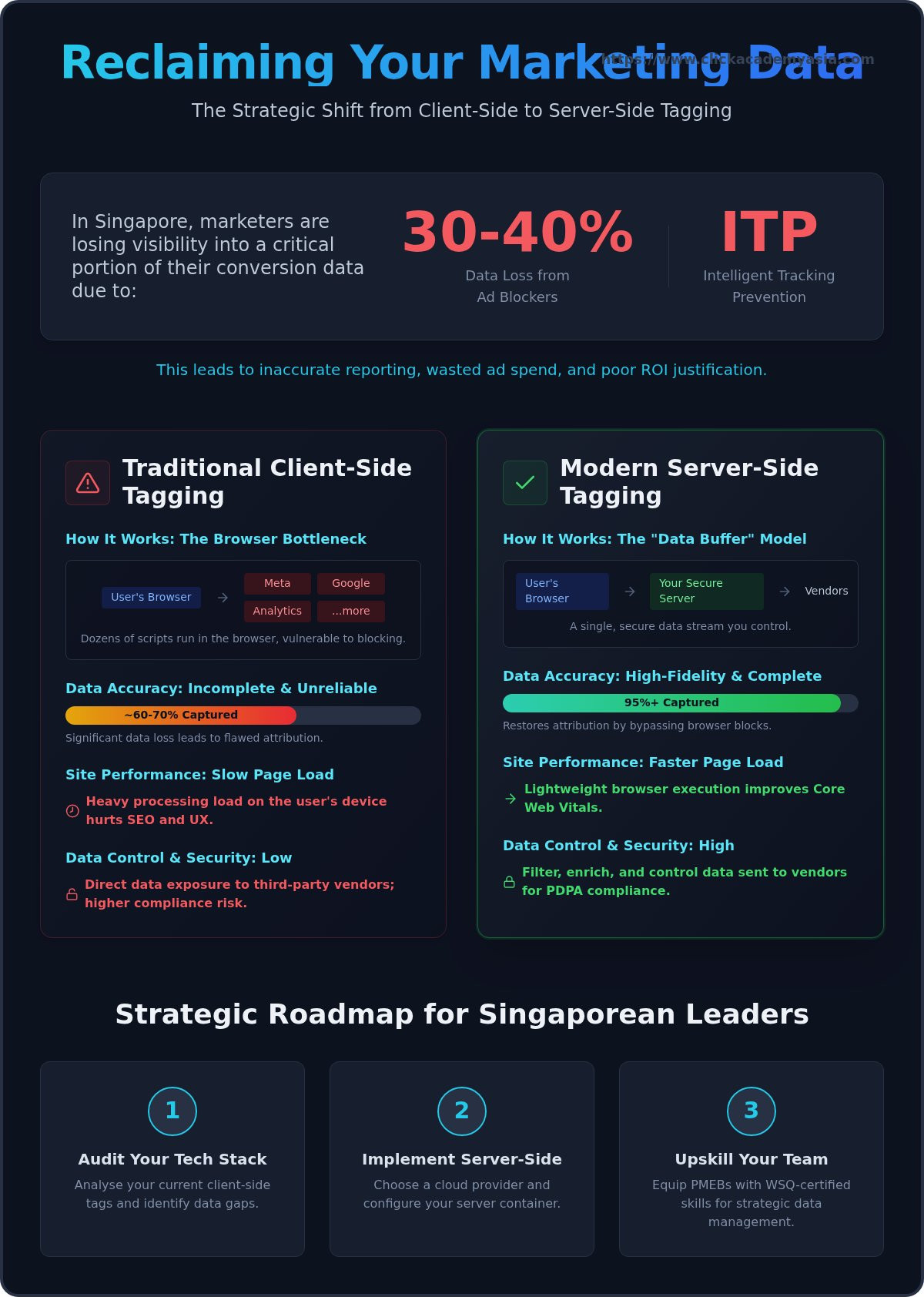
For years, most Singaporean businesses relied on client-side tagging. This traditional approach uses a tag management system to execute tracking scripts directly within the user's web browser. While convenient, this method is increasingly fragile as privacy-centric technology becomes the global standard. It's no longer enough to rely on the browser to report performance accurately.
Local PMEBs are now facing a visibility crisis. When you look at your GA4 reports, you might see a growing volume of "unassigned" traffic or conversion numbers that don't match your backend CRM. This discrepancy often stems from Intelligent Tracking Prevention (ITP) and ad blockers, which can cause marketers to lose 30% to 40% of their conversion data. Adopting server-side tagging for improved data accuracy is no longer just a technical upgrade; it's a strategic necessity for reliable business intelligence in Singapore.
The Impact of Cookie Deprecation on Marketing ROI
Missing data hurts ROI. If your tracking doesn't capture the final conversion, your bidding algorithms can't optimise effectively, leading to higher acquisition costs. Many Singaporean firms struggle with cross-device attribution because third-party cookies are frequently blocked or deleted prematurely. This lead to several critical issues:
Wasted Budgets: Decisions based on incomplete conversion sets lead to poor resource allocation in Google Ads.
Inaccurate Reporting: Stakeholders lose confidence when digital reports contradict actual sales figures.
Fragmented Journeys: The inability to link touchpoints across devices results in a misunderstood customer path.
Browser Limitations vs. Business Intelligence
Browsers like Safari and Chrome have drastically limited the lifespan of cookies to protect user privacy. In the APAC region, users are becoming more privacy-conscious, often opting for tools that strip away tracking parameters. Quick fixes don't work. These browser-level restrictions are designed to be robust, meaning traditional workarounds for professional-grade analytics are failing.
Relying on the browser to handle your data logic is a gamble that most corporate leaders can't afford. Professional mastery in this field requires moving beyond browser-based dependencies. By implementing server-side tagging for improved data accuracy, you regain control over the data flow, ensuring your marketing strategy is built on a foundation of truth rather than estimates. You can explore advanced analytics frameworks through the programmes at ClickAcademy Asia to stay ahead of these shifts.
What is Server-Side Tagging and How Does It Restore Integrity?
Think of server-side tagging as a sophisticated "Data Buffer" for your organisation in Singapore. Instead of letting dozens of third-party scripts run wild in a user's browser, you consolidate the tracking into a single request. This request travels to a secure, private server that you control before being distributed to external partners like Meta or Google. This shift is the cornerstone of server-side tagging for improved data accuracy, as it removes the browser's ability to block individual tracking pixels.
The process is elegant and logical. The flow follows a clear path: your website sends data to your private server, which then relays it to third-party vendors. This architecture ensures that you, not the browser, decide what data is shared. It transforms your measurement strategy from a passive recipient of browser data into an active manager of first-party insights, securing your data ownership in an era of cookie deprecation.
Improving Website Performance and User Experience
Every tracking script you add to a website acts like a weight, slowing down load times and frustrating users. By moving this logic to a server, you significantly reduce the "processing burden" on the user's device. This leads to faster page speeds, which is a critical factor for SEO rankings in Singapore. Professionals looking to master these technical nuances can explore WSQ-certified digital marketing programmes to understand how performance impacts the bottom line.
Data Governance and First-Party Control
Security is no longer optional. Server-side tagging allows you to clean and filter data before it ever leaves your ecosystem. You can strip out sensitive customer information, such as Personally Identifiable Information (PII), ensuring it's never shared unintentionally with third-party platforms. This level of control positions your organisation as a leader in ethical data handling. Implementing server-side tagging for improved data accuracy demonstrates a commitment to both performance and privacy, building long-term trust with your audience.
Comparing Client-Side vs. Server-Side Tagging for Data Accuracy
Choosing the right infrastructure is a balance between technical control and resource allocation. While client-side tagging remains cost-effective for small blogs, server-side tagging for improved data accuracy is the superior choice for high-volume Singaporean enterprises. It provides a robust framework that prioritises data integrity and security, ensuring your business intelligence remains untainted by browser-level interference.
Implementing this technology does involve cloud infrastructure costs and requires specific technical expertise. However, the investment protects your marketing attribution from total erosion in a way that traditional methods cannot. For PMEBs, the ability to present clean, compliant data to stakeholders is a vital step toward professional mastery. It transforms your analytics from a passive reporting tool into an active, strategic asset for the organisation.
Solving the Ad Blocker Challenge
Traditional tracking relies on the browser to execute scripts, which tech-savvy Singaporean users often block. Server-to-server communication bypasses this by sending data directly from your cloud container to the vendor. Many organisations report a 10-30% increase in measurable data after switching. This allows your bidding algorithms to optimise more effectively and is a core component of our Marketing Analytics with GA4: A Strategic Guide for 2026 Professionals.
Compliance with Singapore's PDPA
Data governance is a top priority for local HR and legal teams, particularly with the PDPA NRIC authentication deadline approaching on 31 December 2026. Server-side containers allow you to redact Personally Identifiable Information (PII) before it ever reaches external platforms. This granular control helps you meet the "Consent" and "Purpose" requirements outlined in the WSQ framework. By implementing server-side tagging for improved data accuracy, you ensure your measurement strategy aligns with Singapore's strict regulatory environment.
Strategic Implementation: A Roadmap for Singaporean Marketing Leaders
Successful implementation begins with a rigorous audit of your current tracking environment. You must identify specific gaps where ad blockers or browser restrictions cause data discrepancies between your site and your CRM. Selecting a robust cloud provider like Google Cloud or AWS is the next critical step to host your server container securely. This infrastructure provides the foundation for server-side tagging for improved data accuracy by moving measurement logic away from the user's browser.
Mapping the data flow from your website to the server ensures every event is captured without redundancy. Once the architecture is in place, use the GTM Preview mode to validate that events fire correctly and reach their intended destinations. This validation phase is essential for catching configuration errors before they affect your live reports. It ensures your marketing attribution remains intact despite the evolving digital landscape in Singapore.
Transitioning from Client to Server GTM
Setting up the server-side container within Google Tag Manager requires a shift in how you categorise web requests. You'll need to configure a custom domain to ensure your tracking operates in a first-party context; this is vital for bypassing third-party cookie restrictions. This technical precision mirrors the strategic depth required for high-level digital growth, much like the concepts explored in our Advanced Keyword Research Strategies: A 2026 Masterclass.
Monitoring and Debugging for Long-Term Accuracy
Accuracy isn't a "set and forget" task for PMEBs. Establish a monthly data audit routine to monitor the health of your server logs and identify any "leaky" tags that might still bypass your server logic. Training your team to interpret these logs is the final piece of the puzzle, turning raw data into actionable business intelligence. To lead this transition effectively, consider enrolling your team in the WSQ Marketing Analytics & Insights programme to bridge the technical skill gap and master server-side tagging for improved data accuracy.
Upskilling for the Future: Mastering Data Strategy in Singapore
Implementing server-side tagging for improved data accuracy is far more than a simple technical checkbox for your IT department. It represents a fundamental strategic shift that requires a marketing leader's vision to align data collection with overarching business objectives. In the evolving Singaporean digital landscape, staying ahead means mastering the specific tools that protect your attribution and ensure ongoing PDPA compliance. ClickAcademy Asia serves as your expert mentor in this journey, providing the tangible skills needed to navigate these technical waters with absolute confidence.
Leveraging WSQ Frameworks for Corporate Training
The WSQ Digital Marketing Strategy & Planning module is specifically designed for PMEBs who must bridge the gap between high-level strategy and granular technical execution. Government subsidies through SSG make this high-level training remarkably accessible for local organisations. A WSQ certification carries significant prestige in the Singaporean job market, signalling a commitment to practical mastery and industry-recognised standards. Current funding options include:
SSG Funding: Up to 70% of course fees for Singapore Citizens and Permanent Residents.
Mid-Career Support: Up to 90% funding for citizens aged 40 and above under the Mid-Career Enhanced Subsidy.
SME Incentives: Up to 90% funding available via the SkillsFuture Enterprise Credit (SFEC) for eligible companies.
Next Steps: Enrolling in Marketing Analytics & GA4 Training
Theory only provides the foundation; true expertise comes from hands-on application. Our workshops move beyond the "what" to focus on the "how," ensuring you can return to your organisation and immediately begin auditing your data infrastructure for tracking gaps. By enrolling, you join a robust community of future-ready Singaporean PMEBs who are collectively raising the bar for data integrity in the APAC region.
Taking the next step in your professional development is straightforward. Secure your team's future by exploring the ClickAcademy Asia Marketing Analytics course to begin your transition toward server-side tagging for improved data accuracy. Mastering these advanced analytics frameworks is the most effective way to future-proof your career and lead your organisation toward a more resilient, data-driven future. We're here to ensure your team has the skills to thrive in this new era of measurement.
Securing Your Data Leadership in Singapore
Transitioning to server-side tagging for improved data accuracy is a strategic imperative for any Singaporean professional managing high-value digital assets. By moving beyond the limitations of browser-based tracking, you reclaim lost conversion data and ensure your marketing ROI remains transparent. This shift provides the granular control necessary to meet strict PDPA requirements while future-proofing your analytics against further cookie deprecation. It's about turning fragmented reports into a single source of truth that drives better business decisions.
True mastery requires more than just a technical setup; it demands a strategic mindset that only continuous learning can provide. Equip your team with the skills to lead this transition by enrolling in our expert-led workshops designed specifically for PMEBs. Explore our WSQ-funded Digital Marketing programmes at ClickAcademy Asia today to benefit from up to 70% SSG funding for eligible Singaporeans. Our WSQ-certified training tracks are the premier choice for professionals looking to dominate the local digital ecosystem. The future of measurement belongs to those who adapt, and we're ready to partner with you to turn these technical challenges into your team's greatest competitive advantage.
Frequently Asked Questions
Is server-side tagging better for SEO in Singapore?
Server-side tagging contributes to better SEO by reducing the amount of JavaScript running in a user's browser. This leads to faster page load speeds, which is a critical ranking factor for search engines. Since Google prioritises user experience, a faster site often sees improved rankings. For Singaporean businesses, this technical optimisation ensures your website remains competitive in a digital landscape where speed and performance are paramount for maintaining high visibility.
How much does it cost to run a server for GTM tagging?
The cost depends on your traffic and infrastructure choice. A standard configuration for a single server instance on Google Cloud Run costs approximately $45 (USD) per month. A recommended setup with a minimum of two servers plus a preview server costs roughly $145 (USD) per month before traffic-dependent costs. These infrastructure fees are separate from any training or implementation costs but are essential for maintaining a robust and reliable server-side environment.
Can I use server-side tagging with my existing GA4 setup?
You can definitely integrate server-side tagging with your current GA4 configuration. In fact, GA4 is designed to work seamlessly with server-side containers to help you reclaim data lost to browser restrictions. This setup allows you to send events from your website to your server first, where you can then validate or clean the data before it reaches your GA4 property. It's a powerful way to ensure your marketing analytics remain reliable and accurate.
Does server-side tagging help with PDPA compliance?
Server-side tagging is a strategic tool for managing PDPA compliance in Singapore. It acts as a secure buffer, allowing you to redact or filter Personally Identifiable Information (PII) before it ever leaves your server. This ensures that sensitive customer data is never shared unintentionally with third-party vendors. By controlling the data flow at the server level, you can more easily meet the "Consent" and "Purpose" requirements set by local regulations and avoid heavy financial penalties.
Do I need a developer to set up server-side tagging?
While having a developer is beneficial for initial cloud server configuration, marketers can manage the ongoing tagging logic themselves. The shift toward server-side tagging for improved data accuracy requires a blend of technical and strategic skills. Many PMEBs find that upskilling through specialised training allows them to oversee the implementation without needing a full-time developer for every change. This empowers your marketing team to take full ownership of the organisation's overarching data strategy.
Will server-side tagging completely bypass ad blockers?
Server-side tagging significantly reduces the impact of ad blockers by serving tracking scripts from your own custom domain. This makes the tracking requests appear as first-party data rather than third-party scripts, which are what most blockers target. While it isn't a "magic bullet" to bypass every privacy tool, it restores visibility into an estimated 30-40% of conversion data that traditional client-side methods often lose. It's the most effective professional solution currently available for maintaining data integrity.
How does server-side tagging improve data accuracy exactly?
Implementing server-side tagging for improved data accuracy works by shifting the data processing from the user's browser to a secure server you control. This prevents browsers from prematurely deleting cookies or blocking tracking pixels through Intelligent Tracking Prevention (ITP). By serving tags from a first-party context, you ensure that the data reaching your analytics platforms is more complete and less prone to the discrepancies commonly seen in traditional client-side setups where scripts are often blocked.
Are there WSQ-funded courses in Singapore for learning this?
Yes, ClickAcademy Asia offers several WSQ-certified courses that cover the technical and strategic aspects of modern tracking. Our WSQ Marketing Analytics & Insights programme is particularly relevant for professionals looking to master these advanced concepts. Eligible Singaporeans and Permanent Residents can receive up to 70% SSG funding for these courses. These workshops provide practical, hands-on experience to help you implement robust data strategies within your organisation effectively while leveraging available government support for professional development.


Comments