
Reducing Cart Abandonment Rate Strategies for Singapore Businesses in 2026
- ClickAcademy Asia

- 40 minutes ago
- 11 min read
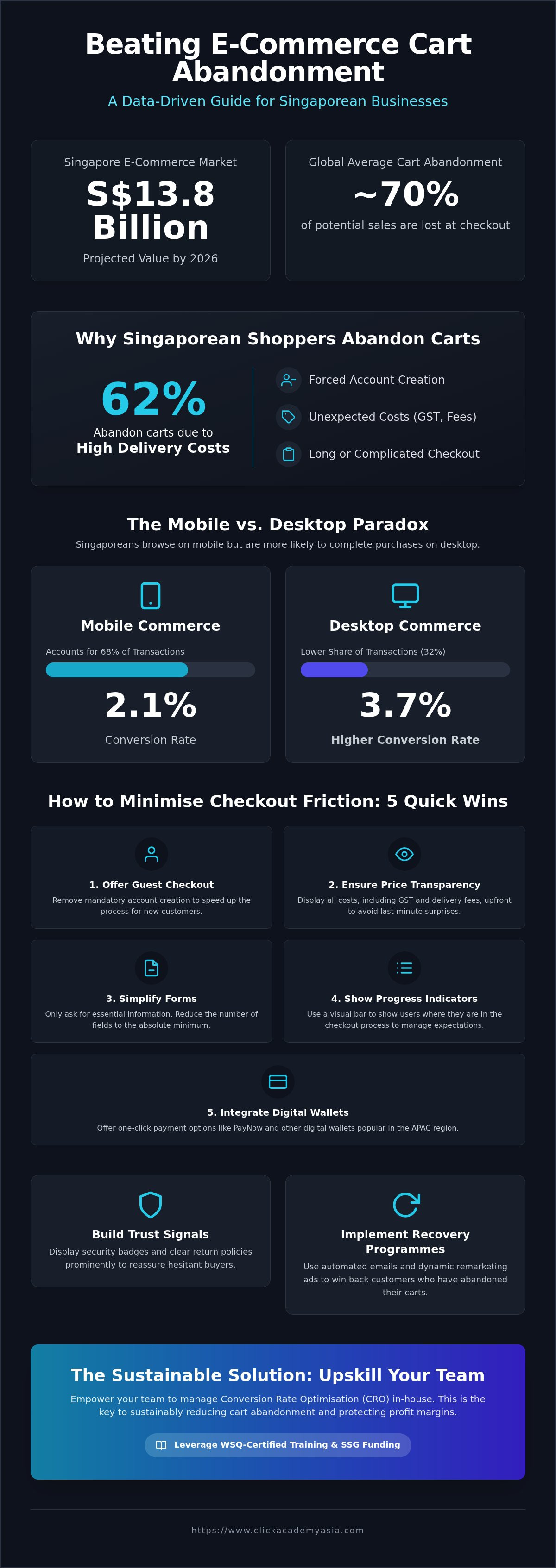
Did you know that 62% of consumers in Singapore will abandon their shopping carts simply because delivery costs are too high? With the local e-commerce market projected to hit S$13.8 billion in 2026, implementing effective reducing cart abandonment rate strategies is no longer optional. It's a frustrating reality for many PMEBs who see healthy traffic but struggle with low conversion rates.
You likely find yourself staring at confusing GA4 data, wondering why your retargeting efforts aren't hitting the mark. We understand that high customer acquisition costs make these lost opportunities feel even more painful for your bottom line. This guide shares actionable, data-driven insights to help you recover sales and optimise your checkout flow through strategic upskilling.
We'll examine how to bridge the gap between mobile browsing and desktop purchasing. You'll discover how your team can leverage SSG funding and WSQ frameworks to master CRO independently, ensuring your profit margins remain healthy as you navigate the competitive local market.
Table of Contents
Why Reducing Cart Abandonment Rate Strategies are Critical for Singapore E-commerce
Optimising the Checkout Journey: Practical Tactics to Minimise Friction
Leveraging GA4 and Marketing Analytics to Pinpoint Abandonment Triggers
How to Build a Multi-Channel Recovery Programme for Lost Sales
Future-Proofing Your Team: Mastering Conversion Strategies via WSQ Training
Why Reducing Cart Abandonment Rate Strategies are Critical for Singapore E-commerce
In the Singaporean digital ecosystem, cart abandonment isn't just a missed click; it's a significant leak in your revenue pipeline. With the local e-commerce market projected to reach S$13.8 billion in 2026, even a minor percentage shift in conversion can result in millions of dollars in recovered sales. For local PMEBs, understanding cart abandonment rates is the first step toward reclaiming lost profit. Currently, the global average sits at approximately 70.22%, but in high-competition markets like Singapore, the stakes are even higher due to rising customer acquisition costs.
The Cost of Friction in the Digital Journey
Friction refers to any hurdle that prevents a user from completing a transaction. When shoppers encounter unexpected costs or complex checkouts, they don't just leave; they often head straight to a competitor. This friction damages long-term brand loyalty and inflates your marketing spend. If you're spending heavily on SEO or SEM but losing 70% of those leads at the finish line, your ROI is effectively being throttled by a lack of internal expertise in optimisation.
E-commerce Trends Shaping 2026 Consumer Behaviour
Singaporean shoppers are increasingly mobile-first, often engaging in 'commuter shopping' on the MRT. While M-commerce accounts for 68% of all transactions, the conversion rate on mobile (2.1%) lags significantly behind desktop (3.7%). This "mobile paradox" suggests that while we browse on the go, we wait for a frictionless environment to actually pay. Research shows that 62% of consumers in Singapore will abandon a cart if delivery costs are too high. By 2026, shoppers expect instant gratification and total transparency regarding GST and delivery fees. Implementing effective reducing cart abandonment rate strategies means moving beyond window shopping and creating a path of least resistance.
In the APAC region, businesses that prioritise conversion rate optimisation (CRO) gain a massive head start. It's no longer enough to have a great product; you need a team capable of identifying technical triggers and psychological barriers. This is where upskilling through WSQ-certified programmes becomes a strategic asset, allowing your staff to manage complex retargeting and data analysis independently. By focusing on these core competencies and reducing cart abandonment rate strategies, your business can turn 2026's high expectations into a unique competitive advantage.
Optimising the Checkout Journey: Practical Tactics to Minimise Friction
Checkout optimisation is where your digital strategy meets the moment of truth. With Singapore's smartphone penetration reaching 84%, a mobile-clunky checkout isn't just an inconvenience; it's a revenue killer. Effective reducing cart abandonment rate strategies start with removing mandatory account creation. Forced registration is a major friction point that often leads to drop-offs, as search abandonment research indicates users want speed over commitment. Implementing a guest checkout option allows shoppers to finish their purchase without the hurdle of a long-term relationship.
Total price transparency is another non-negotiable factor. Since 62% of Singaporean consumers abandon carts due to high delivery costs, showing the final price including GST early is vital. Don't wait until the final click to reveal shipping fees. Clearly displaying these costs on the product page or cart summary reduces the psychological shock that often leads to abandonment. When users know exactly what they're paying, they're far more likely to click 'buy'.
Streamlining the Path to Purchase
Efficiency is the cornerstone of a successful e-commerce flow. You should reduce form fields to the absolute minimum required for delivery; asking for a phone number when an email suffices can cause unnecessary friction. Use visual progress indicators to manage user expectations. These bars show exactly how many steps remain, which lowers anxiety and keeps users engaged. Integrating one-click payment options like PayNow or digital wallets is also a "quick win" for the APAC region, catering to the 11% of transaction value now held by digital wallets.
Building Trust Through Transparency
Trust signals act as the final reassurance for a hesitant buyer. Display security badges and clear return policies near the 'Buy' button to validate your brand's credibility. Strategic placement of customer reviews can also nudge a shopper forward by providing social proof. If your team lacks the technical depth to implement these changes, exploring E-commerce Strategy & Operations training can provide the practical skills needed to refine your funnel. Shipping durations must also be communicated with precision. In Singapore, shoppers expect to know if their package arrives in two days or seven. Transparency here reduces the "where is my order" anxiety and builds long-term loyalty. By mastering these reducing cart abandonment rate strategies, you'll see a direct impact on your conversion metrics.
Leveraging GA4 and Marketing Analytics to Pinpoint Abandonment Triggers
Implementing reducing cart abandonment rate strategies requires more than just guesswork; it demands granular data. GA4 offers a powerful 'Funnel Exploration' tool that allows you to visualise exactly where your potential customers are dropping off. By mapping out the journey from 'view_item' to 'purchase', you can identify if the leak happens at the shipping selection stage or the payment gateway. This level of visibility is essential for preventing cart abandonment at the final hurdle, where technical glitches or slow loading times often derail a sale.
Tracking the gap between 'Add to Cart' and 'Begin Checkout' events is particularly revealing. If users add items but never start the checkout process, the issue might be price-related or a lack of trust. Conversely, a drop-off after 'Begin Checkout' usually points to technical friction or a confusing form. You should also segment this data by device. Given that mobile conversion in Singapore is significantly lower than desktop, identifying mobile-only bugs is a high-priority task for any PMEB looking to secure their share of the market.
Setting Up Custom Conversion Funnels
Configuring GA4 event tracking for every checkout step provides a roadmap for your optimisations. You can use the drop-off rate metric to identify 'leaky' pages that need immediate attention. Whether it's a broken 'Next' button or a layout that obscures the total price on smaller screens, data reveals what the eye might miss. For a deeper dive into these technical setups, refer to our Marketing Analytics with GA4: A Strategic Guide.
Data-Driven Decision Making for Managers
Moving from 'gut feeling' to evidence-based site optimisations transforms how your team operates. Instead of subjective debates about button colours, you can present hard data to stakeholders to secure budget approval for larger technical fixes. Conversion Rate Optimisation (CRO) is a continuous iterative process that relies on testing, learning, and refining based on real-time user feedback. By mastering these reducing cart abandonment rate strategies through data, you empower your team to make decisions that directly improve profit margins.
How to Build a Multi-Channel Recovery Programme for Lost Sales
Capturing a lead is expensive; letting it go without a fight is bad business. A multi-channel recovery programme ensures that your reducing cart abandonment rate strategies extend beyond the website and back into the shopper's daily flow. Automated 'Abandoned Cart' email sequences remain the backbone of this effort, especially when paired with personalised incentives that address specific shopper concerns. By combining these with dynamic remarketing ads on Google and Meta, you create a persistent but polite reminder of the value left behind.
Mastering Email Remarketing Sequences
Timing is everything in recovery. The 'Golden Hour' rule suggests sending your first email within 60 minutes of abandonment, while the intent is still fresh in the customer's mind. Your subject lines should be helpful rather than intrusive; think "Did you forget something?" instead of "Complete your order now." You can also use ethical scarcity, such as "Only 2 items left in stock," to nudge hesitant buyers forward. A/B testing different recovery offers, like free shipping versus a 10% discount, will help you identify what resonates best with your specific Singaporean audience.
Omnichannel Retargeting Strategies
In Singapore's mobile-first market, SMS and WhatsApp reminders are exceptionally high-performing channels for recovery. These direct touchpoints often see much higher open rates than traditional email, making them a "quick win" for local PMEBs. However, consistency is key. Your ad creative across Search, Social, and Display must align perfectly to maintain a professional brand voice. If your internal team struggles to manage these complex cross-platform campaigns, you should consider enrolling them in an Advanced SEM Strategies Course to bridge the skills gap.
Effective recovery isn't just about badgering the customer; it's about providing a solution to the friction they faced. Whether you're using dynamic ads or personalised messages, every touchpoint should feel like a supportive extension of the shopping experience. To ensure your team has the tactical proficiency to execute these reducing cart abandonment rate strategies, explore our WSQ Digital Advertising modules today. By building a robust, multi-channel system, you'll turn lost carts into loyal customers.
Future-Proofing Your Team: Mastering Conversion Strategies via WSQ Training
Technical tweaks and automated recovery emails are vital components of a successful funnel, but the human element is the engine that drives consistent implementation. Many Singaporean businesses rely on self-taught "quick fixes" or generic online tutorials that often fail to deliver a sustainable long-term ROI. To truly excel at reducing cart abandonment rate strategies, your team needs a structured, industry-recognised framework that aligns with the latest digital standards. Investing in professional development ensures that your staff can move beyond basic troubleshooting to proactive strategic planning.
The Value of WSQ Digital Marketing Certification
A structured learning path provides a cohesive language for your marketing and operations departments. In our competitive local landscape, being a certified marketing professional carries significant weight and signals a mastery of global best practices. By enrolling in a WSQ Digital Marketing Course, PMEBs gain the tactical confidence to execute complex optimisations. This systematic approach transforms conversion rate optimisation from a series of disconnected experiments into a predictable and scalable growth driver for your business.
Practical Mastery Over Theory
ClickAcademy Asia prioritises real-world business case studies that reflect the unique challenges of the Singaporean market. This practical focus ensures that your team isn't just absorbing abstract theory; they're learning how to resolve specific friction points in a live e-commerce environment. Empowering your workforce to manage SEO, SEM, and GA4 Analytics in-house reduces your reliance on external agencies and keeps your strategic data secure. It's about building an internal culture of excellence where data-driven decisions are the norm rather than the exception.
Leveraging government support makes this transition highly accessible for local enterprises. With SSG funding available, Singapore Citizens and Permanent Residents can receive subsidies ranging from 70% to 90% of the course fees. For those aged 40 and above, the Mid-Career Enhanced Subsidy provides a powerful incentive to future-proof their skill sets. Equip your workforce with the skills to dominate the 2026 e-commerce landscape by integrating advanced reducing cart abandonment rate strategies into your core competencies. Take the first step toward practical mastery by exploring our WSQ-certified training tracks today.
Driving E-commerce Excellence Through Practical Mastery
Mastering the complexities of checkout optimisation requires a blend of technical precision and strategic foresight. By focusing on mobile responsiveness, transparent pricing, and data-driven GA4 analysis, you're not just fixing a website; you're building a resilient revenue stream. These reducing cart abandonment rate strategies are most effective when managed by an internal team that understands the local landscape's nuances.
With over 10 years of excellence in executive education, ClickAcademy Asia provides the structured frameworks your business needs to thrive. Our expert trainers bring real-world APAC experience to every session, ensuring your upskilling journey is grounded in practical application rather than just theory. You can also leverage SSG-funded and WSQ-certified programmes to significantly reduce training costs for your PMEBs.
Empower your team with our WSQ Digital Marketing Strategy & Planning course today. It's time to turn those abandoned carts into long-term customer loyalty and sustainable growth.
Frequently Asked Questions
What is a good cart abandonment rate for Singapore e-commerce?
A competitive cart abandonment rate for Singaporean e-commerce businesses is typically between 60% and 65%. While the global average sits at approximately 70.22%, high-performing local sites achieve lower rates by addressing shipping costs and mobile friction. Monitoring your performance against these benchmarks is essential for evaluating your reducing cart abandonment rate strategies. If your rate exceeds 75%, it often indicates technical errors or a lack of transparency in your checkout flow.
Can I use SkillsFuture Credit for marketing courses at ClickAcademy Asia?
You can certainly use your SkillsFuture Credits to offset course fees for eligible programmes at ClickAcademy Asia. All Singapore Citizens aged 25 and above receive a base credit of S$500. Additionally, those aged 40 and above benefit from a S$4,000 credit under the SkillsFuture Level-Up Programme. These credits provide a practical way for PMEBs to pursue WSQ-certified training in areas like Digital Marketing Strategy and Marketing Analytics without significant out-of-pocket costs.
How often should I audit my checkout process for friction points?
You should audit your checkout process at least once every quarter to identify and remove new friction points. For high-volume e-commerce platforms in Singapore, a monthly review is more effective for catching technical bugs or payment gateway delays. Regular audits allow your team to test mobile responsiveness and ensure that GST or delivery fees remain transparent. This consistent monitoring is a cornerstone of successful reducing cart abandonment rate strategies in a competitive digital market.
What is the most common reason for cart abandonment in 2026?
Unexpectedly high delivery costs remain the primary reason for cart abandonment in 2026, affecting 62% of Singaporean consumers. Shoppers expect total price transparency before they reach the final payment step. Other significant drivers include mandatory account creation and slow mobile loading speeds. Addressing these specific pain points by offering guest checkout and upfront shipping calculations can lead to an immediate improvement in your conversion rates and overall profit margins.
Are automated recovery emails still effective for Singaporean shoppers?
Automated recovery emails are still highly effective, particularly when sent within the "Golden Hour" of abandonment. Singaporean shoppers respond well to personalised reminders that include specific incentives like free shipping or limited-time discounts. To maximise reach, many local businesses now combine email sequences with SMS or WhatsApp reminders. This multi-channel approach ensures your brand stays top-of-mind while the customer is still in the decision-making phase of their journey.
How does GA4 help in reducing cart abandonment rates?
GA4 provides critical insights through Funnel Exploration and event tracking, allowing you to see exactly where users drop off. By comparing 'Add to Cart' events against 'Begin Checkout' actions, you can pinpoint whether the issue is price-related or technical. GA4 also allows you to segment data by device, which is vital for identifying mobile-specific bugs. This granular data empowers managers to make evidence-based site optimisations rather than relying on subjective gut feelings.
What is the difference between WSQ and non-certified marketing courses?
WSQ courses are aligned with a national skills framework and are quality-assured by SkillsFuture Singapore (SSG), making them eligible for significant funding. Unlike many non-certified courses, WSQ training focuses on practical mastery and real-world application rather than just theory. Completing a WSQ-certified programme provides PMEBs with a recognised credential that holds weight in the local corporate ecosystem. This structured approach ensures your team gains the specific competencies needed to manage complex marketing operations in-house.
How do I apply for SSG funding for my team's training?
You can apply for SSG funding for your team's training through the Enterprise Portal for Jobs & Skills (EPJS). Singapore Citizens and Permanent Residents are eligible for subsidies ranging from 70% to 90% of course fees, depending on their age and the company's SME status. At ClickAcademy Asia, we assist HR decision-makers in navigating the application process for our WSQ-certified modules. This financial support makes high-level executive education much more accessible for businesses looking to future-proof their workforce.



Comments