
EQ for Marketing Leaders: 2026 Guide for Singapore PMEBs

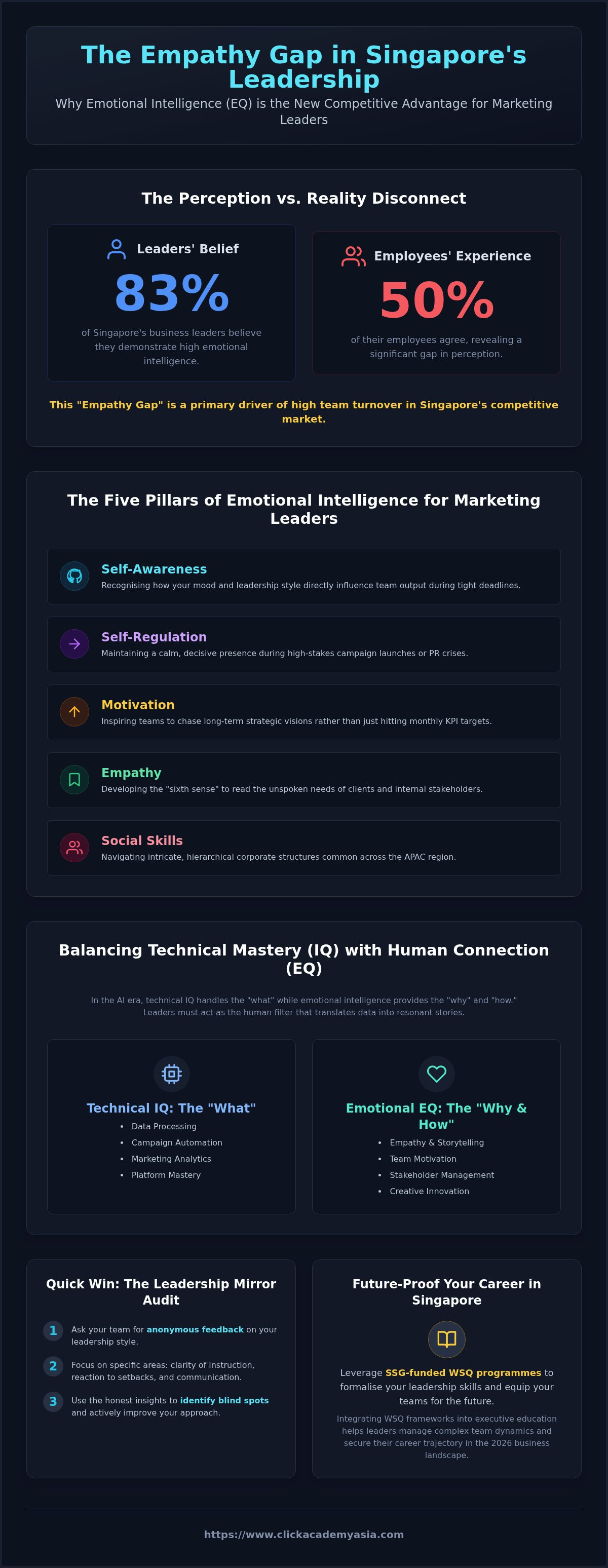
83% of Singapore's business leaders believe they demonstrate high emotional intelligence, yet only 50% of their employees agree. This stark "empathy gap" is a primary driver behind high team turnover in our competitive local market, making emotional intelligence for marketing leaders a critical priority for 2026. As a leader in Singapore, you're likely facing increased pressure to deliver results while your team grapples with anxiety over AI replacing their roles. It's a difficult balance to strike, especially when communication breakdowns between your creative and technical departments stall progress.
By developing your EQ, you'll learn to lead high-performing teams that feel valued rather than automated. This guide explores how to leverage human-centric leadership to improve morale, manage complex stakeholder relationships, and blend data-driven insights with genuine empathy. We'll also look at how SSG-funded programmes can help Singapore PMEBs transition into this new era of marketing excellence.
Table of Contents
The Strategic Importance of Emotional Intelligence for Marketing Leaders in Singapore
In a marketing context, Emotional Intelligence (EQ) isn't just a soft skill; it's the ability to perceive, control, and evaluate emotions to drive strategic outcomes. For Singaporean PMEBs in 2026, this capability has moved from a "nice-to-have" trait to a non-negotiable requirement. As technical barriers fall, the capacity to lead with empathy determines who thrives and who merely survives. High-pressure environments like campaign launches demand leaders who can maintain composure and motivate teams under fire. Emotional intelligence for marketing leaders serves as the bridge between cold data and human connection, ensuring that campaigns resonate with audiences while keeping internal teams intact.
Bridging the leadership gap requires structured development. Many global firms in Singapore are now leveraging SSG-funded training to equip their directors with these human-centric skills. By integrating WSQ frameworks into executive education, leaders can formalise their ability to manage complex team dynamics. You can explore these development pathways through ClickAcademy Asia to ensure your leadership style remains future-proof.
Why Technical IQ is No Longer Enough
The role of a marketing head has shifted dramatically from tactical execution to high-level strategic leadership. While technical IQ was the primary benchmark for decades, automation now handles the heavy lifting of data processing and campaign execution. This leaves the "human element" as the primary value-add for senior PMEBs. Emotional intelligence for marketing leaders acts as the human filter that translates raw marketing analytics into resonant consumer stories. When AI provides the "what," your EQ provides the "why" and the "how" that moves people to action.
Navigating Singapore’s Competitive Talent Market
Employee turnover in Singapore's marketing sector remains a costly challenge for brands. Replacing a senior marketer often costs several times their annual salary when accounting for recruitment and lost productivity. Empathetic leadership is the most effective tool for fostering loyalty, particularly among Gen Z and Millennial marketers who prioritise purpose and psychological safety. When your team feels safe to fail, they're more likely to propose the bold, creative innovations that win awards and market share. Leaders who master this balance create a culture where high performance and mental well-being coexist.
The Five Pillars of EQ for Modern Marketing Management
Mastering emotional intelligence for marketing leaders requires a deep dive into five core pillars. These aren't just abstract concepts; they're the operational tools that separate high-performing PMEBs from those who struggle with team burnout. In the 2026 Singaporean market, where talent is mobile and expectations are high, these pillars provide a roadmap for sustainable leadership.
Self-Awareness: Recognising how your mood and leadership style directly influence team output during tight deadlines.
Self-Regulation: Maintaining a calm, decisive presence during high-stakes campaign launches or PR crises.
Motivation: Inspiring teams to chase long-term strategic visions rather than just hitting monthly KPI targets.
Empathy: Developing the "sixth sense" to read the unspoken needs of clients and internal stakeholders.
Social Skills: Navigating the intricate, often hierarchical corporate structures common across the APAC region.
If you're looking to refine these leadership traits, our Digital Transformation for Leaders programme offers a structured path to practical mastery.
Self-Awareness and Data-Driven Humility
Effective leadership starts with recognising your own cognitive biases. It's easy to fall in love with a specific audience segment or marketing strategy because it worked in the past. However, emotional intelligence for marketing leaders involves the humility to accept feedback from junior specialists who are closer to the latest platform trends. Don't let ego cloud your strategic judgement. You can perform a "Leadership Mirror" audit by asking your team for anonymous feedback on three specific areas: your clarity of instruction, your reaction to setbacks, and your openness to new ideas. This quick win provides immediate data on where your self-perception might differ from your team's reality.
Empathy in Stakeholder Management
Stakeholder management is often where marketing strategies succeed or fail. Empathy allows you to translate complex marketing jargon into the language of the C-suite. Your CFO doesn't need to hear about "engagement rates"; they need to understand how your strategy protects the bottom line. By viewing the business through their emotional lens, you build stronger cross-departmental bridges. This empathy also extends to the sales department. Instead of blaming sales for poor lead conversion, use your EQ to understand their daily challenges. When sales and marketing departments feel heard and supported by one another, the entire organisation's performance improves.
EQ vs. Technical Mastery: Balancing Soft Skills in the AI Era
Many leaders believe that as marketing becomes more automated, technical mastery is the only shield against irrelevance. This is a fundamental misunderstanding of how the 2026 landscape operates. While AI agents can now handle the heavy lifting of execution, they cannot manage the human emotions of the people operating them. Emotional intelligence for marketing leaders is what prevents a high-tech department from becoming a low-morale environment. You don't just need to know how the algorithm works; you need to know how your team feels about the algorithm.
Technical proficiency in SEO or SEM is essential for baseline operations, but it doesn't help you pitch a disruptive strategy to a skeptical board. You need EQ to read the room, address unspoken concerns, and build consensus among stakeholders with competing interests. Balancing these technical skills with human-centric leadership is a core component of Mastering Strategy: The WSQ Digital Marketing Framework, which helps Singapore PMEBs integrate high-level planning with effective team management.
Leading Through Digital Transformation
Digital transformation isn't just about switching to a new tech stack; it's about managing the human transition. When you introduce new automation tools, your team's first reaction is often fear for their job security. EQ allows you to spot this "AI anxiety" early and pivot the conversation toward a growth mindset. By validating their concerns and showing how technology augments their unique human value, you turn resistance into active adoption. In this context, EQ is the bridge between technical capability and strategic execution, much like how a digital confidence coach NZ helps individuals build the mindset needed to navigate technological shifts.
High-EQ leadership provides a tangible return on investment by reducing the "friction cost" of miscommunication. In complex multi-channel campaigns, communication breakdowns between creative and data teams can delay launches and inflate budgets. Leaders who can mediate these conflicts see higher project success rates and significantly lower team turnover. This emotional agility also improves how you handle external partners. Managing vendor and agency relationships requires more than a contract; it requires the social skills to align different company cultures toward a single goal. Emotional intelligence for marketing leaders ensures that these partnerships remain productive even when campaign performance hits a temporary plateau.
Practical Frameworks to Optimise Your Leadership Style Using EQ
The impact of these interpersonal skills often transcends professional boundaries. For high-achieving professionals looking to mirror their career success in their personal lives, Rachel Mailer Coaching provides expert dating and relationship guidance focused on creating genuine, lasting connections.
Practical application is where emotional intelligence for marketing leaders delivers the highest return. It moves beyond abstract theory into the daily interactions that define your team's culture. In the high-pressure Singaporean market, having a set of reliable frameworks allows you to lead with consistency even when campaign performance is volatile. These tools help you navigate human complexity with the same precision you apply to a media plan.
Use the "Active Listening" technique during client discovery meetings to uncover the emotional anxieties behind a brief. Instead of jumping to technical solutions, reflect the client's concerns back to them to ensure they feel truly understood. This builds the psychological capital required to pitch risky creative campaigns later. By reading emotional cues like hesitation or defensive body language, you can time your pitch for when the client feels most secure. These skills are integral to effective Sales Leadership, where understanding the buyer's emotional state is the primary driver of conversion.
The Conflict Resolution Roadmap
Disagreements are inevitable in fast-moving marketing departments. Use this three-step roadmap to resolve friction without damaging relationships:
Step 1: De-escalate. If a meeting becomes heated, call a five-minute "reset" to lower emotional responses and allow for rational reflection.
Step 2: Identify Needs. Look past the professional argument to find the core human need, such as a desire for recognition or a fear of project failure.
Step 3: Co-create. Invite all parties to build a solution that respects these underlying needs while still meeting the business objective.
Developing a High-EQ Hybrid Work Culture
Maintaining emotional connection in Singapore's hybrid work environment requires intentionality. You can't rely on office "vibes" to gauge morale; you must look for digital cues. A sudden shift in communication style, such as uncharacteristically brief messages or a persistent "camera-off" policy, often signals burnout. To build trust virtually, swap generic team-building for "vulnerability minutes" where leaders share a recent professional challenge they've faced. This humanises leadership and encourages a culture where specialists feel safe to report errors before they become campaign-ending disasters. To formalise these leadership strategies within your organisation, consider enrolling your management team in our Sales Leadership training programme.
Future-Proofing Your Career: Leadership Development through WSQ-Funded Programmes
Developing emotional intelligence for marketing leaders isn't a one-time achievement; it's a career-long practice of refinement. As the 2026 marketing environment becomes increasingly automated, your ability to provide human-centric leadership remains your most durable competitive advantage. ClickAcademy Asia, established in 2011, specialises in bridging this gap by providing PMEBs with structured, practical education that translates high-level EQ theory into tangible business results. We focus on empowering you to lead with confidence in a landscape where technical skills are only half the equation.
Enrolling in Certified Marketing Leadership Tracks
While ad-hoc online tutorials offer quick fixes, they often lack the depth required for strategic leadership. Structured WSQ-certified programmes provide a rigorous framework that ensures standardised quality across the Singaporean industry. These tracks allow you to step away from daily operations and engage in high-level networking with other senior marketing professionals in Singapore. This peer-to-peer exchange is invaluable for cross-pollinating ideas and finding collaborative solutions to common leadership challenges. To maintain a well-rounded skill set, you should balance these human-centric skills with technical mastery by exploring our guide on [Internal Link: Choosing the Best Advanced SEM Strategies Course in 2026: A Buyer’s Guide].
Leveraging SSG Subsidies for Corporate Training
Professional development in Singapore is highly accessible thanks to significant government support. HR managers can utilise the SkillsFuture Enterprise Credit (SFEC), which provides up to $10,000 to support workforce transformation and leadership upskilling. For individual PMEBs, the Mid-Career Enhanced Subsidy (MCES) offers Singapore Citizens aged 40 and above subsidies of up to 90% for WSQ-accredited modules. Even baseline funding provides up to 70% subsidy for Singapore Citizens and Permanent Residents, making it easier than ever to equip your entire team with advanced EQ skills.
The process of claiming these subsidies is streamlined for WSQ courses, reducing the administrative burden on your finance department. By choosing accredited training, you're guaranteed a curriculum that aligns with national standards for excellence in marketing and leadership. This investment in your team's emotional agility directly impacts retention and campaign performance. You can contact ClickAcademy Asia today to customise a leadership development programme that fits your organisation's specific needs and maximises your available SSG funding.
Lead with Human-Centric Strategy in 2026
As automation reshapes the marketing landscape, your human-centric leadership remains your most valuable asset. Mastering emotional intelligence for marketing leaders allows you to navigate team anxieties, bridge communication gaps between technical and creative departments, and drive high-performance results that data alone cannot achieve. By integrating the five pillars of EQ into your daily management, you transform from a tactical supervisor into a strategic mentor who can thrive in the face of digital transformation.
Now is the time to formalise these capabilities. Equip your team with future-ready leadership skills through ClickAcademy Asia’s WSQ-funded programmes. Our WSQ-certified modules are taught by industry practitioners with real-world experience, ensuring practical mastery rather than just theory. With up to 70-90% SSG funding available for eligible Singaporeans and PRs, professional development is both accessible and impactful. Take the next step in your career journey and lead your organisation toward a more empathetic, high-performing future in Singapore.
Frequently Asked Questions
Why is emotional intelligence for marketing leaders more important in 2026?
Technical execution is increasingly automated by AI agents, meaning raw IQ and data processing are no longer unique human advantages. Marketing leaders must now focus on human-centric strategy, team motivation, and navigating the psychological impact of digital transformation. Without high EQ, leaders struggle to bridge the gap between data-driven insights and consumer resonance. It's the primary differentiator for PMEBs looking to maintain high team retention in Singapore's competitive talent market.
Can emotional intelligence be taught through professional training programmes?
Yes, emotional intelligence is a skill set that can be developed through structured professional training. While some traits are innate, the practical application of EQ in a corporate setting is best learned through expert-led workshops. ClickAcademy Asia provides WSQ-certified modules that focus on leadership and digital transformation. These programmes use real-world scenarios to help PMEBs refine their self-awareness, empathy, and conflict resolution skills in a professional environment.
How does EQ affect the ROI of digital marketing campaigns?
EQ directly improves ROI by reducing the "friction cost" of miscommunication between departments. When marketing leaders use emotional intelligence to align creative and technical teams, campaigns launch faster and with fewer errors. Better stakeholder management also ensures that budgets are approved for innovative strategies. By understanding the emotional needs of the audience, high-EQ leaders create campaigns that drive higher engagement and conversion rates than purely data-led approaches.
Are there WSQ-certified courses in Singapore that focus on leadership and EQ?
Singapore offers several WSQ-certified courses that integrate EQ into leadership frameworks. ClickAcademy Asia provides programmes like Digital Transformation for Leaders and Sales Leadership, which are designed specifically for PMEBs. These courses are accredited under the WSQ framework, ensuring they meet national standards for quality. They include modules on managing team dynamics and stakeholder relationships, making them ideal for those looking to formalise their emotional intelligence for marketing leaders.
How can I measure the emotional intelligence of my marketing team?
You can measure EQ through a combination of qualitative feedback and quantitative metrics. Conduct "Leadership Mirror" audits or anonymous 360-degree feedback sessions to gauge how team members perceive management's empathy and communication. On a broader level, monitor team retention rates and employee engagement scores. High turnover or persistent communication breakdowns between departments often signal a need for EQ development within the leadership tier or the wider marketing team.
What is the link between EQ and managing AI in a marketing department?
EQ is the essential tool for managing the human transition to AI-driven workflows. As automation takes over routine tasks, many employees experience anxiety regarding their job security. Leaders with high emotional intelligence recognise these fears early and pivot the conversation toward how AI augments human value. By fostering a growth mindset, they ensure that the team remains motivated and collaborative rather than resistant to new technology stacks.
How do I use SkillsFuture credit for marketing leadership courses?
You can apply SkillsFuture credit and SSG funding directly to WSQ-accredited programmes. Singapore Citizens aged 40 and above can utilise the Mid-Career Enhanced Subsidy (MCES) for subsidies of up to 90%. HR managers can also leverage the SkillsFuture Enterprise Credit (SFEC) for team-wide training. Simply select a WSQ-certified course from ClickAcademy Asia and the subsidies are often applied during the enrollment process, significantly reducing the out-of-pocket costs.
What are the first steps to improving my EQ as a Marketing Manager?
Start by practicing active listening in your daily meetings to better understand client and team needs. Reflect on your emotional reactions during high-pressure campaign launches and identify areas where you can improve your self-regulation. Enrolling in a structured programme like Digital Transformation for Leaders is also a vital step. This provides you with the frameworks and peer feedback necessary to transition from a technical specialist to a high-EQ strategic leader.



Comments