
Providing Constructive Feedback to Creatives with Clear Examples

Useful creative feedback does more than identify what feels wrong. Providing constructive feedback to creatives means offering specific, respectful suggestions that improve the work while keeping the project’s goals in view. Focus on the output, not the person who made it, and explain why a change could make the work more effective.
Commenting on creative work can be challenging because personal preferences and project objectives do not always align. Learn what constructive feedback looks like, why these conversations can feel difficult, and how to identify a problem without taking ownership away from the creative. The examples below show how to turn vague reactions into clear, actionable suggestions grounded in the brief.
Table of Contents
1. What is constructive feedback?
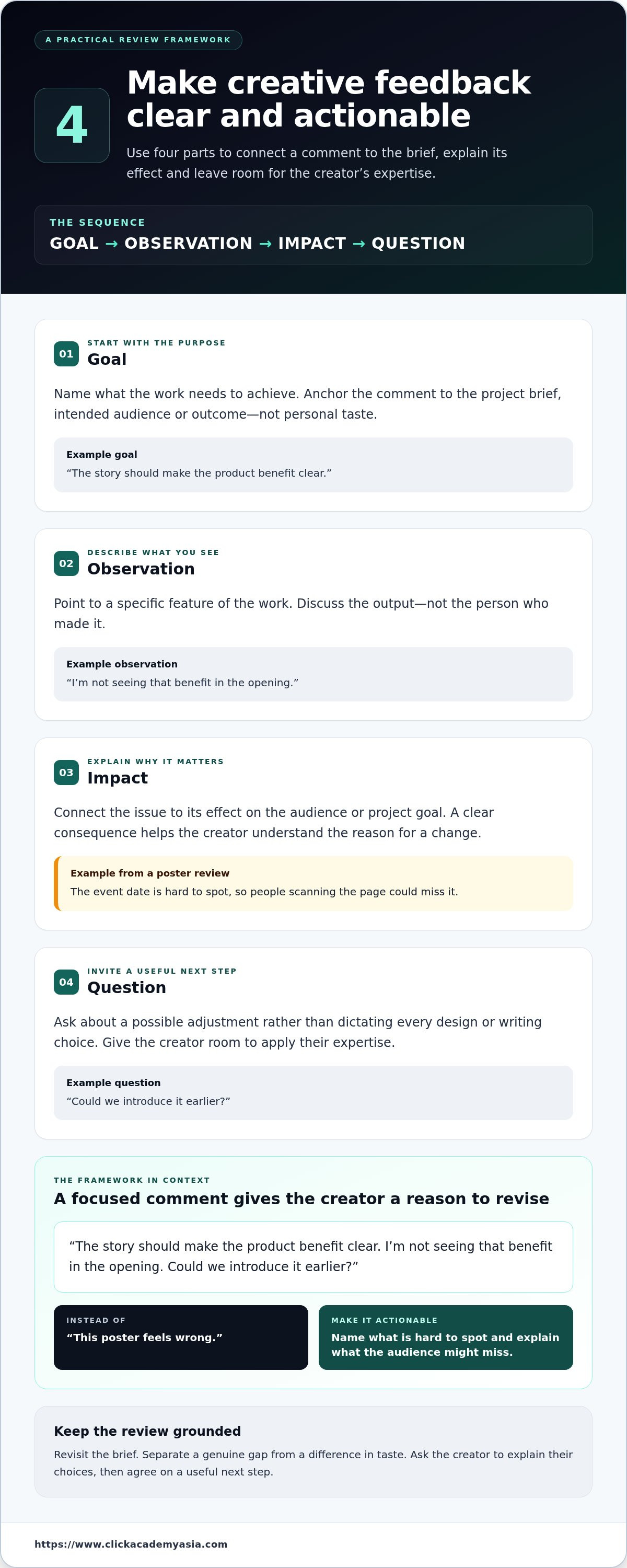
Constructive feedback helps improve a piece of work in relation to its purpose. It links an observation to the project goal and identifies a useful next step. Instead of saying, “This poster feels wrong,” explain that the event date is hard to spot and could be missed by people scanning the page. This addresses the poster, not the designer’s ability or taste.
Effective feedback is specific, respectful and actionable. Before commenting, revisit the brief and ask: Who needs to respond to this work? What should they understand or do? Which requirement matters most? If a campaign aims to encourage sign-ups, assess whether its message and call to action make that goal clear, rather than whether you personally like the colour palette.
Keep criticism tied to the agreed project goals. A useful comment might be, “The opening explains the service, but the intended customer benefit appears near the end. Could we bring it forward?” This gives the writer a clear reason to revise. For a designer, “The button blends into the background, so the next step is easy to overlook” identifies a visual issue and its effect without prescribing every design choice.
Before giving feedback, ask the creator to explain the choices behind the work. Questions such as “What should the audience notice first?” and “Which part of the brief shaped this layout?” can reveal whether a choice is deliberate or a genuine gap. The conversation helps reviewers distinguish a missed requirement from a different, valid interpretation.
A practical framework for writers, designers and artists is goal, observation, impact, question. Name the goal, describe what you see, explain its effect, then ask about a possible adjustment. For example: “The story should make the product benefit clear. I’m not seeing that benefit in the opening. Could we introduce it earlier?” Apply the same sequence to a webpage layout, illustration or campaign concept.
Tailor comments to the creator’s goals and experience. With a new team member, identify one successful choice and one priority improvement, such as strengthening the headline’s connection to the brief. With an experienced artist, discuss the intended emotional effect and where the composition supports or distracts from it. In both cases, separate feedback on the idea from feedback on its execution.
Creatives can respond to feedback by listening for the goal behind each comment, asking for clarification and recording agreed actions. They might ask, “Which audience need should this revision address?” or explain why a different approach better serves the brief. The reviewer offers guidance; the creator applies their expertise to develop the work.
2. Recognise the difficulty of giving creative feedback
Giving feedback can feel uncomfortable when a colleague has invested thought and care in a draft. It may also feel risky if the reviewer is not a designer, writer or artist. Separate the relationship from the review: discuss the work’s effect, then connect your comment to a shared project requirement. For example, “The opening sets a warm tone, but the key service detail arrives late” is candid without judging the writer.
Balance praise and criticism by naming a specific strength before identifying one priority for improvement. “The illustrations make the guide approachable; the labels need stronger contrast so readers can distinguish each step” gives the artist useful recognition and clear direction. Avoid praise that sounds like a cushion, such as “Great work, but everything needs changing.” It can make the criticism feel greater and leave the creator unsure what to retain.
Subjective opinions and differing creative visions are easier to discuss when the team returns to the brief. Ask what the intended audience should feel, understand or do, then compare each proposed direction with that goal. A reviewer may prefer a restrained layout, while the creative team favours a bold one. If both approaches serve the brief, treat the difference as a decision to discuss, not proof that someone is wrong.
Honesty does not require prescribing the design. Describe the issue and its consequence, then give the creative room to solve it. For example, “The headline doesn’t explain the offer, so a new visitor may not understand the page” is clearer than “Make the headline bigger and use blue.” The first comment defines the communication problem; the second dictates execution without explaining why.
For a creative review in Singapore, agree on the brief, decision-maker and review purpose before discussing the draft. Ask each reviewer to connect comments to a project goal, and have one person consolidate overlapping notes. This keeps feedback clear across marketing, design and leadership roles. If a stakeholder simply says, “I don’t like it,” ask which audience need or business objective informs that reaction.
Keep criticism proportionate to the issue. A missed requirement needs direct correction; a difference in style calls for discussion about audience and intent. Give the creator room to explain their reasoning, clarify ambiguous notes and propose a response. Teams can strengthen the strategic thinking behind content reviews through deliberate practice and ClickAcademy Asia Sales/Marketing courses.
Managers giving feedback on creative work should first consider whether their expectations were clear and realistic. Feedback should be honest, sincere, kind and respectful, and address specific features of the work in relation to the end goal. Creative directors should respond to ideas rather than leave creatives without guidance. Clients should communicate what they want a design to achieve instead of dictating its execution. They should not request additional design versions without explaining what works, what does not and why. When reviewing a first draft, clients should focus on understanding the designer’s choices and rationale rather than expecting a perfect result.
3. Identifying problems instead of prescribing solutions
Start a review by comparing the deliverable with its intended use, rather than choosing a redesign. For a product page, trace what a first-time visitor needs to understand before taking action. If the price appears before the product’s main benefit, identify the sequence and its effect. Don’t jump straight to “Put the benefit at the top”; another layout may solve the same problem more effectively.
Separate what you can observe from what you assume. “The headline uses a technical term” is an observation; “customers won’t understand it” is a prediction. Make the concern testable by asking whether the intended audience knows the term or whether a plain-language alternative would clarify the offer. This gives the copywriter a specific question to investigate, rather than a directive based on instinct.
Questions can reveal the reasoning behind a creative choice. If a campaign image feels disconnected from its message, ask, “What should the audience take away from this visual?” The designer may explain a link that isn’t obvious in the draft. If that explanation does not resolve the gap, discuss how the image supports the campaign objective.
Avoid common review mistakes: vague reactions, personal preferences presented as requirements, and unrelated corrections bundled together. “Make it pop” does not identify whether the issue is contrast, hierarchy or audience attention. Similarly, asking for a new colour, shorter copy and different imagery in one note makes it hard to understand which change addresses the actual problem.
Providing constructive feedback to creatives means distinguishing the underlying issue from your preferred fix. If a sign-up form seems difficult to complete, describe where a user might hesitate, such as an unexplained field asking for company details. Ask what information is essential at that stage, then let the designer explore ways to reduce friction without removing information the team needs.
Prioritise the problem that most affects the project’s purpose. A presentation might have inconsistent spacing and an unclear recommendation, but the recommendation is likely the more important issue to discuss. Explain why the audience needs to find the decision easily, then invite the creative to suggest how the slide can make that message more prominent.
Providing constructive feedback to creatives also means leaving room for a response. A reviewer might say, “The opening doesn’t establish why this report matters to sales managers. What context would help them act on the findings?” The writer may suggest a short scenario, a sharper opening claim or another approach. Assess the suggestion against the reader’s needs, not your preferred solution.
the audience or its need,” then explain why that isn’t working. Compare the creative work with the brief, identifying where it aligns and where it does not. State specifically what is not working and why, rather than offering an unexplained negative reaction. Managers can describe the problem without dictating a solution, preserving the creative’s ownership of the response. Keep the note focused instead of listing every change; a question can help the creative find an answer and take ownership.
4. Offering specific suggestions and examples
Specific feedback gives a creative professional something to test in the next draft. Name the detail, explain its effect, and connect it to the audience or task. For example, “The opening paragraph introduces the organisation before explaining the reader’s problem. Could we lead with the problem so the value is clear sooner?” identifies a precise issue and a reason to act.
To make feedback actionable without discouraging a creative, describe the work rather than judging the person. Pair one genuine positive observation with a focused improvement, then explain why it matters. For a social post, try: “The image feels energetic and suits the campaign. The caption’s action is less clear, so readers may not know what to do next.” This recognises an effective choice while making the revision goal visible.
Use examples to clarify your point, not to insist on one answer. If a report’s chart is difficult to interpret, point to the crowded legend and ask whether labels beside each line would make comparisons easier. If the designer has another solution, discuss how well it improves readability. That keeps the suggestion practical while leaving creative decisions to the person doing the work.
For usability feedback, describe a realistic use case. Instead of writing, “The form is confusing,” explain: “A first-time visitor reaches the delivery field before seeing which details are required. Could we make the required fields clearer?” This gives the creative a situation to evaluate and helps distinguish a genuine barrier from a reviewer’s preference for a particular layout.
Replace broad comments with precise observations. “The tone is off” could mean the language feels too formal, the humour distracts from the offer, or the wording doesn’t suit the intended audience. Identify the line that raises concern and explain its effect: “The phrase ‘best-in-class’ sounds generic here. Could we use a concrete customer benefit instead?”
Keep each comment focused on a changeable issue. A poster review might note that the venue name is less prominent than the sponsor logos, making the location harder to find. Ask whether the venue could be easier to spot at a glance. Avoid unrelated requests about colour, typography and imagery unless they address the same problem.
Before sending notes, read each comment as if you were receiving it. Can the creator locate the issue, understand its impact and identify a useful next step? If not, add an example or clarify the rationale. “Shorten this” offers little direction; “The introduction repeats the headline’s main point, so could we use that space for the customer example?” gives the writer a clear revision path.
5. Defining constructive feedback
Constructive feedback is a purposeful exchange that helps creative work meet its intended outcome. It combines a clear observation, a reason grounded in the project and room for the creator’s judgement. For a podcast script, “The guest’s key insight appears after the sponsor message, so listeners may miss it” identifies a concern without dismissing the idea or dictating a rewrite.
It also separates the idea from its execution. A concept may suit the audience, while a particular draft obscures its value. For example, a campaign’s central promise could be compelling, but the supporting copy may introduce too many benefits at once. Naming that distinction helps teams preserve a strong idea while improving how it reaches people.
Reasoning matters. “This doesn’t work” gives the creator no useful basis for revision. “The infographic introduces three unfamiliar terms before explaining the process, which may make the first step hard to follow” connects an observable detail to its likely effect. The creative can then assess the issue and choose an appropriate response.
Useful feedback is actionable, but it does not need to dictate every edit. A reviewer might say, “The case study’s outcome is difficult to find; could we make the result more prominent?” That identifies a specific improvement while inviting the writer to apply their judgement. A fixed instruction about sentence order might address the reviewer’s concern but limit better options.
Dialogue makes the exchange more reliable than a one-way list of corrections. The reviewer can explain the objective, and the creator can describe the reasoning behind a choice. If an animation’s opening feels slow, ask what viewers need to understand before the main action. The answer may show that the pacing supports the story or reveal where clarity needs work.
Constructive comments should reflect the creator’s experience and role. A junior copywriter may benefit from an explanation of why a claim needs evidence; an experienced art director may prefer a focused discussion of how the visual hierarchy supports the concept. In either case, criticism should address identifiable work and useful next steps, not character or presumed effort.
Think of a comment as a small learning loop: identify the intended result, describe the work’s effect, explain the gap, and agree on what to explore. After reviewing a presentation deck, for instance, a manager might note that the recommendation appears after extensive background. The team can discuss how to bring the decision into focus while retaining necessary context.
That is the defining difference: constructive feedback develops both the deliverable and the creator’s understanding of the brief. Teams can strengthen their content planning and review skills through ClickAcademy Asia’s [Internal Link: ClickAcademy Asia Content Marketing Strategy].
ClickAcademy Asia: WSQ Digital Marketing Strategy & Planning
ClickAcademy Asia’s WSQ Digital Marketing Strategy & Planning helps professionals connect marketing decisions with audience needs and business objectives. It is a relevant next step when creative reviews need stronger strategic context or when teams want to align campaign content with a clear plan.
For teams focused on content, WSQ Content Marketing Strategy can help develop skills in planning and creating purposeful content. Other relevant learning options include WSQ Search Engine Optimization (SEO) and WSQ Search Engine Marketing (SEM). These programmes support practical upskilling for professionals who want to contribute more confidently to digital marketing work and team discussions.
Choose the learning focus that best matches your team’s current priorities. Visit ClickAcademy Asia to explore its training options.
Build feedback into your team’s growth
Make thoughtful review part of how your team works, then strengthen the skills that support it. As you practise providing constructive feedback to creatives, build the strategic capability to connect creative decisions with business priorities and audience needs.
Develop relevant skills through WSQ-funded training that supports stronger marketing planning and collaboration. Choose a learning focus that reflects your team’s development goals, then apply it to upcoming projects.
Contact ClickAcademy Asia to discuss WSQ-funded training tracks for your team and take a considered next step towards stronger creative collaboration.
Frequently Asked Questions
What is constructive feedback?
Constructive feedback is guidance that improves creative work while keeping its purpose and the creator’s professional growth in view. For example, if a newsletter’s subject line promises a product launch but the email announces a customer event, explain the mismatch and its effect on reader expectations. This gives the writer a clear issue to address and helps the team keep future campaign messages consistent.



Comments