
Leadership Training for Marketing Managers in SINGAPORE: A 2026 Strategic Guide
- ClickAcademy Asia

- 2 minutes ago
- 12 min read
Why do the most technically gifted marketing "doers" in SINGAPORE often struggle the most when they transition into management? It's a common frustration for many PMEBs who find that the technical expertise that earned them a promotion isn't enough to lead a diverse team or defend a budget to the C-suite. You're likely feeling the pressure of being caught between daily execution and the urgent need for high-level strategic influence, which is why targeted leadership training for marketing managers has become essential for career progression.
Mastering this shift requires more than just years of experience; it demands a deliberate evolution of your professional toolkit. This guide provides a clear roadmap to bridge that gap, focusing on the soft skill assessments and strategic mindsets required for the 2026 landscape. We'll show you how to stop being "stuck" in the weeds and start operating as a high-impact leader who commands respect across the organisation.
We will explore how to move beyond the execution trap, utilise SSG-funded programmes for team growth, and master the art of justifying marketing value to non-marketing stakeholders. By the end of this guide, you'll have the framework to lead with confidence and future-proof your career in the APAC region's competitive market.
Key Takeaways
Transition from tactical execution to strategic influence by understanding the specific demands of the 2026 SINGAPORE business landscape for PMEBs.
Master "Strategic Heuristics" to manage diverse teams and communicate marketing value clearly to non-marketing stakeholders.
Learn how to assess hard-to-teach soft skills like EQ and influence during recruitment using a structured leadership evaluation framework.
Compare the benefits of WSQ-certified courses against executive education to select the most impactful leadership training for marketing managers.
Develop a practical roadmap to audit team capabilities and leverage SSG-funded upskilling to future-proof your department.
Table of Contents
Why Leadership Training for Marketing Managers is Essential in SINGAPORE for 2026
Success in the SINGAPORE marketing scene in 2026 is no longer defined by how well you can run a campaign, but by how effectively you can lead the people behind it. Marketing leadership serves as the vital bridge between technical execution and sustainable business growth. As the local market matures, PMEBs must pivot from being tactical "doers" to strategic "thinkers" who can align marketing efforts with high-level corporate objectives. Leadership training for marketing managers is the catalyst for this transformation, turning specialists into visionary leaders who can navigate the complexities of a regional hub.
To better understand the core concepts of marketing management and how they apply to leadership, watch this helpful video:
The Workforce Skills Qualifications (WSQ) framework has fundamentally raised national professional standards in SINGAPORE, ensuring that leadership is grounded in practical, industry-aligned competencies. Leadership training represents a strategic investment in team retention and long-term ROI. By adopting these standards, managers move beyond basic supervision to inspire innovation across their departments. It's about creating a culture where technical skills are supported by a strong foundation of professional excellence.
The Gap Between Technical Mastery and Strategic Influence
Being an expert in SEO or SEM is a fantastic foundation, but it's no longer enough to secure a promotion to senior management. Many talented professionals fall into the "execution trap," where they remain bogged down in daily tasks rather than focusing on the bigger picture. This creates a ceiling for growth that technical skills alone cannot break. Leadership training for marketing managers helps bridge this gap by providing the tools to delegate effectively and influence the C-suite. It facilitates a smoother transition to Director roles by shifting your focus from "how" a task is done to "why" it matters for the bottom line.
Future-Proofing Your Career in the 2026 Digital Ecosystem
AI is rapidly automating technical execution, which makes leadership the new "human premium" in the modern workforce. Modern leaders must be able to manage complex digital transformations that go beyond simple software implementation. Understanding foundational leadership development principles is crucial for anyone looking to navigate these changes with confidence. This expertise allows you to mentor your team through shifts in technology while maintaining a steady focus on business outcomes. For a broader look at how these skills fit into the current market, you should explore mastering the 2026 landscape through WSQ digital marketing courses in SINGAPORE. Investing in these soft skills ensures you remain indispensable as the digital ecosystem continues to evolve.
Core Competencies of a Modern Marketing Leader
Managing a marketing channel is a technical skill. Managing the diverse perspectives of a corporate board is a leadership art. In the current SINGAPORE business environment, the most effective leadership training for marketing managers focuses on this critical shift from managing "channels" to managing "people and perspectives." You're no longer just responsible for campaign ROI; you're responsible for organisational alignment and the professional growth of your team.
High-pressure environments like SINGAPORE require "Strategic Heuristics." These are mental shortcuts that allow leaders to make rapid, accurate decisions when faced with data overload. Instead of getting lost in every minor metric, a modern leader uses these frameworks to identify which 20% of activities will drive 80% of the business results. This ability to filter noise and focus on strategic impact is what separates a senior manager from a tactical lead.
Data literacy has also evolved into a primary leadership tool. It's not about knowing how to set up a tag in GA4, but about interpreting that data to tell a compelling story to the board. When you can translate complex analytics into clear business outcomes, you gain the influence needed to secure larger budgets and drive digital transformation. To sharpen these specific skills, you might consider how to optimise your strategic reporting through advanced analytics training.
Leading with a Customer Perspective
A modern leader must be the primary advocate for the customer at the executive table. This involves more than just looking at personas; it requires aligning every marketing goal with the broader business vision. You should focus on these practical steps to build a customer-centric culture:
Bridge the Silos: Ensure your marketing data informs sales and product development.
Advocate with Evidence: Use qualitative customer feedback to challenge internal assumptions.
Strategic Reporting: Integrate high-level insights from your marketing analytics and GA4 platforms to prove how customer satisfaction drives revenue.
Managing and Mentoring High-Performance Teams
Your role has shifted from "checking work" to "developing talent." In SINGAPORE'S competitive PMEB market, retaining top talent requires effective feedback loops, especially for remote and hybrid teams. You don't just want a team that hits targets; you want a team that innovates. Focus on these mentoring techniques:
Outcome-Based Management: Measure success by results rather than hours spent at a desk.
Proactive Feedback: Move beyond annual reviews to weekly "pulse checks" that address challenges in real-time.
Burnout Prevention: Encourage boundaries and prioritise high-impact work to maintain team energy in our high-intensity market.
By mastering these competencies, you transform from a manager who executes tasks into a leader who shapes the future of the brand.
Assessing Soft Skills in Marketing Interviews: A Practical Guide
Hard skills are easy to verify through certifications and portfolios. However, identifying the emotional intelligence and influence required for high-level management is far more complex. Soft skills like adaptability and EQ are significantly harder to teach than technical execution, making them the primary differentiator in your hiring process. When you invest in leadership training for marketing managers, you're essentially looking to cultivate these elusive traits in your existing team or identify them in new recruits.
The cost of a bad hire in the tight SINGAPORE PMEB market is staggering. It's not just the recruitment fee; it's the ripple effect of low team morale and stalled digital transformations. To mitigate this risk, you need a "Marketing Leadership Heuristic" that weighs a candidate's ability to influence over their ability to execute. Before your next interview, use this preparation checklist:
Define the Stakeholders: Identify exactly who the candidate will need to influence (e.g., Sales, Finance, or Regional Directors).
Prioritise Resilience: Look for evidence of how they handled a failed campaign or a budget cut.
Assess Storytelling: Determine if they can turn raw data into a narrative that justifies marketing spend.
Behavioural Questioning Techniques for Marketers
The STAR method (Situation, Task, Action, Result) remains the gold standard for uncovering strategic thinking. You want to hear about the "why" behind their actions, not just the "what." Ask this sample question to test stakeholder management: "Tell me about a time you had to align three different agencies with conflicting KPIs for a single product launch in the APAC region." A major red flag is any response that blames external partners or fails to acknowledge the collaborative nature of the solution.
The Soft Skills Scorecard: What to Look For
A modern leader must be a "translator" who can strip away marketing jargon for the CEO. During the interview, ask the candidate to explain a complex concept like programmatic bidding or attribution modelling as if they were speaking to a non-marketing board member. If they can't simplify it, they'll struggle to lead. You can also implement a 10-minute crisis management pitch where they must respond to a sudden drop in lead quality. This reveals their resilience and intellectual curiosity under pressure.
Bridging the Gap with Leadership Training
Interviews often reveal gaps where a candidate has the right attitude but lacks the formal framework to lead. This is where WSQ-certified programmes become invaluable. By linking interview outcomes to a personalised development roadmap, you can hire for potential and use leadership training for marketing managers to build the specific competencies they lack. Striking the right balance between technical mastery and strategic influence ensures your team remains agile and results-oriented in a shifting market.
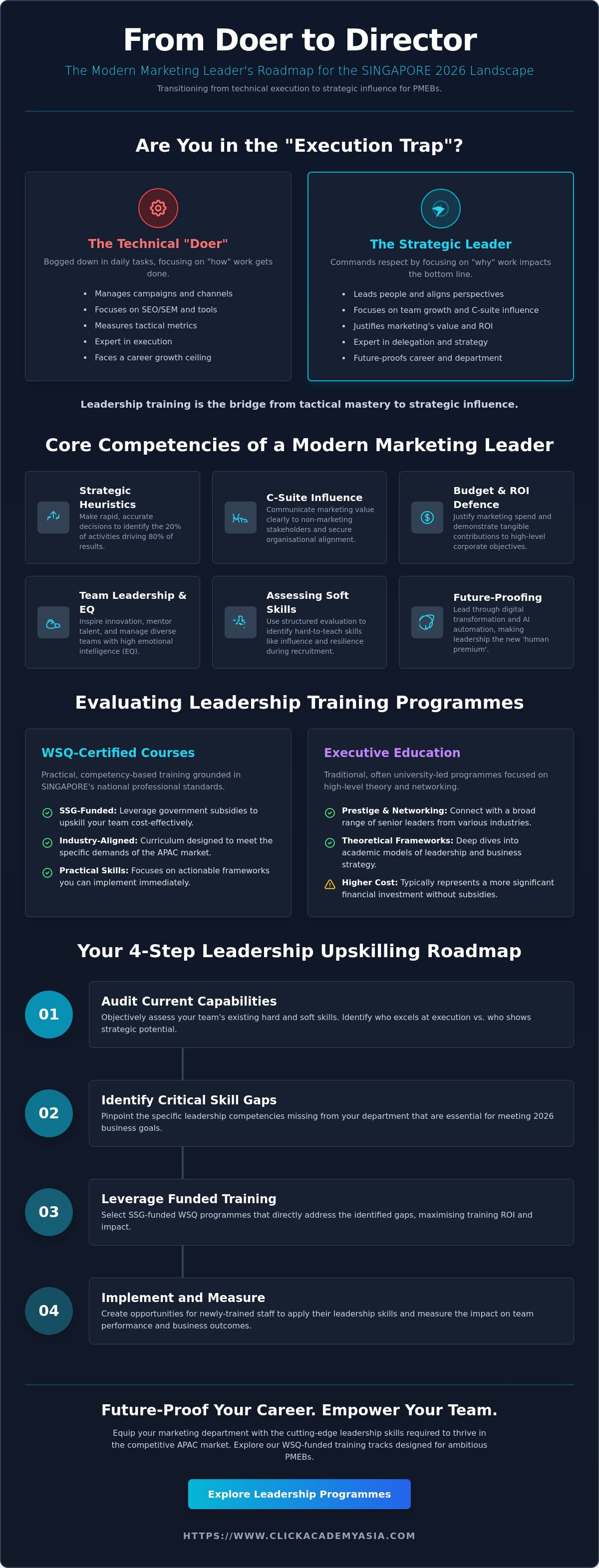
Evaluating Leadership Training Programmes: WSQ vs. Executive Education
Choosing between a two-day executive workshop and a modular certification pathway is a critical strategic decision for any PMEB. While high-level executive education offers prestige, leadership training for marketing managers within the WSQ framework provides a distinct advantage: immediate, practical application grounded in the local business ecosystem. For SINGAPORE-based professionals, the choice often rests on balancing long-term career recognition with the tangible ROI of specific skill acquisition.
Short-term workshops are excellent for "quick wins" or addressing a single knowledge gap. However, long-term certification pathways allow for a more profound transformation from a tactical specialist to a strategic leader. These programmes focus on building a comprehensive toolkit that includes data interpretation, team mentoring, and stakeholder influence. In the 2026 market, a certificate that proves you can apply theory to real-world SINGAPOREAN business challenges is far more valuable than a theoretical lecture.
The Power of WSQ and SSG Funding
The Workforce Skills Qualifications (WSQ) system is designed to meet national professional standards, making it highly respected by SINGAPORE HR decision-makers. One of the most significant benefits is the accessibility provided by SSG funding. Singaporeans aged 40 and above can receive up to 90% subsidy under the Mid-Career Enhanced Subsidy (MCES), while SMEs sponsoring their employees can also access up to 90% funding. This makes elite training a low-risk, high-reward investment for your department.
Navigating the SkillsFuture Credit portal is a straightforward process that allows you to offset remaining programme fees. When you calculate the final cost after maximum SSG funding, the barrier to high-quality upskilling virtually disappears. This financial support ensures that your team can stay ahead of technological shifts without draining your annual marketing budget. To see how these subsidies apply to your specific career path, you can explore our WSQ-funded leadership and marketing programmes.
What to Look for in a Training Provider
Not all training providers are created equal. You should prioritise institutions that employ industry-practitioner trainers rather than academic-only lecturers. You need mentors who have managed real marketing budgets and navigated complex digital transformations within the APAC context. Practical experience ensures the curriculum is relevant to the daily pressures you face in the SINGAPORE market.
A high-quality programme should also offer regional reach and post-training support. Marketing leadership in 2026 requires an understanding of how to scale strategies across diverse markets. Look for providers that offer networking opportunities with other senior PMEBs and corporate leaders. These connections often provide as much value as the curriculum itself, giving you a community of peers to consult as you implement your new leadership roadmap.
Upskilling for the Future: Implementing Your Leadership Roadmap
Your transition from a tactical manager to a strategic leader isn't an overnight event; it's a deliberate shift in focus. In the competitive SINGAPORE market, PMEBs who fail to evolve beyond execution-heavy roles risk becoming obsolete as AI continues to automate technical tasks. Embracing continuous learning is no longer a choice but a career non-negotiable for those aiming for the C-suite. Securing the right leadership training for marketing managers is the most effective way to ensure your department remains agile and your personal career trajectory stays upward.
Success in 2026 requires you to audit your team's current capabilities against the strategic needs of the next three years. This isn't just about technical proficiency but about the "human premium" of influence, storytelling, and complex decision-making. By identifying these gaps now, you can leverage the robust support of the SINGAPOREAN upskilling ecosystem to build a future-ready workforce without straining your resources.
Quick Wins: Actionable Steps for Monday Morning
You don't need a total department overhaul to start seeing results. Begin with these practical changes to shift the needle toward strategic leadership:
Audit Your Meetings: Review your calendar for the coming week. Are your discussions focused on high-level strategy or just status updates? Pivot at least 30% of that time toward long-term planning and problem-solving.
Identify a Soft Skill Gap: Pick one specific area where your team struggles, such as stakeholder influence or data storytelling. Research a relevant WSQ module that addresses this specific deficiency.
Initiate Career Dialogues: Schedule a 15-minute conversation with each direct report. Focus entirely on their professional growth and how upskilling can help them achieve their 2026 goals.
Equip Your Team with ClickAcademy Asia
As a premier destination for specialised education in the APAC region, ClickAcademy Asia is your vital partner in this transformation. We offer comprehensive leadership and sales management tracks designed for the modern professional. These programmes are grounded in real-world application, ensuring that you and your team can implement new strategies immediately. Our curriculum is aligned with the latest industry standards and global certifications.
If you're looking to upskill an entire department, we can help you request a customised corporate training plan. This ensures that every module is tailored to your specific business challenges and growth objectives. Most of our programmes are eligible for significant SSG funding, making high-level leadership training for marketing managers highly accessible. Empower your future-ready workforce today by exploring our WSQ-funded training tracks and securing your place as a leader in the digital age.
Lead the Future of Marketing in SINGAPORE
The transition from a technical expert to a strategic leader requires a fundamental pivot in how you approach your daily responsibilities. By mastering soft skill assessments and adopting a "mentor-strategist" mindset, you ensure your value remains high in an AI-driven ecosystem. Moving beyond the "execution trap" allows you to focus on high-impact decision-making that drives tangible business growth across the APAC region.
Investing in leadership training for marketing managers is the most reliable way to bridge the gap between campaign execution and board-level influence. As an Official Google Certification Partner, ClickAcademy Asia provides WSQ-certified and SSG-funded programmes delivered by industry experts with real-world experience. These tracks are specifically designed to help PMEBs navigate complex digital transformations with authority and confidence.
Equip your team with future-ready leadership skills by exploring ClickAcademy Asia’s WSQ-funded training tracks today. Your journey toward strategic mastery begins with a commitment to continuous upskilling. Stay agile, stay curious, and lead your organisation into the future of marketing with excellence.
Frequently Asked Questions
What is the most important soft skill for a marketing manager in 2026?
Adaptability and high emotional intelligence (EQ) are the most critical soft skills for the 2026 landscape. These traits allow you to navigate rapid technological shifts and manage diverse PMEB teams with empathy and clarity. Leaders who can pivot strategies based on real-time data while keeping their teams motivated will consistently outperform those who rely solely on technical mastery.
How can I use SkillsFuture Credit for leadership training in SINGAPORE?
You can use your SkillsFuture Credit to offset the out-of-pocket fees for any SSG-funded programme in SINGAPORE. Simply log in to the MySkillsFuture portal after registering for a course to submit your claim. It's a seamless way to reduce the cost of leadership training for marketing managers while you focus on high-level professional development.
Is WSQ certification recognised by global companies in the APAC region?
Yes, WSQ certification is highly respected by global organisations across the APAC region. Because the framework is built on industry-validated standards, it proves you possess practical, real-world competencies that transcend local borders. Many multinational corporations in SINGAPORE prioritise WSQ-aligned training to ensure their leaders meet rigorous national and international benchmarks.
How do I assess soft skills if the candidate has a perfect technical portfolio?
You should use behavioural questioning and practical simulations to look beyond the technical portfolio. Ask candidates to explain a complex campaign to a non-marketing stakeholder to test their "translation" skills and strategic influence. A perfect technical record doesn't guarantee the resilience or people-management skills needed for a senior leadership role.
What is the difference between marketing management and marketing leadership?
Marketing management focuses on operational efficiency and the execution of tactical tasks. In contrast, marketing leadership is about vision, strategic influence, and the development of talent. Leadership requires you to move from "checking work" to shaping the long-term growth of the brand and its people.
How long does a typical leadership training programme for marketing managers take?
The duration varies depending on the depth of the curriculum. Short-term WSQ workshops typically take 2 to 3 days to complete. More comprehensive modular pathways for senior PMEBs may be spread over several months to allow for practical application and mentoring between sessions.
Can leadership training help me influence stakeholders who don't understand digital marketing?
Absolutely. Effective leadership training for marketing managers teaches you how to translate technical metrics into the language of business ROI. By focusing on outcomes that matter to the board, such as revenue growth and market share, you can successfully justify budgets to non-digital stakeholders.
Are there specific leadership courses for digital-first marketing teams?
Yes, specialised tracks like "Digital Transformation for Leaders" are designed for digital-first environments. These programmes focus on managing hybrid teams and leveraging data-driven insights for strategic planning. They provide the frameworks needed to lead teams that are already technically proficient but require strategic direction.


Comments