
Enterprise Sales Enablement Content Strategy: A 2026 Guide for SINGAPORE Leaders
- ClickAcademy Asia

- 2 minutes ago
- 12 min read
If your marketing team is producing endless whitepapers while your sales reps are still scouring their sent folders for a pitch deck that actually works, your SINGAPORE enterprise is losing more than just time. You've likely realised that simply creating more assets isn't the answer when 80% of local sellers are already using AI to manage their daily workloads. Implementing a cohesive enterprise sales enablement content strategy is the only way to ensure marketing produces what sales actually needs to win.
This guide provides a roadmap to design a high-impact workflow that aligns both departments and drives higher win rates through better prospect engagement. We'll show you how to move beyond the frustration of unused content and unproven ROI. You'll also learn how to maximise team efficiency by integrating WSQ-certified upskilling into your strategy, ensuring your workforce is ready to leverage AI and data hygiene for a competitive edge in the APAC region.
Key Takeaways
Identify critical content gaps by conducting a comprehensive audit and developing nuanced buyer personas tailored to the specific needs of the APAC enterprise sector.
Design a high-impact enterprise sales enablement content strategy that balances internal playbooks and objection-handling scripts with external, high-value assets like interactive ROI calculators.
Bridge the gap between marketing and sales by establishing a formal "Content Council" and integrating CRM data to track which assets actually influence deal closures.
Maximise team efficiency and execution by leveraging WSQ-certified training programmes that equip your SINGAPORE workforce with the skills to manage complex sales relationships.
Future-proof your sales operations by utilising SSG-funded frameworks to ensure your team remains agile in the face of evolving 2026 market demands.
Table of Contents
Why Enterprise Sales Enablement Content Strategy is Critical for SINGAPORE Firms in 2026
How to Design an Enterprise Sales Enablement Content Strategy: A Step-by-Step Framework
Bridging the Gap: Aligning Marketing and Sales Through Strategic Content Governance
Driving Execution: Scaling Your Strategy with WSQ-Certified Sales Training
Why Enterprise Sales Enablement Content Strategy is Critical for SINGAPORE Firms in 2026
An enterprise sales enablement content strategy is no longer a luxury for marketing teams to ponder; it's a structured framework that dictates how your business creates, manages, and distributes assets to drive revenue. In SINGAPORE, where 82% of sellers now consider AI agents critical to meeting business demands, your content must do more than just look professional. It has to be accessible, relevant, and ready for immediate use in the sales enablement process. Without a clear strategy, your organisation risks falling into the trap of content waste.
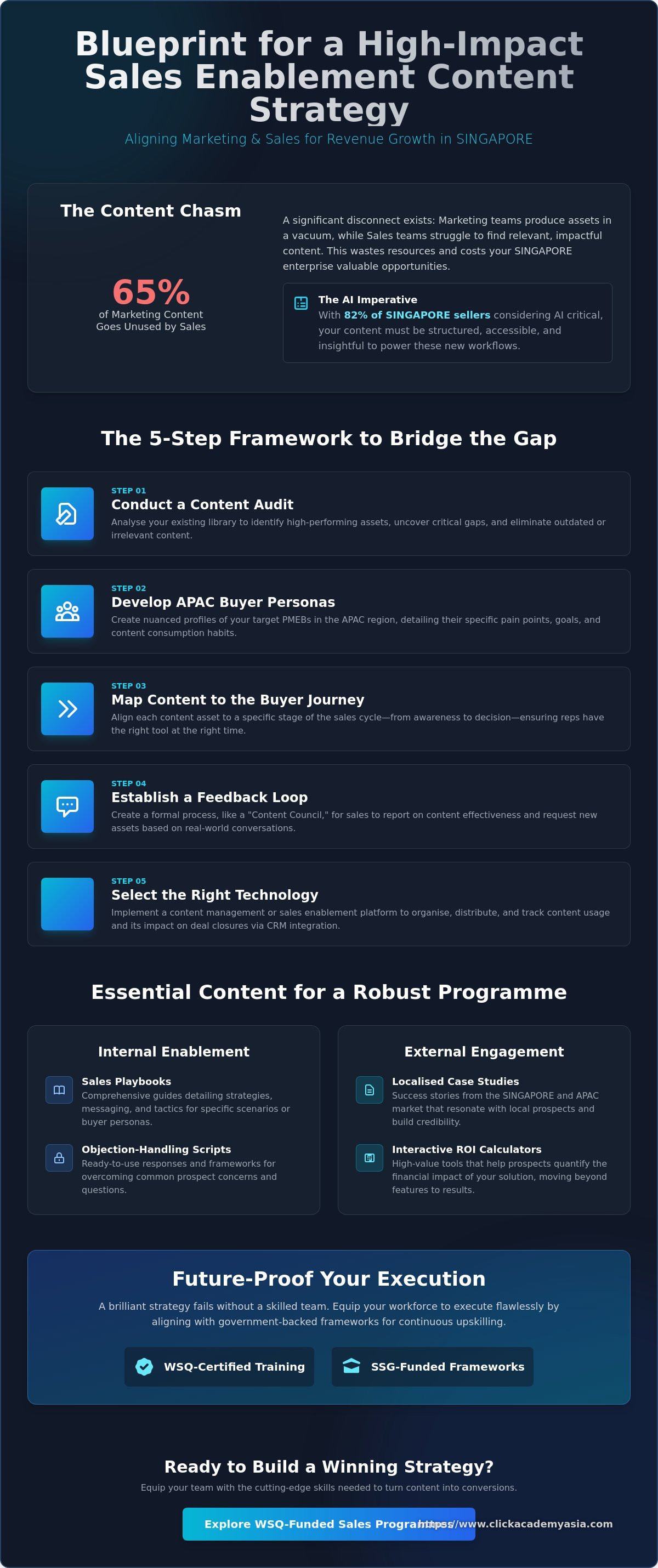
Industry data suggests that 65% of marketing content goes completely unused by sales teams [External Link: Content Marketing Institute study]. This happens because assets are often created in a vacuum, ignoring the actual needs of the sales rep in a high-stakes meeting. In the SINGAPORE business ecosystem, where electronic shipments jumped 94.8% in early 2026, the speed of commerce doesn't allow for lost time. A unified strategy ensures that every whitepaper or pitch deck produced contributes directly to closing complex deals.
To better understand this concept, watch this helpful video:
The 2026 Shift: From Information to Insight
Basic product brochures have lost their impact on enterprise-level decision-makers. Modern PMEBs in the APAC region are digital-first buyers who expect predictive analytics and data-driven storytelling. They've likely done their research before your rep even picks up the phone. Your enterprise sales enablement content strategy must pivot from providing information to delivering unique insights that establish regional authority. This requires content that addresses specific pain points through interactive ROI calculators and local case studies that resonate with the SINGAPORE market.
Aligning with the WSQ Framework for Strategy Success
Even the most sophisticated strategy will fail if your team lacks the skills to execute it. This is why forward-thinking SINGAPORE leaders are turning to the SkillsFuture Singapore (SSG) framework to support their digital transformation. By aligning your internal processes with WSQ-certified training, you ensure your workforce is future-ready. ClickAcademy Asia acts as a strategic partner in this journey, helping you bridge the gap between high-level theory and practical mastery. Equipping your team through ClickAcademy Asia ensures that your content strategy isn't just a document, but a living part of your sales success.
How to Design an Enterprise Sales Enablement Content Strategy: A Step-by-Step Framework
Building a high-impact enterprise sales enablement content strategy requires moving beyond ad-hoc document creation toward a repeatable, data-backed system. To design an enterprise sales enablement content strategy that actually moves the needle, leaders must follow a structured five-step framework:
Step 1: Conduct a comprehensive content audit to identify gaps in your current library.
Step 2: Develop detailed buyer personas specific to the APAC enterprise sector.
Step 3: Map existing and new content to every stage of the 2026 buyer journey.
Step 4: Establish a formal feedback loop between sales reps and marketing creators.
Step 5: Select the right technology stack for seamless content distribution and tracking.
This systematic approach ensures that your marketing efforts translate into tangible sales results. If your team needs to master these frameworks, exploring a WSQ Content Marketing Strategy programme can provide the practical skills required to lead this transition effectively.
Auditing Your Current Asset Library
A content audit is the systematic evaluation of all sales-facing materials to determine their current relevance, accuracy, and performance. You should categorise every asset by its intended funnel stage: Top-of-Funnel (TOFU) for awareness, Middle-of-Funnel (MOFU) for consideration, and Bottom-of-Funnel (BOFU) for decision-making. During this process, be ruthless in identifying "ROT" content: assets that are redundant, outdated, or trivial. Streamlining your library prevents sales reps from accidentally sharing obsolete information with high-value SINGAPORE prospects.
Mapping Content to the 2026 Buyer Journey
Enterprise buyers in the APAC region have become increasingly sophisticated, often involving multiple stakeholders before a purchase. While the awareness stage captures interest, the consideration stage is the most critical for MOFU sales enablement. This is where prospects weigh your solution against competitors and internal alternatives. Your enterprise sales enablement content strategy must provide deep-dive technical guides and comparison sheets for this phase. Quick Win: Create a content map spreadsheet to visualise your coverage gaps immediately; this allows you to prioritise production for the stages where deals typically stall.
Essential Content Types for a Robust Enablement Programme
A successful enterprise sales enablement content strategy relies on a diverse mix of assets that serve different purposes at specific moments. You can't rely on a single "master deck" to close a complex, multi-stakeholder deal. Instead, your library must include both internal-facing resources that guide the rep and external-facing collateral that persuades the prospect. Aligning Marketing and Sales around these specific asset types is what separates top-performing SINGAPORE firms from those struggling with low conversion rates.
To maintain a competitive edge, your content library should be categorised into four main pillars:
Internal Assets: Competitive battlecards, sales playbooks, and objection-handling scripts.
External Assets: Case studies, industry whitepapers, and interactive ROI calculators.
Training Materials: Micro-learning videos and product FAQ documents for rapid knowledge retrieval.
Personalised Content: Digital sales rooms and bespoke pitch decks tailored for key accounts.
Internal Enablement: Empowering the Rep
Your sales team needs "behind-the-scenes" intelligence to navigate difficult conversations effectively. Competitive battlecards are essential for this, but they must be built to analyse competitors objectively rather than sounding aggressive. Focus on "how we win" rather than "why they lose" to ensure your reps remain professional and consultative during high-stakes negotiations. This objective approach builds credibility with savvy SINGAPORE buyers who value transparency.
Sales playbooks and scripts also play a vital role in standardising the enterprise sales process across SINGAPORE teams. Playbooks act as the definitive guide for specific products or territories, outlining the ideal sales motion from first contact to close. Meanwhile, objection-handling scripts provide consistent brand messaging, ensuring every rep handles common pushbacks with the same level of expertise. Standardisation doesn't mean sounding like a robot; it means giving your team a proven foundation to build upon.
External Enablement: Persuading the Prospect
External assets must focus on the prospect's world, not your own. Case studies often fail because they lean too heavily on product features rather than tangible business outcomes. For a robust enterprise sales enablement content strategy, these assets must highlight clear ROI and specific problem-solving scenarios. In the APAC market, decision-makers are looking for proof that your solution solves their specific regional challenges, such as regulatory compliance or cross-border logistics.
High-value whitepapers are excellent for establishing authority, but they are often too dense for a quick sales touchpoint. You should repurpose long-form whitepapers into digestible sales snippets that reps can easily share via email or LinkedIn. If your team needs to refine these content production and distribution techniques, exploring ClickAcademy Asia Sales/Marketing courses can provide the practical foundation needed for high-impact content creation.
Bridging the Gap: Aligning Marketing and Sales Through Strategic Content Governance
Even the most creative enterprise sales enablement content strategy will fail if there's a disconnect between the people creating the assets and those using them. In many SINGAPORE organisations, marketing teams produce high-quality collateral that never sees the light of day because sales reps don't know it exists or don't find it relevant. Solving this requires more than just better communication. It demands a formalised governance structure that mandates collaboration at every stage of the content lifecycle.
A high-impact first step is establishing a "Content Council" that meets monthly to review performance and set future priorities. This council should include marketing leads and top-performing sales PMEBs who can provide real-world feedback on what prospects are actually asking for. To prevent ad-hoc requests from derailing your production schedule, implement a standard "Sales Enablement Brief" for all new content. This brief ensures every new asset has a defined persona, a specific funnel stage, and a clear metric for success before a single word is written.
The Role of CRM in Content Strategy
Your CRM is the most powerful tool for measuring the effectiveness of your enablement efforts. By using CRM tags, you can monitor content usage patterns to see which assets are being shared by your most successful reps. It's also vital to analyse content "velocity," which measures how effectively specific assets move prospects from the consideration stage to a closed deal. CRM integration transforms content from a cost centre into a measurable revenue driver that directly supports your bottom line.
To master the technical side of these integrations and drive measurable growth, exploring Digital Transformation for Leaders can equip you with the strategic oversight needed to manage these complex systems.
Governance and Maintenance
In the fast-moving SINGAPORE business environment, information can become obsolete overnight. You must set clear ownership for every asset and establish a quarterly review schedule to ensure all data points, case studies, and product specs remain accurate. A "request-to-publish" workflow should be used to maintain quality control and prevent the "content sprawl" that often plagues large enterprises. Quick Win: Archive any asset that hasn't been used in the last six months to keep your library lean and easily searchable for your sales team.
Driving Execution: Scaling Your Strategy with WSQ-Certified Sales Training
A sophisticated enterprise sales enablement content strategy remains a theoretical exercise if your team lacks the practical skills to implement it. Even the most data-rich ROI calculator or polished battlecard is useless if a sales rep cannot navigate the complex interpersonal dynamics of a multi-stakeholder deal. Execution is the bridge between a well-documented plan and actual revenue growth. For SINGAPORE firms, the most effective way to scale this execution is through formalised, industry-recognised upskilling.
WSQ-certified programmes offer a rigorous framework that ensures your PMEBs are not just learning theory, but mastering real-world applications. These certifications are designed to meet the specific needs of the local business ecosystem, providing a stamp of quality that aligns with national standards. ClickAcademy Asia serves as the premier partner in this journey, offering a suite of strategic programmes that turn content into a powerful sales engine.
Upskilling for the 2026 Sales Landscape
Foundational knowledge is the first step in any enablement journey. The Mastering the 2026 Landscape: WSQ Digital Marketing Courses in Singapore pillar provides the essential context your team needs to understand digital-first buyer behaviour. This foundation allows marketing and sales to align their efforts based on shared insights and data-driven strategies.
Asset creation requires a specific set of skills that go beyond basic copywriting. The WSQ Content Marketing Strategy course directly addresses the link between strategic intent and high-impact asset production. Finally, sales leadership development ensures that managers have the coaching skills to reinforce these new behaviours, making enablement a permanent part of the organisational culture.
Maximising SSG Funding for Your Team
One of the most significant advantages for SINGAPORE enterprises is the availability of robust government support. SSG funding can substantially reduce the financial barrier to high-level corporate training, making it easier to upskill entire departments simultaneously. Employers can tap into various grants and subsidies, including SkillsFuture Enterprise Credits, to offset the costs of professional development for their Singaporean and Permanent Resident employees.
HR leaders should take this opportunity to conduct a comprehensive skills gap audit alongside their content audit. Identifying where your team struggles, whether in digital prospecting or technical storytelling, allows you to select the most relevant ClickAcademy Asia Sales Training tracks. By leveraging these resources, you ensure your organisation remains agile and competitive.
Summary of Actionable Points
Audit and Align: Identify content gaps and map assets to the 2026 buyer journey.
Equip Your Team: Develop internal battlecards and external ROI calculators that focus on outcomes.
Govern through Data: Use CRM integration to monitor content usage and deal velocity.
Upskill for Success: Utilise SSG funding to provide WSQ-certified training for your workforce.
Ultimately, your enterprise sales enablement content strategy is only as powerful as the people behind it. Providing your team with the right tools is half the battle; providing them with the right skills is what wins the war. Visit ClickAcademy Asia to explore our WSQ-funded training tracks and empower your workforce for the future.
Mastering the Future of Enterprise Sales in SINGAPORE
Implementing a robust enterprise sales enablement content strategy is about more than just organising files. It's about creating a unified ecosystem where marketing and sales work in lockstep to drive revenue. You've seen how auditing your assets, aligning with the 2026 buyer journey, and integrating CRM data can transform your operations. However, the most critical component remains the proficiency of your people to execute these frameworks in a competitive APAC market.
As a premier APAC training academy since 2011 and an official Google Certification Partner, ClickAcademy Asia is uniquely positioned to guide your team through this transition. Our WSQ-certified and SSG-funded programmes ensure that your professional development is both high-impact and cost-effective. We don't just teach theory; we provide the practical mastery needed to lead in an evolving technological landscape.
Empower your team with WSQ-certified strategy training at ClickAcademy Asia and secure your organisation's growth for the years ahead. Your journey toward sales excellence starts with a commitment to continuous learning.
Frequently Asked Questions
What is the primary goal of an enterprise sales enablement content strategy?
The primary goal of an enterprise sales enablement content strategy is to empower sales teams with high-impact assets that accelerate the buyer journey and increase win rates. It focuses on removing friction by ensuring reps don't waste time searching for or creating their own materials. By aligning marketing output with sales needs, organisations provide prospects with the exact insights required to make a confident purchase decision.
How does sales enablement content differ from standard content marketing?
Standard content marketing focuses on building brand awareness and generating leads through top-of-funnel assets like blog posts or social media. Sales enablement content is specifically designed to help reps navigate the later stages of the sales cycle. It includes internal tools like objection-handling scripts and external resources like technical whitepapers that address specific stakeholder concerns during complex negotiations.
Can my company claim SSG funding for sales enablement training in SINGAPORE?
Yes, enterprises in SINGAPORE can significantly reduce training costs by leveraging SSG funding for WSQ-certified programmes. Eligible companies receive subsidies of up to 70% for SME-sponsored employees or through the Mid-Career Enhanced Subsidy (MCES). These grants make it highly accessible for firms to upskill their PMEBs in advanced sales and marketing strategies without straining their corporate budgets.
How often should we audit our enterprise sales content library?
You should audit your content library at least once every quarter to maintain accuracy and relevance in SINGAPORE's rapidly evolving business environment. Regular reviews help identify "ROT" (redundant, outdated, trivial) content that could potentially mislead a prospect or provide obsolete data. This frequency ensures your team always has access to the latest regional case studies and verified industry statistics.
What are the most effective content types for the decision stage of the buyer journey?
ROI calculators, bespoke pitch decks, and detailed case studies that focus on tangible business outcomes are the most effective for the decision stage. These assets provide the final proof points needed to satisfy multiple stakeholders and procurement teams. Internal battlecards also become critical here, helping reps address last-minute competitive comparisons with the precision and authority required to close the deal.
How do we measure the ROI of our sales enablement content strategy?
Measuring the ROI of an enterprise sales enablement content strategy involves tracking deal velocity and the correlation between content usage in your CRM and closed-won deals. You should analyse which specific assets are shared by your top-performing reps and how those pieces influence the time it takes to move a prospect through the funnel. This data transforms content from a cost into a measurable revenue driver.
What role does AI play in enterprise sales enablement in 2026?
In 2026, AI agents are critical for automating non-selling tasks like lead scoring, drafting personalised emails, and initial prospecting. 80% of SINGAPORE sales professionals currently use AI to manage their daily workloads. However, the focus has shifted toward data hygiene, with 85% of sellers prioritising data cleansing to ensure AI-generated insights remain accurate and actionable for the sales team.
Why is the WSQ framework important for SINGAPORE businesses?
The WSQ framework is essential because it provides a nationally recognised standard for professional skills, ensuring that training is practical and industry-relevant. For SINGAPORE businesses, it offers a structured pathway for upskilling the workforce while unlocking significant SSG financial support. This framework helps PMEBs stay future-ready in a landscape where technical mastery and strategic execution are key competitive advantages.


Comments