
Marketing Budget Modelling and Forecasting: A Strategic Guide for Singapore Professionals

How many times have you presented a visionary marketing plan only to have the finance department slash your numbers because the projected ROI felt like a "best guess"? It's a recurring frustration for PMEBs in SINGAPORE who manage vast amounts of data but lack a clear, defensible framework to justify their spend. You know that marketing is a growth engine, yet aligning your KPIs with rigid financial goals often feels like speaking two different languages.
Mastering marketing budget modeling and forecasting is the bridge that turns uncertainty into strategic confidence. This guide provides the exact frameworks and methodologies you need to build accurate models that drive measurable results and secure enthusiastic stakeholder buy-in. We will explore how to allocate resources effectively and leverage local support like SSG grants to ensure your team has the analytical rigour required to thrive in a competitive market.
Key Takeaways
Distinguish between static budgeting and dynamic forecasting to ensure your resource allocation remains agile and responsive to SINGAPORE'S market shifts.
Evaluate incremental, zero-based, and driver-based methodologies to determine which framework best aligns with your organisation's specific growth objectives.
Master the essential frameworks for marketing budget modeling and forecasting to build data-backed ROI predictions that secure stakeholder buy-in.
Identify your North Star metric and secondary KPIs to transform fragmented data into a clear, actionable roadmap for long-term profitability.
Learn how to leverage SSG funding and WSQ frameworks to upskill your team in advanced analytics while minimising out-of-pocket training expenses.
Table of Contents
Marketing Budget Modelling and Forecasting in Singapore: A Strategic Overview
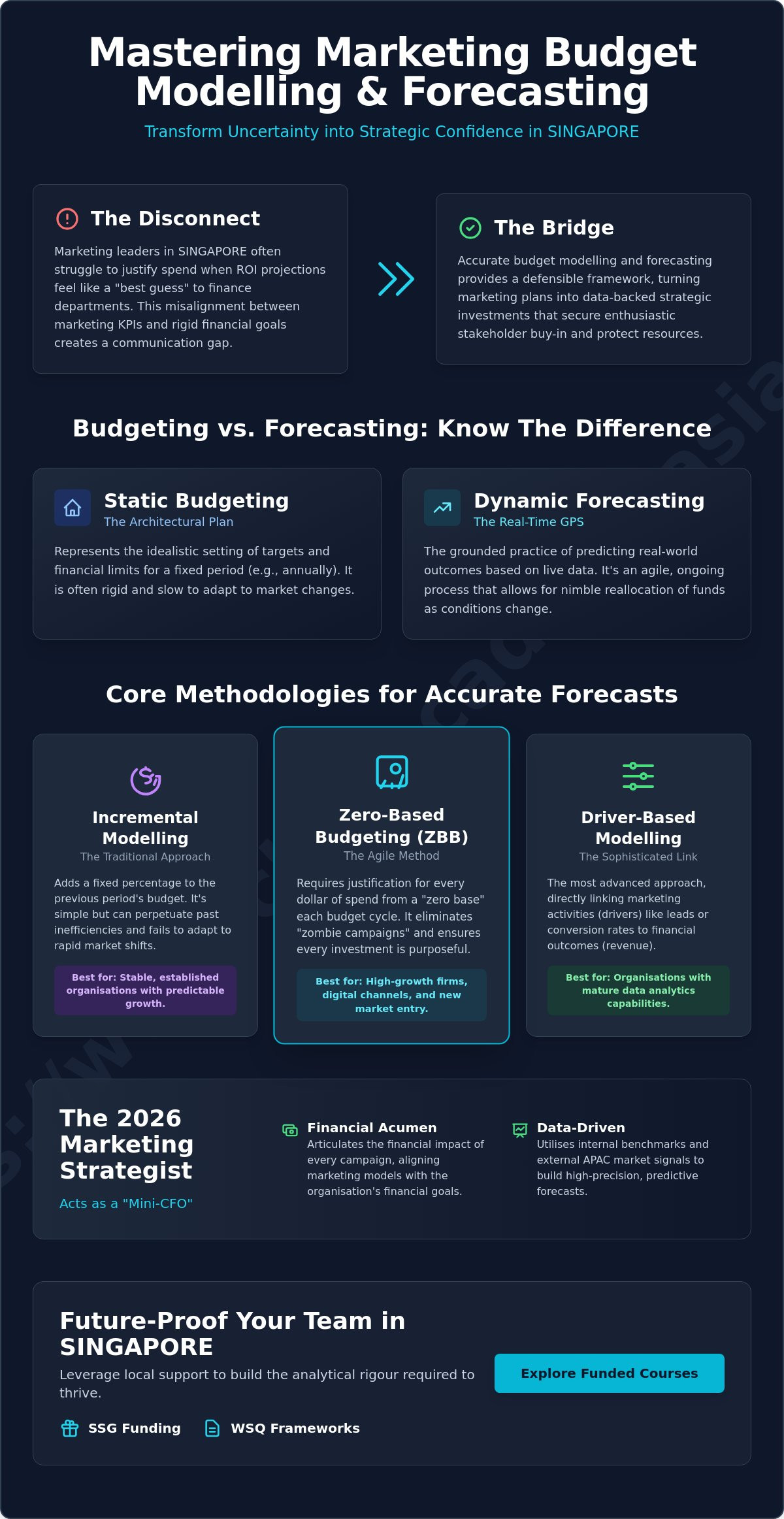
In SINGAPORE'S corporate environment, a marketing plan is only as robust as the financial logic behind it. Marketing budget modelling serves as the architectural framework for resource allocation, ensuring that every investment aligns with long-term business viability. While budgeting represents the idealistic setting of targets, forecasting is the grounded practice of predicting real-world outcomes based on live data. For PMEBs, mastering marketing budget modeling and forecasting is essential to secure stakeholder buy-in and protect departmental resources from arbitrary cuts.
The shift toward agile, data-driven forecasting in 2026 has replaced the traditional, static annual budget. This transformation allows organisations to remain nimble, reallocating funds as market conditions change rather than waiting for the next fiscal cycle. To better understand the fundamentals of financial logic, watch this helpful video:
The Role of the Marketing Strategist in 2026
Today’s marketing leads must function as "mini-CFOs" who can articulate the financial impact of their campaigns. It is no longer enough to report on clicks or impressions; you must align your marketing models with the organisation’s broader financial goals. Gaining a professional certification through a WSQ Digital Marketing Strategy & Planning course equips you with the analytical tools to bridge the gap between creative execution and fiscal responsibility. This capability ensures that your budget requests are viewed as strategic investments rather than overhead costs.
Key Drivers of Forecasting Accuracy
High-precision forecasting requires a balance between internal performance benchmarks and external APAC market signals. You must account for regional economic shifts and SINGAPORE'S specific seasonality, such as the surge in social commerce during major local shopping festivals. Utilising advanced techniques like Marketing Mix Modeling allows you to isolate the variables that actually move the needle. Predictive modelling is the intersection of historical data and future market assumptions.
Core Methodologies for Accurate Marketing Forecasts
Choosing the right methodology is the first step toward building a reliable model. Incremental modelling is the traditional choice for established multinationals, yet it often hides inefficiencies by simply adding a percentage to last year’s spend. While simple, it fails to account for the rapid shifts in SINGAPORE’S digital landscape. For high-growth organisations or those entering new markets, Zero-Based and Driver-Based approaches offer the precision required for modern marketing budget modeling and forecasting.
Static annual plans are increasingly obsolete in 2026. Rolling forecasts have emerged as the standard for agile PMEBs, allowing teams to update their 12-month outlook every quarter or month. This flexibility is vital when navigating a market where ChatGPT-driven traffic to brand sites grew by 340% year-on-year by early 2026. To master these data-driven techniques, consider upskilling through WSQ Marketing Analytics & Insights training.
Zero-Based Budgeting (ZBB) for Digital Channels
Zero-Based Budgeting requires you to justify every dollar spent on SEM or Social Media from scratch each period. This methodology is particularly effective when applying for the Market Readiness Assistance (MRA) Grant to fund overseas expansion. It prevents "zombie campaigns" that continue to consume budget simply because they were approved in the previous year. By starting from zero, you ensure that resources are only allocated to channels that demonstrate a clear path to ROI in the current market climate.
Driver-Based Modelling: Linking Metrics to Money
Driver-Based modelling is the most sophisticated approach for connecting marketing activities directly to revenue. Instead of focusing on total spend, you identify the core "drivers" of your funnel, such as Conversion Rate (CVR), Customer Acquisition Cost (CAC), and Lifetime Value (LTV). This allows you to build a dynamic model where changing one variable, like a 1% increase in CVR, automatically updates your entire revenue forecast.
To succeed with this method, you need a high level of data integrity. Implementing a robust tracking framework, as detailed in our guide on marketing analytics with GA4, provides the reliable performance benchmarks necessary for accurate driver data. When your drivers are grounded in reality, your forecasts become powerful tools for strategic persuasion during board-level budget discussions.
A Step-by-Step Guide to Building a Marketing Budget Model
Building a robust framework for marketing budget modeling and forecasting requires a disciplined, sequential approach. It's not just about filling cells in a spreadsheet; you're creating a strategic narrative that justifies your spend to the board. By following a structured process, you can transform fragmented data into a defensible roadmap for growth. Adhering to marketing budget planning best practices ensures that your financial logic remains sound even under intense scrutiny.
Audit historical data: Identify reliable performance benchmarks from the past 24 months to establish a baseline.
Define your North Star: Select one primary metric, such as Customer Lifetime Value (LTV), and align all secondary KPIs to support this goal.
Select your methodology: Choose between zero-based or driver-based models depending on your organisation's maturity. Many SINGAPORE firms leverage WSQ-aligned training to ensure their teams can execute these complex frameworks.
Build scenario analyses: Develop Best Case, Worst Case, and Most Likely outcomes to account for market volatility.
Present with visualisations: Use data dashboards to show how specific marketing drivers impact the final revenue forecast, making your model tangible for executives.
Data Auditing and Cleaning
You can't build a reliable forecast on "dirty data." Inconsistent tracking or gaps in historical records will lead to skewed predictions and lost confidence from the finance department. Marketing attribution plays a critical role here; it helps you understand which touchpoints actually contribute to conversions so your model reflects reality rather than guesswork. To normalise data for outliers like the 11.11 or 12.12 sales periods in SINGAPORE, you must isolate these high-volume spikes from your baseline performance to prevent them from skewing your standard monthly averages.
Scenario Planning and Risk Mitigation
Relying on a single-point forecast is a recipe for failure in volatile markets. Strategic PMEBs use "What-If" analysis to prepare for sudden shifts, such as ad platform price hikes or aggressive competitor moves. You should validate your growth assumptions using credible regional data. For instance, knowing that YouTube reach in SINGAPORE has hit 90.6% of the adult internet user base, as reported in Digital 2026: Singapore, allows you to model the potential impact of scaling video content with greater accuracy. This multi-layered approach ensures you have a contingency plan ready before the market shifts, protecting your ROI and your reputation.
Navigating Singapore’s Business Ecosystem: Grants and Local Nuances
Securing a budget in SINGAPORE isn't just about the numbers on a screen; it's about understanding the local support ecosystem that can stretch your capital further. High-level marketing budget modeling and forecasting shouldn't only account for media spend and payroll. It must also factor in the significant subsidies available through SkillsFuture Singapore (SSG) to offset the cost of team upskilling. Addressing the current talent gap in marketing analytics within the local PMEB workforce is a strategic priority that requires a blend of data-driven planning and certified expertise.
Maximising SSG Funding for Marketing Teams
Training budgets are often the first to be cut during lean periods, yet this is exactly when strategic upskilling is most critical. SSG funding allows organisations to reduce the out-of-pocket expenses for high-level strategy programmes by up to 70% for SINGAPORE Citizens and Permanent Residents. For professionals aged 40 and above, the Mid-Career Enhanced Subsidy can cover up to 90% of course fees, making advanced education highly accessible. To build a team capable of executing these complex models, explore our WSQ Digital Marketing Strategy & Planning tracks today.
Strategic Allocation: Redirect the savings from training grants into your experimental ad budget or advanced attribution software.
SFEC Integration: Utilise the SkillsFuture Enterprise Credit (SFEC) to cover up to 90% of out-of-pocket expenses for transformation initiatives.
Standardised Learning: Identify WSQ-certified courses that focus specifically on strategy and planning to ensure your team meets national standards for excellence.
The WSQ Framework as a Standard for Excellence
Hiring or training based on WSQ competencies provides a baseline of strategic rigour that is recognised throughout the SINGAPORE corporate world. It eliminates the guesswork involved in assessing a candidate's analytical skills, ensuring that every team member speaks the same data-driven language. This standardised approach is particularly beneficial for large organisations where marketing plans must be consolidated across multiple departments without losing clarity.
Positioning continuous learning as a non-negotiable line item in your 2026 budget protects your team from becoming obsolete in a rapidly shifting APAC market. When your staff are certified in marketing budget modeling and forecasting, they bring a level of professional credibility that satisfies both internal auditors and external stakeholders. This commitment to practical mastery ensures that your marketing department remains a growth engine rather than a cost centre.
Future-Proofing Your Strategy: Upskilling with WSQ Digital Marketing Courses
Mastering marketing budget modeling and forecasting is more than a technical exercise. It's a career-defining skill that separates tactical managers from strategic leaders. By transforming how you present financial data, you move beyond passive spending and adopt a mindset of active strategic investing in both your media channels and your people. ClickAcademy Asia serves as your mentor in this journey, providing the structured frameworks needed to command respect in the boardroom.
The immediate ROI of enrolling in WSQ Digital Marketing Strategy & Planning courses is felt the moment you apply these models to your next quarterly review. You'll no longer guess where to allocate funds. Instead, you'll lead with the confidence that comes from analytical rigour and predictive agility. This shift in capability ensures that your marketing department is viewed as a vital growth partner rather than a cost centre.
Mastering Strategy & Planning
Our WSQ Digital Marketing Strategy & Planning programme includes specific modules designed to demystify the budgeting process. You'll learn from industry practitioners who have navigated the unique complexities of the APAC market, ensuring your education is grounded in real-world experience rather than just theory. For PMEBs aiming for Director-level roles, this certification serves as a "quick win" that demonstrates your ability to manage high-stakes financial responsibilities. It provides the strategic vocabulary needed to align marketing outcomes with the overarching goals of your organisation.
Next Steps for Your 2026 Budget
Don't feel pressured to overhaul your entire financial framework overnight. Start with a small pilot model for a single channel, such as SEO or Social Media, to test your assumptions and refine your drivers. This incremental approach allows you to demonstrate success early and build the data-backed authority required to scale the model across your entire budget. Precision in 2026 isn't about having all the answers; it's about having a reliable process to find them.
Audit your data: Ensure you have a clean baseline before building new models.
Identify core drivers: Link your marketing activities directly to revenue outcomes.
Leverage SSG funding: Upskill your team in advanced analytics while minimising out-of-pocket costs.
Present with clarity: Use visualisations to make your strategic logic tangible for executives.
Empower your team to deliver precision in 2026. Lead your department with the authority that only a master of marketing budget modeling and forecasting can provide. Explore our WSQ-funded training tracks today and secure your organisation's place at the forefront of the SINGAPORE business ecosystem.
Mastering Your Strategic Financial Roadmap
Transforming your marketing department from a cost centre into a growth engine requires a commitment to analytical rigour. You've seen how moving from static annual budgets to rolling forecasts allows your team to remain agile in SINGAPORE'S competitive landscape. By implementing driver-based models, you can finally speak the language of finance and link every digital activity directly to revenue outcomes. Don't let the talent gap hold your organisation back when SSG funding makes high-level strategy training so accessible for local PMEBs.
Mastering marketing budget modeling and forecasting isn't just a technical skill; it's a competitive advantage that secures your seat at the executive table. As a WSQ-certified training provider and Official Google Power Partner, ClickAcademy Asia has been trusted by PMEBs across 30+ countries to deliver practical, result-driven education. We're here to help you navigate these complex strategic frameworks with confidence and clarity.
Equip your team with strategic budgeting mastery—Explore our WSQ Digital Marketing Strategy & Planning courses today. Take the lead in defining your organisation's future and build the data-backed authority you need to thrive in 2026 and beyond.
Frequently Asked Questions
What is the difference between marketing budget planning and forecasting?
Planning is the process of setting your strategic goals and allocating resources to achieve them, whereas forecasting is the data-driven prediction of actual outcomes. While a plan represents your intended destination, marketing budget modeling and forecasting uses historical performance and market signals to predict where you'll actually land. In SINGAPORE'S agile business environment, your plan might be annual, but your forecast should be updated continuously.
How can I accurately forecast marketing ROI for a new product launch in Singapore?
Accurate forecasting for a new launch requires a blend of proxy data from similar past campaigns and current APAC market benchmarks. You should account for local variables, such as SINGAPORE'S 98.4% internet penetration rate, to estimate potential reach. Building a driver-based model that focuses on conversion rates and average order value allows you to create Best Case and Worst Case scenarios for your ROI predictions.
Which budget modelling method is best for a small business in Singapore?
Zero-Based Budgeting (ZBB) is typically the most effective method for smaller SINGAPOREAN organisations. It requires you to justify every dollar of spend from scratch each period, which prevents the "zombie campaigns" that often drain resources in incremental budgeting. This rigour ensures that your limited capital is only directed toward high-performing channels with a clear, measurable path to revenue.
How often should I update my marketing budget forecast?
You should aim to update your forecast at least once a month using a rolling 12-month outlook. This frequency allows you to react to sudden shifts in the digital landscape, such as changes in ad platform costs or competitor moves. Staying updated is vital in a market where ChatGPT-driven traffic to brand sites grew by 340% between 2024 and 2026, requiring rapid resource reallocation.
Can I use SSG funding for marketing strategy and budget modelling courses?
Yes, many WSQ-certified programmes that cover marketing budget modeling and forecasting are eligible for significant SSG funding. SINGAPORE Citizens and Permanent Residents can receive up to 70% in subsidies, while those aged 40 and above can access up to 90% funding under the Mid-Career Enhanced Subsidy. This support makes it highly affordable for PMEBs to master the complex analytical frameworks required for strategic leadership.
What are the most common mistakes in marketing budget modelling?
The most frequent errors include building models on "dirty data" and failing to normalise for local seasonality, such as the 11.11 or 12.12 sales spikes. Many marketers also rely on static, single-point forecasts that don't account for market volatility. To avoid these pitfalls, always isolate outliers from your baseline and use scenario planning to prepare for different market conditions.
How do I align my marketing budget with the finance department's expectations?
Alignment is achieved by speaking the language of finance rather than marketing jargon. Instead of focusing on impressions or clicks, present your budget through the lens of Customer Acquisition Cost (CAC) and Lifetime Value (LTV). Using a driver-based model demonstrates that you understand how marketing spend directly impacts the organisation's bottom line, which builds immediate professional credibility.
What tools are recommended for marketing budget forecasting in 2026?
GA4 is the foundational tool for capturing first-party data, but 2026 requires the integration of AI-enabled predictive analytics for higher accuracy. Many strategic PMEBS also utilise advanced spreadsheet modelling for "What-If" analyses and dedicated marketing analytics software to track attribution. The goal is to create a unified data stack that provides a real-time view of how your budget is performing against your forecasts.



Comments