
2026 Singapore Mobile App Go-to-Market Strategy Guide
- ClickAcademy Asia

- 2 days ago
- 11 min read
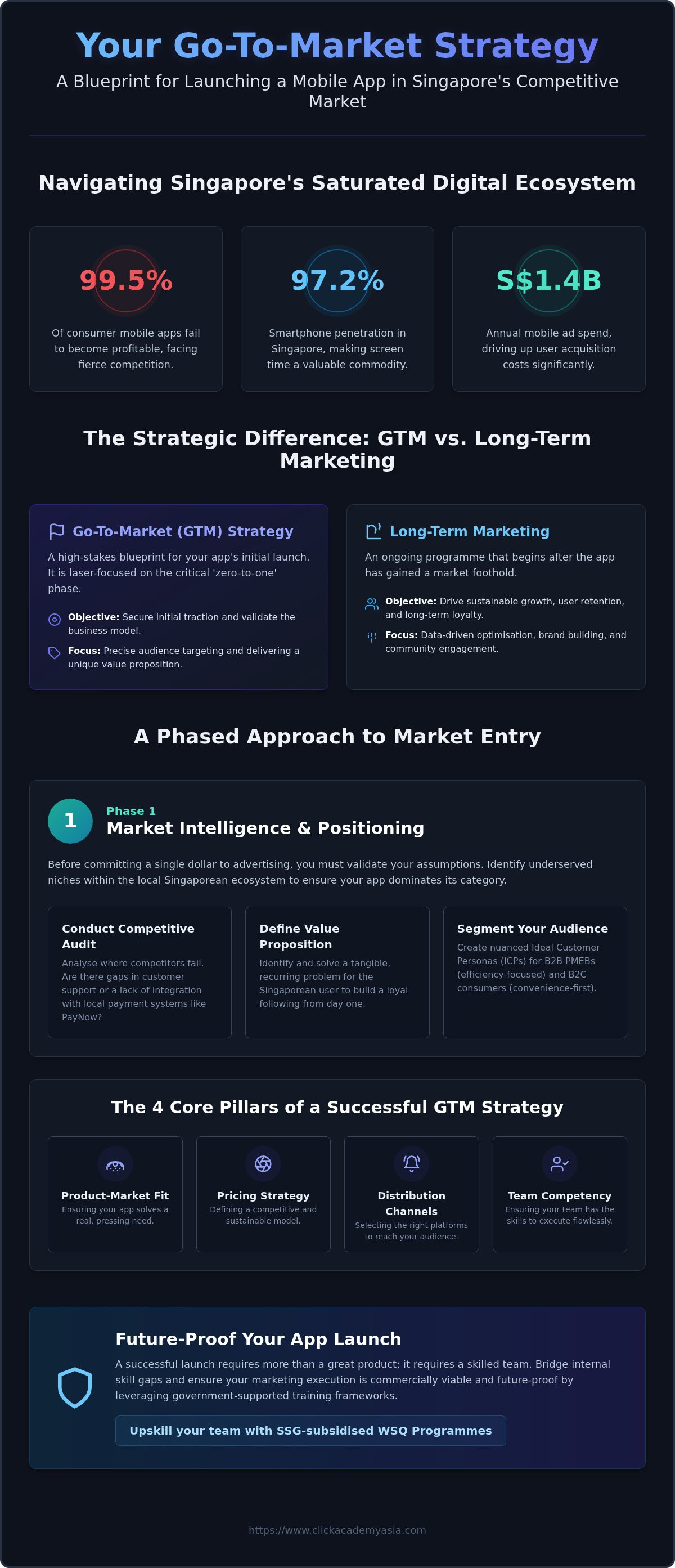
Did you know that a staggering 99.5% of consumer mobile apps fail to ever turn a profit? In Singapore's highly saturated digital ecosystem, where smartphone penetration has reached 97.2%, simply having a great piece of code is no longer enough to guarantee commercial success. You've likely spent months perfecting your product, only to face the daunting reality of high acquisition costs and fierce competition from established super-apps.
It's frustrating to watch a marketing budget vanish without seeing a meaningful return on investment. We understand the pressure to perform in a market where mobile commands S$1.4 billion in annual ad spend. This guide provides a repeatable go-to-market strategy for launching a mobile app that transforms technical potential into a sustainable, revenue-generating business. You'll master the frameworks needed to navigate IMDA's 2026 Online Safety regulations while driving long-term user retention.
We'll explore how to bridge internal skill gaps using SSG-funded training and execute a launch that secures a definitive foothold in the APAC region. From optimising for local payment systems like PayNow to leveraging WSQ-aligned marketing tactics, this is your roadmap to professional excellence.
Table of Contents
What is a Go-to-Market Strategy for Launching a Mobile App in Singapore?
A go-to-market strategy for launching a mobile app is far more than a simple checklist of promotional activities. It acts as a comprehensive roadmap designed to deliver a unique value proposition to a specific Singaporean audience with surgical precision. While a standard marketing plan focuses on ongoing brand awareness, a GTM strategy is a high-stakes blueprint for the initial entry phase. It addresses how your app will penetrate a mature market where smartphone penetration has reached 97.2% and competition for screen time is relentless.
To understand the foundational mechanics, one can look at What is a Go-to-Market Strategy in a broader corporate context. In the 2026 Singaporean landscape, this framework must account for high user acquisition costs and the dominance of established super-apps. Success relies on four core pillars: achieving a tight product-market fit, defining a competitive pricing strategy, selecting the right distribution channels, and ensuring high levels of professional competency within your team.
The Strategic Advantage for Singaporean PMEBs
For PMEBs, a structured GTM framework serves as an essential risk-mitigation tool that protects capital and reputation. With failure rates for new applications sitting at 99.5%, corporate leaders cannot afford to rely on intuition alone. A well-defined strategy empowers the marketing lead to align cross-functional teams, from developers to sales units, around a single source of truth. This alignment ensures that every dollar of the S$1.4 billion digital ad spend in Singapore is utilised effectively rather than being wasted on fragmented campaigns. Ultimately, a GTM strategy functions as a vital insurance policy for any corporate leader venturing into the digital product space.
GTM vs. Long-term Marketing Strategy
The primary distinction lies in the lifecycle phase. A GTM strategy focuses exclusively on the "zero-to-one" phase, where the goal is to secure initial traction and validate the business model. Once the app gains a foothold, the focus shifts toward sustainable growth, user retention, and long-term brand loyalty. Identifying key stakeholders is critical in a Singapore-based launch; this typically includes the Chief Marketing Officer, Product Owners, and HR decision-makers who oversee the upskilling of the workforce. By mastering this transition, teams can move from a frantic launch state to a steady, data-driven optimisation programme that ensures longevity in the APAC region.
Phase 1: Market Intelligence and Positioning for the APAC Region
Before committing a single dollar to digital advertising, you must validate your assumptions through rigorous market intelligence. A successful go-to-market strategy for launching a mobile app relies on identifying underserved niches within the local ecosystem. With mobile commerce now accounting for 71% of all e-commerce revenue in Singapore, the stakes for accurate positioning have never been higher. You need to understand the nuances of Singapore's digital economy to ensure your app doesn't just enter the market but dominates its specific category.
Conducting a competitive audit is your first step toward differentiation. Look beyond basic features and analyse where local competitors fail to meet user expectations. Are there gaps in customer support, or perhaps a lack of integration with local payment systems like PayNow? By identifying these friction points, you can define a value proposition that solves a tangible, recurring problem for the Singaporean user. To capture high-intent traffic from day one, it's vital to align your content with 2026 search behaviours. You can explore [Internal Link: https://www.clickacademyasia.com/post/advanced-keyword-research-strategies-a-2026-masterclass-for-digital-professionals] to identify the specific trends driving downloads in your niche.
Segmenting the Singaporean Audience
Singapore's diverse demographic requires nuanced Ideal Customer Personas (ICPs). You must differentiate between B2B PMEB users who prioritise operational efficiency and B2C consumers who exhibit a "convenience-first" mindset. Psychographic profiling reveals that local users expect seamless, low-friction experiences. Mapping the customer journey from initial awareness to the first download allows you to identify where potential users might drop off. This data-driven approach ensures your marketing efforts are concentrated on the channels that actually convert.
Competitive Benchmarking and Differentiation
Benchmarking goes far beyond comparing subscription costs. It involves a "Blue Ocean" strategy to find niches that remain underserved in the broader APAC mobile market. For corporate decision-makers and HR leaders, your positioning must highlight how the app improves productivity or employee engagement. Analyse the user reviews of your closest rivals to find recurring complaints; these are your opportunities to shine. Crafting a punchy positioning statement that addresses these specific pain points will set you apart from the 99.5% of apps that fail to find a foothold. If you want to refine these strategic skills, consider exploring WSQ-certified marketing programmes to help your team lead with confidence.
Phase 2: Distribution Channels and Monetisation Models
Selecting the right distribution mix is a critical component of your go-to-market strategy for launching a mobile app. In Singapore, the split between iOS and Android users is relatively balanced; a cross-platform approach is almost mandatory for broad reach. Your monetisation framework must align with local spending habits. For instance, m-commerce accounts for 71% of all e-commerce revenue here. Whether you choose a subscription model, freemium access, or in-app purchases, ensure the payment flow integrates with local preferences like PayNow to reduce friction at the point of sale.
Immediate discovery often requires a boost beyond organic reach. Search Engine Marketing (SEM) allows you to capture users at the exact moment they search for solutions your app provides. To manage acquisition costs effectively, you can refer to [Internal Link: https://www.clickacademyasia.com/post/choosing-the-best-advanced-sem-strategies-course-in-2026-a-buyer-s-guide] to refine your bidding strategies. This ensures you aren't wasting marketing budget on low-intent traffic while trying to scale your initial user base.
App Store Optimisation (ASO) for Local Visibility
ASO serves as the SEO of the mobile world for PMEBs, ensuring your app remains visible without constant ad spend. To succeed in the Singaporean App Store, your keyword strategy must reflect local search intent rather than generic global terms. Localising your creative assets is equally important. High-quality screenshots and preview videos that feature local contexts can significantly improve conversion rates from view to download. This organic foundation is vital for long-term sustainability and lower overall marketing costs.
Paid vs. Organic Acquisition Strategies
Balancing paid and organic efforts is the hallmark of a sophisticated go-to-market strategy for launching a mobile app. While social media marketing builds brand awareness, high-intent SEM drives immediate action. In Singapore, influencer marketing within specific business sectors can provide the social proof needed to sway corporate decision-makers. You must constantly monitor your metrics to stay ahead of the curve. Consider these essential actions:
Calculate Customer Acquisition Cost (CAC) against Lifetime Value (LTV) to ensure long-term profitability.
Leverage 5G-enabled rich media in your digital ads to capture attention in a crowded market.
Align team skills with WSQ frameworks to maintain a competitive edge in digital execution.
By integrating these channels into a cohesive roadmap, you ensure that every touchpoint in the user journey is optimised for conversion. This structured approach prevents the common pitfall of over-investing in a single channel that may not deliver the desired ROI.
Phase 3: Executing the Launch Roadmap: From Beta to Scale
Executing a go-to-market strategy for launching a mobile app requires a disciplined, multi-stage roadmap that moves from internal validation to regional scaling. You shouldn't just "flip a switch" on launch day; you must build momentum through a series of controlled tests. Start with internal beta testing to refine the UX/UI with a closed user group. This initial phase identifies technical friction points before they impact your brand's reputation in the wider Singaporean market.
Once the core features are stable, you can transition into a soft launch to validate your GTM assumptions in a live environment. This is followed by the hard launch, where you execute the full-scale marketing programme in Singapore. Establishing robust feedback loops is the final step in the roadmap. To ensure your team can interpret results accurately, you can utilise [Internal Link: https://www.clickacademyasia.com/post/marketing-analytics-with-ga4-a-strategic-guide-for-2026-professionals] to track real-time user behaviour and refine your strategy.
The Soft Launch: Validating Your GTM Assumptions
Launching in a smaller, similar market, such as Malaysia, allows you to test your go-to-market strategy for launching a mobile app without exhausting your primary Singapore budget. This phase is your opportunity to identify "leaky buckets" in the conversion funnel. By gathering qualitative feedback from early adopters, you can refine the onboarding flow to reduce day-one churn. It's far more cost-effective to fix a broken user journey now than during the high-stakes hard launch.
The Hard Launch: Creating Maximum Impact
Coordinating a "Big Bang" entry involves synchronising PR, email marketing, and paid ad campaigns for maximum impact. During this initial spike, managing server load and customer support is critical to maintaining a positive user experience. You must set measurable KPIs, such as active users and conversion rate targets, to benchmark success against the broader APAC landscape. If you're looking to lead a high-performance team through this complex process, you should explore WSQ-certified Digital Marketing Strategy programmes to ensure every stakeholder is aligned with the latest industry standards. Mastering these launch phases transforms a technical product into a commercially viable asset.
Future-Proofing Your App Launch: Upskilling via WSQ Frameworks
Even the most sophisticated go-to-market strategy for launching a mobile app will falter if the individuals behind the execution lack the necessary technical and strategic depth. In Singapore's 2026 digital landscape, the speed of change in app store regulations and user expectations means that static knowledge is a liability. PMEBs must actively engage with [Internal Link: https://clickacademyasia.com/post/mastering-the-2026-landscape-wsq-digital-marketing-courses-in-singapore] to ensure their launch plans remain commercially viable. By adopting a structured approach to mobile marketing, you transform a risky venture into a series of calculated, data-driven decisions that protect your brand's reputation.
Bridging the Skill Gap in Your Marketing Team
Identifying core competencies is the first step toward a successful 2026 launch. Your team needs to master predictive UX analytics, AI-native feature integration, and the nuances of the latest IMDA safety regulations. Corporate leaders are increasingly prioritising WSQ Digital Marketing Strategy & Planning because it provides a standardised, industry-recognised framework for these complex tasks. ClickAcademy Asia mentors professionals to lead successful app launches by grounding theoretical frameworks in real-world Singaporean case studies. This hands-on guidance ensures your marketing leads aren't just following a template but are actively shaping the future of your digital presence.
Maximising SSG Subsidies for Corporate Training
Investing in professional education offers a significantly higher ROI than outsourcing critical strategic functions to expensive agencies that may not understand your specific business goals. Singaporean citizens and Permanent Residents can leverage substantial SSG funding to offset training costs, making high-level upskilling accessible for teams of all sizes. These SkillsFuture grants are designed to close the digital skills gap, allowing your staff to manage complex GTM roadmaps internally. By building this internal expertise, you retain institutional knowledge and gain the agility needed to pivot your strategy based on live market data.
To ensure your next project achieves its full potential, consider these actionable steps:
Review the ClickAcademy Asia course calendar for the next intake to secure your team's spot in our upcoming WSQ-certified programmes.
Audit your team's current certifications to identify gaps in mobile marketing or data analytics.
Apply for SSG subsidies early to maximise your training budget for the 2026 financial year.
Equipping your workforce with these future-ready skills is the ultimate way to ensure your go-to-market strategy for launching a mobile app delivers long-term, revenue-generating results in the competitive APAC market.
Mastering the 2026 Digital Launch
A successful entry into Singapore's mature mobile market demands more than technical excellence; it requires a disciplined, data-driven go-to-market strategy for launching a mobile app. You've seen how identifying underserved niches and optimising for local payment systems like PayNow can differentiate your product. By executing a phased roadmap from beta testing to regional scaling, you mitigate the high risks of failure and ensure every dollar of your marketing budget is spent with precision.
The most critical asset in this journey is a certified, future-ready workforce. Our expert mentors provide real-world APAC experience through WSQ-certified and SSG-funded programmes. As an official Google Certification Partner, we help you bridge internal skill gaps so you can lead with confidence. Equip your team with the strategic skills to launch successfully; explore our WSQ Digital Marketing Strategy & Planning course today. With the right frameworks and a commitment to continuous upskilling, your app is positioned to become a dominant force in the digital ecosystem.
Frequently Asked Questions
What is the most critical element of a go-to-market strategy for a mobile app?
The most critical element is achieving a precise product-market fit by solving a specific friction point for Singaporean users. You must define a value proposition that resonates with local needs, such as integrating with regional payment systems or addressing 2026 IMDA safety standards. Without this foundation, even an aggressive marketing spend won't drive long-term retention. A successful go-to-market strategy for launching a mobile app hinges on this strategic alignment before scaling.
How much does it cost to launch a mobile app in Singapore in 2026?
Launching costs vary significantly based on your app's complexity and your specific growth targets. In 2026, mobile accounts for 74% of total digital advertising spend in Singapore, reaching a total of S$1.4 billion. You'll need to budget for technical development, App Store Optimisation, and high user acquisition costs. Instead of focusing on fixed numbers, monitor your Customer Acquisition Cost (CAC) relative to the expected Lifetime Value (LTV) to ensure sustainability.
Should I launch on iOS or Android first for the Singaporean market?
Singapore's market is relatively balanced, so a cross-platform launch is typically the most effective approach for reaching the 97.2% smartphone penetration rate. If budget constraints force a choice, iOS often attracts users with higher spending power, while Android provides broader reach across diverse demographic segments. Most corporate leaders prioritise a simultaneous release to ensure they don't miss out on the 71% of e-commerce revenue generated through mobile devices.
What is the difference between ASO and SEO for mobile app launches?
ASO focuses on improving your app's visibility within the App Store and Google Play Store through keyword optimisation and localised creative assets. SEO targets traditional web search engines to drive traffic to your landing page or website. Both are essential components of a go-to-market strategy for launching a mobile app. While ASO drives direct downloads, SEO builds the top-of-funnel awareness needed to capture users during their initial research phase.
How can I use SSG funding for my team's digital marketing training?
You can access SSG funding by enrolling your team in WSQ-certified programmes through registered training providers like ClickAcademy Asia. Eligible Singapore Citizens and Permanent Residents receive significant subsidies, which helps offset the cost of high-level professional development. These grants are designed to bridge the digital skills gap in areas like marketing analytics and strategy. You'll typically apply through the SkillsFuture portal or coordinate directly with your HR department.
Is a soft launch necessary for every mobile app GTM strategy?
While not strictly mandatory, a soft launch is a vital risk-mitigation tool for any serious GTM strategy. It allows you to test your user journey and conversion funnel in a secondary APAC market before committing your full Singapore budget. This phase helps you identify "leaky buckets" in your onboarding flow and gather qualitative feedback. Fixing these issues early prevents expensive churn during your high-profile hard launch.
What are the key KPIs to track during an app's first 30 days?
During the first 30 days, you should prioritise tracking user retention rates at the Day 1, Day 7, and Day 30 marks. These metrics indicate whether your app provides immediate value and successfully forms a habit. Additionally, monitor your Customer Acquisition Cost (CAC) and the percentage of active users compared to total downloads. These KPIs provide the data needed to pivot your strategy or double down on high-performing acquisition channels.
How do I ensure my app's monetisation model is sustainable?
Sustainability is achieved by aligning your monetisation model with local consumer behaviour and payment preferences. In Singapore, integrating ubiquitous systems like PayNow is essential for reducing transaction friction. You must also ensure that your Lifetime Value (LTV) consistently exceeds your acquisition costs. Regularly auditing your freemium or subscription tiers based on user feedback ensures that your pricing remains competitive within the mature Singaporean digital ecosystem.


Comments