
2026 Data Clean Room Guide for Singapore Marketers
- ClickAcademy Asia

- 2 minutes ago
- 11 min read
With the global data clean room market projected to reach $2.52 billion in 2026, privacy-safe collaboration is no longer just a luxury for the elite. In Singapore, you've likely felt the sting of declining attribution accuracy as Safari and Firefox continue their strict blocking. This makes data clean room implementation for marketers the most critical step for those struggling to manage first-party data while worrying about a PDPA breach or complex partner integrations.
Mastering this technology is now the primary way to future-proof your strategy in the local ecosystem. This guide provides a clear technical and strategic roadmap to help you secure marketing ROI while ensuring total privacy compliance. You'll learn how to justify this vital investment to stakeholders who may still be wary of the technical complexity involved.
We'll break down the practical steps to integrate your first-party data with partner sets and navigate the latest PDPC guidelines on data anonymisation. From understanding SSG-funded training options for PMEBs to selecting the right cloud-based platform, you'll gain the confidence to lead your team through this technological shift.
Table of Contents
Navigating the Post-Cookie Era in Singapore: The Rise of Data Clean Rooms
The marketing landscape in Singapore has reached a tipping point. While Google has adjusted its mandatory deprecation timeline for Chrome, the reality for APAC marketers is that signal loss is already a daily challenge. Safari and Firefox have blocked third-party cookies for years, eroding the accuracy of traditional attribution models that many PMEBs relied upon. This fragmentation means your conversion data is likely incomplete, leading to wasted spend and missed opportunities.
To solve this, a Data clean room acts as a "Switzerland of data." It provides a neutral, secure environment where two parties can match their datasets without ever exposing sensitive customer information to each other. This is why data clean room implementation for marketers has transitioned from a technical experiment to a core strategic requirement for 2026.
Signal Loss and Regional Privacy Regulations
Singapore's Personal Data Protection Act (PDPA) remains a strict framework for any brand handling consumer information. With the 31 December 2026 deadline for organisations to stop using NRIC numbers for authentication, the pressure to find privacy-compliant ways to identify users is mounting. PDPA limits the sharing of raw, identifiable data, forcing a shift from deterministic tracking to probabilistic measurement. In this environment, consent isn't just a checkbox; it's the operational fuel that allows data to flow into a clean room for analysis without breaching trust or local law.
Why Marketers Must Lead the Implementation
It's a mistake to view this technology as a purely IT-led project. Successful data clean room implementation for marketers requires a deep understanding of campaign objectives and first-party data strategy. Your CRM data is the foundation here. Without high-quality, consented first-party sets, the insights gained from a clean room will be shallow. Mastering these platforms through a WSQ-certified programme ensures you can bridge the gap between technical data science and marketing strategy.
One common misconception among Singaporean corporate leaders is that using a clean room means "giving away" data ownership. In reality, you maintain full control. You define exactly what data enters the environment and what queries your partners can run. This ensures you can scale your insights while keeping your most valuable intellectual property secure, making it a vital skill set for those looking to justify marketing spend to stakeholders.
Defining the Data Clean Room: How Privacy-Safe Collaboration Works
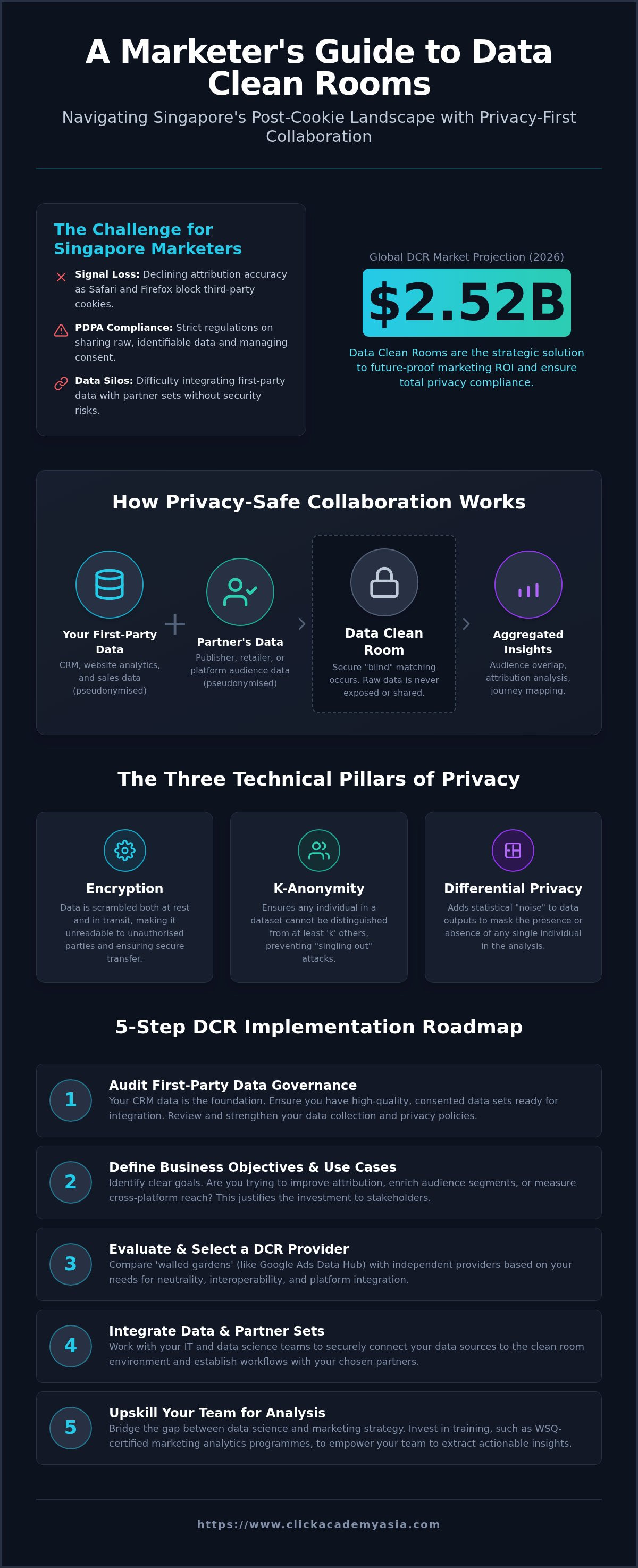
Understanding the internal mechanics of a data clean room (DCR) is essential for any leader overseeing a digital transformation. At its core, a DCR allows two or more parties to join their datasets in a secure environment where the data is processed, but never shared. Unlike traditional methods where raw files are exchanged, DCRs use a "blind" matching process. This ensures that while you can see the overlap between your customers and a partner's audience, you never gain access to their personally identifiable information (PII). This architectural shift is why The Truth About Data Clean Rooms often focuses on their role as the ultimate privacy-first solution.
Successful data clean room implementation for marketers relies on three technical pillars that ensure compliance with Singapore's PDPA:
Encryption: Data is scrambled both at rest and in transit, ensuring it remains unreadable to unauthorised parties.
K-anonymity: This mathematical property ensures that any individual in a dataset cannot be distinguished from at least 'k' other individuals, preventing "singling out" attacks.
Differential Privacy: A method that adds statistical "noise" to the data to mask the presence or absence of any single individual.
The Architecture of Privacy
The security of a clean room often hinges on pseudonymisation. This process replaces direct identifiers, such as email addresses or NRIC numbers, with unique alphanumeric codes. When you work within a hosted environment, a neutral third party manages the infrastructure. This intermediary ensures that query restrictions are strictly enforced. These restrictions prevent users from running overly specific searches that could potentially re-identify a single customer. If you're looking to deepen your team's technical literacy in this area, exploring a WSQ-certified marketing analytics programme can provide the necessary foundation.
Input vs. Output: What Marketers Actually See
One of the biggest shifts in data clean room implementation for marketers is moving away from individual-level data. Instead, you receive aggregated cohorts or high-level insights. For example, instead of seeing that "John Tan" bought a specific product, you might see that "65% of the High-Value Shopper cohort" engaged with your latest campaign. This balance allows for precise campaign optimisation without compromising user privacy. Differential privacy adds mathematical noise to the data to protect individuals, ensuring that the final output remains useful for strategy while being impossible to reverse-engineer. This allows Singaporean businesses to scale their insights while maintaining the highest standards of data ethics.
Evaluating Data Clean Room Providers: A Strategic Framework for 2026
Selecting the right partner is a high-stakes decision for any PMEB in Singapore. With 89% of organisations using multi-cloud solutions as of 2025, your data clean room implementation for marketers must account for where your data currently sits and where your partners operate. The landscape is broadly divided into three categories: walled gardens, neutral platforms, and cloud-native solutions. Each has distinct implications for your budget, technical resources, and long-term scalability.
Walled Gardens vs. Neutral Platforms
Walled gardens like Google Ads Data Hub and Amazon Marketing Cloud are often the first port of call. They provide unparalleled depth for measuring media spend within their own ecosystems. If your primary goal is to optimise YouTube or Search performance, these are essential. However, the data remains locked within their environment, which limits your ability to perform cross-platform analysis.
Neutral platforms, such as Snowflake or Habu, offer a more flexible "neutral ground" for multi-partner collaboration. These are ideal when you need to match your first-party CRM data with datasets from retailers or other third parties. When weighing these options, this guide to choosing a data clean room provider highlights the importance of network scale and interoperability. You don't want to invest in a solution that cannot talk to the rest of your marketing tech stack.
Walled Gardens: Best for deep channel-specific measurement; lower technical entry barrier.
Neutral Platforms: Best for complex, multi-partner strategies; requires higher data engineering maturity.
Cloud-Native: Solutions like AWS Clean Rooms are excellent if your data infrastructure is already hosted within that specific cloud provider.
Selection Criteria for Singaporean Businesses
For Singapore-based leaders, data residency is a non-negotiable factor. You must verify whether the provider stores and processes data within Singapore to remain fully aligned with PDPA standards. Many global providers now offer local regions, but it's your responsibility to confirm this during the vetting process. Ease of use is another critical factor. Marketing teams shouldn't need a PhD in data science to pull basic overlap reports or cohort insights.
Integration with local CRM and POS systems is the final piece of the puzzle. Your data clean room implementation for marketers will fail if it cannot ingest the specific data formats used by your local sales and loyalty programmes. Bridging this technical gap is exactly what we cover in our WSQ-certified marketing analytics and insights modules. Upskilling your team to understand these infrastructure requirements ensures you can justify the investment to your board while maintaining a competitive edge in the APAC region.
Step-by-Step Data Clean Room Implementation for Marketers
Successful data clean room implementation for marketers requires a shift from "big data" thinking to "smart data" precision. It's not enough to simply have the technology; you need a repeatable workflow that moves your team from raw logs to refined strategy without compromising privacy. This process ensures your insights are both actionable and legally sound within the Singapore business ecosystem.
To get started, follow this tactical sequence:
Audit: Standardise your identifiers, such as hashed emails or mobile numbers, to ensure high match rates.
Legal: Draft specific Data Processing Agreements (DPAs) that define exactly how data will be used within the clean room.
Privacy: Set your k-anonymity thresholds to prevent the re-identification of any single customer.
Integration: Connect your secure cloud storage to the chosen DCR environment.
Execution: Run specific queries to find audience overlaps or conversion attribution.
Data Readiness and Governance
Your clean room is only as good as the data you put into it. Start by cleaning and standardising your first-party data to maximise match rates with your partners. Under the PDPA, you must ensure you have explicit consent for data collaboration. This isn't just a compliance hurdle; it's a fundamental requirement for maintaining consumer trust. If your team needs to sharpen their data management skills, the ClickAcademy Asia Marketing Analytics & Insights course provides the practical foundation needed to lead these technical audits. Proper governance at this stage prevents costly errors during the matching process.
Building the Pilot Use Case
Don't try to overhaul your entire strategy on day one. Focus on "quick wins" like audience suppression or lookalike modelling. By identifying existing customers within a partner's dataset, you can immediately stop wasting spend on people who have already converted. This provides a tangible boost to your ROI. Set clear KPIs, such as a reduction in Cost Per Acquisition (CPA), to prove the value of data clean room implementation for marketers to your leadership team. Once the pilot succeeds, you can confidently scale from a single partner to a multi-partner data ecosystem, leveraging the full potential of privacy-safe collaboration.
Equip your team with the skills to lead these technical audits and drive ROI by enrolling in our WSQ-funded Marketing Analytics & Insights training track.
Future-Proofing Your Strategy: Upskilling Through WSQ Marketing Analytics
The sophisticated technical pillars of clean rooms mean nothing if your team lacks the literacy to interpret the output. In Singapore, the demand for data-literate PMEBs is surging as businesses move away from legacy tracking. Successful data clean room implementation for marketers requires a unique blend of technical oversight and strategic vision. You don't need to be a data scientist, but you must understand how to translate aggregated cohorts into high-impact campaigns.
Bridging the gap between the IT department and the marketing suite is the biggest hurdle for most local firms. WSQ-certified programmes empower leaders to speak the language of both worlds, ensuring that digital transformation isn't just a buzzword. By focusing on practical application, these frameworks provide a structured path to mastery that theory alone cannot offer. This ensures your investment in privacy-safe technology delivers a tangible return.
The Skills Required for DCR Management
Managing a clean room involves more than just running queries. It requires a deep understanding of data ethics and privacy-first measurement. You must know how to set k-anonymity thresholds that satisfy the PDPC while still extracting meaningful insights. Continuous learning is the only way to stay ahead in this shifting 2026 environment. For a broader look at how to navigate these changes, check out our guide on Mastering the 2026 Landscape: WSQ Digital Marketing Courses in Singapore.
Leveraging SSG Funding for Executive Education
Professional upskilling in Singapore is heavily supported by government initiatives, making leadership training accessible to all. As of June 2026, SSG provides significant course fee subsidies for WSQ-certified modules. Singapore Citizens aged 40 and above can receive up to 70% in subsidies, while those below 40 and Permanent Residents are eligible for 50%. Small and Medium Enterprises (SMEs) can even access up to 90% through the Enhanced Training Support for SMEs (ETSS) scheme.
These subsidies make it highly cost-effective to align your entire team on a unified DCR strategy. Corporate group training ensures that your marketing, sales, and analytics teams are all working from the same playbook. Don't let your data clean room implementation for marketers stall due to a talent gap. Enrol in ClickAcademy Asia’s WSQ Digital Marketing Strategy & Planning programme today to secure your team's place in the future of privacy-safe marketing.
Mastering the Privacy-Safe Future in Singapore
The transition to a cookieless landscape isn't a distant threat; it's a present reality for every PMEB in Singapore. By embracing data clean room implementation for marketers, you're not just solving for signal loss, you're building a foundation of trust and compliance. Success requires a strategic audit of your first-party data and a clear-eyed evaluation of whether a walled garden or a neutral platform fits your multi-partner goals.
Your team's ability to navigate these technical waters will define your brand's competitive edge in 2026. ClickAcademy Asia serves as a vital partner for those looking to future-proof their skills through strategic partnerships with Google and global industry leaders. Our WSQ-accredited modules offer practical application, ensuring your staff can justify every dollar of marketing spend to stakeholders.
Equip your team with WSQ-funded Marketing Analytics skills at ClickAcademy Asia and leverage SSG-subsidised training for Singaporeans and PRs. It's time to turn privacy challenges into your greatest strategic advantage and lead your organisation with confidence.
Frequently Asked Questions
What is the primary benefit of data clean room implementation for marketers?
The primary benefit is the ability to perform secure, privacy-safe data collaboration with partners to restore attribution accuracy. This process allows you to match customer records without exposing personally identifiable information (PII). By using these environments, brands gain deep insights into audience overlap and campaign performance while respecting consumer trust. It's the most effective way to combat signal loss from browser restrictions in the 2026 landscape.
Is a data clean room compliant with Singapore’s PDPA regulations?
Yes, DCRs are designed to align with the Personal Data Protection Act (PDPA) by using techniques like pseudonymisation and differential privacy. These methods ensure that raw data is never shared, which is critical given the 31 December 2026 deadline for organisations to stop using NRIC numbers for authentication. Data clean room implementation for marketers provides a technical safeguard that keeps your data processing within legal boundaries while still delivering high-value insights.
How much first-party data do I need to start using a clean room?
You don't need millions of records, but you do need a high-quality, consented first-party dataset to achieve statistical significance. Most mid-sized firms in Singapore start with a specific segment of their loyalty or CRM data that includes at least several thousand active records. The focus should be on the accuracy and standardisation of your identifiers, such as hashed emails, to ensure high match rates with your chosen collaboration partners.
Do I need a data scientist to manage our data clean room?
You don't necessarily need a dedicated data scientist to manage the daily operations, but you do need data-literate marketing leaders. While the initial setup requires technical expertise, the strategic direction of data clean room implementation for marketers should be led by PMEBs who understand campaign objectives. Upskilling your existing team through WSQ-certified programmes ensures they can interpret aggregated outputs and translate them into actionable marketing strategies.
What is the difference between a data clean room and a Customer Data Platform (CDP)?
A Customer Data Platform (CDP) is an internal tool used to create a single view of your own customers across various touchpoints. In contrast, a data clean room is a collaboration environment used to match your data with an external partner's data safely. Think of the CDP as your private vault and the DCR as a secure, neutral meeting room where you compare notes with a partner without showing your full files.
Can I use a data clean room for multi-touch attribution (MTA)?
Yes, multi-touch attribution is one of the most powerful use cases for these platforms. By matching touchpoints from multiple media partners within a secure environment, you can see the full customer journey without relying on third-party cookies. This allows you to allocate your budget more effectively across different channels based on their actual contribution to the final conversion, rather than relying on flawed last-click models that ignore mid-funnel influence.
How long does a typical DCR implementation take for a mid-sized company?
A typical implementation for a mid-sized company usually takes between three to six months. This timeline includes auditing your first-party data, establishing legal agreements with partners, and configuring the technical parameters of the clean room. The most time-consuming phase is often the legal and compliance review, so it's vital to involve your PDPC officer early in the process to avoid unnecessary delays during the pilot phase.
Are there SSG-funded courses to help my team learn about data clean rooms?
Yes, ClickAcademy Asia offers several WSQ-certified modules that cover the skills needed for data-driven marketing and clean room strategy. Singapore Citizens aged 40 and above can access up to 70% in SSG subsidies, while those under 40 and Permanent Residents are eligible for 50%. These programmes are specifically designed to help Singaporean PMEBs master marketing analytics and insights, ensuring your team is ready to lead in a privacy-first world.


Comments