
International Sales and Cross-Cultural Communication: A 2026 Professional Guide

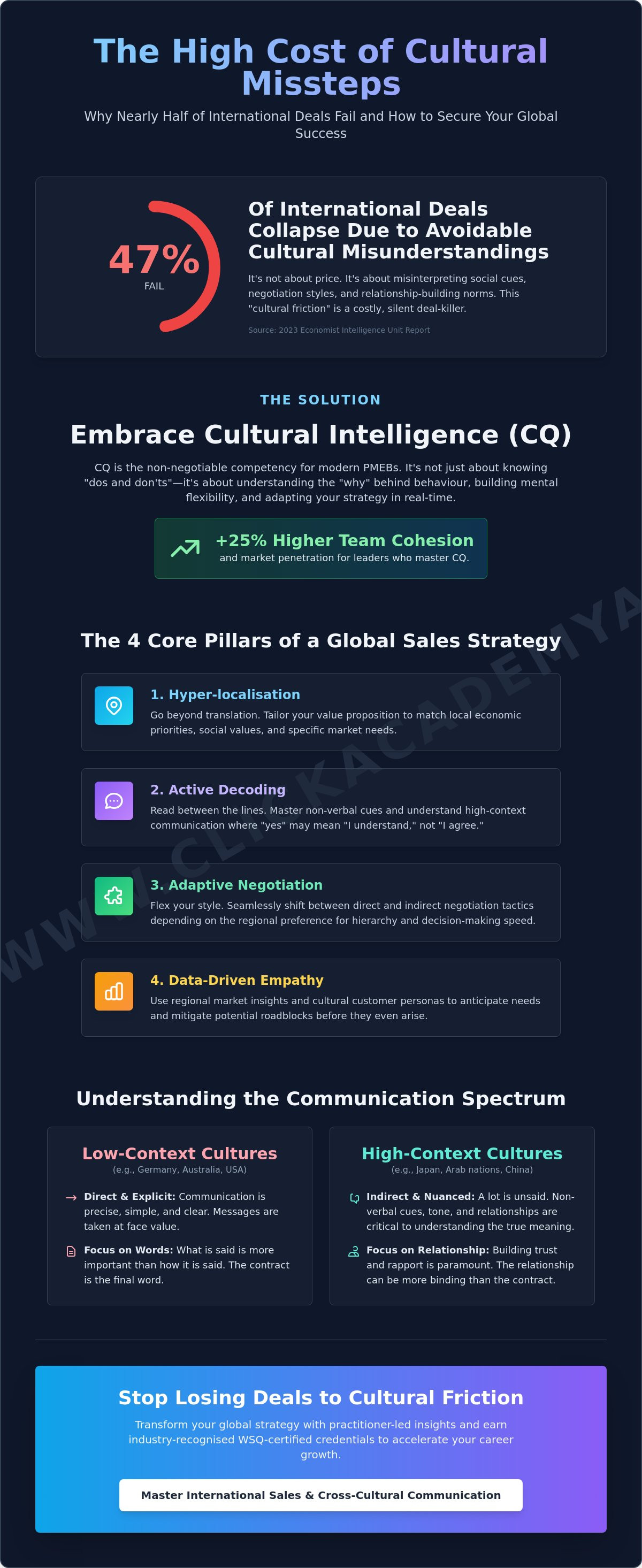
Recent data from the 2023 Economist Intelligence Unit report reveals that 47% of international deals fail not because of price, but due to avoidable cultural misunderstandings. You've likely felt the frustration of a high-stakes meeting where social cues were missed or a customer persona that worked in Singapore failed to resonate abroad. Mastering International Sales and Cross-Cultural Communication - https://www.clickacademyasia.com/course/international-sales-cross-cultural-communication is no longer an optional skill; it's the difference between a closed deal and a wasted flight.
We agree that interpreting international buyer data shouldn't feel like guesswork or lead to inconsistent results. This guide promises to help you master the nuances of global buyer behaviour and adapt your sales strategy for diverse cultural markets. You'll gain a repeatable framework for international sales interactions and the confidence to manage global stakeholders effectively. We'll break down how to create culturally-sensitive customer profiles and avoid the common pitfalls that sink foreign market expansions.
Key Takeaways
Learn how to interpret diverse social norms and adapt your sales approach beyond simple translation to truly resonate with global buyers.
Master the nuances of high-context and low-context cultures to accurately read non-verbal cues in both digital and hybrid environments.
Discover how to map the global customer journey and influence purchasing decisions by mastering International Sales and Cross-Cultural Communication - https://www.clickacademyasia.com/course/international-sales-cross-cultural-communication.
Develop a robust framework for your team by building cultural customer personas and market-specific research protocols that drive results.
Transform your global strategy with practitioner-led insights and earn industry-recognised WSQ-certified credentials to accelerate your career growth.
Table of Contents Mastering International Sales and Cross-Cultural Communication in 2026 The Science of Cultural Nuance in Global Sales Analysing the Global Customer Journey and Buyer Behaviour Building a Cross-Cultural Communication Framework for Your Team Elevating Your Global Strategy with Professional Sales Training
Mastering International Sales and Cross-Cultural Communication in 2026
Closing a deal in Singapore feels very different from closing one in Berlin or Tokyo. It isn't just about the product; it's about the unspoken rules of engagement. At its core, cross-cultural communication is your ability to interpret and adapt to diverse social norms, ensuring your message lands as intended without causing unintentional offence.
Success in International Sales and Cross-Cultural Communication - https://www.clickacademyasia.com/course/international-sales-cross-cultural-communication requires you to look beyond the surface. A translated pitch deck is just the start; the real work happens in the nuances of negotiation and relationship building. If you don't understand the cultural landscape, you aren't just losing a lead; you're potentially damaging your brand's reputation in an entire region.
To better understand how these differences impact your bottom line, watch this helpful video:
Cultural friction isn't just awkward; it's expensive. A 2023 study by Economist Impact revealed that 44% of executives believe cultural differences have caused international business deals to fail. In Singapore's S$500 billion export market, even a 1% loss due to "cultural friction" represents a massive hit to the bottom line. A successful 2026 global sales strategy rests on four core pillars:
Hyper-localisation: Tailoring value propositions to match local economic priorities and social values.
Active Decoding: Reading non-verbal cues and high-context communication where "yes" might actually mean "I understand" rather than "I agree".
Adaptive Negotiation: Shifting between direct and indirect styles depending on the regional preference for hierarchy.
Data-Driven Empathy: Using regional market insights to predict and mitigate potential cultural roadblocks before they occur.
The Shift Toward Cultural Intelligence (CQ)
CQ has emerged as a non-negotiable competency for PMEBs in Singapore. Unlike traditional sales training that focuses on aggressive closing techniques, CQ builds the mental flexibility to thrive in unfamiliar settings. It's the difference between memorising a list of "dos and don'ts" and actually understanding the "why" behind a prospect's behaviour. Regional leaders who master this see a 25% higher rate of team cohesion and market penetration because they can bridge the gap between headquarters and local boots on the ground.
Why One-Size-Fits-All Sales Models Fail
Relying on domestic Singaporean sales tactics in a market like Indonesia or the United Kingdom is a recipe for silence. Hidden barriers, such as differing attitudes toward risk or the speed of decision-making, often stall the purchasing process without the salesperson ever knowing why. If your strategy doesn't account for these variables, you're essentially flying blind. Cultural Intelligence is a data-driven sales asset that transforms social nuance into measurable revenue.
Mastering these skills is the only way to future-proof your career. You can start your journey toward global expertise with ClickAcademy Asia, where practitioner-led training helps you turn these challenges into competitive advantages.
The Science of Cultural Nuance in Global Sales
Mastering global sales requires more than a great product; it demands an obsession with the "silent language" of your prospects. If you are targeting markets beyond Singapore, mastering International Sales and Cross-Cultural Communication is essential for closing deals in 2026. Understanding whether a culture is high-context or low-context determines how much information you need to put in writing versus what is understood through the relationship.
Low-context cultures, such as those in Germany or Australia, value explicit, direct communication. In these markets, your contract is the final word. Conversely, high-context cultures across Asia and the Middle East rely on history, status, and non-verbal cues. In a digital or hybrid sales environment, these cues often shift to response times on messaging apps or the level of formality in a video call background. Ignoring these signals can lead to a quick "no" before you even reach the pitch.
Power distance also dictates your B2B strategy. In high power distance markets, decision-making is strictly top-down. Pitching to a middle manager in these regions might be a waste of resources unless they are a confirmed "champion" with direct access to the C-suite. You must also manage time-perception differences. Monochronic cultures view time as a linear, scarce resource; being five minutes late is a sign of disrespect. Polychronic cultures see time as fluid, often prioritising the current conversation over a rigid schedule.
Communication Styles: Direct vs. Indirect
One of the most common pitfalls in international trade is misinterpreting a "Yes." In many Southeast Asian cultures, "Yes" often means "I hear you" or "I understand," rather than "I agree to the terms." You must recognise these nuances to avoid forecasting errors. Sales professionals should use open-ended questions to verify intent rather than seeking simple binary confirmations.
Navigating indirect feedback requires a soft touch. Developing Cultural Intelligence in Business helps you decode subtle hesitations that signal a "no" without the prospect losing face. Building trust through culturally-aligned protocols, such as proper title usage or gift-giving etiquette, ensures your communication remains effective throughout the negotiation phase.
The Impact of Social Proof and Relationship Building
Relationship-first cultures require a significantly longer sales timeline. You cannot rush the rapport-building phase, as trust is the primary currency. In Singapore and surrounding regions, local references and regional testimonials carry more weight than a global case study from a Western market. Prospects want to see that your solution works within their specific regulatory and cultural ecosystem.
Managing diverse stakeholders involves understanding the collective identity of the organisation. You aren't just selling to one person; you are selling to a network. This is why a practitioner-led approach to learning is so vital for modern professionals. To sharpen your ability to lead these complex regional deals, consider how you can upskill with industry-recognised certifications that focus on practical application.
Analysing the Global Customer Journey and Buyer Behaviour
Understanding how a buyer moves from curiosity to conversion requires more than looking at Google Analytics. Cultural traits act as invisible filters at every stage of the journey. For instance, buyers in high-uncertainty avoidance cultures often spend 30% longer in the "Consideration" phase compared to those in more risk-tolerant markets. They require detailed technical specifications, long-term warranties, and extensive social proof before they feel comfortable moving toward a transaction. Mastering International Sales and Cross-Cultural Communication means recognising that your standard "Search to Purchase" funnel might need a complete overhaul to suit regional expectations.
Successful sales leaders integrate qualitative buyer insights with quantitative market data to build a clearer picture. Hard data might show you *where* users are dropping off, but cultural analysis tells you *why*. In Singapore, for example, a 2024 consumer report indicated that 68% of B2B decision-makers value relationship-building over immediate price discounts. If your data shows high traffic but low conversion in this region, your automated email sequences might be too transactional and lack the necessary personal touch. Use this behavioural data to predict your team's response capabilities and adjust your resource allocation accordingly.
High-Context Markets: Focus on building trust and providing long-form educational content.
Low-Context Markets: Prioritise speed, clarity, and direct calls to action.
Data-Driven Pivots: Shift your strategy when regional conversion rates deviate by more than 15% from your global average.
Gathering International Buyer Data
Collecting feedback across borders is tricky because cultural politeness can often mask genuine dissatisfaction. You must use methods that strip away bias, such as anonymous localised surveys or third-party social listening tools. Analysing these patterns allows you to refine market-specific solutions rather than offering a generic product. When you present your quarterly results, use this specific buyer data to justify sales strategy pivots. It's much easier to gain stakeholder approval for a budget increase when you can prove that a specific cultural tweak will improve the International Sales and Cross-Cultural Communication process for your team.
Measuring Organisational Readiness
Is your team actually ready to handle global customer identities? Evaluating readiness goes beyond checking if your CRM supports multiple currencies. You need to set measurable performance indicators for cross-cultural interactions, such as "Cultural Sentiment Scores" in customer support tickets or "Regional Lead Response Times." These KPIs ensure your team isn't just speaking the same language, but also communicating with the right cultural nuance. Analyse your team strategy with our WSQ Digital Marketing courses to ensure your staff possesses the technical and strategic skills required for this level of global coordination.
Building a Cross-Cultural Communication Framework for Your Team
Scaling a sales team across international borders requires more than just a translated pitch deck. You need a repeatable system that removes guesswork and empowers your reps to close deals with confidence. A structured framework for International Sales and Cross-Cultural Communication - https://www.clickacademyasia.com/course/international-sales-cross-cultural-communication ensures that your team treats cultural nuances as strategic advantages rather than obstacles.
Start by developing a rigorous protocol for researching new markets. This should include a deep dive into local business etiquette and power dynamics. For instance, 2023 data from the Hofstede Insights platform shows that Singapore scores 74 on the Power Distance Index, which significantly impacts how junior staff interact with senior decision-makers. A 2024 report by the Singapore Business Federation found that 62% of local firms cite cultural differences as a primary barrier to regional expansion. By implementing a culturally-sensitive customer profiling guide, your reps can categorise leads based on their cultural context rather than just their budget.
Step-by-Step: Creating Cultural Customer Personas
Identify regional pain points: Focus on what keeps a local lead awake at night. In Singapore, this often involves productivity gains and strict regulatory compliance.
Map local decision-making structures: Determine if the market favours consensus-based models, like the Japanese ringi system, or top-down hierarchies common in many Middle Eastern firms.
Determine preferred communication channels: Research from 2024 suggests that 80% of B2B buyers in Southeast Asia prefer mobile-first communication via apps like WhatsApp or WeChat over traditional email.
A robust persona must include at least three regional cultural traits, such as a high-context communication style, a preference for collective decision-making, and a strong emphasis on saving face during negotiations.
Designing Market-Specific Sales Strategies
Your value proposition shouldn't be a one-size-fits-all statement. You must adapt it to align with local priorities. For example, a German client might prioritise technical precision and long-term stability; conversely, a prospect in a fast-growing market like Vietnam might value speed to market and immediate ROI. Pitching the same way to both will likely result in a 40% lower conversion rate, according to 2023 industry benchmarks.
Ensuring long-term loyalty requires culturally-aware relationship management. This means understanding when to push for a close and when to invest time in social bonding or guanxi. By refining your sales pitches to align with these regional sensitivities, you build a foundation of trust that transcends the transaction. Master these skills by joining a practitioner-led training programme at ClickAcademy Asia today.
Elevating Your Global Strategy with Professional Sales Training
Expanding your business beyond Singapore requires more than just a great product; it demands a sophisticated understanding of how different cultures perceive value and trust. While local success provides a solid foundation, international markets operate on diverse social cues and negotiation styles. Professional training bridges this gap by transforming abstract cultural concepts into actionable sales tactics. Mastery in International Sales and Cross-Cultural Communication ensures your team doesn't just enter a market, but actually thrives within it.
Practitioner-led training is the cornerstone of this professional growth. Unlike academic lectures, these sessions are led by experts who have spent decades closing deals in major hubs like London, Tokyo, and New York. You gain insights into real-world scenarios, such as navigating the high-context communication styles of North Asia or the directness of Western European boardrooms. This practical exposure allows you to anticipate objections before they are even voiced, giving you a distinct competitive edge in 2026.
In Singapore, the government provides robust support for professionals looking to upskill through SSG (SkillsFuture Singapore) and WSG (Workforce Singapore). WSQ-certified courses offer industry-recognised credentials that validate your expertise to global employers and partners. By leveraging SSG subsidies, eligible Singaporeans and Permanent Residents can significantly reduce their training costs, sometimes by as much as 70% to 90% for SMEs or mid-career individuals. This makes high-level professional development an accessible investment for any ambitious sales leader.
The ClickAcademy Advantage
ClickAcademy Asia stands out by prioritising practical application over dry theoretical discussion. We don't just talk about cultural differences; we simulate high-stakes negotiations to test your agility. You get direct access to global standards and expert mentors who provide personalised feedback on your sales approach. This hands-on methodology ensures you leave the programme with a toolkit ready for immediate use. We focus on future-proofing your career by blending traditional sales excellence with advanced leadership skills tailored for the digital age.
Next Steps for Future-Ready Professionals
The first step toward global mastery is identifying the specific sales challenges your team faces. Whether it's a lack of confidence in cross-border pitching or a need to understand regional compliance, choosing the right curriculum is vital. ClickAcademy Asia offers flexible options for both individual enrolment and customised corporate group training. Our consultants can help you map out a learning path that aligns with your 2026 expansion goals. Don't let cultural barriers limit your revenue potential.
Master International Sales and Cross-Cultural Communication today!
Future-Proof Your Global Sales Strategy
Success in the global market by 2026 requires more than just a great product; it demands a deep understanding of the science behind cultural nuance. You've seen how analysing the global customer journey and implementing a structured framework can transform your team's performance. By focusing on these practical strategies, you'll navigate complex buyer behaviours and build lasting relationships across Singapore and international borders.
Professional growth is about staying ahead of the curve. ClickAcademy Asia has already helped over 30,000 professionals upskill through practitioner-led workshops that focus on real-world case studies. Since our courses are WSQ-certified and SSG-funded, you're getting education that meets rigorous national standards while remaining accessible to your professional development budget.
It's time to refine your approach to International Sales and Cross-Cultural Communication - https://www.clickacademyasia.com/course/international-sales-cross-cultural-communication. Take the next step in your career and start leading with confidence in every international negotiation.
Enrol in the International Sales and Cross-Cultural Communication Course
We're ready to help you master these essential skills and thrive in the competitive global landscape.
Frequently Asked Questions
What is the difference between international sales and domestic sales communication?
International sales communication requires navigating varying social norms and linguistic subtleties that don't exist in domestic markets. While domestic sales often rely on shared cultural shorthand, international deals demand an explicit understanding of local business etiquette. A 2023 study by the Harvard Business Review found that 70% of international ventures fail due to cultural differences. You'll need to adapt your pitch to match the specific pacing and formality expected in different regions to succeed.
How does cultural intelligence (CQ) improve sales ROI?
Cultural intelligence (CQ) boosts sales ROI by reducing friction in the negotiation process and increasing lead conversion rates. Higher CQ allows your team to build trust faster, which is critical since 82% of B2B buyers prefer working with sales reps who understand their specific business environment. By mastering International Sales and Cross-Cultural Communication, you avoid the costly delays caused by misaligned expectations. This leads to shorter sales cycles and more sustainable long-term partnerships.
Can cross-cultural communication skills be measured in a professional setting?
You can measure these skills using validated frameworks like the Cultural Intelligence (CQ) Scale, which assesses drive, knowledge, strategy, and action. Many organisations use these 20-point assessments to benchmark a salesperson's ability to function effectively across different cultures. Beyond formal testing, you can track progress through specific KPIs like time-to-close in new markets or client retention rates in specific regions. This data provides a clear picture of how well your team is adapting to global demands.
What are the most common cultural mistakes made in international sales pitches?
The most frequent mistakes include using overly aggressive "hard sell" tactics in relationship-based cultures and ignoring local decision-making hierarchies. In countries like Japan, a direct "no" is rarely spoken, so misinterpreting polite hesitation as agreement can lead to failed forecasts. Another error is failing to localise your presentation materials, which signals a lack of commitment to the local market. Avoiding these pitfalls ensures your message resonates with the intended audience and builds immediate credibility.
Is the International Sales and Cross-Cultural Communication course WSQ-certified?
Yes, this International Sales and Cross-Cultural Communication course is WSQ-certified, meaning it aligns with the national Skills Framework for the professional services sector. This certification ensures the curriculum meets rigorous quality standards set by SKILLSFUTURE SINGAPORE (SSG). You'll receive a Statement of Attainment (SOA) upon successful completion of the assessment. This credential validates your expertise and enhances your professional standing in the Singaporean job market.
How can I use SkillsFuture credit for this sales training?
You can offset your course fees by claiming your SkillsFuture Credit through the official MySkillsFuture portal. Simply log in with your Singpass, search for the course code, and submit your claim before the training commences. As of 2024, Singapore Citizens aged 25 and above receive an initial S$500 credit, with additional top-ups available for mid-career professionals. This makes high-level professional development more accessible for everyone looking to upskill and stay competitive.
What is a cultural customer persona and why do I need one?
A cultural customer persona is a detailed profile that adds layers of cultural values, communication preferences, and buying triggers to standard demographic data. You need one because standard personas often overlook how local traditions influence a buyer's motivations. For example, a persona for a Singaporean SME owner might prioritise long-term stability and government grant eligibility. Creating these profiles helps you tailor your outreach so it feels personal and culturally relevant to the prospect.
How does high-context communication affect virtual sales meetings?
High-context communication makes virtual sales meetings more complex because participants rely heavily on non-verbal cues and reading between the lines. In these cultures, what's left unsaid is often as important as the spoken word. This can be challenging on platforms like Zoom where body language is limited to a small screen. You'll need to pay closer attention to tone of voice and pauses to accurately gauge the client's interest and concerns during the session.


Comments