
How to Master Video Content Marketing Training in 2026

Updated: Aug 21
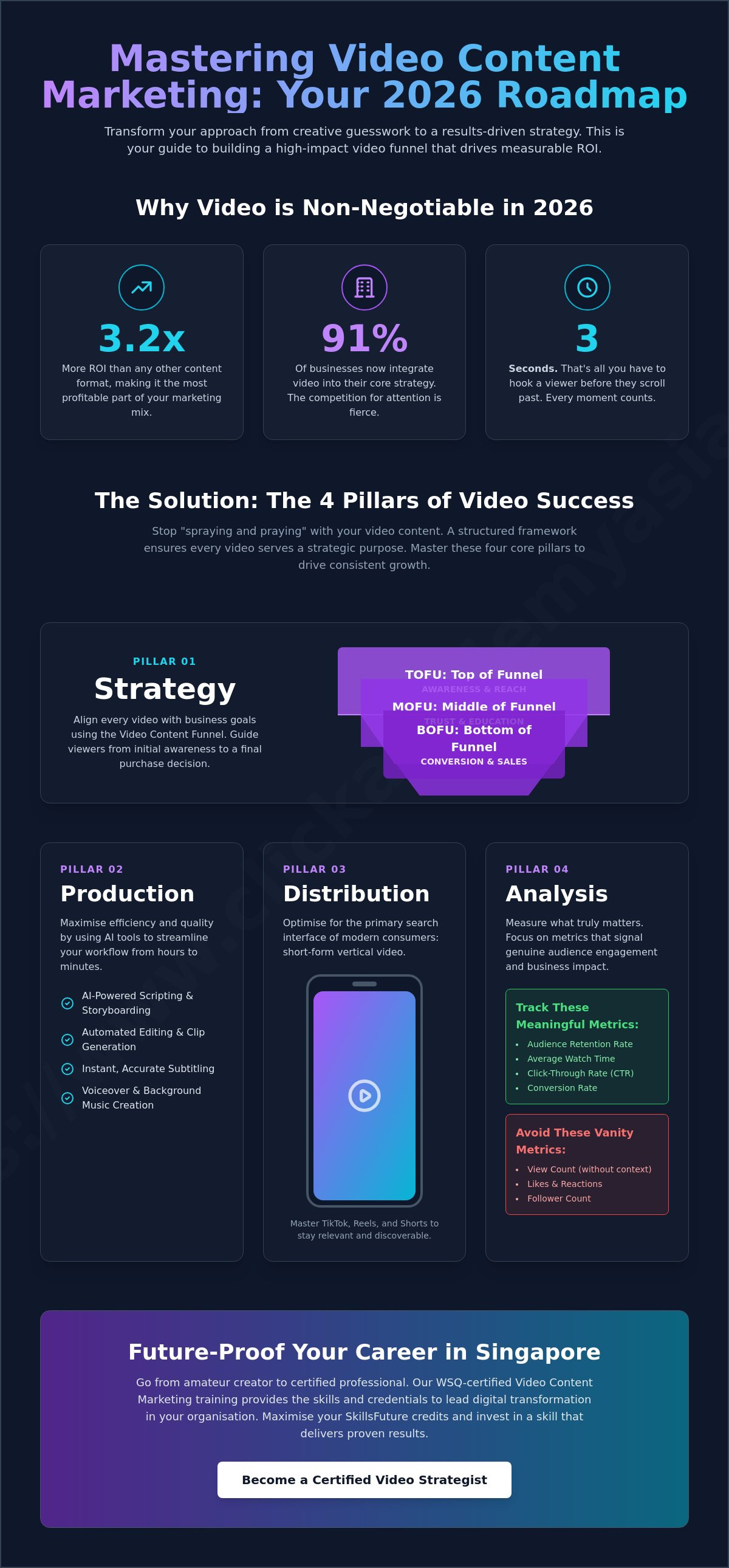
Short-form video now generates 3.2x more ROI than any other content format, yet many professionals find that video content marketing training is the missing link between high production costs and actual engagement. It's frustrating to invest hours into a project only to see it get buried in a feed within seconds. You aren't alone if you feel overwhelmed by the technical skills and platform changes needed to stay competitive.
We're here to help you bridge that gap by building a high-impact strategy that drives measurable results using modern frameworks. You'll learn how to optimise your production workflow using AI tools without losing the authentic human touch that defines your brand. This isn't about chasing fleeting trends; it's about mastering the tools that make video a sustainable and profitable part of your marketing mix.
This guide provides a clear roadmap to help you navigate the 2026 video landscape with confidence. We'll cover everything from vertical video specifications for TikTok and Reels to obtaining the WSQ certifications that boost your career credibility and professional standing in Singapore. You'll walk away with the skills to create high-quality content that captures attention in the first three seconds.
Key Takeaways
Transform your video approach by viewing it as a strategic search interface rather than just a creative task.
Master the "Video Content Funnel" to ensure your strategy aligns with tangible business KPIs and drives measurable ROI.
Use modern AI tools to streamline your production workflow, allowing you to create professional content at a fraction of the traditional cost.
Focus on retention rates and watch time instead of vanity metrics to accurately analyse your video performance and audience engagement.
Find out how to leverage WSQ-certified video content marketing training in Singapore to future-proof your career and maximise your SkillsFuture credits.
Table of Contents
Why Video Content Marketing Training is Essential in 2026
How to Plan a Video Strategy: A Step-by-Step Framework
Maximising Efficiency with AI and Production Tools
Measuring Success: How to Analyse Video Performance
Choosing the Right Video Content Marketing Training
Why Video Content Marketing Training is Essential in 2026
Gone are the days when video was a "nice-to-have" addition to your marketing plan. In 2026, video content marketing is a high-value strategic asset that dictates how your brand is discovered and perceived. With 91% of businesses now integrating video into their core strategy, the competition for attention is fiercer than ever. To stand out, you need more than just a camera; you need comprehensive video content marketing training that treats video as a serious business driver rather than a creative side project.
The landscape has shifted significantly as short-form vertical video has officially become the primary search interface for modern consumers. When someone wants to learn about a product or service, 63% of them now prefer to watch a short video rather than read a manual. This shift belongs to the broader discipline of Content Marketing, but video requires its own specific set of technical and strategic skills to master effectively.
To better understand how this fits into your wider strategy, watch this helpful guide:
The "Attention Economy" is brutal, and you have exactly three seconds to hook a viewer before they scroll past. Without professional training, brands often fall into the trap of "spraying and praying" with their ad spend, leading to high costs and zero conversion. Obtaining a WSQ-certified qualification from a provider like ClickAcademy Asia ensures you aren't just making pretty pictures; you're building a funnel that converts in the Singapore market and beyond.
The Problem with "DIY" Video Marketing
Many marketers try the "DIY" route, but producing content without a strategic framework is a recipe for burnout. You might get lucky with a viral hit, but high view counts don't always lead to business growth if the audience isn't your target demographic. If your TikTok presence doesn't match the professional tone of your LinkedIn or YouTube channel, you risk confusing your audience and diluting your brand equity. Consistency is key, and it's difficult to maintain without a repeatable system grounded in professional standards.
Learning Objectives for Modern Marketers
Mastering this field requires a balance of four core pillars: Strategy, Production, Distribution, and Analysis. Our approach is strictly "no fluff," focusing on the practical skills you can apply immediately to your next campaign. By becoming a certified video strategist, you gain the authority to lead digital transformation within your organisation. You'll learn to use AI to speed up editing while keeping your storytelling authentic and impactful. This video content marketing training is designed to turn you into a results-driven leader who knows exactly how to prove ROI to stakeholders.
How to Plan a Video Strategy: A Step-by-Step Framework
Planning a video strategy requires moving beyond random acts of content creation. To build campaigns that convert, you must map your videos to a structured "Video Content Funnel." This framework ensures you aren't just entertaining an audience, but moving them closer to a purchase decision. Top-of-funnel (TOFU) content focuses on broad reach and awareness, middle-of-funnel (MOFU) builds trust through educational value, and bottom-of-funnel (BOFU) content uses clear calls to action to drive sales.
Every video you produce must align with specific business KPIs, such as lead generation or brand sentiment scores. Before picking up a camera, conduct deep audience research to understand their specific consumption habits. For instance, data shows that 63% of consumers prefer short videos when learning about a product. This insight should dictate your format choices from the start. Effective video content marketing training teaches you how to marry these audience insights with advanced keyword research to ensure your titles and descriptions are optimised for search discoverability.
Step 1: Identifying Your Core Narrative
Your core narrative is the emotional thread that connects your brand to your viewer. Even technical products become accessible when framed through a story that solves a specific human problem. A strong brand story for video might be: "We provide the technical mastery that empowers professionals to lead with confidence." You should balance your content mix across three categories to keep your feed healthy:
Educational: How-to guides and industry insights that solve problems.
Entertaining: Behind-the-scenes footage or relatable workplace humour.
Inspirational: Success stories and case studies that showcase real-world impact.
Step 2: Choosing the Right Platforms
Don't try to be everywhere at once. Analyse where your audience actually spends their time, whether it's the long-form educational environment of YouTube or the fast-paced vertical feeds of TikTok and Instagram Reels. Each platform has its own "language." While you can repurpose a single message, you must tailor the format. A 10-minute YouTube deep-dive needs to be reimagined as a 60-second punchy Reel to perform well.
Make sure to leverage platform-native features like "Link in Bio" or "Shop" tags to reduce friction in the buyer journey. If you find this strategic planning phase daunting, enrolling in a WSQ Content Marketing Strategy course can provide the structured mentorship needed to master these workflows. Mastering these platform nuances is what separates a hobbyist from a professional strategist who delivers measurable ROI.
Maximising Efficiency with AI and Production Tools
AI has fundamentally changed the economics of video. High production costs used to be the biggest barrier for smaller teams, but modern tools have democratised the process. Traditional workflows involving weeks of post-production are being replaced by agile methods that allow you to move from concept to upload in hours. This efficiency is a core component for those looking to optimise their digital marketing strategy by integrating high-frequency video content.
In the 2026 social landscape, "perfect" is often the enemy of "published." Audiences now crave authenticity over high-gloss polish; founder-led and behind-the-scenes content frequently outperforming studio-shot commercials. It is anticipated that approximately 75% of marketing videos in 2026 will be generated or assisted by AI. Comprehensive video content marketing training helps you identify which parts of your production can be automated and which require your unique human perspective.
AI-Driven Video Creation
AI tools now handle the heavy lifting of scriptwriting, voice cloning for voiceovers, and automated subtitling. For teams with limited design resources, platforms like Canva Pro offer a massive stock library and 1TB of storage for a manageable monthly fee. While these tools speed up the process, human oversight remains essential for storytelling and quality control. Use AI to generate the first draft, but always refine the emotional hooks to ensure your brand voice remains consistent and relatable.
The Content Repurposing Workflow
Efficiency isn't just about making new videos; it's about making your existing content work harder. You can turn a single 45-minute webinar into ten punchy, high-impact clips for social media. This repurposing strategy is vital for mobile-first audiences who consume content in vertical 9:16 formats on TikTok, Instagram Reels, and YouTube Shorts. Managing a multi-channel calendar becomes much simpler when you follow a "create once, distribute many" philosophy.
Identify "Gold" Moments: Extract the most insightful 30 to 60 seconds from long-form content to create standalone value.
Nativise the Format: Ensure your clips meet platform-specific resolutions, such as 1080 x 1920 px for Reels and Stories.
Sound-Off Design: Use AI to add captions immediately, as many mobile users watch videos without sound enabled.
Mastering these agile workflows through dedicated video content marketing training ensures your team stays productive without sacrificing quality. By focusing on volume and variety, you can test different messages quickly to see what truly resonates with your audience before committing to larger production budgets.
Measuring Success: How to Analyse Video Performance
It's easy to get distracted by thousands of views, but high numbers don't always translate to revenue. Views and likes are often vanity metrics that mask a lack of real engagement. To truly understand your impact, you need video content marketing training that focuses on data-backed decision making rather than chasing viral fame. You should prioritise "Watch Time" and "Retention Rate" because these metrics tell you exactly where your audience finds value and where they lose interest.
Integrating your video data into your broader marketing analytics with GA4 is essential for a holistic view of the customer journey. By using UTM parameters in your video descriptions and tracking CTA overlays, you can see exactly which videos are driving sales and which are just filling the top of your funnel. This level of granularity allows you to justify your production budget to stakeholders with absolute confidence.
Key Performance Indicators (KPIs) for Video
Your KPIs must change based on your specific campaign goals. If you're building brand awareness in Singapore, you might look at unique reach and impressions. For lead generation, your focus shifts to the Click-Through Rate (CTR) and actual conversions from the video description. Don't guess which thumbnail works best; use A/B testing to compare different hooks and visuals to see what actually stops the scroll.
Continuous Optimisation
Successful video marketing isn't a "set and forget" activity. Use viewer drop-off data to pinpoint the exact second people stop watching, then adjust your future scripts to keep that momentum. Audience comments are a goldmine for new content topics, often highlighting pain points you haven't yet addressed. Finally, don't ignore the role of SEO. Optimising your video titles and metadata ensures your content continues to generate evergreen traffic long after the initial upload.
If you want to turn these insights into a professional career, consider enrolling in WSQ Marketing Analytics & Insights to master the data behind the content.
Choosing the Right Video Content Marketing Training
Selecting the right video content marketing training is a pivotal decision for your career growth. In Singapore, the gold standard for professional development is the WSQ framework. These courses are designed with direct industry input, ensuring that the skills you acquire are immediately applicable to the local and regional business environment. Choosing a WSQ-certified course means you're investing in a curriculum that has been vetted for quality and relevance by national authorities.
One of the most significant advantages for Singaporeans and Permanent Residents is the ability to use SkillsFuture credits to offset training costs. This financial support makes high-level education accessible, allowing you to future-proof your skills without a heavy financial burden. At ClickAcademy Asia, we focus on delivering "Future-Ready" skills that go beyond basic video editing. We empower you to lead digital transformation projects and manage complex content ecosystems with confidence.
Learning from practitioners rather than theorists is what separates a good course from a great one. You need mentors who have managed real-world budgets and navigated the same platform shifts you face daily. Our trainers bring years of hands-on experience from the front lines of digital marketing, providing insights that you simply won't find in a textbook. This practical mastery is the hallmark of our educational philosophy, ensuring you leave with a toolkit of actionable strategies.
What to Look for in a Certification
Before committing to a programme, you should verify that it meets several critical criteria. First, ensure the course is accredited by SSG and WSQ, as this guarantees the certification is recognised by employers across Singapore. A robust curriculum must cover both high-level strategy and hands-on production techniques. Finally, check the profiles of the trainers; they should have a documented track record of success in the digital and corporate training industries.
Next Steps for Your Professional Growth
Taking the next step in your career is straightforward. You can check our website for upcoming intake dates and application requirements for our specialised modules. Beyond the classroom, you'll join a vibrant network of certified marketing professionals, providing opportunities for collaboration and peer-to-peer learning long after the course ends. This community is an invaluable resource as you continue to navigate the evolving technological landscape.
Ready to master the art of strategic storytelling and drive measurable ROI? Enrol in our WSQ Content Marketing Strategy course today and start building your high-impact video roadmap.
Take Lead of Your Video Marketing Future
Mastering the 2026 video landscape requires a shift from sporadic content creation to a disciplined, data-driven strategy. By aligning your video funnel with business KPIs and leveraging AI to streamline production, you can produce high-quality content that truly resonates with your audience. Success is measured by retention and conversion, not just raw views. Engaging in professional video content marketing training is the most effective way to consolidate these skills and lead your brand's digital growth with confidence.
ClickAcademy Asia brings over 10 years of executive education excellence to the table as an official Google Certification Partner. Our WSQ-certified and SSG-funded training programmes are designed to provide practical, real-world mastery that goes beyond theory. You'll learn from industry practitioners who understand the nuances of the Singapore market and the global digital economy, ensuring your skills remain relevant in a shifting environment.
Don't let your brand get left behind in the scroll. Master your video strategy with ClickAcademy Asia’s WSQ-certified courses and start driving measurable ROI today. Your journey toward becoming a certified video strategist starts with a single step, and we're here to support your professional evolution every step of the way.
Frequently Asked Questions
Is video content marketing training worth it for small businesses?
Yes, it is worth it because it allows small teams to compete with larger brands by using smart strategy instead of massive budgets. Learning how to create high-impact content with limited resources prevents the common mistake of wasting money on unoptimised posts. This specialised video content marketing training empowers small business owners to build authentic connections that drive sales without needing a full production house.
Can I use my SkillsFuture credits for video marketing courses?
You can certainly use your SkillsFuture credits for any courses that carry the WSQ certification mark. Most Singaporeans aged 25 and above have credits that can be applied directly to offset the fees for professional development. It's a practical way to upskill while making the most of available national grants provided by SSG to future-proof your career in the digital economy.
How long does it take to see results from a new video strategy?
You'll often see immediate spikes in social media engagement and reach within the first few days of posting natively optimised content. However, building a sustainable pipeline of leads and improving your search rankings typically takes between three to six months of consistent posting. Patience is vital as you collect enough data to refine your "hooks" and improve your viewer retention rates over time.
Do I need expensive equipment to start video marketing in 2026?
High-end equipment is no longer a requirement for success since modern smartphones and AI editing tools can produce professional results. Most audiences in 2026 actually prefer the "creator-style" look of authentic, handheld footage over overly polished studio productions. You should focus on good lighting and clear audio instead of buying the latest cinema camera to get started with your first campaign.
What is the difference between WSQ and other marketing certifications?
WSQ certifications are specifically aligned with the national skills framework in Singapore and focus on practical, competency-based learning. Unlike some academic or purely theoretical certificates, WSQ training requires you to demonstrate that you can actually perform specific tasks in a real-world setting. This makes them highly respected by local employers and eligible for significant government funding through WSG and SSG.
How does video marketing training help with SEO?
Professional video content marketing training teaches you how to optimise your video metadata, such as titles and closed captions, to rank higher on Google. High-quality video also keeps visitors on your website for longer, which signals to search engines that your content is valuable. This "dwell time" is a critical factor in boosting your overall domain authority and increasing your organic search visibility.
What are the most important video platforms to focus on this year?
Short-form vertical video platforms like TikTok, Instagram Reels, and YouTube Shorts should be your primary focus this year. These platforms currently offer the highest organic reach and are becoming the preferred search interface for modern consumers. Developing a "mobile-first" mindset ensures your content is accessible to the vast majority of users who now consume video exclusively on their smartphones.


Comments