
How to Become a Digital Marketing Specialist in 2026: A Strategic Guide

With global digital ad spending projected to hit $836 billion in 2026, the demand for skilled professionals has reached an all-time high. You've likely felt the weight of information overload while searching for how to become a digital marketing specialist, perhaps worrying if AI will make the role redundant or if a specific certificate is actually worth the investment. It's a common concern, especially when the landscape shifts as quickly as the algorithms we track.
This guide provides a definitive roadmap for the current year, showing you exactly how to master technical SEO and secure the WSQ-certified credentials that employers in Singapore truly respect. We'll bridge the gap between theory and practice, helping you understand which skills lead to the average $65,418 specialist salary reported by ZipRecruiter this May. You'll gain a clear sequence of steps to transition from a curious learner to a confident, results-driven professional.
Key Takeaways
Learn how the role has evolved from tactical execution to becoming a strategic architect who uses AI to orchestrate complex data and marketing campaigns.
Discover the essential "T-shaped" skill stack for how to become a digital marketing specialist, prioritising technical mastery in SEO and SEM alongside strategic vision.
Understand the value of WSQ certifications as the recognised national standard in Singapore and how to access SSG subsidies to fund your professional development.
Gain a practical framework for building a portfolio by conducting digital audits and documenting measurable results that prove your expertise to potential employers.
Master the art of profile optimisation to ensure your LinkedIn and resume highlight the strategic outcomes and credentials that recruiters are actively seeking in 2026.
Table of Contents
What Does a Digital Marketing Specialist Actually Do in 2026?
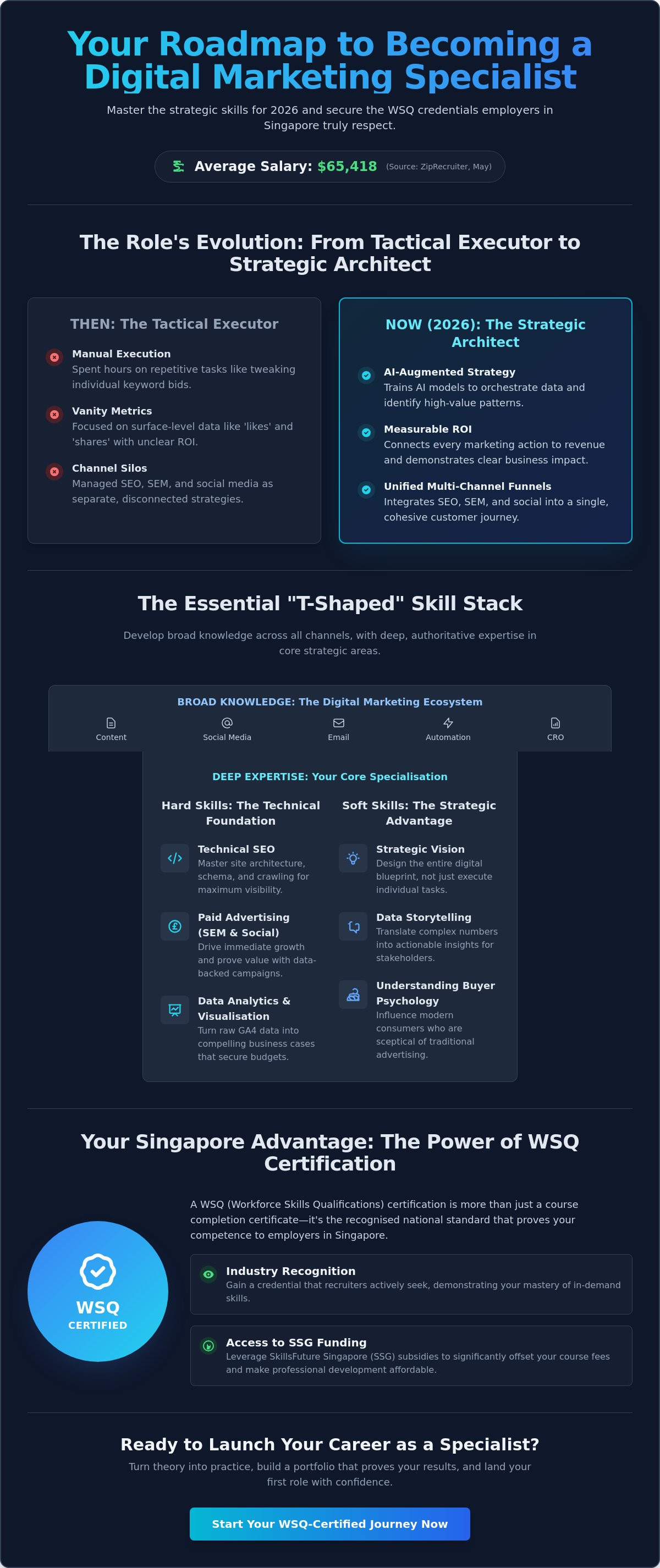
If you picture a digital marketing specialist as someone who just spends their day posting on Instagram, it's time for a quick reality check. By 2026, the role has evolved into that of a strategic architect. You aren't just creating content; you're designing the entire digital blueprint that connects a brand to its ideal customer through complex, automated systems.
Manual execution has largely been replaced by AI-augmented strategy and data orchestration. Instead of tweaking individual keyword bids for hours, you'll be training AI models to recognise high-value patterns. This shift is critical for businesses in Singapore and beyond as they navigate a post-cookie landscape. Without third-party tracking, companies rely on specialists to build first-party data strategies that respect privacy while driving growth.
To better understand how these strategic roles translate into a professional career, watch this helpful video:
The Shift from Tactical to Strategic Marketing
Businesses have moved away from vanity metrics like "likes" or "shares." In the current market, every action must be tied to a clear ROI. A specialist must understand the entire digital marketing ecosystem to track a non-linear customer journey. You'll be expected to bridge the gap between marketing and sales, ensuring that the leads you generate actually turn into revenue for the company.
Key Responsibilities in the Modern Workplace
Your daily routine will involve managing multi-channel funnels where SEO, SEM, and paid social work as a unified strategy. It's no longer about silos; it's about how one channel supports another. If you're looking into how to become a digital marketing specialist, you must master data storytelling. You'll use platforms like GA4 to translate raw numbers into actionable business insights that stakeholders can actually understand.
While a generalist knows a little about everything, a true specialist adopts a "T-shaped" skills profile. This means you have a broad understanding of the whole field but possess deep, authoritative expertise in a specific niche. Whether you choose to focus on technical SEO or performance advertising, your value lies in your ability to lead the strategy rather than just following a checklist.
The Essential Skill Stack: From Technical Tools to Strategic Vision
Knowing how to post a social update is a start, but it isn't enough to build a career. To truly understand how to become a digital marketing specialist, you must develop a "T-Shaped" skill stack. This framework requires a broad knowledge of all digital channels while maintaining deep, authoritative expertise in one or two core areas. In 2026, AI literacy serves as the foundational layer for this stack, as AI-generated content now accounts for 25% of all marketing material online according to recent industry estimates.
Hard Skills: The Technical Foundation
Search Engine Optimisation (SEO) remains a non-negotiable pillar of your technical foundation. You'll need to master technical nuances like site architecture and schema markup to ensure search engines can effectively crawl and index your content. Paid advertising, encompassing both SEM and social ads, provides the immediate business growth that stakeholders demand. Proving the value of these efforts requires advanced knowledge of GA4 and data visualisation. If you can't demonstrate a clear return on investment, your campaigns will struggle to secure long-term budget. Developing these competencies through structured WSQ Marketing Analytics & Insights training ensures you can turn raw data into a compelling business case.
Soft Skills: The Strategic Advantage
Technical ability might get you the interview, but strategic vision is what helps you keep the job. You must understand the psychology of selling to influence modern buyers who are increasingly sceptical of traditional advertising. Building a cohesive marketing framework is about more than just creative ideas; it requires disciplined project management and clear stakeholder communication. When you're advancing your digital marketing career, the ability to translate complex technical metrics into a story that a CEO understands is vital. Specialists who can bridge the gap between technical execution and business goals are the ones who command the highest salaries in 2026.
When researching how to become a digital marketing specialist, don't overlook the importance of content marketing and social media strategy. These aren't just "creative" tasks; they are the strategic pillars that fuel your SEO and SEM engines. A specialist ensures that every piece of content serves a purpose within the wider marketing funnel, moving a prospect from initial awareness to a final sale. This holistic approach is exactly what modern employers are looking for in their marketing leadership.
Navigating the Certification Landscape: Why WSQ Matters
If you've spent any time on forums like Reddit, you've probably seen advice to "just start a blog" or watch YouTube tutorials to learn the ropes. While hands-on experimentation is valuable, it often misses the formal recognition needed to clear the HR hurdle in Singapore. When you're researching how to become a digital marketing specialist, you need to understand that the local job market places significant weight on the Workforce Skills Qualifications (WSQ) framework.
Global certifications from Google and Meta are excellent for platform-specific technical skills, but WSQ modules offer a broader strategic context. A WSQ Digital Marketing Strategy & Planning course doesn't just teach you which buttons to click; it teaches you how to design a framework that aligns with business objectives. This national standard is a cornerstone of how to become a digital marketing specialist in the local market, ensuring your training is recognised by employers across various industries.
One of the most significant advantages for professionals in Singapore is the financial support provided by SkillsFuture Singapore (SSG). These subsidies make high-level training accessible, allowing you to upskill through SkillsFuture Credit or mid-career grants. It's a structured, cost-effective way to build a resume that stands out to recruiters who are specifically looking for talent that can handle high-level data orchestration and strategy.
The Benefits of WSQ-Certified Training
WSQ-accredited courses are built on industry-validated standards, meaning the curriculum is designed to meet the actual needs of the modern workplace. These courses prioritise practical application over abstract theory, ensuring you leave with skills you can use on day one. Because they align with the Skills Framework for Infocomm Technology, these certifications provide a clear pathway for career progression and salary growth within the digital economy.
Building a Portfolio of Credentials
To build a truly competitive profile, you should consider stacking specific modules to create a well-rounded specialist identity. Combining WSQ Search Engine Optimisation (SEO) with WSQ Search Engine Marketing (SEM) demonstrates a mastery of both organic and paid search. You can then supplement these with official Google Ads and Analytics certifications to prove your platform-specific expertise. When evaluating training providers, use this checklist to ensure you get the best value:
Verify the provider is an SSG-approved training organisation.
Look for trainers with active, high-level industry experience.
Ensure the curriculum includes practical, real-world case studies rather than just theory.
Check if the course offers post-training support or industry-recognised credentials.
For a deeper look at your educational options, read our guide on Mastering the 2026 Landscape: WSQ Digital Marketing Courses in Singapore. This will help you map out exactly which credentials will have the most impact on your specific career goals and long-term earning potential.
Turning Theory into Practice: Building a Real-World Portfolio
Securing your WSQ credentials is a vital milestone, but a certificate alone won't convince a hiring manager. You need to demonstrate that you can translate those frameworks into tangible business growth. The secret to how to become a digital marketing specialist lies in your ability to showcase a portfolio of real-world results, even if you haven't held a full-time role yet.
Begin by executing a personal project or auditing the digital presence of a local business. You might offer to analyse a small retailer's SEO or manage a low-budget social media campaign for a non-profit. Document every stage of this process, from your initial strategy to the final execution. Highlighting these practical wins shows you have the initiative and technical capability that employers crave.
Crafting High-Impact Case Studies
When building your portfolio, move beyond a simple list of tasks. Instead, adopt the Challenge, Action, Result framework for each entry. Clearly define the problem the business faced, the specific strategic actions you took, and the measurable outcomes that followed. Use visual data like GA4 graphs or search console screenshots to prove your impact. Explaining the "why" behind your tactical choices proves you are a strategic architect rather than a manual executor.
Gaining Experience Without a Full-Time Job
Don't wait for a job offer to start gaining experience. Volunteering your skills for a charity or taking on micro-internships can provide the diverse channel exposure you need. These short, project-based stints allow you to test your skills in SEO, SEM, and content marketing across different industries. Your WSQ course projects are also excellent initial pieces; they represent industry-validated work that demonstrates your grasp of the national standard.
Once you have three or four solid entries, present them in a professional digital format. A personal website or a polished, interactive PDF is far more effective than a standard resume. This digital-first approach shows you are comfortable with the tools of the trade. If you're ready to start building those high-impact projects, our WSQ Content Marketing Strategy course provides the perfect environment to develop your first portfolio-ready campaigns.
Launching Your Career: Landing Your First Specialist Role
You have mastered the T-shaped skill stack and built a portfolio that proves your worth. Now you must apply those same marketing principles to your own career. Understanding how to become a digital marketing specialist culminates in this final stage: convincing employers that you are the strategic architect their business needs. It's about moving from a learner to a professional who can deliver measurable ROI.
Optimising Your Digital Presence
Recruiters in Singapore rely heavily on LinkedIn filters to find talent in 2026. Ensure your profile includes high-intent keywords like GA4, Performance Strategy, and Conversion Rate Optimisation. Don't just list your duties; share industry insights or reflections on your recent WSQ projects to build immediate authority. Networking with training alumni and industry mentors often reveals "hidden" job opportunities that never reach public job boards.
Tailor your resume to lead with strategic outcomes rather than a simple list of tools. Instead of saying you "did SEO," state that you "optimised site architecture to increase organic visibility by a specific percentage." Highlighting your WSQ credentials prominently shows that your skills meet the national standard recognised by SSG. This level of specificity proves you understand the direct correlation between technical execution and business revenue.
Acing the Marketing Interview
Technical interviews now go far beyond simple definitions. You should be prepared to explain your analytical process when faced with a sudden drop in organic traffic or a rising Cost Per Acquisition. If an interviewer asks about a failed campaign, talk through the data honestly and explain the strategic pivots you made. This demonstrates the continuous learning mindset that distinguishes a specialist from a tactical executor.
Show that you are comfortable with the latest AI-augmented tools without relying on them as a crutch. Explain how you use these technologies to speed up data orchestration while keeping the strategic vision firmly in your control. Employers are looking for professionals who can lead a brand through the post-cookie landscape with confidence and technical precision.
Your Next Step Toward Mastery
The journey from a curious learner to a recognised expert is a marathon. By following this roadmap, you've moved from understanding the 2026 landscape to securing the industry-validated credentials that set you apart. A specialist role offers more than just a title; it provides a platform to shape the future of how brands connect with their audiences. The most reliable way to ensure success is to start with a structured, professional foundation that employers trust.
Start your journey with ClickAcademy Asia's WSQ Digital Marketing Strategy course and take the first step toward your new career today.
Ready to Lead the Digital Frontier?
The roadmap for how to become a digital marketing specialist in 2026 is clear. It requires a shift from tactical execution to strategic architecture, supported by a T-shaped skill stack and a portfolio of measurable results. By prioritising industry-recognised WSQ credentials, you ensure your expertise aligns with the national standards employers in Singapore trust.
Success in this competitive landscape depends on your ability to adapt to AI-augmented tools while maintaining a human-centric strategic vision. You don't have to navigate this transition alone. With training delivered by industry practitioners and a curriculum backed by partnerships with global platforms like Google, you can gain the practical mastery needed to excel.
Empower your career with our WSQ Digital Marketing Strategy & Planning course. Our SSG-funded modules provide the structured foundation and financial support you need to turn your aspirations into a tangible professional reality. The digital future is waiting for you; take charge of it.
Frequently Asked Questions
Do I need a university degree to become a Digital Marketing Specialist?
You don't strictly need a university degree to enter the field. Many employers in Singapore now prioritise practical skills, a strong portfolio, and industry-recognised certifications over traditional academic titles. Securing WSQ credentials and demonstrating your ability to drive ROI often carries more weight in a modern marketing interview.
How long does it take to become a Digital Marketing Specialist in 2026?
It typically takes six to twelve months of focused study and practice to build a professional foundation. If you're researching how to become a digital marketing specialist, you can accelerate this timeline by stacking intensive modules like SEO and SEM. The speed of your progression depends on how quickly you can move from theory to executing real-world projects.
What is the average salary for a Digital Marketing Specialist in Singapore?
Salaries in Singapore vary significantly based on your technical niche and years of experience. While entry-level positions offer a solid starting point, specialists who master high-value skills like GA4 and strategic data orchestration often command higher compensation. It's best to consult the latest Ministry of Manpower salary guides or local recruitment reports for the most current data.
Are WSQ digital marketing courses worth it for career switchers?
WSQ courses are highly effective for career switchers because they provide a structured, industry-validated pathway. These modules align with the national Skills Framework, making your new credentials immediately recognisable to local hiring managers. The practical, hands-on nature of the training ensures you gain the confidence to handle professional campaigns from day one.
Can I learn digital marketing for free online?
You can learn basic concepts for free, but these resources often lack the strategic depth and formal recognition required by top employers. Free tutorials are excellent for introductory awareness. However, professional roles usually require the structured mentorship and government-subsidised certification that only accredited training providers can offer.
What is the difference between a Digital Marketing Generalist and a Specialist?
A generalist has a broad, surface-level understanding of multiple channels, whereas a specialist possesses deep, authoritative expertise in one specific area. Most successful professionals today aim for a "T-shaped" profile. This means you understand the whole digital ecosystem but can lead a strategy in a core niche like technical SEO or paid advertising.
How has AI changed the role of a Digital Marketing Specialist?
AI has shifted the role from manual execution to strategic orchestration and data analysis. Instead of spending hours on repetitive tasks, you'll use AI tools to generate insights and optimise campaigns at scale. Mastering these tools is now a core part of how to become a digital marketing specialist, as it allows you to focus on high-level strategy.
How do I use my SkillsFuture Credit for marketing courses?
You can use your credits by searching for approved WSQ modules on the MySkillsFuture portal. Once you've selected a course from an SSG-approved training provider, you can submit a claim to offset the fees. This system makes professional upskilling highly accessible for Singapore citizens and permanent residents looking to future-proof their careers.


Comments