
Strategic Foresight for Marketing Planners: Navigating the 2026 Singapore Landscape

A static 12-month marketing roadmap is no longer an asset; it's an educated guess that expires before the first quarter ends. If you find it exhausting to justify long-term investments to stakeholders while generative AI reshapes search and consumer behaviour overnight, you aren't alone. Traditional forecasting relies on historical patterns that no longer hold up in fragmented digital channels. Adopting strategic foresight for marketing planners in Singapore transforms this dynamic, shifting your focus from reactive firefighting to commanding proactive, future-ready brand strategy.
True resilience doesn't come from guessing a single outcome correctly; it comes from preparing your systems to thrive across whatever scenarios unfold. In this guide, you will master actionable frameworks to scan for emerging macro trends, build adaptable scenario-based marketing budgets, and lead your organisation with measurable conviction. We will also explore how local PMEBs can anchor these capabilities through recognised WSQ training pathways to future-proof their strategic value.
Table of Contents
Why Traditional Marketing Planning Fails in the 2026 Singapore Market
Most annual marketing plans fail before mid-year review because they rely on linear projections. Planners routinely take previous performance data, add an optimistic five to eight percent growth target, and parcel out media spend across established channels. In a disrupted commercial environment, this approach creates severe operational blind spots. When generative search summaries siphon organic traffic and ad platform automation takes over bid allocations, standard benchmarks turn into corporate liabilities. Applying strategic foresight for marketing planners provides the disciplined structure needed to escape this reactive loop and anticipate sudden market shifts.
Many local marketing teams remain trapped in firefighting mode. Tactical pivots consume daily bandwith, leaving little room to question underlying assumptions. According to established principles in the strategic foresight framework, sustainable competitive advantage requires scanning systemic horizon changes rather than simply tweaking live campaigns. Strategic foresight serves as the crucial discipline for Singaporean firms seeking to move past quarter-by-quarter survival.
The Limits of Historical Data
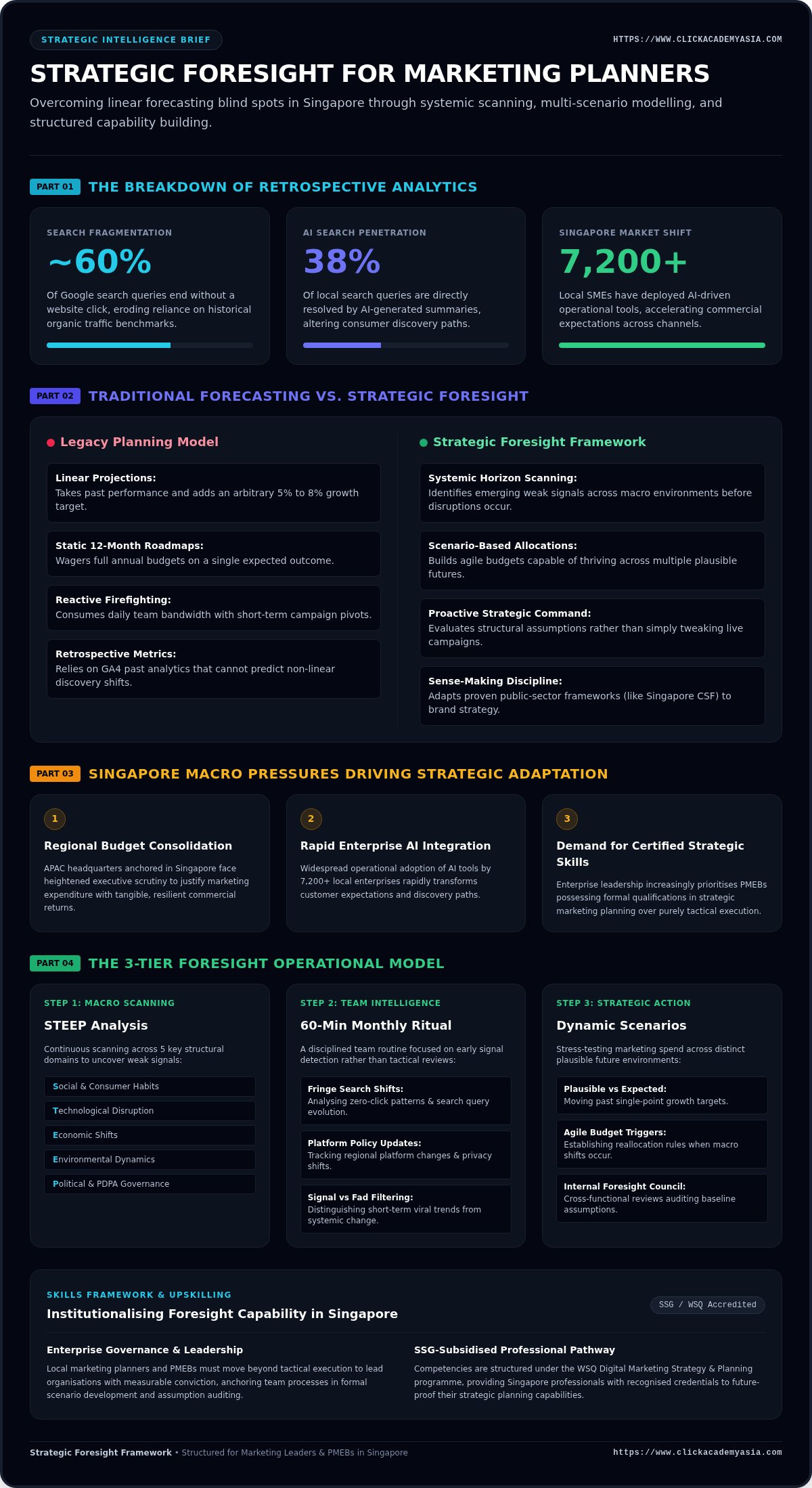
Relying purely on retrospective analytics leaves teams vulnerable. Campaign numbers from 2025 cannot account for non-linear shifts, such as roughly 60% of Google queries ending without a website click, or AI-generated summaries answering 38% of local search queries. GA4 dashboards tell you what happened yesterday, not how audience discovery will splinter tomorrow. Copy-pasting previous media schedules ignores systemic market changes, leading to wasted spend and diminished reach.
Singapore’s Unique Volatility Factors
Local marketing planners manage distinctive regional pressures that demand sharper foresight capabilities:
Regional Budget Consolidation: APAC headquarters in Singapore are under pressure to justify marketing expenditures with immediate commercial returns.
Rapid Enterprise AI Integration: With over 7,200 local SMEs deploying AI-driven operational tools, audience engagement expectations are transforming faster than traditional campaigns can adapt.
Demand for Certified Strategic Skills: Enterprise leadership increasingly looks beyond tactical execution, creating a clear preference for PMEBs with formal WSQ qualifications in strategic planning.
Navigating these disruptions requires shifting from single-point forecasts to dynamic scenario planning. Embedding strategic foresight for marketing planners into quarterly workflows equips teams to stress-test their playbooks against genuine uncertainty.
The Strategic Foresight Framework for Marketing Planners
Strategic foresight is the disciplined exploration of multiple plausible futures to make smarter, more resilient marketing decisions today. Rather than wagering your entire annual budget on a single projected outcome, foresight expands your perspective across systemic drivers. At its core, strategic foresight for marketing planners employs STEEP analysis (Social, Technological, Economic, Environmental, and Political scanning) to uncover weak signals, which are subtle, emerging anomalies in consumer habits or regulations that hint at larger structural disruption.
This structured discipline mirrors public-sector methodologies pioneered by the Singapore Centre for Strategic Futures, where strategic planners use continuous sense-making to navigate volatility. Translating this practice to commercial campaigns ensures you aren't caught off guard when market dynamics pivot unexpectedly.
Horizon Scanning: The Planner's Early Warning System
Horizon scanning is a continuous intelligence-gathering process designed to detect early indicators of cultural, regulatory, and technological change before they reshape consumer behaviour. Establish a monthly 60-minute scanning ritual with your team to review fringe search data, shifts in regional platform policies, and regulatory updates like PDPA privacy adjustments. Focus on distinguishing short-lived algorithmic fads from structural shifts that permanently change how customers discover and evaluate products.
Scenario Development for Marketing Campaigns
Once you gather emerging signals, map them across three distinct marketing futures:
Best-Case Scenario: Channel efficiency improves, customer acquisition costs stabilise, and campaign automation scales smoothly.
Worst-Case Scenario: Core organic traffic declines steeply, ad costs spike across primary channels, and consumer discretionary spending contracts.
Transformative Scenario: Generative search replaces traditional landing pages entirely, forcing an immediate pivot to owned communities and direct brand authority.
Distribute baseline resources across resilient core initiatives while keeping contingency funds tied to clear, data-driven trigger points. When early-warning indicators appear, your team pivots instantly without executive friction. Marketers looking to operationalise this methodology can develop these capabilities through ClickAcademy Asia's marketing strategy programmes, turning theoretical foresight into everyday planning tools.
Strategic Foresight vs. Traditional Forecasting: A Comparison
Marketing leaders often confuse forecasting with foresight, yet they serve entirely different functions. Forecasting is tactical and narrow. It assumes the operating environment remains identical while projecting historical data into a single expected outcome. In contrast, strategic foresight for marketing planners is systemic and exploratory. It recognises that consumer habits, privacy policies, and digital channels are constantly shifting, mapping multiple plausible futures instead of betting the marketing budget on a single linear trajectory.
Relying solely on traditional forecasting methods creates a dangerous illusion of precision. A quarterly spreadsheet might pinpoint conversion rates under static assumptions, but it collapses the moment search algorithms, consumer confidence, or competitive landscapes shift. Resilient teams don't discard quantitative forecasting; they nest it inside a broader foresight architecture to balance near-term efficiency with strategic agility.
When to Use Forecasting
Forecasting remains valuable for short-horizon operational decisions where market conditions stay relatively stable. Marketing planners should deploy quantitative forecasting for:
Allocating monthly paid search budgets across active search engine marketing campaigns.
Adjusting tactical media spend around established retail holidays and predictable consumer spending cycles.
Managing short-term lead generation targets and inventory distribution based on historical conversion velocity.
These near-term calculations provide the operational precision needed to optimise return on ad spend, answering how to execute efficiently within the current environment.
When to Use Strategic Foresight
Strategic foresight steps in when the operating environment itself is undergoing profound change. Deploy foresight methodologies to guide:
Long-term brand positioning and multi-year market entry across evolving APAC territories.
Proactive adaptation to disruptive technological developments, such as agentic AI and privacy-first tracking architectures.
Developing internal capability by enrolling marketing talent in accredited courses through ClickAcademy Asia to master emerging strategic competencies.
Foresight answers whether you are solving the right challenges for tomorrow's audience. Embedding strategic foresight for marketing planners into your workflow ensures you stop chasing last quarter's benchmarks and start shaping your brand's future market position.
Actionable Steps to Implement Foresight in Your Marketing Team
Implementing strategic foresight requires embedding concrete operational habits into your team's weekly routines. Rather than treating foresight as a theoretical exercise, marketing leaders must integrate structured tools that challenge existing beliefs and systematically de-risk future spend. Putting strategic foresight for marketing planners into practice begins by interrogating the legacy assumptions embedded in your current campaigns, then institutionalising proactive decision-making across departmental silos.
Forming an internal, cross-functional Foresight Council accelerates this cultural shift. Convene representatives from brand marketing, performance media, sales leadership, and product operations once a month to review emerging market signals together. This collaborative dynamic breaks down communication barriers, ensuring that front-line customer feedback immediately informs broader marketing strategy. It also aligns cross-departmental efforts with regional compliance standards, including local data governance guidelines.
Step 1: The Assumption Audit
Marketing teams frequently operate under obsolete legacy assumptions, such as presuming that high social follower counts equate to qualified commercial demand, or that paid search costs will remain stable indefinitely. To run an effective audit, instruct your marketing planners to document their five core planning assumptions and rigorously stress-test each one against sudden regulatory changes, platform algorithm updates, or macroeconomic shifts. If an assumption fails under scrutiny, develop an immediate scenario-based pivot.
Step 2: Integrating WSQ Standards
Formalising strategic competence across your department prevents foresight from remaining an ad-hoc experiment. Aligning internal workflows with the national Singapore Workforce Skills Qualifications (WSQ) framework provides your team with standardized, certifiable competencies in strategic planning and market analysis. This alignment offers measurable advantages:
Subsidised Capability Building: Singapore enterprises can leverage substantial SSG course fee subsidies and absentee payroll funding to upskill existing staff affordably.
Standardised Strategic Vocabulary: Adopting formal framework models ensures all planners evaluate trend trajectories and allocate resources using consistent methodologies.
Documented Enterprise Impact: WSQ-aligned deliverables provide structured documentation for quarterly corporate reporting, HR performance reviews, and executive strategy audits.
Upskilling your workforce bridges the gap between raw data interpretation and resilient long-term planning. To establish these capabilities within your organisation, explore WSQ-accredited strategy training programmes with ClickAcademy Asia and build a team equipped to lead in an unpredictable market.
Future-Proof Your Strategy with ClickAcademy Asia
Outsourcing your long-term planning to external management consultancies often results in expensive slide decks that gather dust once market conditions change. Sustainable agility requires cultivating these strategic capabilities within your own marketing department. ClickAcademy Asia’s WSQ Digital Marketing Strategy & Planning programme equips marketing professionals with practical methodologies to anticipate industry shifts, build resilient frameworks, and lead organisational change. Rather than passively absorbing pre-recorded video lectures, learners engage directly in mentor-led workshops led by veteran industry practitioners who bring real commercial scenarios into the classroom.
Founded in 2011, ClickAcademy Asia has spent over a decade preparing PMEBs and corporate teams to lead digital transformation across the region. Developing continuous upskilling pathways ensures that your planners aren't simply executing reactive tactics, but actively steering business growth.
WSQ-Certified Strategy and Planning
The curriculum focuses on actionable execution, moving past theoretical concepts to focus on real-world application. Planners master horizon scanning techniques, multi-scenario budget construction, and competitive disruption analysis. In Singapore, WSQ certification remains the recognised gold standard for professional competency, validating your ability to translate macro insights into high-performing commercial campaigns. Marketing planners who complete this track gain the confidence and credentials required to step into senior advisory positions, presenting executive boards with resilient roadmaps rather than fragile single-point forecasts.
Accessing SSG Funding and Support
Building internal foresight capability doesn't have to strain corporate budgets. Through SkillsFuture Singapore (SSG), eligible individuals and corporate-sponsored professionals can secure substantial course fee subsidies:
Baseline Course Fee Subsidies: SSG provides direct subsidies of up to 50% to 70% for Singapore Citizens and Permanent Residents.
SkillsFuture Mid-Career Enhanced Subsidy (MCES): Singapore Citizens aged 40 and above can access up to 70% course fee funding.
Enhanced Training Support for SMEs (ETSS): Qualifying local enterprises receive up to 70% to 90% course fee funding when sponsoring resident employees.
Absentee Payroll (AP) Support: Sponsoring employers can claim AP funding at a fixed rate of S$4.50 per training hour, capped at S$100,000 per organisation annually.
Mastering strategic foresight for marketing planners ensures your brand leads through market volatility instead of scrambling behind it. Equip your team with strategic foresight through our WSQ-funded training tracks and secure your brand's competitive advantage in Singapore's fast-moving market.
Transform Your Planning from Reactive to Resilient
Market uncertainty doesn't have to dictate your marketing results. By auditing legacy assumptions, monitoring weak signals through regular horizon scanning, and designing multi-scenario roadmaps, you position your organisation to adapt seamlessly. Embedding strategic foresight for marketing planners into your core workflow turns ambiguous market shifts into structured commercial advantages.
You don't have to navigate this transition alone. As an official Google certification partner established in 2011, ClickAcademy Asia delivers hands-on, WSQ-certified modules designed specifically for ambitious PMEBs and enterprise leaders. With robust SSG course fee funding making advanced upskilling accessible, now is the ideal moment to secure your strategic leadership role. Advance your marketing career with WSQ-certified strategic training at ClickAcademy Asia and build the confidence to shape your industry's future.
Frequently Asked Questions
What is the primary difference between strategic foresight and market research?
Market research analyses current and past consumer behaviours to validate immediate tactics, whereas strategic foresight examines emerging drivers and uncertainties to explore multiple plausible futures. While market research tells you where your audience stands right now, foresight helps you anticipate structural shifts in regulation, culture, and technology before they impact your business model. Both disciplines work best when integrated into a proactive planning cycle.
How can small marketing teams in Singapore implement foresight without a large budget?
Small teams can start by dedicating sixty minutes each month to structured horizon scanning using free industry signals, regulatory updates, and platform release notes. Rather than commissioning costly external research reports, lean marketing departments can map out basic best-case, worst-case, and transformative scenarios for their core product lines. Leveraging national resources like SSG subsidies also allows lean teams to build advanced strategic planning skills at minimal out-of-pocket cost.
Which WSQ courses are best for learning strategic foresight for marketing planners?
The WSQ Digital Marketing Strategy & Planning course provides the primary foundation for mastering strategic foresight for marketing planners, teaching multi-scenario roadmapping and horizon scanning. Professionals can also complement this with WSQ Marketing Analytics & Insights to sharpen quantitative signal interpretation, or Digital Transformation for Leaders to master enterprise governance. These SSG-funded programmes combine accredited practical frameworks with immediate workplace application.
How do I present strategic foresight scenarios to my C-suite or board?
Frame scenarios around enterprise risk mitigation and commercial opportunity rather than theoretical predictions. Present three distinct plausible futures alongside clear operational trigger points, showing leadership exactly what metrics will prompt a strategic reallocation of budget. Demonstrating that your plans are resilient across multiple market conditions builds board confidence far more effectively than defending a single, fragile revenue forecast.
Can strategic foresight help with immediate digital marketing campaign performance?
Yes, because foresight prevents you from over-investing in declining channels before performance falls off a cliff. By monitoring weak signals early, marketing planners adjust audience targeting parameters and messaging angles ahead of major platform algorithm overhauls or data privacy updates. This proactive awareness keeps your active campaigns agile, cutting wasted media spend and safeguarding your return on ad spend across live paid channels.
How often should a marketing planner update their horizon scanning data?
Marketing planners should maintain a monthly cadence for tracking weak signals and conduct a formal scenario review each quarter. A monthly scan keeps your team attuned to micro shifts in search algorithms, local platform adoption, and regulatory advisories. Quarterly reviews give you enough longitudinal data to evaluate whether emerging signals warrant recalibrating your core campaign playbooks or shifting budget allocations between channels.
Is strategic foresight relevant for B2B marketing planners in Singapore?
Strategic foresight is critical for B2B marketers because enterprise sales cycles are longer and vendor switching costs are high. B2B decision-makers face prolonged procurement reviews that require marketing teams to anticipate shifting corporate compliance, regional supply chain volatility, and enterprise technology adoption years ahead. Applying strategic foresight for marketing planners in B2B organisations ensures your value proposition remains compelling throughout extended commercial buying cycles.
What are the first steps for a PMEB to start a career in strategic marketing planning?
Start by auditing how your current campaigns respond to external disruptions, shifting your daily focus from purely tactical metrics to systemic industry drivers. Next, pursue accredited upskilling through WSQ-certified courses such as WSQ Digital Marketing Strategy & Planning at ClickAcademy Asia. Earning recognised certifications equips you with proven frameworks for horizon scanning and scenario modelling, positioning you for senior strategic advisory roles across Singapore's corporate landscape.


Comments