
E-commerce Personalisation Guide for Singapore Leaders

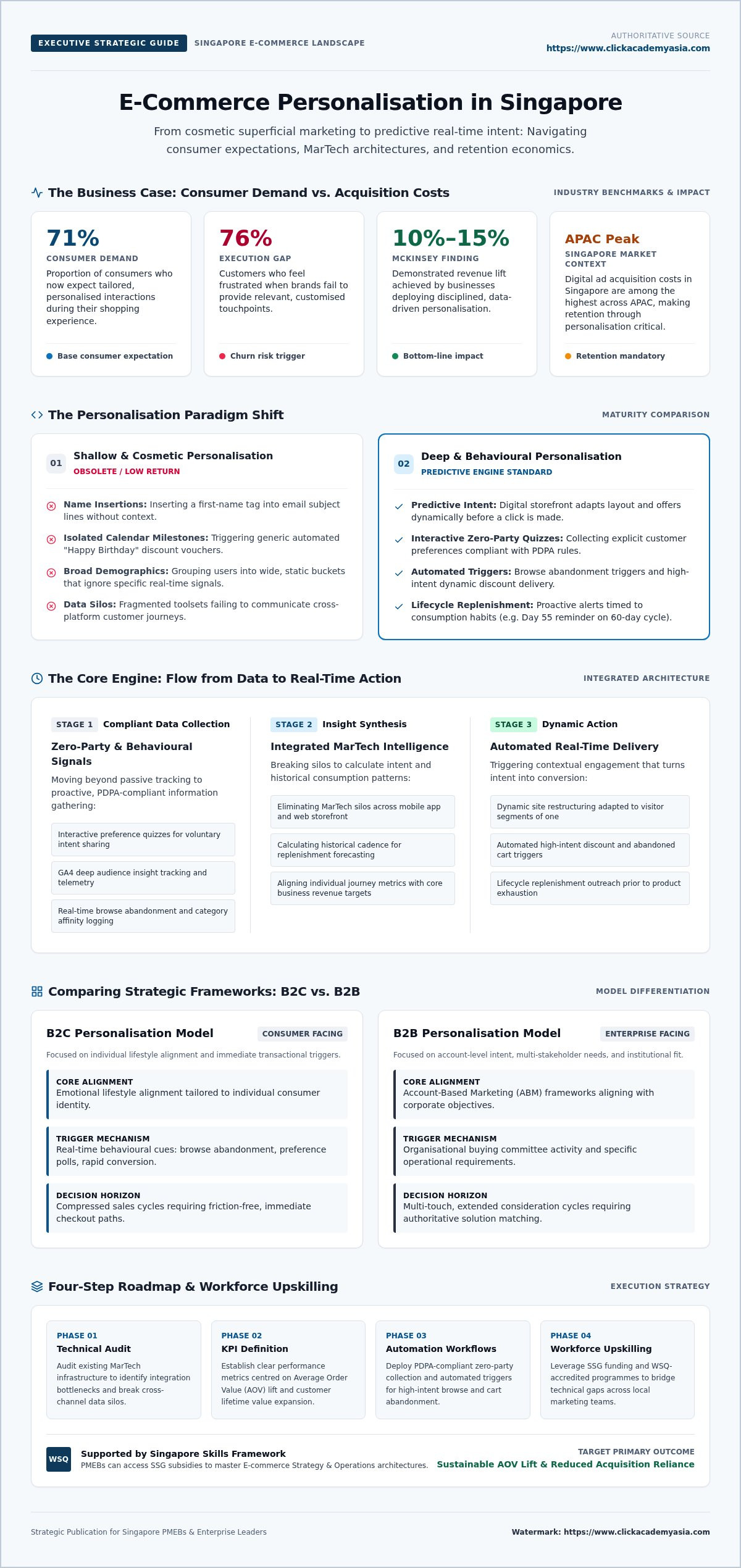
Did you know that 71% of consumers now expect personalised interactions, and 76% feel frustrated when brands fail to deliver? In the hyper-competitive Singapore retail landscape, you've likely noticed that generic marketing is yielding diminishing returns while customer acquisition costs continue to climb. Many PMEBs find it difficult to bridge the gap between data collection and the advanced e-commerce personalization techniques required to stay relevant.
We understand that the "one-size-fits-all" approach is no longer sustainable for your bottom line. This guide provides the sophisticated strategies and technical frameworks you need to dominate the local digital marketplace. We'll help you transform stagnant data into a high-converting engine that significantly improves customer lifetime value.
By the end of this article, you'll have a clear roadmap for implementing these strategies. We'll preview how to leverage WSQ-funded programmes and SSG subsidies to build a future-ready team capable of mastering advanced tools. It's time to move beyond basic segmentation and embrace a results-driven, mentor-led approach to digital excellence.
Table of Contents
The Evolution of E-commerce Personalisation Techniques in Singapore
Personalisation in Singapore has moved past the era of simply inserting a customer's name into an email. In the 2026 landscape, e-commerce personalization techniques have matured into predictive engines that anticipate user intent before a click is even made. This evolution requires PMEBs to move from tactical execution, such as setting up basic email triggers, to strategic planning that aligns high-level business goals with individual customer journeys. By focusing on predictive intent, you can ensure that your digital storefront adapts in real-time to the specific needs of each visitor.
There's a clear distinction between shallow, cosmetic personalisation and deep, behavioural personalisation. While shallow efforts might include a "Happy Birthday" discount code, deep personalisation involves the dynamic restructuring of a site based on real-time data. This level of sophistication is exactly what Singaporean consumers now expect as a baseline service when interacting with local brands. If your platform doesn't feel intuitive and relevant, you risk losing high-value customers to more agile competitors who prioritise the user experience.
To better understand this concept, watch this helpful video:
Why Personalisation is Non-Negotiable for Local Brands
With Singapore's digital advertising costs among the highest in the APAC region, relying solely on acquisition is a losing game. Personalisation acts as a critical differentiator against global giants, allowing local brands to treat customers as "segments of one" rather than broad demographics. By refining your e-commerce personalization techniques, you can create a unique value proposition that drives loyalty. McKinsey reports that data-driven personalisation can generate a 10% to 15% revenue lift, which is vital for maintaining margins in a competitive market. [External Link: McKinsey & Company study on revenue lift] Investing in retention through tailored experiences is no longer just a "nice-to-have" feature; it's a survival strategy.
The Strategic Framework: Data, Insight, and Action
Success depends on the flow from data collection to real-time customer experience. I define personalisation as the strategic alignment of user intent with dynamic content. In the local business ecosystem, an integrated MarTech stack is essential to ensure that insights are actionable across all touchpoints. A fragmented stack leads to data silos, making it impossible to deliver a consistent experience across mobile apps and web platforms. Leaders must ensure their teams possess the skills to manage these complex tools by exploring E-commerce Strategy & Operations programmes. This technical foundation allows you to turn raw data into a narrative that resonates with your audience.
Advanced Data-Driven Personalisation: From Segmentation to AI
Static segmentation is dead. Modern e-commerce personalization techniques require a shift toward individualised experiences driven by real-time data. By leveraging interactive content like preference quizzes, you can collect zero-party data that remains compliant with local PDPA regulations while providing a roadmap for tailored offers. This proactive approach encourages customers to share their needs, ensuring your marketing feels like a helpful service rather than an intrusive advertisement.
Behavioural triggers take this a step further by automating responses to specific user actions. Whether it's a browse abandonment email or a personalised discount for a high-intent visitor, these automated workflows ensure you never miss an opportunity to convert. Predictive analytics then uses this historical data to anticipate future purchase cycles. For instance, if a customer typically buys skincare every 60 days, your system should automatically trigger a replenishment reminder at day 55 to secure the next sale.
Utilising GA4 for Deep Audience Insights
Technical tools are only as effective as the insights they produce. Identifying high-value segments becomes a streamlined process when your team masters Google Analytics (GA4) Training. This platform allows you to map the multi-touch journey and understand exactly where personalisation has the most impact on your conversion funnel. By using predictive metrics like purchase probability, you can identify churn risks early and deploy retention strategies before the customer disengages from your brand.
AI-Powered Product Recommendations
Moving beyond basic "Customers also bought" logic is essential for a sophisticated digital storefront. Advanced collaborative filtering and deep learning algorithms now allow for hyper-relevant recommendations based on micro-intent signals. Implementing visual search or similar-item discovery creates an immersive shopping experience that mimics the helpfulness of an in-store assistant. However, it's vital to balance this automation with human oversight. Strategic leaders must ensure the AI remains aligned with the brand voice to prevent irrelevant suggestions that could alienate loyal shoppers.
Dynamic content optimisation rounds out the technical stack by tailoring website banners and landing pages in real-time. When a returning visitor arrives, they shouldn't see a generic homepage; they should see products and promotions aligned with their past behaviour. This level of technical execution is complex, but it's the foundation for dominating the Singaporean marketplace. To lead these initiatives effectively, PMEBs should consider upskilling through WSQ Marketing Analytics & Insights programmes to bridge the gap between data collection and actionable strategy.
Comparing B2C and B2B Personalisation Frameworks
Personalisation isn't a monolith. B2C e-commerce personalization techniques often focus on individual lifestyle alignment and emotional triggers. Think urgency-driven flash sales or personalised social ads that mirror a user's aesthetic preferences. These tactics aim for immediate conversion by creating a sense of personal relevance that resonates with the consumer's daily life.
B2B frameworks shift toward logic and efficiency. Professional buyers in Singapore prioritising Account-Based Marketing (ABM) want contract-specific pricing and bulk-buy calculators. The "consumerisation of B2B" means these buyers now expect the same seamless digital workflows they enjoy on consumer apps. If your B2B portal feels clunky, you're losing to competitors who offer frictionless, personalised experiences. Personalising the post-purchase experience with tailored replenishment schedules ensures long-term loyalty and steady recurring revenue.
Transactional vs. Relationship-Based Personalisation
High-volume B2C retail thrives on transactional triggers like loyalty points and browse abandonment alerts. Conversely, high-value B2B relies on relationship-building through customised portals and technical documentation delivery. You can inform your B2B content strategy by applying Advanced Keyword Research Strategies to identify specific pain points within niche industries. This approach ensures that the content delivered to a corporate client is strategically aligned with their specific procurement needs rather than generic industry trends.
Navigating PDPA and Ethical Personalisation
Delivering relevant content must never compromise compliance with Singapore's Personal Data Protection Act (PDPA). The "Personalisation Paradox" highlights the tension between being helpful and appearing intrusive. Organisations must be transparent about data collection to build trust with their audience. It's a high-stakes environment. The PDPC can levy financial penalties of up to 10% of an organisation's annual local turnover for serious breaches. [External Link: PDPC Singapore Advisory Guidelines] Ethical e-commerce personalization techniques rely on clear consent and the Business Improvement Exception to deliver value without overstepping boundaries. This transparency transforms data collection from a hurdle into a trust-building exercise for national brands.
Leaders must ensure their teams understand these nuances. Upskilling through a WSQ Digital Marketing Strategy & Planning course provides the foundation for managing these frameworks effectively. It's about building a team that can balance technical execution with ethical responsibility.
Building a Roadmap for Strategic Implementation
Implementing advanced e-commerce personalization techniques isn't a weekend project; it's a strategic shift that requires a phased approach. Start by auditing your current data quality and technical infrastructure. If your CRM is filled with duplicates or outdated profiles, even the best AI engine will deliver flawed results. Next, define clear KPIs for personalisation, such as a target lift in Average Order Value (AOV) or conversion rates. Once your goals are set, launch a pilot programme targeting a single high-impact segment, such as your top 10% of spenders. Finally, scale and optimise your efforts based on A/B testing and GA4 insights to ensure every dollar spent on technology delivers a measurable return.
Mapping the Personalised Customer Journey
You need to identify "leaky" parts of your funnel where users drop off without converting. Personalisation provides a quick win here by offering tailored solutions at the exact moment of hesitation. For example, if a user repeatedly views a specific category but doesn't add to cart, a personalised recommendation can bridge the gap. You should create content clusters that respond to different stages of the funnel, a concept we explore deeply in our WSQ Digital Marketing Strategy & Planning programme. This ensures cross-channel consistency, meaning a customer sees the same personalised offer on your mobile app as they do in their email inbox.
Selecting and Managing Your MarTech Stack
Your personalisation engine must integrate seamlessly with your existing ERP and CRM systems. Choosing a tool that doesn't "talk" to your inventory database leads to the mistake of recommending out-of-stock items, which quickly damages consumer trust. Technical SEO is also a critical factor in your roadmap. Personalised content must be performant and crawlable to ensure it doesn't slow down your site or hide your best products from search engines. Avoid vendor lock-in by adopting a strategy-first approach to tool selection. Focus on what your team can actually manage rather than chasing every new feature on the market.
Building these internal capabilities is the most sustainable way to drive growth in the Singaporean market. You can equip your team with the right frameworks by enrolling them in E-commerce Strategy & Operations training. This ensures your technology is led by strategic expertise, not the other way around.
Future-Proofing Your Team: Upskilling for Personalisation Excellence
The most sophisticated software on the market is merely a collection of settings without the human expertise to guide it. While many firms focus on acquiring the latest tech stack, the real competitive advantage lies in your team’s ability to execute complex e-commerce personalization techniques. Bridging the gap between creative marketing and data science requires a structured approach to professional education. You don't just need users of these tools; you need architects who can design customer journeys that convert.
ClickAcademy Asia serves as a vital partner in this journey, transforming theoretical knowledge into practical mastery. Our WSQ Digital Marketing Strategy & Planning course is designed to move PMEBs from tactical execution to strategic leadership. By focusing on real-world application, your team learns to manage the technical engine of personalisation while maintaining a cohesive brand voice across all touchpoints.
The Value of WSQ Digital Marketing Certification
Leveraging the WSQ framework is a strategic move for any Singaporean business. With SSG funding covering up to 70% of course fees, and the SkillsFuture Mid-Career Enhanced Subsidy (MCES) providing up to 90% for Singaporeans aged 40 and above, the barrier to high-level training is lower than ever. Qualifying SMEs can also access the Enhanced Training Support for SMEs (ETSS) for 90% subsidies. One urgent factor for leaders is the SkillsFuture Enterprise Credit (SFEC) deadline. You must claim and utilise your current allocations by 30 November 2026. This makes now the optimal time to invest in your team’s capability through our E-commerce Strategy & Operations programmes.
Actionable Steps for HR and Marketing Leaders
HR and marketing heads should begin with a comprehensive skills audit to identify gaps in data literacy and strategic planning. Don't wait for a campaign to fail before realising your team lacks the skills to interpret GA4 insights or manage automated triggers. Encourage a culture of continuous learning and experimentation where small-scale pilots are used to test new e-commerce personalization techniques. This iterative approach reduces risk while building the confidence needed to scale successful strategies across the organisation.
Personalisation is a journey of constant refinement and professional growth. It’s about more than just technology; it’s about empowering your people to shape the future of your brand in the Singaporean marketplace. By investing in WSQ-certified training, you ensure your team remains agile, results-driven, and ready for the challenges of 2026 and beyond.
Leading the Next Wave of Digital Excellence in Singapore
Mastering the 2026 digital landscape requires a fundamental shift from generic marketing to hyper-relevant interactions. You've explored how moving from shallow segmentation to predictive intent can drive significant revenue lift, provided your team has the strategic depth to manage these complex systems. Implementing advanced e-commerce personalization techniques is no longer a luxury for local brands; it's the baseline for survival in a market where customer acquisition costs continue to soar.
Success depends on bridging the gap between your technical MarTech stack and the human insight needed to architect meaningful customer journeys. By leveraging SSG-funded training and the WSQ framework, you can transform your workforce into a future-ready engine of growth. Don't let your data sit idle while competitors capture your high-value segments. It's time to move from being a user of technology to an architect of experience.
Equip your team with the strategic skills to master personalisation. Explore our WSQ-certified Digital Marketing programmes today. We're here to support your journey toward practical mastery and regional leadership. Your path to digital excellence starts with a commitment to continuous learning.
Frequently Asked Questions
What are the most common e-commerce personalisation techniques for beginners?
Beginners should focus on low-hanging fruit such as personalised email subject lines and product recommendations based on browsing history. Implementing cart abandonment triggers is another entry-level strategy that yields immediate results. These e-commerce personalization techniques build trust without requiring massive data sets. You should start by automating responses to high-intent actions, ensuring the right message reaches the right user at the right time to improve early conversion rates.
How does AI improve e-commerce personalisation in 2026?
In 2026, AI has moved from simple recommendation engines to predictive intent modelling. It allows brands to anticipate a purchase cycle before it begins by analysing real-time clickstream data and historical patterns. This transition enables hyper-relevant interactions that feel like a concierge service. Instead of reacting to past behaviour, AI-driven systems now proactively adjust website layouts and pricing tiers to align with individual user micro-intents across the Singaporean digital marketplace.
Is e-commerce personalisation compliant with Singapore’s PDPA?
Yes, personalisation is compliant as long as it adheres to the PDPC’s advisory guidelines. Organisations must be transparent about data collection and use the Business Improvement Exception when training recommendation algorithms. Financial penalties for breaches can reach 10% of annual local turnover for large firms; staying informed is critical. Implementing clear consent mechanisms and preference centres ensures your strategy remains ethical while delivering the high-value experiences that local consumers now expect.
Can small businesses in Singapore afford advanced personalisation tools?
Advanced tools are increasingly accessible through tiered SaaS models that scale with your traffic. Local SMEs can leverage the Enhanced Training Support for SMEs (ETSS) to subsidise up to 90% of the cost for upskilling their teams. By using SSG-funded programmes to build internal capability, small businesses can manage sophisticated e-commerce personalization techniques without the need for expensive external agencies or massive upfront capital investments that often strain smaller budgets.
What is the difference between segmentation and personalisation?
Segmentation groups users into broad buckets based on demographics or shared traits, while personalisation treats every user as a "segment of one." While segmentation might target "female shoppers in Singapore aged 25-34," personalisation delivers a unique product feed based on an individual's specific real-time intent and past purchase history. Personalisation is the evolution of segmentation, moving from static categories to a dynamic, individualised dialogue that evolves with each interaction.
How do I measure the ROI of my personalisation strategy?
ROI is best measured through a combination of conversion rate lift, Average Order Value (AOV), and Customer Lifetime Value (CLV). By running A/B tests between personalised and non-personalised experiences, you can isolate the direct impact of your strategy on the bottom line. Tracking these metrics in GA4 allows you to see which touchpoints contribute most to revenue, helping you justify the investment in advanced marketing automation tools and professional training.
Which WSQ courses cover e-commerce personalisation techniques?
ClickAcademy Asia offers several modules that address these strategies directly. Our WSQ Digital Marketing Strategy & Planning course provides the high-level framework, while WSQ Marketing Analytics & Insights focuses on data-driven execution. For those looking at the technical side, the E-commerce Strategy & Operations programme covers the integration of personalisation engines. These SSG-funded courses ensure your team has the practical skills to implement strategies that drive measurable business results in Singapore.
How does GA4 help in personalising the customer experience?
GA4 acts as the technical engine by providing predictive metrics like purchase probability and churn risk. It allows you to map the multi-touch journey, identifying exactly where tailored content can provide a "quick win" in the funnel. By integrating GA4 with your personalisation platform, you can trigger real-time updates to website banners or landing pages based on the user’s specific audience segment, ensuring a seamless and relevant browsing experience for every visitor.


Comments