
The Essential Training Plan for a Junior Digital Marketer in Singapore: A 2026 Template

Why does it feel like your junior hires are constantly out the door just as they finally begin to grasp the basics? High turnover in entry-level roles often stems from a lack of clear progression and a failure to connect daily tasks to the broader business strategy. You've likely felt the frustration of managing a team that executes tactical tasks well but struggles to contribute to high-level planning. Developing a robust training plan for a junior digital marketer in Singapore requires more than just a checklist; it demands a structured approach that builds genuine competency and professional confidence.
We understand that navigating various certification pathways can be overwhelming for busy HR leaders and managers. This article provides a definitive 2026 template to bridge that gap. We're sharing a structured 90-day roadmap designed to transform your new hires into strategic assets by leveraging the WSQ framework. You'll learn how to align their development with national standards while maximising your use of SSG funding to offset costs. We'll explore how to build a team that stays, grows, and delivers measurable ROI through targeted [Internal Link: WSQ Digital Marketing Strategy & Planning] programmes.
Table of Contents
The Foundation: Building a 90-Day Training Plan for a Junior Digital Marketer in Singapore
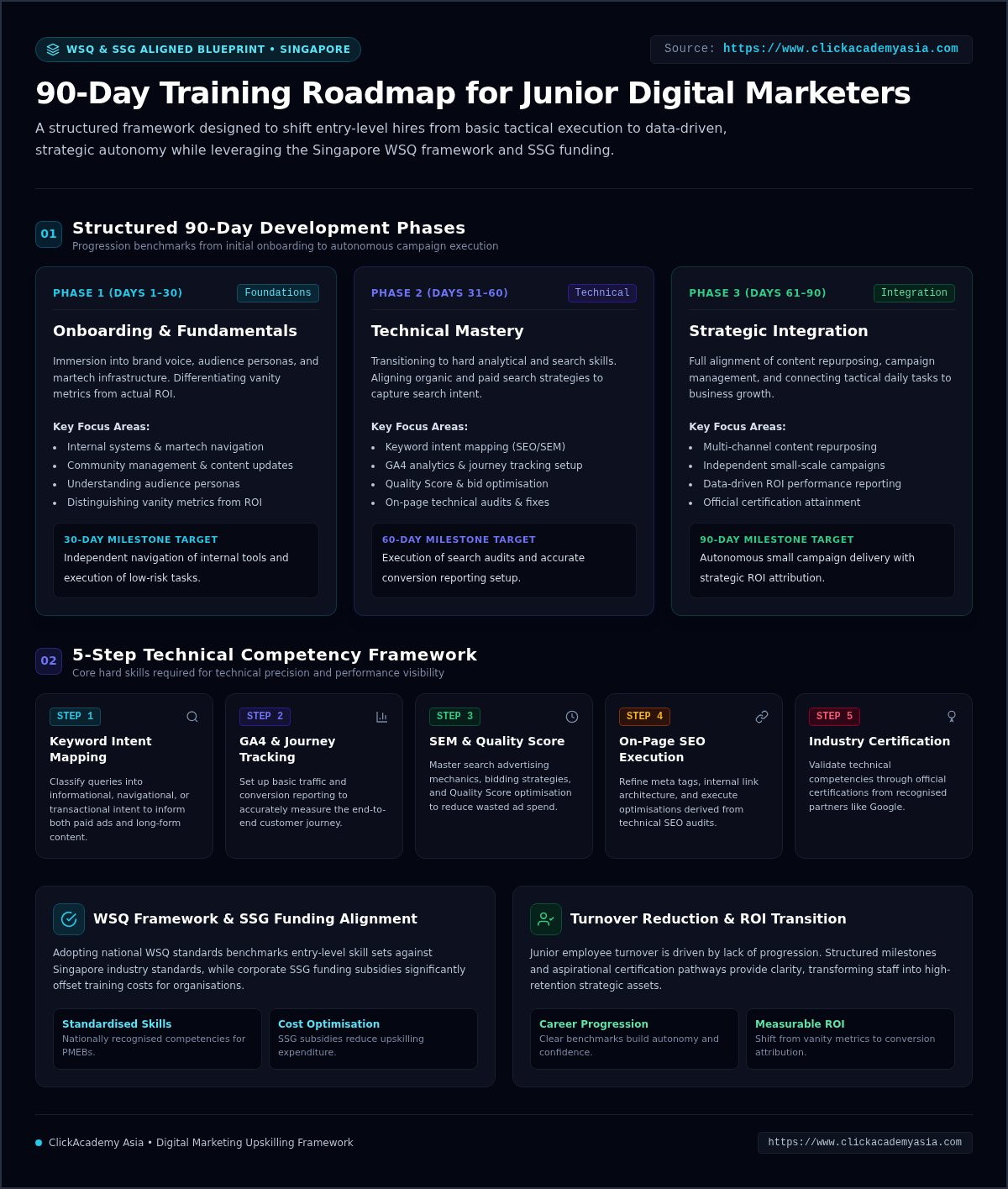
Success in hiring isn't just about finding the right talent; it's about what you do once they're in the building. A training plan for a junior digital marketer is a structured pathway to professional autonomy. It ensures your new hires don't just "do social media" but actually understand how their actions drive business growth. In the local context, aligning this roadmap with the WSQ framework is the gold standard for PMEBs. It provides a recognised benchmark of quality while allowing firms to leverage SSG funding for high-impact upskilling.
We build this roadmap on three essential pillars: Foundations, Technical Mastery, and Strategic Integration. This approach moves the needle from simple task completion to holistic digital marketing expertise. By following this structured template, you're not just training an employee. You're developing a strategic asset who understands the Singapore business ecosystem and can contribute to your bottom line.
Phase 1: The First 30 Days (Onboarding and Fundamentals)
The initial month is about immersion. Your junior hire needs to live and breathe your brand voice and understand your audience personas inside out. Don't just hand them a login; explain the "why" behind your marketing tech stack. They must learn to distinguish between vanity metrics, like follower counts, and genuine ROI indicators like conversion rates or cost-per-lead. Encourage early wins by assigning low-risk tasks such as community management or simple content updates. This builds confidence and provides immediate value to the team while they find their feet.
Setting Expectations and KPIs for New Hires
Clarity is the antidote to high turnover. Establish firm benchmarks for success at the 30, 60, and 90-day marks to keep everyone on track. At 30 days, they should navigate your internal systems; by 90 days, they should manage small-scale campaigns independently. Align these individual learning goals with your broader organisational strategy to ensure every hour of training serves a purpose. We recommend referencing ClickAcademy Asia to identify baseline competency standards for roles ranging from search marketing to social media strategy. This ensures your training plan for a junior digital marketer remains grounded in industry reality rather than just theory.
Technical Competency: Mastering SEO, SEM, and Analytics
Building a training plan for a junior digital marketer requires a shift from general awareness to technical precision. During the second month, focus moves toward the hard skills that drive visibility and lead generation. This technical phase isn't just about learning tools; it's about understanding the logic that powers search engines and data platforms. By grounding their development in WSQ Frameworks and SSG Funding models, you ensure they meet national standards for technical excellence.
Step 1: Conduct foundational keyword research to move beyond volume and understand searcher intent (informational, navigational, or transactional).
Step 2: Navigate GA4 to set up basic traffic and conversion reporting, ensuring they can track the customer journey accurately.
Step 3: Master search advertising mechanics, including bidding strategies and Quality Score optimisation to reduce wasted spend.
Step 4: Execute on-page SEO optimisations, such as refining meta tags and internal linking, based on technical audit findings.
Step 5: Apply for official certifications from partners like Google to validate their technical knowledge and professional standing.
Bridging the Gap with SEO and SEM Training
Juniors often view organic and paid search as separate silos. Your training plan for a junior digital marketer should demonstrate how these disciplines support each other. Start by teaching them to map search intent to specific content types. A junior should know when a high-intent keyword deserves a paid ad and when it's better served by a long-form blog post. This synergy ensures your marketing budget is spent efficiently while building long-term organic authority. For teams looking to accelerate this process, exploring WSQ Search Engine Optimization (SEO) courses provides a structured environment for rapid skill acquisition.
Data-Driven Decision Making with GA4
Reporting is where many juniors struggle. They often present spreadsheets full of sessions without context. Train your staff to look deeper at engagement rates and conversion events to see what actually drives revenue. Developing basic dashboarding skills is essential; they must be able to communicate these results clearly to stakeholders. When a junior can explain why a specific campaign's bounce rate dropped, they transition from a helper to a strategic partner. Integrating these data-driven habits early ensures your team makes decisions based on evidence rather than intuition.
Strategic Execution: Content Marketing and Social Media Integration
Efficiency is the hallmark of a high-performing team. A training plan for a junior digital marketer must move beyond basic posting to strategic asset management. Junior staff often spend too much time creating new content from scratch. Teach them to repurpose a single pillar asset, such as a webinar or a whitepaper, into multiple formats for different channels. This approach ensures your digital marketing strategy remains consistent across every touchpoint without draining creative resources.
Nuance is key in the Singapore market. A junior needs to understand that a LinkedIn post targeting PMEBs requires a different tone and format than a TikTok video for B2C audiences. They should develop a social media calendar that doesn't just fill gaps but aligns with your broader business objectives. Every post should tell a story that drives a measurable outcome, whether it's a lead form submission or a website visit.
The Content Marketing Lifecycle
Mastering the lifecycle from ideation to distribution is a critical milestone for any new hire. Assign your junior the task of auditing your existing content library to find hidden gems that can be updated or transformed. This builds their research skills and helps them understand what resonates with your specific audience. To accelerate this transition, consider enrolling them in a WSQ Content Marketing Strategy programme. This professionalises their approach and ensures they are using industry-standard frameworks for content production.
Social Media Management and Paid Social Fundamentals
Organic reach is only one part of the puzzle. Your training plan for a junior digital marketer should include basic training on paid social amplification. They need to understand how to set up simple ad sets on Meta or LinkedIn and how to target specific audience segments effectively. Beyond the technical setup, they must monitor community sentiment and engagement metrics daily. Responding to comments and tracking brand mentions isn't just admin; it's vital market research that informs your next strategic move.
Measuring Success: KPI Alignment and Certification Pathways
How do you distinguish between a junior who is merely busy and one who is becoming a strategic asset? A robust training plan for a junior digital marketer must move beyond simple task completion to include objective success markers. While finishing a social media calendar is a win, earning a WSQ certification demonstrates a level of professional rigour that internal checklists cannot match. In Singapore, these external benchmarks are essential for validating that your new hire meets industry-standard competencies.
Professional Certification vs. Informal Learning
Informal learning through blogs or tutorials is excellent for troubleshooting, but it rarely provides a structured understanding of the marketing ecosystem. Industry-recognised certifications from Google and Meta offer technical validation for specific platforms. However, for PMEBs looking to advance, WSQ frameworks provide the most comprehensive path. These programmes are designed to bridge the gap between tactical execution and strategic planning. By encouraging your staff to pursue WSQ Digital Marketing Courses in Singapore, you ensure their growth is aligned with national standards and recognised by the local business community.
Tracking Long-Term ROI of Junior Upskilling
The true value of a structured roadmap lies in its impact on your bottom line. You'll notice a marked reduction in time-to-productivity when a junior has a clear curriculum to follow. Instead of months of trial and error, they reach a state of professional autonomy much faster. This investment also pays dividends in employee retention. When juniors see that your firm is invested in their career progression through formal training, they are far less likely to seek opportunities elsewhere.
Linking these training outcomes to campaign improvements makes the ROI of upskilling undeniable. For example, a junior who has mastered GA4 can identify wasted spend that previously went unnoticed. Conduct monthly reviews to pivot the training focus as your organisational needs evolve. These check-ins should compare their current output against the initial benchmarks set in the training plan for a junior digital marketer. This ensures the learning remains relevant and that the junior feels supported in their journey toward becoming a strategic contributor.
Maximising ROI: Leveraging WSQ Frameworks and SSG Funding in Singapore
Securing a high return on investment for your new hires requires a shift from ad-hoc learning to a formalised structure. A training plan for a junior digital marketer that leverages the WSQ framework provides a level of standardisation that internal checklists simply cannot match. This alignment ensures your team speaks the same technical language as the rest of the Singapore business ecosystem. It also signals to your staff that you are invested in their long-term career progression within a future-ready workforce.
Deciding between in-house and external training is a common challenge for HR leaders. While in-house mentoring is excellent for teaching brand-specific nuances, it can lead to skill stagnation if not balanced correctly. External professional training exposes your juniors to broader industry trends and peer perspectives. This external validation is crucial for PMEBs who need to stay ahead of rapid technological shifts. By using a structured external programme, you ensure your team isn't just repeating old habits but is adopting best-in-class strategies.
Navigating the SkillsFuture Landscape
The Singapore government provides significant support for corporate upskilling through various grants. HR leaders should start by identifying which marketing modules align with their specific business gaps. You can use SkillsFuture Credits for individual modules or apply for corporate training grants to cover larger teams. Integrating the [External Link: SSG official funding portal] into your HR workflow allows you to track applications and disbursements efficiently. Understanding the eligibility criteria early ensures you don't leave money on the table when executing your training plan for a junior digital marketer.
Partnering with ClickAcademy Asia for Corporate Growth
Generic online videos often lack the context required to solve local business challenges. We focus on expert-led, practitioner-based workshops that provide immediate, actionable insights. These sessions are designed to be interactive, allowing your team to apply theory to real-world scenarios in real-time. We can help you customise a training roadmap that fits your specific industry needs, ensuring every module delivers maximum value. Empower your team with WSQ-funded training today and transform your junior hires into strategic assets who drive measurable growth.
Future-Proofing Your Marketing Talent in Singapore
Building a high-performing marketing department starts with a clear, strategic roadmap. By implementing a structured training plan for a junior digital marketer, you move beyond tactical busywork to genuine business impact. We've explored how a 90-day template, grounded in technical mastery and strategic content integration, transforms new hires into autonomous professionals. Aligning this journey with the WSQ framework doesn't just ensure quality; it allows your organisation to leverage significant SSG funding for professional development.
As an official Google and Meta training partner, ClickAcademy Asia is dedicated to bridging the digital skills gap. We're a WSQ and SSG approved training provider trusted by over 30,000 PMEBs globally. Our practitioner-led workshops provide the real-world experience your team needs to thrive in Singapore's competitive landscape. Stop managing turnover and start building leadership from within.
Equip your junior marketers with strategic skills through our WSQ-certified programmes and watch your team's productivity soar. Your investment in their growth today is the foundation for your brand's success tomorrow.
Frequently Asked Questions
What should be included in a 90-day training plan for a junior digital marketer?
A comprehensive training plan for a junior digital marketer should feature a three-phase approach. The first 30 days focus on onboarding and brand immersion. The following 60 days prioritise technical mastery in search marketing and GA4 analytics. By day 90, the junior should move into strategic execution, including content repurposing and social media management. This structure ensures they evolve from tactical helpers into strategic contributors who understand your broader business objectives.
How much SSG funding is available for digital marketing courses in Singapore?
SSG funding typically covers a substantial percentage of course fees for eligible Singapore Citizens and Permanent Residents. While exact subsidy levels for 2026 depend on current government policy, many PMEBs benefit from significant offsets for WSQ-certified modules. Companies can also access additional support through corporate training grants. We recommend checking the official SkillsFuture Singapore portal to verify the latest funding brackets for your specific organisation and employee profile.
Are WSQ digital marketing courses suitable for beginners?
Yes, WSQ digital marketing courses are specifically designed to cater to various proficiency levels, including complete beginners. These programmes follow a structured competency map that builds skills from the ground up. Beginners start with foundational principles before advancing to technical modules like SEO or marketing analytics. This ensures a solid professional base, making it an ideal choice for juniors who need to gain industry-recognised credentials quickly while working.
How do I measure the ROI of my junior marketer's training plan?
Measuring ROI involves tracking both qualitative and quantitative milestones. Look at the reduction in time-to-productivity and the successful completion of external certifications as primary indicators. Quantitatively, monitor improvements in campaign performance, such as lower cost-per-acquisition or higher engagement rates, as the junior applies their new skills. Regular monthly reviews help align these training outcomes with your firm's specific financial goals and broader digital transformation objectives.
What are the most important certifications for a junior marketer to have in 2026?
In 2026, the most valued credentials combine platform-specific expertise with broad strategic knowledge. A junior should aim for WSQ-certified modules in Digital Marketing Strategy and Content Marketing. Technical validation through Google Ads Search and Display certifications remains essential. Additionally, mastering GA4 for analytics and obtaining Meta certifications for social advertising provides a well-rounded profile. These certifications ensure your hire meets both national competency standards and global industry requirements.
Can I use SkillsFuture Credits for corporate group training?
SkillsFuture Credits are intended for individual use by Singaporeans to support their personal lifelong learning journey. For corporate group training, organisations should instead apply for SSG training grants through the SkillsFuture Singapore framework. These corporate subsidies are designed to help businesses offset the costs of upskilling their workforce at scale. ClickAcademy Asia can guide your HR team through the application process to maximise your available funding and streamline the enrollment of your team.
How often should I update my junior marketer's training roadmap?
You should conduct light monthly reviews to track progress against immediate KPIs. However, a major update to the training plan for a junior digital marketer should occur every quarter. This frequency allows you to adapt to rapid changes in search algorithms, new social media features, and evolving business priorities. Regular updates ensure the roadmap remains relevant and continues to challenge the junior hire as they gain more autonomy and responsibility within the team.
What is the difference between a WSQ course and a Google certification?
WSQ courses focus on holistic professional competency and are aligned with Singapore's national skills framework. They cover the strategic "why" behind marketing decisions and are recognised across various local industries. Google certifications are platform-specific and validate technical proficiency within the Google ecosystem, such as Ads or Analytics. Combining both provides the best results; WSQ offers the strategic foundation, while Google certifications prove the junior can execute effectively using specific digital tools.


Comments