
How to Align Marketing and Product Development Teams in Singapore: A 2026 Guide
- ClickAcademy Asia

- Aug 3
- 11 min read
Updated: Aug 9
What if the primary bottleneck for your next major release isn't your tech stack, but the invisible wall between your creators and your communicators? In Singapore, misaligned roadmaps and fragmented internal communication often lead to expensive delays and marketing campaigns that fail to reflect actual product capabilities. You've likely seen resources vanish into this gap, leaving your PMEBs frustrated and your customers confused by inconsistent messaging.
We understand that bridging this divide is a strategic necessity for any firm looking to scale in 2026. This guide offers a repeatable, WSQ-aligned framework to help you discover how to align marketing and product development teams for faster launches and improved campaign accuracy. By adopting a shared professional language and leveraging SSG-funded training, you can transform these silos into a synchronised engine for growth.
We will break down the essential steps to integrate your workflows, from setting unified KPIs to utilising digital strategy modules that ensure every team member stays focused on the same roadmap.
Table of Contents
The Strategic Necessity of Aligning Marketing and Product Teams
In the high-stakes SINGAPORE business environment, the gap between what a product does and how it is sold is often a chasm. Misalignment isn't just an internal annoyance; it's a drain on your bottom line. When your technical teams build features in a vacuum while marketers promise capabilities that don't yet exist, the result is a breakdown in trust and efficiency. Understanding how to align marketing and product development teams is no longer a "nice-to-have" skill; it's the foundation of 2026 business resilience.
Friction points often arise from differing priorities. Creative teams want "shiny" features that grab attention in a crowded APAC market, while developers prioritise stability and code integrity. This disconnect leads to "feature creep," where products become bloated with tools that users don't want and marketers can't explain. For PMEBs, this chaos causes marketing fatigue as campaigns are constantly pivoted to catch up with a shifting roadmap.
The Cost of the Marketing-Product Silo
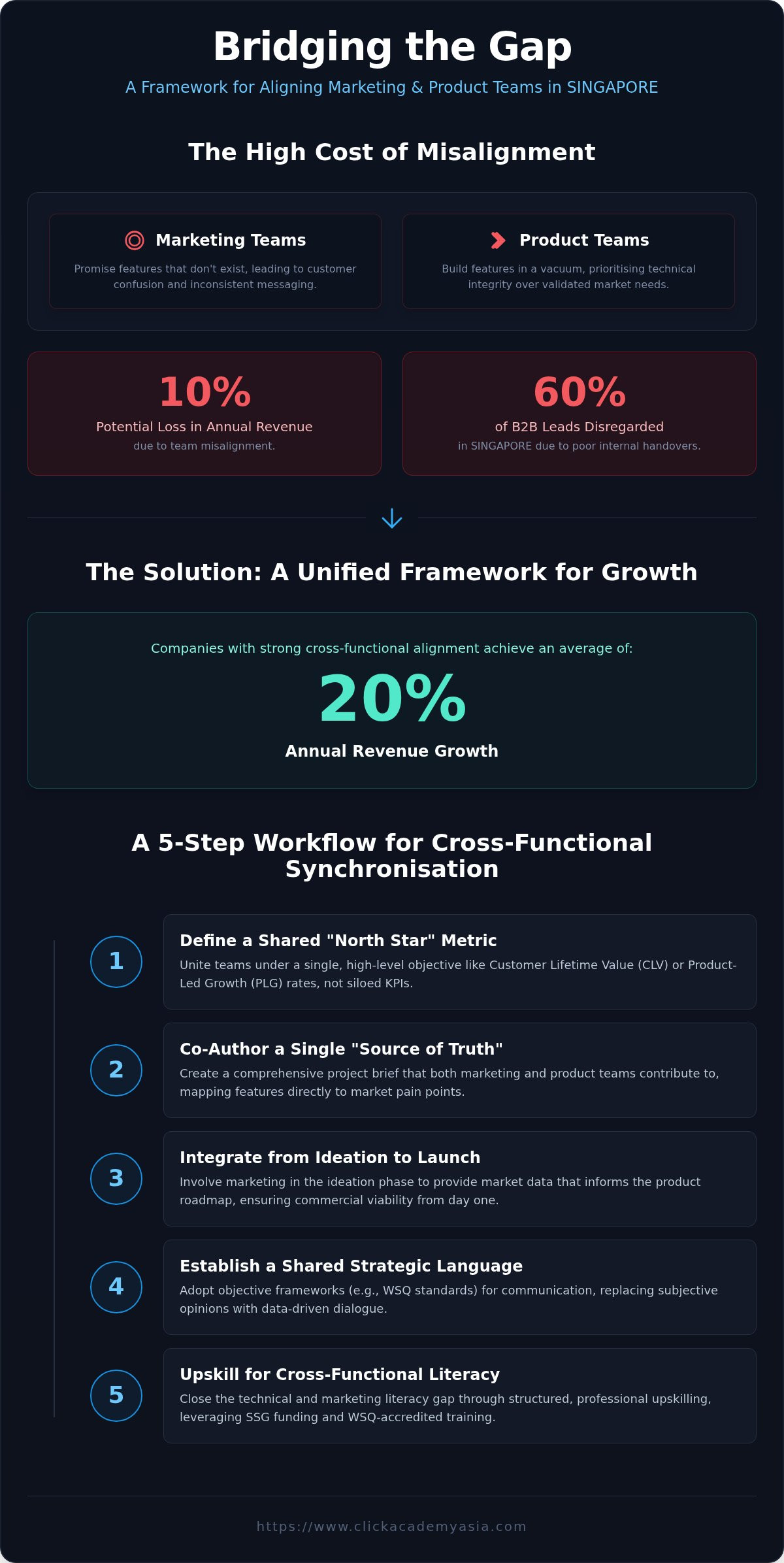
The financial impact of cross-functional silos is staggering. Research indicates that misalignment between core teams can result in a 10% loss in annual revenue. In SINGAPORE, where 60% of B2B leads are often disregarded due to poor internal handovers, the cost of redundant work and missed launch windows can cripple a growing firm. When your messaging contradicts the product reality, you lose the most valuable currency in the digital age: customer trust.
Organisations that bridge this gap see a different reality. Companies with strong cross-functional alignment achieve an average of 20% annual revenue growth. To reach these targets, leadership must move beyond surface-level fixes. You need a unified strategy that treats every department as a co-author of the customer journey. You can begin building this foundation by exploring professional development tracks at ClickAcademy Asia, where strategic synchronisation is a core focus.
Moving from Transactional to Strategic Partnerships
To succeed in 2026, you must shift the perspective from "Marketing as a service" to "Marketing as a partner." Marketing shouldn't just be the team that puts a bow on the finished product. They should be involved during the ideation phase to provide market data that informs the technical roadmap. This transition requires a deep understanding of Product Marketing, which serves as the connective tissue between development cycles and customer needs.
Establishing a shared value proposition is the first step toward this partnership. Both teams must own the "Why" behind every feature. By adopting a shared "Strategic Language" through WSQ standards, teams can communicate using objective frameworks rather than subjective opinions. This alignment ensures that your product development isn't just technically sound, but commercially viable and ready for the specific demands of the SINGAPORE market.
Establishing Shared GTM Objectives: A Framework for Singapore Organisations
A successful Go-To-Market (GTM) strategy in SINGAPORE requires more than just a checklist of tasks; it demands a unified architecture. For 2026, the most effective frameworks integrate the technical product roadmap directly into the marketing funnel stages. This ensures that every feature developed is tied to a specific stage of the buyer's journey, preventing the common trap of building for build's sake. By identifying how to align marketing and product development teams through shared objectives, you eliminate the friction that usually occurs when a product "goes live" but the market isn't ready.
Setting a "North Star" metric is the most powerful way to drive this collaboration. Instead of marketing chasing clicks and developers chasing code deployments, both teams should be held accountable for high-level outcomes like Customer Lifetime Value (CLV) or Product-Led Growth (PLG) rates. When these objectives are aligned with advanced keyword research strategies, your teams can work together to capture high-intent demand that actually matches the product's core strengths.
Defining the Shared Product Vision
Alignment starts with a single "source of truth", a comprehensive project brief that both teams co-author. This document should map specific product features to validated market pain points. By incorporating user feedback loops early, you ensure the technical roadmap is grounded in reality. As noted by Scrum.org on team alignment, this level of synchronisation is essential for agile environments where speed and accuracy are paramount. This collaborative approach ensures that the promises made in marketing campaigns are fully supported by the product's actual capabilities.
KPI Synchronisation: Beyond Siloed Metrics
Traditional metrics often encourage teams to work against each other. Marketing might focus on lead volume, while Product focuses on the number of features shipped. To fix this, replace siloed KPIs with shared success markers like "Feature Adoption Rate" and "Retention ROI." Utilising GA4 allows both departments to track how specific product updates influence user behaviour in real-time. This data-driven approach removes the guesswork from cross-departmental success.
To master these cross-functional tools, many organisations turn to marketing analytics with GA4 training to ensure their reporting is accurate and actionable. Developing these skills is a vital step for any PMEB looking to lead in the APAC region. You can start building this expertise by exploring WSQ-certified strategy courses that bridge the gap between technical data and commercial success.
A Five-Step Workflow for Cross-Functional Synchronisation
Establishing shared objectives is the first step, but execution requires a disciplined, repeatable workflow. Without a structured process, even the best intentions dissolve into chaotic email threads and missed deadlines. To master how to align marketing and product development teams, you must implement a system that forces interaction at every stage of the development cycle. This five-step approach ensures that your product isn't just built well, but is also positioned perfectly for the SINGAPORE market.
Step 1: Joint Ideation Sessions. Move beyond silos by bringing marketers and developers together to brainstorm solutions, not just features. This prevents technical teams from building tools that have no market demand.
Step 2: Unified Documentation. Use shared project management platforms to track the product roadmap. When both teams view the same "source of truth," you eliminate the "I didn't know that was changing" excuse.
Step 3: The Continuous Feedback Loop. Schedule weekly "syncs" to adjust marketing messaging based on actual development progress. This agility allows you to pivot campaigns before they go live with outdated information.
Step 4: Launch Readiness Checklists. Ensure your Sales and Marketing teams are fully trained on the "Why" behind a feature. A feature is only valuable if your team can articulate its benefits to a PMEB audience.
Step 5: Post-Launch Analysis. Review performance data as a single unit. Use these insights to inform your next development sprint, ensuring your roadmap is always driven by real-world customer behaviour.
Executing the Joint Ideation Phase
Mastering Internal Communication Channels
Communication failure is the most common cause of launch delays. To fix this, adopt dedicated Slack or Teams channels for every major product launch. These channels should be the only place for cross-departmental updates, reducing the noise of general company chat. Standardise your project brief format to strip away unnecessary technical jargon that often confuses marketers. Finally, implement "Demo Days" where the Product team shows "work in progress" to Marketing. This early look inspires content creators and allows them to start building assets long before the final code is shipped. Building these communication habits is a core component of WSQ-aligned leadership training, which helps professionals future-proof their internal operations.
Addressing the Skills Gap: Why Technical Literacy Matters for Marketers
The most sophisticated collaboration tools in the world won't solve a fundamental lack of technical literacy within your marketing department. Software doesn't solve silos. People do. When marketers don't understand the underlying architecture of what they are selling, they struggle to communicate value effectively to a savvy SINGAPORE audience. Modern marketers must understand technical SEO and product architecture to build campaigns that are grounded in technical reality rather than just creative aspiration.
Product Marketing functions as the vital bridge between these two worlds. It requires a professional who can translate complex technical specifications into compelling customer benefits. For PMEBs, the core competency lies in managing these cross-functional conversations without getting lost in translation. A deep understanding of high-intent product search is also crucial, which you can master through a comprehensive advanced SEM strategies programme to ensure your product is visible exactly when users need it.
Building Technical Empathy in Marketing Teams
True synchronisation begins with empathy. Encourage your marketers to attend developer "stand-ups" occasionally. This isn't about them becoming coders; it's about understanding the constraints and complexities your technical team faces. When marketing teams grasp the basics of product roadmapping and agile methodologies, they stop asking for "quick fixes" that disrupt the entire development cycle. This technical literacy leads to more realistic and effective campaign planning. It ensures that every promise made in a digital advertisement is something the product can actually deliver on launch day.
Upskilling as the Catalyst for Alignment
Structured training is the fastest way to create a "shared language" across your organisation. WSQ-certified training provides a standardised strategic framework that both teams can respect and follow. By utilising corporate group training, you can align entire cohorts of staff simultaneously, ensuring everyone is moving in the same strategic direction. This approach is particularly cost-effective in SINGAPORE due to the availability of SSG funding, which significantly reduces the financial barrier to high-level upskilling.
Investing in your team's professional growth isn't just an HR initiative; it's a strategic move to ensure you know how to align marketing and product development teams for long-term success. Equip your staff with these essential cross-functional skills by exploring our WSQ Digital Marketing Strategy & Planning course today.
Elevating Team Performance with WSQ-Accredited Strategic Training
While frameworks and workflows provide the necessary structure, the most sustainable way to solve how to align marketing and product development teams is through a shared strategic foundation. The WSQ Digital Marketing Strategy & Planning programme serves as the ultimate alignment tool for modern organisations. It bridges the gap between high-level theory and real-world execution, providing a common language that both technical developers and creative marketers can speak with confidence. When everyone understands the commercial objectives behind a feature, the path to a successful launch becomes much clearer.
Professional development in SINGAPORE is uniquely supported by SkillsFuture Singapore (SSG) subsidies. These grants ensure that elite, executive-level education remains accessible to all local firms. By reducing the financial burden, SSG funding allows corporate leaders to invest in the long-term career growth of their PMEB staff. This investment leads to higher ROI through faster product launches and more accurate market positioning. ClickAcademy Asia’s expert-led bootcamps capitalise on this by focusing on practical mastery rather than abstract concepts.
Why WSQ Certification is the Gold Standard
The rigour of the WSQ framework is unmatched in its relevance to the local business ecosystem. It doesn't just teach concepts; it demands the practical application of knowledge to real-world scenarios. When your entire organisation is standardised in the same methodology, you eliminate the friction caused by conflicting strategic approaches. ClickAcademy Asia provides post-training support to ensure these lessons are successfully integrated into your daily operations. This commitment to excellence is what makes us a vital partner for firms looking to dominate the APAC region.
Next Steps for Corporate Leaders and HR
Take the first step toward a more unified and high-performing team by exploring our Sales and Marketing courses to view upcoming intake dates and intake details. Equipping your staff with these essential cross-functional skills is the most effective way to ensure you know how to align marketing and product development teams for the long term.
Future-Proof Your Organisation with Strategic Synchronisation
Achieving true synergy between your technical and creative departments isn't just about better software; it's about a cultural shift toward shared accountability. By establishing unified "North Star" metrics and closing the technical literacy gap, you ensure every feature developed serves a verified market need. This guide has outlined how to align marketing and product development teams through a disciplined five-step workflow and a commitment to continuous professional upskilling.
Success in the SINGAPORE market requires your leaders and PMEBs to speak a common strategic language. Our WSQ-certified modules and expert trainers with real-world APAC experience provide the practical tools needed to bridge internal silos. With up to 70% SSG funding available for eligible Singaporeans and PRs, high-level corporate training is more accessible than ever.
Equip your team with the strategic framework for success; explore ClickAcademy Asia’s WSQ-funded training tracks today.
The transition from a siloed organisation to a synchronised powerhouse won't happen overnight, but with the right framework, your team's growth is inevitable.
Frequently Asked Questions
What is the best way to align marketing and product development?
The most effective way is to establish a shared strategic framework and unified KPIs from the project's inception. This prevents teams from working in silos and ensures that every technical feature has a clear commercial purpose. By involving marketing during the initial ideation phase, you ensure that the product roadmap is grounded in actual APAC market demand and customer pain points.
How often should marketing and product teams meet for alignment?
Weekly "sync" meetings are recommended to maintain momentum and adjust marketing messaging based on real-time technical progress. These should be supplemented by deeper joint ideation sessions at the start of every new development sprint. Frequent communication allows teams to pivot quickly if technical constraints change, ensuring that external messaging always reflects the product's current capabilities.
Who should lead the alignment process between marketing and product?
A Product Marketing Manager or a senior PMEB with cross-functional expertise should lead the alignment process. This individual acts as the "connective tissue" between the technical roadmap and the market-facing campaigns. They are responsible for translating complex technical specifications into compelling customer benefits while ensuring that the marketing team's feedback reaches the developers.
How does WSQ training help in team alignment?
WSQ training provides a standardised strategic language and methodology that both teams can follow with confidence. It removes subjective opinions and replaces them with objective, industry-recognised frameworks for how to align marketing and product development teams. By training together, staff members develop technical empathy and a mutual understanding of each other's operational constraints and priorities.
What are the most common causes of misalignment between teams?
Conflicting KPIs and a lack of technical literacy within marketing teams are the most frequent causes of friction. When developers prioritise code stability while marketers prioritise "shiny" features for lead generation, silos inevitably form. Fragmented communication channels and the absence of a single "source of truth" for the product roadmap further exacerbate these internal divisions.
Can SkillsFuture Singapore (SSG) funding be used for team training?
Yes, eligible SINGAPORE citizens and PRs can access up to 70% SSG funding for WSQ-certified training tracks. This makes high-level professional development highly cost-effective for local organisations looking to upskill their workforce. Many firms utilise this funding to put entire cohorts through strategic programmes, ensuring that the whole team adopts the same methodology simultaneously.
How do I create a shared GTM roadmap for marketing and product?
Create a shared roadmap by co-authoring a single "source of truth" project brief that maps technical features directly to validated customer pain points. This document should integrate your marketing funnel stages with the product's release schedule. By aligning these timelines, you ensure that Sales and Marketing are fully prepared to support the product the moment it goes live.
What metrics should marketing and product teams share?
Shared metrics should focus on high-level outcomes such as Customer Lifetime Value (CLV), Feature Adoption Rate, and Retention ROI. These "North Star" metrics require both departments to collaborate, as neither can hit these targets in isolation. Tracking these through a shared GA4 dashboard is a practical way for how to align marketing and product development teams while maintaining data-driven accountability.


Comments