
Developing a Winning E-commerce Market Entry Strategy for the Philippines in 2026

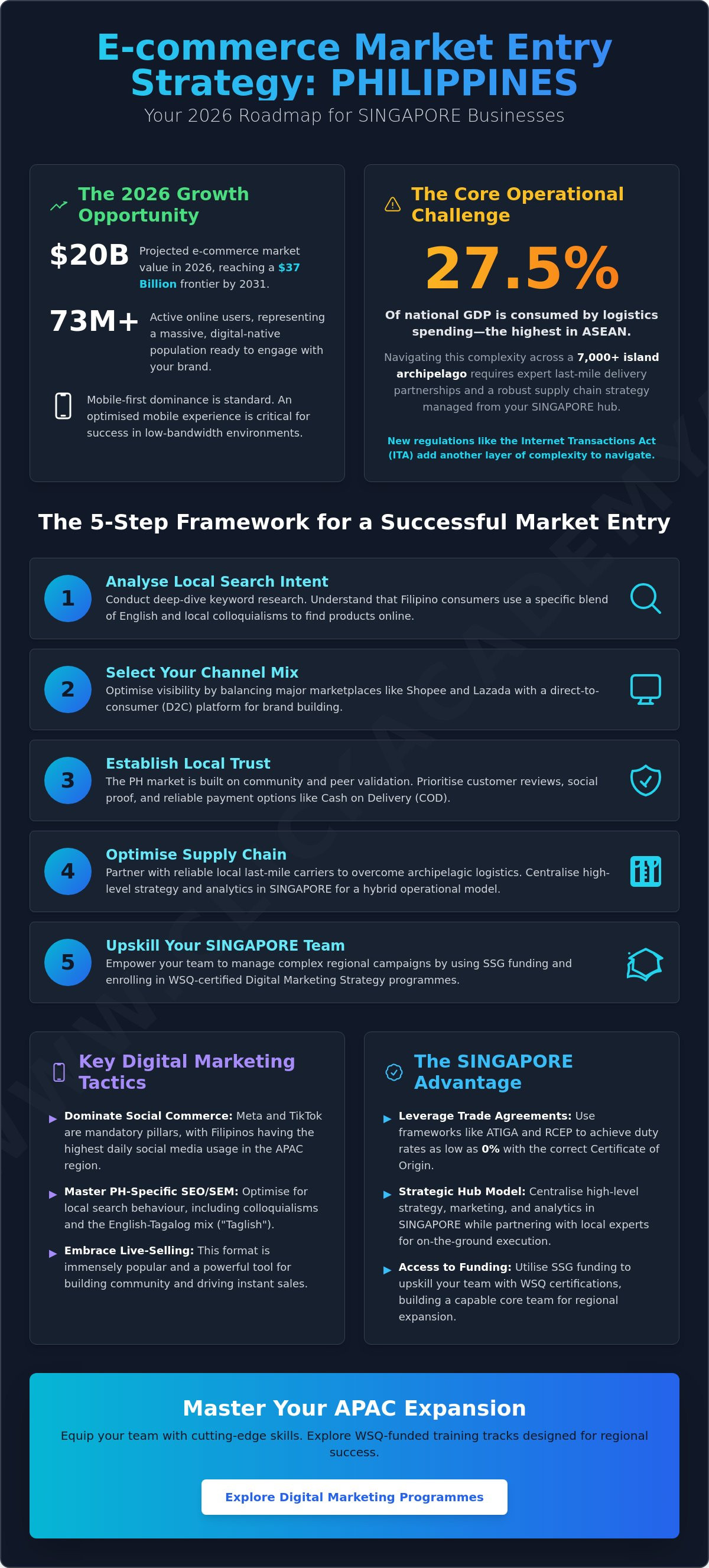
Did you know that logistics spending in the PHILIPPINES consumes a staggering 27.5% of the nation's GDP? For PMEBs in SINGAPORE looking to expand, this figure highlights the immense complexity of managing a supply chain across a 7,000-island archipelago. Scaling your brand beyond SINGAPORE requires more than just a great product; it demands a robust e-commerce market entry strategy for the philippines that accounts for high operational costs and evolving regulations like the Internet Transactions Act (ITA).
You've likely felt the uncertainty of navigating fragmented payment preferences or building consumer trust in a market where cash on delivery remains a staple. It's a significant challenge, but one that's manageable with the right regional expertise. This guide provides your definitive 2026 roadmap, detailing how to optimise your operations and identify the ideal platform mix between Shopee, Lazada, and TikTok. We'll also explore how to use WSQ-certified skills and SSG-funded frameworks to empower your team for long-term success in the APAC region.
Key Takeaways
Analyse why the PHILIPPINES is the essential hub for your 2026 expansion and how to leverage trade agreements from SINGAPORE to gain a competitive edge.
Master a 5-step framework to build a scalable e-commerce market entry strategy for the philippines, starting with deep-dive local keyword intent and strategic channel selection.
Navigate the complexities of the 2026 legal landscape, including new DTI requirements and the unique last-mile logistics of an archipelagic market.
Discover why Meta and TikTok dominate the local digital landscape and how to optimise your PH-specific SEO and SEM tactics for maximum reach.
Identify how to use WSQ Digital Marketing Strategy & Planning certifications and SSG funding to upskill your SINGAPORE-based team for regional growth.
Table of Contents
Why the Philippines is the Core of Your 2026 APAC E-commerce Market Entry Strategy
The PHILIPPINES represents the most dynamic expansion opportunity within the APAC region for 2026. While other markets face saturation, the e-commerce market in the Philippines is projected to reach approximately USD 20.05 billion in 2026. This trajectory isn't just a temporary spike; the PH e-commerce opportunity is a $37 billion frontier by 2031.
SINGAPOREAN firms are uniquely positioned to capitalise on this growth due to strong regional trade agreements like ATIGA and RCEP. These frameworks allow you to move goods with duty rates as low as 0% provided you have the correct Certificate of Origin. Developing a successful e-commerce market entry strategy for the philippines means moving beyond simple curiosity and adopting a structured, data-driven approach to the middle-of-the-funnel (MOFU) stage where consumer trust is built.
To better understand the local marketing landscape, watch this helpful video from the DTI PHILIPPINES:
The 2026 Growth Drivers for Singaporean Businesses
Success in this market depends on your ability to reach a massive, digital-native population. With over 73 million active online users, the sheer scale of the audience is a primary motivator for expansion. Filipinos have the highest daily social media usage in the APAC region, making social commerce and live-selling mandatory pillars of your strategy.
Mobile-first dominance is the standard, not the exception. Your digital store must be optimised for low-bandwidth mobile environments to ensure a seamless user experience across all devices. As the middle class grows in Tier 1 cities like Manila, Cebu, and Davao, discretionary spending is shifting toward international brands that offer reliability and prestige.
Overcoming the Fragmentation Myth
Logistical anxiety often prevents PMEBS from entering the market because of the 7,107 islands. It's true that logistics spending accounts for 27.5% of the country's GDP; this is currently the highest in ASEAN. However, digital infrastructure and the 2022-2030 E-commerce Roadmap are rapidly bridging these gaps through improved logistics integration and simplified customs processes.
SINGAPORE serves as the ideal strategic hub for these operations. By centralising your high-level strategy and marketing analytics in SINGAPORE, you can maintain control while partnering with local last-mile carriers for execution. This hybrid model allows you to manage the e-commerce market entry strategy for the philippines with the precision of a local player and the scale of a regional leader. You can begin mastering these complexities through a specialised E-commerce Strategy & Operations programme.
The 5-Step Framework for a Philippines E-commerce Market Entry Strategy
Executing a successful expansion into the PHILIPPINES requires more than just listing products on a website. It demands a tactical, five-step framework designed to navigate a unique digital ecosystem. Your e-commerce market entry strategy for the philippines begins with Step 1: deep-dive keyword research. Understanding local search intent is vital because Filipino consumers often use a specific blend of English and colloquialisms to find products. Step 2 involves selecting your channel mix, balancing marketplaces with direct-to-consumer (D2C) platforms to ensure maximum visibility.
Step 3 focuses on establishing local trust. The Philippines eCommerce market is built on community and peer validation. Step 4 addresses the supply chain, where you must optimise last-mile delivery partnerships to handle the archipelagic geography. Finally, Step 5 ensures your team in SINGAPORE is ready. You can effectively manage these complex regional campaigns by enrolling your staff in specialised sales and marketing programmes that focus on regional execution. This structured approach moves your business from market curiosity to operational excellence.
Platform Selection: Shopee, Lazada, or TikTok Shop?
In 2026, the "Big Three" platforms serve different strategic purposes. Shopee and Lazada remain the primary destinations for high-intent searches in electronics and home essentials. However, TikTok Shop has seen a massive shift, becoming the dominant force for impulsive fashion and beauty purchases through live-selling. Relying on a single platform is a risk to your brand resilience. A multi-channel approach allows you to capture different segments of the 73 million active online users while hedging against platform-specific policy changes or fee hikes.
Localising the Value Proposition
Localisation goes beyond currency conversion. To resonate with the PHILIPPINES market, you must adapt your brand voice to "Taglish" and community-driven narratives. This creates an immediate emotional connection that a generic global voice lacks. Trust is also tied to payment flexibility. While digital wallets like GCash and Maya are ubiquitous in 2026, offering Cash on Delivery (COD) is still a non-negotiable requirement for many regions. Credibility is further cemented by partnering with local influencer and affiliate networks. These local voices act as cultural translators for your SINGAPOREAN brand, bridging the gap between an international product and a local household staple.
Navigating Regulatory and Logistical Hurdles from Singapore
Managing a cross-border venture requires more than just digital marketing; it requires a deep understanding of the local legal framework. The Internet Transactions Act (ITA) of 2023 is now fully in effect as of June 20, 2025, following its transition period. This means all online merchants targeting the PHILIPPINES must comply with strict consumer protection and data privacy rules. A successful e-commerce market entry strategy for the philippines must account for these compliance costs from day one to avoid heavy penalties or site blocks.
Taxation is a critical pillar for SINGAPOREAN PMEBS. Currently, the de minimis threshold for imported goods is PHP 10,000. Items valued at or below this amount are exempt from duties and taxes; however, a 12% VAT applies once the value exceeds this limit. Navigating the Bureau of Customs (BOC) becomes significantly easier when you use the ASEAN Trade in Goods Agreement (ATIGA) to reduce duties to 0% for qualified products. You can find more granular details in this Philippines e-commerce market overview. Executing a resilient e-commerce market entry strategy for the philippines means being prepared for these regulatory shifts before they impact your bottom line.
The Logistics Roadmap for Singaporean Exporters
Cross-border fulfilment is often the best way to test the market with minimal capital. Once your SKU count grows, shifting to local fulfilment in Metro Manila or regional hubs like Cebu becomes necessary to reduce delivery times. Returns management is often the silent killer of margins in the PHILIPPINES; you need a clear process for handling failed COD deliveries. You must also prepare for the mandatory issuance of e-invoices by December 31, 2026, which applies to all e-commerce businesses.
Intellectual Property and Brand Protection
Counterfeit listings and grey market sellers are common on major marketplaces. Registering your trademarks with the IPOPHL is the first step in protecting your brand equity. Once registered, you can use platform-specific tools on Shopee and Lazada to take down unauthorised listings. Combining this legal protection with a robust SEO strategy ensures that your official store dominates brand searches. Leaders who understand these operational nuances often succeed where others fail. You can master these regional complexities through our Digital Transformation for Leaders programme.
Digital Marketing Tactics to Dominate the Philippine Market
In the PHILIPPINES, Meta platforms like Facebook and Instagram aren't just social networks; they effectively serve as the primary gateway to the internet for millions of users. Your e-commerce market entry strategy for the philippines must prioritise these channels to capture attention where consumers spend the majority of their digital lives. Success here requires a shift from generic regional templates to localised SEO that incorporates "Taglish" and regional colloquialisms. Incorporating local reviews and user-generated content into your SEO strategy further boosts rankings, as search engines prioritise signals of local authenticity in the PHILIPPINES search landscape.
Building community trust through storytelling is the core of effective content marketing in this region. Filipino consumers value peer recommendations and brand authenticity far above polished corporate messaging. To ensure your marketing spend is generating results, you must accurately measure regional ROI. Using GA4 for marketing analytics allows you to track complex cross-platform journeys and attribute sales accurately across fragmented touchpoints. This data-driven approach is what separates a speculative entry from a profitable, long-term expansion.
The Social Commerce Powerhouse
Social commerce is a dominant force, with Facebook Groups and live-selling sessions driving immediate conversions and high engagement. These high-trust environments allow for real-time interaction, which is essential for a market that prioritises "conversational commerce" via Messenger or WhatsApp. Live-selling isn't just a trend; it's a primary sales driver where influencers demonstrate products in real-time, answering questions and offering exclusive flash discounts. Integrating TikTok Ads with your Shopee or Lazada storefront creates a seamless funnel for impulsive buyers. By engaging customers directly in their preferred chat apps, you reduce friction and build the rapport necessary for loyalty.
Advanced SEM and Performance Marketing
The Philippine audience is notoriously price-sensitive yet highly brand-conscious, requiring a sophisticated bidding strategy that balances value and prestige. Performance Max (PMAX) campaigns are particularly effective in 2026 for reaching fragmented audiences across various Google properties simultaneously. This advanced SEM strategies guide explains how managers can prepare for this complexity by mastering automated bidding and high-value audience signals. To truly lead the market, you must equip your team with the latest tactical knowledge through WSQ Digital Marketing Strategy & Planning certifications that focus on regional APAC execution.
Upskilling Your Team for Regional Success with WSQ Frameworks
A resilient e-commerce market entry strategy for the philippines depends on the calibre of the professionals executing it. While choosing the right logistics partner or platform is essential, strategy beats software every time. Without a team that understands regional nuances and data-driven planning, even the most sophisticated tools will fail to deliver a sustainable ROI. Investing in your human capital ensures that your SINGAPORE-based team can navigate the complexities of the 2026 digital landscape with confidence and precision.
SINGAPOREAN businesses have a distinct competitive advantage through the local training ecosystem. By leveraging WSQ frameworks, you can systematically build the competencies required for APAC leadership. ClickAcademy Asia bridges the gap between academic theory and the ground reality of the PH market, providing professionals with actionable insights that can be applied immediately to regional campaigns. This commitment to practical mastery is what transforms a standard marketing lead into a high-performing regional strategist.
Maximising SSG Funding for Professional Development
Expansion into new territories involves inherent financial risks, but upskilling your team shouldn't be one of them. SINGAPOREAN PMEBS can significantly reduce the cost of professional development by utilising SSG funding for WSQ-accredited modules. The co-payment model allows companies to train their staff in high-value areas like WSQ Digital Marketing Strategy & Planning at a fraction of the usual cost. Many PMEBS also use their SkillsFuture Credit to offset remaining fees, making strategic upskilling an affordable part of their e-commerce market entry strategy for the philippines. This financial support enables you to build a sophisticated regional team without straining your expansion budget.
The Roadmap to Regional Marketing Mastery
The path from a local Marketing Lead to a Regional Director requires a mastery of cross-border execution and marketing analytics. Our curriculum integrates real-world PH market case studies into the classroom, allowing your team to practice solving logistical and cultural challenges before they impact your live operations. This hands-on approach ensures that your workforce is not just familiar with the 2026 regulations, but is also capable of optimising campaigns for maximum regional impact. Preparing your team for these challenges today creates a future-ready workforce capable of dominating the APAC region for years to come.
Explore our WSQ-funded digital marketing tracks to empower your regional expansion and ensure your team has the tactical expertise to succeed in the PHILIPPINES and beyond.
Mastering the Philippine Digital Frontier
Success in the ARCHIPELAGO requires more than just logistical coordination; it demands a deep strategic alignment with local consumer habits and 2026 regulatory shifts. By integrating a multi-channel approach with robust marketing analytics, your business can turn high operational costs into a scalable competitive advantage. You've seen how critical it's to master the nuances of the local landscape, from "Taglish" SEO to the complexities of the Bureau of Customs.
Implementing a winning e-commerce market entry strategy for the philippines is ultimately a people-driven initiative. Equipping your SINGAPORE-based team with the right skills ensures your brand remains agile and authoritative in a rapidly evolving market. Continuous learning isn't just an option; it's the primary solution to regional expansion challenges. Expert-led training reduces the risks associated with new market entry while building long-term brand equity.
As an official Google Training Partner with a WSQ-certified curriculum, ClickAcademy Asia has empowered over 10,000 professionals across APAC to lead with excellence. Equip your team for regional dominance with our WSQ-funded Digital Marketing Strategy programmes. Your journey toward regional leadership starts with a commitment to practical mastery; let's build that future together.
Frequently Asked Questions
What is the most effective e-commerce platform for entering the Philippines in 2026?
Shopee and Lazada remain the dominant marketplaces for high-intent searches, but TikTok Shop is the leader for discovery-based purchases in 2026. A successful e-commerce market entry strategy for the philippines should ideally utilise a combination of these platforms to hedge against platform-specific risks. This multi-channel approach ensures you reach the 73 million active online users across different stages of the buyer journey.
How much does it cost to set up an e-commerce business in the Philippines from Singapore?
Setup costs depend on whether you opt for a cross-border model or establish a local entity through the SEC. Cross-border entry is often more cost-effective for testing the market, especially with the PHP 10,000 de minimis threshold for duty-free imports. However, local entities may face higher overheads but benefit from faster delivery times and increased consumer trust through local fulfilment.
Can I use Singapore-based staff to manage my Philippines digital marketing?
You can certainly use your SINGAPORE-based team to manage regional marketing if they possess the right strategic framework. Success depends on their ability to localise content and understand the PHILIPPINES digital ecosystem rather than their physical location. Upskilling your staff through a e-commerce market entry strategy for the philippines focused programme ensures they can handle regional campaigns with technical precision.
What are the main regulatory requirements for e-commerce in the Philippines?
The primary requirements include compliance with the Internet Transactions Act (ITA) of 2023 and registration with the DTI or SEC. Businesses must also prepare for the mandatory Bureau of Internal Revenue (BIR) e-invoicing mandate by 31 December 2026. Protecting your brand through trademark registration with the IPOPHL is also highly recommended to prevent counterfeit listings on marketplaces.
Is SSG funding available for regional marketing strategy courses?
Yes, SSG funding is available for various WSQ-accredited digital marketing and strategy programmes. Eligible SINGAPOREAN companies and individuals can benefit from significant subsidies through the co-payment model. This allows your team to acquire advanced skills in regional strategy and analytics while significantly reducing the financial burden of professional development.
What is the role of social commerce in a Philippines market entry strategy?
Social commerce is the cornerstone of the Philippine digital economy, driven by the highest daily social media usage in the APAC region. It facilitates immediate conversion through live-selling and conversational commerce via apps like Messenger and WhatsApp. Building a community on these platforms is essential for establishing the trust required for high-value transactions and long-term brand loyalty.
How do I handle last-mile delivery in the Philippines archipelago?
Effective last-mile delivery requires partnering with established local 3PL providers that have extensive provincial networks. While Metro Manila is the primary hub, using regional warehouses in cities like Cebu or Davao can drastically reduce shipping times to the Visayas and Mindanao regions. Balancing speed with the high cost of archipelagic logistics is a key component of operational success.
What payment methods are essential for Philippine online consumers?
You must offer a mix of digital wallets and traditional payment options to maximise conversion rates. GCash and Maya are the leading e-wallets in 2026, but Cash on Delivery (COD) remains a critical requirement for many consumers outside major metropolitan areas. Providing these diverse options ensures you cater to the varied trust levels and banking access of the local population.


Comments