
Ecommerce Operations Course Singapore: The 2026 Professional Upskilling Guide

Pouring capital into customer acquisition won't rescue margins if backend fulfilment bottlenecks are silently eating your profits. As retail leaders know all too well, managing fragmented stock across Shopee, Lazada, and Shopify quickly drains resources without airtight systems. That is why choosing the right ecommerce operations course Singapore professionals rely on has shifted from a simple training checklist item into an urgent strategic priority.
You already recognise that scalable commercial growth depends on automated logistics, dependable inventory synchronisation, and rigorous cost control rather than ad hacks. In this guide, you'll discover how to eliminate order latency across regional hubs, streamline omnichannel workflows, and tap into SSG funding subsidies of up to 70% to upskill your team. We examine Singapore's premier WSQ-aligned training pathways, breaking down the exact operational competencies required to protect your margins and future-proof your digital enterprise.
Table of Contents
The Operational Bottleneck: Why Digital Retail Requires Advanced Logistics Skills
Core Competencies Taught in an Advanced Ecommerce Operations Course Singapore
Evaluating Executive Training: Practical Execution Versus Academic Theory
How to Maximise SSG Funding and WSQ Subsidies for Singapore Professionals
Upskilling Your Organisation: The ClickAcademy Asia Strategic Advantage
The Operational Bottleneck: Why Digital Retail Requires Advanced Logistics Skills
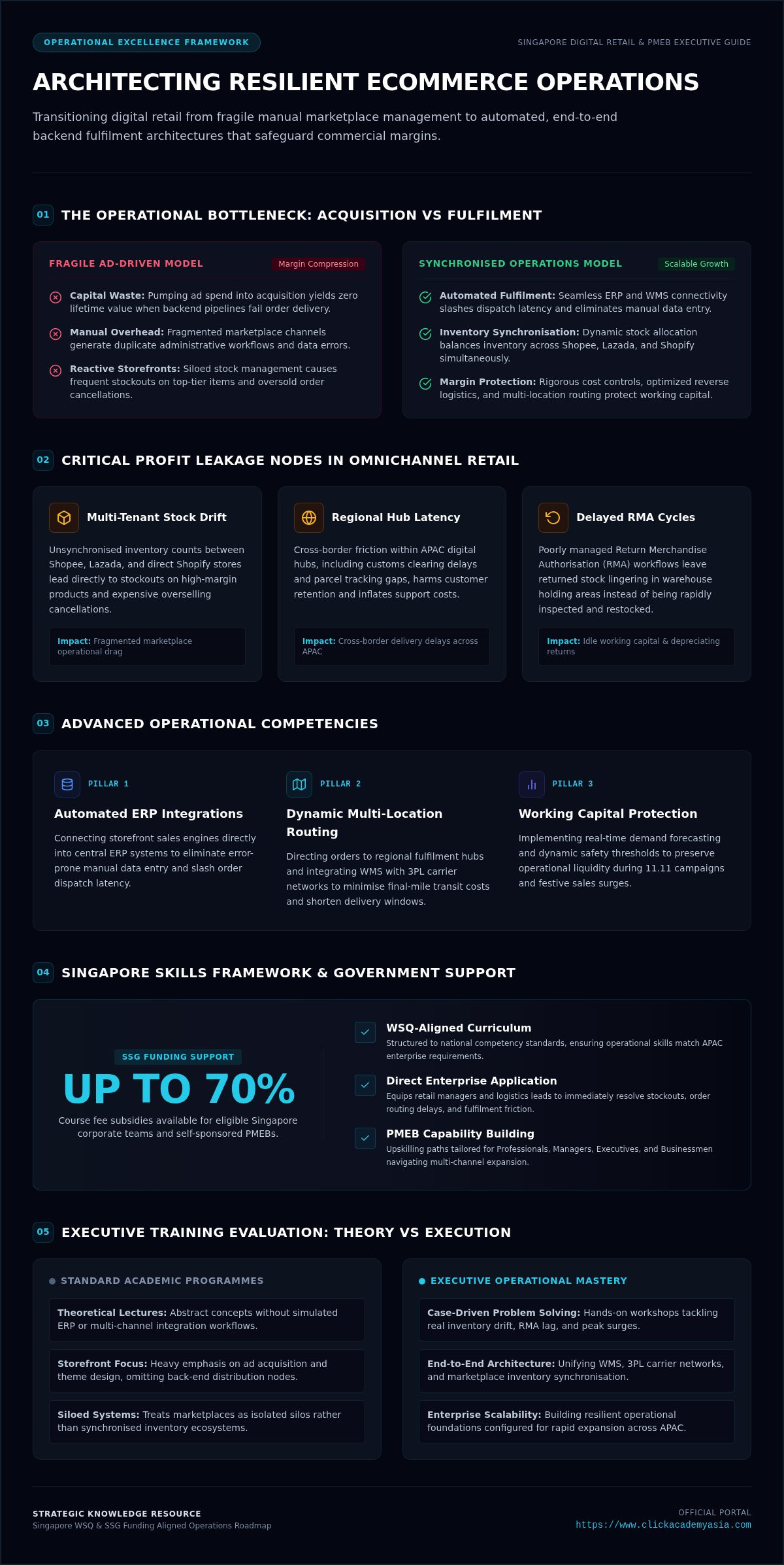
Modern digital retail operations extend far beyond managing a sleek storefront or uploading products to marketplaces. True retail resilience requires synchronised inventory architecture, automated order routing, and real-time reverse logistics. In Singapore, consumer brands face tightening margins because fragmented marketplace channels create duplicate administrative workflows and inventory discrepancies. While many teams focus exclusively on acquiring customers, silent backend friction drains balance sheets. Enrolling your key personnel in a structured ecommerce operations course Singapore retail leaders endorse addresses this exact vulnerability, converting fragile manual tasks into automated, repeatable workflows.
To better understand the core foundations required to structure a sustainable online venture, watch this overview video:
Deconstructing the Profit Leakage in Omnichannel Retail
Unsynchronised stock levels across multi-tenant platforms create instant operational penalties. When inventory counts drift between Shopee, Lazada, and direct Shopify stores, brands suffer stockouts on high-margin items alongside costly order cancellations on oversold stock. Cross-border friction within the regional APAC digital hubs also hampers customer retention when customs clearing or parcel tracking lags. Poorly managed Return Merchandise Authorisation (RMA) cycles exacerbate these problems, as returned items linger in holding areas instead of being rapidly restocked. These systemic breakdowns show why mastering modern supply chain management principles remains essential for sustaining profitability across high-volume digital channels, as outlined in [External Link: local statistic/industry study].
The Shift from Ad Spend to Supply Chain Mastery
Pumping ad budgets into paid acquisition channels yields zero lifetime value if your backend fulfilment pipelines cannot deliver orders accurately. Top retail teams focus their operational strategy around several core disciplines:
Automated ERP Integrations: Connecting sales engines directly with central enterprise resource planning software removes error-prone data entry, slashing order dispatch latency.
Dynamic Multi-Location Routing: Directing orders to regional fulfilment hubs cuts final-mile transit costs and keeps delivery times competitive.
Peak Season Working Capital Protection: Real-time demand forecasting protects operational cash flow during high-volume sales campaigns like 11.11 and festive surges.
By mastering these competencies through an enterprise-grade ecommerce operations course Singapore professionals can systematically eliminate margin drag, keeping digital retail operations agile, scalable, and resilient against competitive margin pressures.
Core Competencies Taught in an Advanced Ecommerce Operations Course Singapore
Most commercial programmes focus narrowly on promotional marketing or setting up simple digital storefronts. However, real enterprise scale requires institutional mastery over complex operational nodes. A comprehensive ecommerce operations course Singapore retail managers trust bridges front-end conversions with rigorous back-end logistics, turning isolated tasks into a unified, high-performing distribution engine. By connecting physical inventory systems with live customer engagement touchpoints, businesses eliminate manual redundancies and protect profit margins.
Omnichannel Inventory and Warehouse Management Architecture
Modern retail operators must master intelligent inventory allocation rules to balance stock across marketplaces and direct brand webstores simultaneously. You'll learn to integrate Warehouse Management Systems (WMS) directly with regional third-party logistics (3PL) carrier networks, establishing dynamic safety thresholds that prevent devastating stockouts during peak promotional campaigns. This level of system cohesion guarantees your physical stock matches digital figures across every channel in real time.
Customer Experience, Returns, and Reverse Logistics Workflows
Post-purchase efficiency directly drives long-term customer lifetime value. Developing automated return merchandise workflows keeps reverse logistics predictable and prevents returned stock from stagnating in fulfilment centres. Professional upskilling focuses on several core customer journey checkpoints:
Automated Dispatch Notifications: Implementing tracking triggers that proactively inform buyers, slashing inbound service inquiries.
SLA Benchmarking: Establishing rigorous service level agreements to hold final-mile delivery couriers accountable for transit speeds.
Restocking Automation: Routing inspected return items back into available sellable inventory within designated timelines.
Operational Data Analytics and Financial Reporting
Accurate reporting transforms raw operational metrics into actionable commercial strategy. Leaders must routinely monitor inventory turnover rates, holding costs, and order fulfilment cycle speeds to expose hidden operational inefficiencies. Linking these physical metrics with marketing conversion data, as detailed in our [Internal Link: ClickAcademy Asia Marketing Analytics with GA4] guide, provides complete clarity across the entire buyer journey. Professionals can also tap into SSG Funding and WSQ Subsidies to acquire these high-demand analytics skills without placing heavy capital strain on corporate training budgets.
Building executive dashboards allows management to visualise real-time fulfilment performance alongside gross merchant margins. If your organisation wants to master these foundational execution frameworks, exploring the executive programmes at ClickAcademy Asia equips your team with the actionable workflows required to outpace digital market competition.
Evaluating Executive Training: Practical Execution Versus Academic Theory
Enterprise leaders can't afford to waste capital on abstract lectures that fail to translate onto the warehouse floor or digital dashboard. While traditional academic courses spend weeks debating legacy retailing concepts, high-growth commercial teams need immediate operational execution. Selecting the right ecommerce operations course Singapore providers deliver requires auditing whether the syllabus tackles modern multi-channel challenges or merely recycles outdated retail textbooks. With the nation accelerating its logistics transformation through new government talent and skills development initiatives, HR directors must prioritise programmes built around tangible business ROI.
Key Criteria for Selecting an Executive Programme
When vetting potential curricula, HR managers and department heads should look beyond brand pedigree and evaluate three practical pillars:
Software-Stack Relevance: Confirm the coursework directly addresses modern architecture, including Shopify Plus, regional ERP integrations, and specialised WMS applications.
Practitioner Credibility: Ensure instructors have hands-on experience scaling digital retail operations rather than purely academic credentials.
Actionable Capstone Projects: Effective programmes require participants to resolve an active operational bottleneck, creating an immediate implementation roadmap for their employer.
Corporate Cohort Training Versus Individual Public Enrolment
Sending a solo manager to an open-enrolment workshop builds personal capability, but training an entire cross-functional cohort transforms departmental velocity. When fulfilment leads, inventory controllers, and digital marketers study alongside each other, internal friction disappears. The training adapts directly to your specific vendor agreements, API limits, and supply chain constraints.
This unified approach allows corporate sponsors to tie learning milestones directly to quarterly operational KPIs, such as decreasing order processing latency and trimming return handling cycles. Investing in a structured ecommerce operations course Singapore enterprise teams rely on ensures your staff speaks the same operational language, executing backend improvements from day one.
How to Maximise SSG Funding and WSQ Subsidies for Singapore Professionals
Singapore maintains one of the world's most supportive ecosystems for workforce transformation, making executive training exceptionally cost-effective. Through the WSQ framework, programmes are rigorously audited by SkillsFuture Singapore (SSG) to ensure every module addresses immediate industry gaps. Enrolling your retail team in an accredited ecommerce operations course Singapore training providers offer allows you to offset a substantial portion of training fees while building internal supply chain capabilities.
Navigating SkillsFuture Singapore (SSG) Subsidies and Eligibility
Government subsidies differ based on residency status, company profile, and age bracket, giving organisations multiple routes to co-fund operational development:
Baseline WSQ Subsidies: Eligible Singapore Citizens and Permanent Residents can access course fee subsidies of up to 70%, drastically lowering the barrier to individual upskilling.
Enhanced Training Support for SMEs (ETSS): Qualifying small and medium enterprises enjoy up to 90% course fee subsidies for local staff. Your enterprise must be registered locally with at least 30% local shareholding and an annual turnover under S$100 million or fewer than 200 workers.
SkillsFuture Mid-Career Enhanced Subsidy (MCES): Singapore Citizens aged 40 and above qualify for up to 90% course fee funding, regardless of whether their employer is an SME or a multinational corporation.
Corporate Funding, Absentee Payroll, and SFEC Schemes
Beyond baseline tuition subsidies, enterprise HR teams can tap into corporate support mechanisms to reduce the friction of sending staff for training during working hours. Employers can claim Absentee Payroll (AP) funding at S$4.50 per hour of training, capped at S$100,000 per organisation annually. This directly offsets staff downtime as your teams master core operational tools.
Eligible employers can also utilise the SkillsFuture Enterprise Credit (SFEC), which provides a one-off S$10,000 credit to cover up to 90% of out-of-pocket expenses after initial subsidies are applied. To explore how your company can combine these funding streams across broader digital skills development, review our [Internal Link: ClickAcademy Asia WSQ Digital Marketing Courses in Singapore] guide. Ready to upgrade your digital logistics without straining your operating budget? Apply for corporate training subsidies with ClickAcademy Asia and equip your team with accredited, future-proof operational capabilities today.
Upskilling Your Organisation: The ClickAcademy Asia Strategic Advantage
Executing scalable digital operations demands more than isolated tactics or self-serve tutorials. Established in 2011 with over a decade of executive training experience, ClickAcademy Asia bridges high-level strategic planning with pragmatic commercial execution. Having delivered programmes to professionals across more than 30 countries, the academy understands the regional complexities local enterprises face when scaling across Southeast Asia. By completing our premier E-commerce Strategy & Operations programme, an ecommerce operations course Singapore teams trust, your staff will transform operational bottlenecks into reliable competitive advantages.
Practitioner-Led Executive Education Tailored for PMEBs
Our curriculum is purposefully architected for PMEBs, business leaders, and marketing heads managing multi-market ecosystems. Rather than listening to abstract theory, learners dissect operational case studies reflecting real Singapore marketplace pressures. Participants transition directly from operational concepts to documented standard operating procedures (SOPs) they can deploy immediately on Monday morning.
This hands-on methodology ensures teams master critical operational capabilities without disruption:
Regional Fulfilment Design: Map multi-market cross-border shipping networks to minimise parcel handling fees and tracking delays.
Custom SOP Deployment: Establish standardized picking, packing, and dispatch workflows to curb peak-volume warehouse errors.
Vendor Governance: Negotiate resilient 3PL service contracts that safeguard customer delivery expectations.
Driving Measurable ROI Through Structured Operational Tracks
Executive learning must deliver visible commercial returns. In our courses, capstone projects challenge participants to automate real operational choke points inside their current organisations. This process ensures your training investment pays dividends immediately through reduced order cycle times and tighter inventory management.
Balancing backend delivery pipelines with reliable front-end conversion volume is equally critical. Leaders frequently combine this operational curriculum with targeted customer acquisition training, such as the [Internal Link: ClickAcademy Asia Advanced SEM Strategies Course], ensuring sustained traffic arrives at a fully synchronised backend. Equipping your workforce with these WSQ-aligned competencies protects gross margins while accelerating enterprise growth. Equip your team with ClickAcademy Asia today and start building resilient, scalable retail systems.
Future-Proof Your Retail Logistics with Strategic Workforce Upskilling
Scaling digital commerce doesn't happen through top-of-funnel ad spend alone; sustainable profitability demands automated, resilient backend logistics. Mastering multi-channel stock synchronisation, optimising reverse supply chains, and establishing firm delivery SLAs transform fulfilment from an operational headache into an engine of margin growth.
Substantial SSG funding and WSQ frameworks make this structural transformation readily achievable for organisations of every size. Selecting an accredited ecommerce operations course Singapore teams rely on empowers your staff to eliminate workflow friction, resolve dispatch bottlenecks, and protect working capital. Operating across Singapore and APAC since 2011, ClickAcademy Asia delivers practitioner-led, enterprise-ready curricula that translate directly into measurable workplace performance. Scale your retail business with enterprise training from ClickAcademy Asia and build the high-performing operational infrastructure your brand needs to thrive across the region.
Frequently Asked Questions
What prerequisites are required to enrol in an ecommerce operations course Singapore?
Most executive programmes don't require formal supply chain qualifications, but candidates should possess a foundational understanding of digital business models. An advanced ecommerce operations course Singapore professionals undertake typically targets PMEBs, retail managers, and brand owners who oversee active sales channels. Basic numeracy, familiarity with digital spreadsheets, and an active operational role within a retail environment will help participants apply course frameworks to practical business workflows immediately.
How do SSG subsidies apply to corporate-sponsored employees taking ecommerce training?
Corporate sponsors claim substantial fee subsidies directly through the Enterprise Portal when sponsoring eligible Singapore Citizens and Permanent Residents. Qualifying SMEs receive Enhanced Training Support for SMEs (ETSS) covering up to 90% of course fees, while non-SME organisations access baseline funding of up to 70%. Employers can also claim Absentee Payroll funding at S$4.50 per hour to offset employee working hours committed to attending training.
Can Singaporeans use their individual SkillsFuture Credit to pay for course fees?
Yes, self-sponsored Singapore Citizens aged 25 and above can utilise their SkillsFuture Credit to offset remaining out-of-pocket course fees for approved WSQ programmes. Eligible mid-career professionals aged 40 and older can also combine their credit balance with Mid-Career Enhanced Subsidy (MCES) funding to cover up to 90% of tuition costs, keeping personal investment minimal while securing industry-standard credentials.
How does an ecommerce operations course differ from a digital marketing course?
Digital marketing courses concentrate primarily on front-end acquisition, focusing on traffic generation through search engine marketing, social media campaigns, and creative content strategy. An operations programme centres on backend fulfilment, inventory synchronisation across regional marketplaces, warehouse workflows, 3PL carrier coordination, and reverse logistics. Operations ensures your business can reliably and profitably deliver the purchase volume that marketing campaigns generate.
What specific software tools and operational platforms are covered in the curriculum?
The curriculum examines enterprise tools that power digital commerce, focusing on multi-channel integrations across Shopify, Shopee, and Lazada. Participants explore enterprise resource planning (ERP) connections, warehouse management systems (WMS), and middleware solutions that synchronise inventory counts automatically. Training also covers parcel tracking platforms and service desk software used to monitor delivery SLAs and post-purchase customer interactions.
Are courses conducted online, in-person, or via a blended learning model?
Programmes generally feature interactive in-person executive workshops or blended formats combining live virtual lectures with intensive classroom problem-solving. This interactive setup allows hands-on capstone work, group case discussions, and workflow demonstrations alongside fellow retail PMEBs. The blended format provides working executives with scheduling flexibility while preserving the peer collaboration needed to tackle complex retail challenges.
How quickly can corporate teams implement course learnings into daily operations?
Teams can deploy these frameworks immediately following training. Because programmes emphasise practical standard operating procedures (SOPs) rather than abstract theory, participants complete capstone projects that target actual bottlenecks inside their current organisation. Completing a practical ecommerce operations course Singapore businesses trust equips staff to audit inventory flows, streamline carrier handoffs, and eliminate manual order processing errors from their first week back.


Comments