
Charting Your Career Path in Digital Marketing: A 2026 Strategy Guide for Singaporean PMEBs

Updated: Sep 23
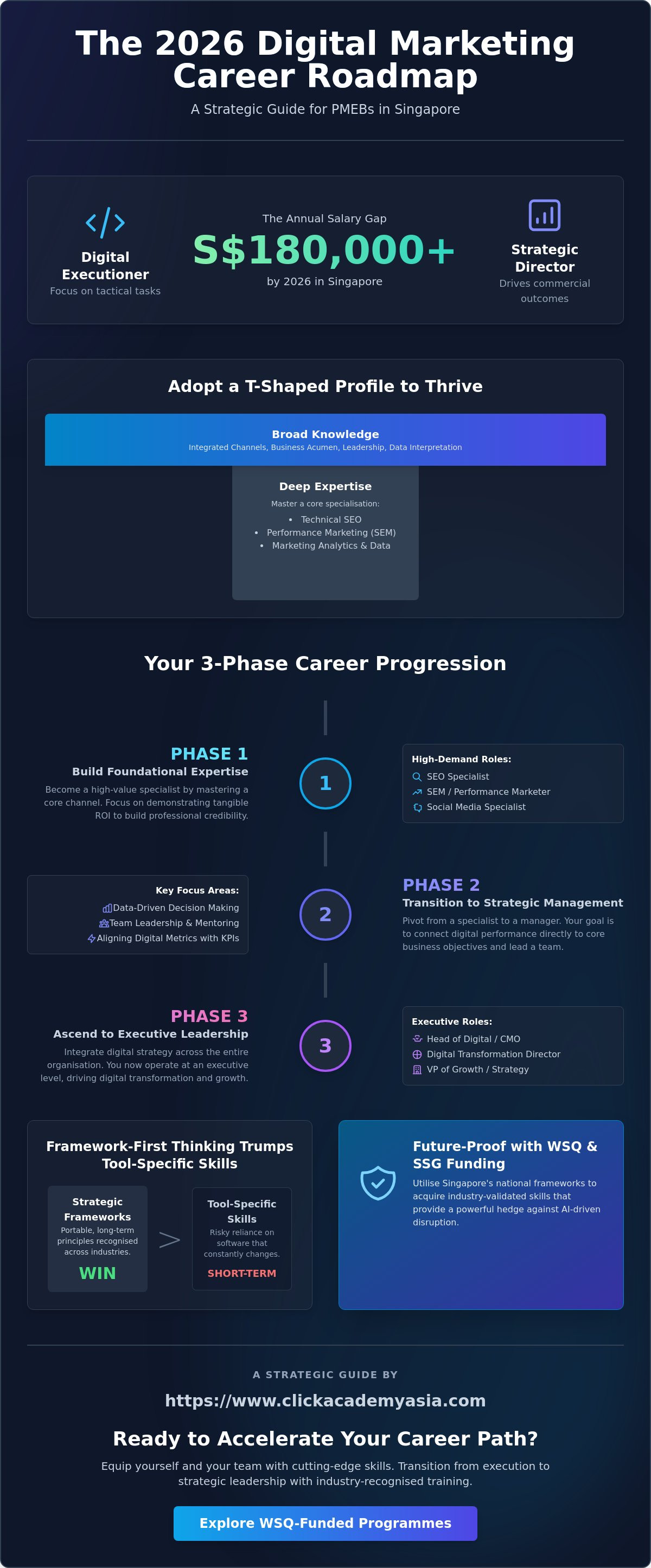
By 2026, the salary gap between a digital executioner and a strategic director in Singapore has widened to more than S$180,000 annually. While many professionals fear that AI will make their roles obsolete, the market is simply rewarding a different type of expertise. If you feel stuck in a cycle of endless campaign execution, you aren't alone in wondering how to bridge that divide and secure a lucrative career path in digital marketing.
It's natural to feel overwhelmed by the rapid shift toward AI-driven automation and the pressure to choose the right certifications. You want a strategy that offers long-term security and leadership opportunities rather than just another technical skill. This guide provides a definitive 2026 roadmap to help you transition from a generalist to a high-value strategic leader.
We'll examine the specific WSQ certifications that Singaporean employers prioritise, how to maximise your SSG funding, and the exact milestones needed to achieve a resilient T-shaped skill set. By the end of this article, you'll have a clear plan to future-proof your career and lead with confidence in a results-driven environment.
Key Takeaways
Shift your focus from simple task execution to high-level commercial strategy to bridge the salary gap in the Singapore market.
Build a credible foundation for your career path in digital marketing by mastering technical specialisations like SEO, SEM, or marketing analytics.
Learn how to pivot from a specialist to a strategic manager by aligning digital metrics with core business KPIs.
Understand the requirements for executive leadership roles, where digital strategy integrates with every facet of the organisation.
Utilise the WSQ framework and SSG funding to acquire industry-validated skills that provide a hedge against AI-driven disruption.
Table of Contents
Navigating the Career Path in Digital Marketing in 2026 Singapore
Phase 1: Building Foundational Expertise as a Digital Marketing Specialist
Phase 2: Transitioning to Strategic Management and Data-Driven Leadership
Phase 3: Reaching Executive Leadership and Digital Transformation Roles
Future-Proofing Your Career Path in Digital Marketing with WSQ Training
Navigating the Career Path in Digital Marketing in 2026 Singapore
The career path in digital marketing has undergone a radical transformation. In the past, entry-level roles focused almost entirely on tactical execution, such as scheduling posts or setting up basic ad sets. By 2026, however, these manual tasks have been largely automated or augmented by AI. This shift means that professionals in Singapore must now pivot toward becoming strategic architects who can bridge the gap between technical tools and commercial objectives.
To stay relevant, you must adopt a "T-shaped" profile. This involves developing deep expertise in one specific area, such as Digital marketing analytics or performance marketing, while maintaining a broad understanding of how all channels integrate to drive business results. ClickAcademy Asia serves as your strategic partner in this journey, providing the mentorship and structured learning needed to navigate these complex professional shifts.
To better understand the various roles available in this field, watch this helpful walkthrough:
The Evolution of Marketing Roles in the APAC Region
Digital transformation across the APAC region has accelerated, leading to a surge in demand for leaders who can manage integrated ecosystems rather than siloed channels. We've moved past the era where a company simply hired "the social media person" or "the email marketer." Today's market requires versatile strategists who can master the 2026 landscape by aligning digital initiatives with overarching business goals. This evolution has created new opportunities for PMEBs to step into high-value roles that focus on digital transformation and regional growth. Successful professionals in this new era are those who can analyse complex data sets and translate them into actionable business insights that drive revenue.
For professionals aiming for regional growth in specific markets like Japan, language proficiency can be a significant differentiator. Resources such as the Nunawading Japanese School offer tailored adult education that helps marketers bridge cultural gaps and communicate more effectively with international stakeholders.
Why Framework-First Thinking Trumps Tool-Specific Skills
Mastering a specific software platform is a short-term win because interfaces and algorithms change constantly. Relying solely on tool-specific knowledge is a risky strategy for your long-term career path in digital marketing. Instead, focusing on WSQ frameworks provides you with a standardised language for marketing excellence that is recognised across Singapore. These frameworks allow you to apply strategic principles regardless of which tool you use. Strategic planning serves as the essential anchor that keeps your career steady as the technological tide continues to shift. By prioritising these high-level frameworks, you ensure that your skills remain portable across different industries and software ecosystems.
Phase 1: Building Foundational Expertise as a Digital Marketing Specialist
Every successful career path in digital marketing begins with a deep technical dive. In the Singaporean market, generalists often struggle to find their footing because employers look for specific, high-impact skills that drive immediate ROI. By mastering a core channel like SEO or SEM, you build the professional credibility needed to transition into broader leadership roles later. This initial phase is about precision; it's about proving you can execute data-backed strategies that move the needle for a business.
Focusing on quick wins through performance monitoring allows you to demonstrate your value to stakeholders quickly. Whether you're managing a small budget or a large-scale technical audit, the ability to show tangible growth is what separates a specialist from a hobbyist. To establish this technical base, many professionals start with foundational courses that align with industry standards.
High-Demand Entry Points: SEO, SEM, and Social Media
The role of an SEO specialist is more technical than ever in 2026. Your daily responsibilities will shift from simple keyword placement to conducting comprehensive technical audits and content optimisation for both search engines and AI discovery tools. You'll need to understand how site architecture influences crawlability and how to structure data to win in a zero-click search environment.
If you prefer the fast-paced nature of paid media, the SEM path offers a direct route to high-intent search management. You'll move beyond basic keyword bidding to master Performance Max strategies, where you guide AI algorithms to find the most profitable customers. Meanwhile, social media marketing remains a vital foundation for those who excel at community engagement and brand storytelling. It's the perfect training ground for understanding consumer psychology and the nuances of platform-specific content distribution.
Validating Your Skills with Official Certifications
In a competitive market, official certifications from global bodies like Google act as a "passport" for your career. Google Ads and GA4 certifications are no longer optional extras; they're non-negotiable requirements for early-career professionals in Singapore. These credentials prove that you have the technical proficiency to manage corporate budgets and analyse complex user journeys with accuracy.
The Singapore Digital Society Report highlights the increasing importance of digital literacy across all sectors of our economy. Validating your skills ensures you're prepared for the high standards expected within the local business ecosystem. These certifications provide a standardised benchmark that HR decision-makers trust when vetting talent for specialised roles. By securing these early wins, you create a solid platform for your long-term career path in digital marketing and prepare yourself for the strategic pivots that come with senior management.
Phase 2: Transitioning to Strategic Management and Data-Driven Leadership
The most significant hurdle in the career path in digital marketing is the transition from specialist to manager. This shift requires a fundamental psychological pivot from "doing" to "directing." While your early career was defined by technical proficiency in a single channel, your success as a manager depends on your ability to align multi-channel efforts with core business KPIs. You are no longer just managing platforms; you are managing investments and expectations.
Developing a T-shaped skill set is essential at this stage of your professional journey. You must maintain a broad understanding of how SEO, SEM, and Content Marketing work in tandem to create a cohesive customer journey. By 2026, the ability to orchestrate these various disciplines into a unified strategy is what separates middle management from high-level leadership. Proving ROI to senior stakeholders becomes your primary objective, making marketing analytics the most powerful tool in your arsenal.
The Pivot from Execution to Strategic Planning
A Digital Marketing Manager functions as an architect rather than a builder. Your role involves overseeing the entire digital ecosystem and ensuring every dollar spent contributes to the organisation's bottom line. The WSQ Digital Marketing Strategy & Planning framework provides the structured methodology needed to navigate this transition with confidence. It offers a standardised approach to campaign orchestration that is highly valued by Singaporean employers. To excel in this phase, you should focus on mastering these core management competencies:
Budgeting and Resource Allocation: Learning how to distribute funds across channels to maximise return.
Stakeholder Management: Translating technical digital metrics into the commercial language of the C-suite.
Team Leadership: Mentoring specialists and fostering a culture of continuous experimentation.
Leveraging Analytics to Drive Business Growth
Mastery of GA4 is the heart of strategic management in the current landscape. It allows you to move beyond reporting on what happened and start predicting what will happen next. By 2026, predictive analytics has become a standard requirement for anticipating customer behaviour and identifying high-value segments before the competition. Managers who can interpret these complex data sets are better positioned to secure larger budgets and drive sustainable growth.
For those looking to deepen their technical oversight, our Marketing Analytics with GA4 guide offers advanced techniques for modern professionals. Singapore continues to invest heavily in its digital economy, and there are numerous government-supported upskilling programs available to help you make this leap. These initiatives ensure that your career path in digital marketing remains on an upward trajectory by providing access to world-class training and industry-recognised certifications.
Phase 3: Reaching Executive Leadership and Digital Transformation Roles
At the executive level, your career path in digital marketing transcends channel management. You are now responsible for shaping the entire digital future of your organisation. Directors of Digital Strategy and Chief Marketing Officers (CMOs) must integrate digital initiatives into every facet of the business, from supply chain logistics to customer service. This stage requires a relentless focus on long-term brand equity and sustainable growth rather than month-to-month campaign performance.
The Role of the Modern Digital Marketing Director
Modern directors manage large-scale budgets and ensure that every marketing dollar aligns perfectly with the CEO’s overarching vision. You'll need to understand the deep psychology of selling to influence digital-first buyers at scale. This involves moving beyond simple demographic targeting to understand the emotional and cognitive triggers that drive modern consumer behaviour. You are no longer looking at clicks; you are looking at the lifetime value of the customer relationship.
Leadership at this tier also involves taking a stand on ethical AI implementation and data privacy. With Singapore's strict regulatory environment, executive leaders must ensure that their organisations remain compliant while still leveraging the power of automation. You are the guardian of the brand's reputation in an increasingly transparent digital world. To prepare for these high-stakes responsibilities, consider exploring Digital Transformation for Leaders programmes that focus on executive-level strategy.
Leading Digital Transformation Across the Enterprise
Digital transformation is fundamentally a cultural and operational shift, not just a technological upgrade. PMEBs can lead these initiatives by acting as a bridge between the marketing department and IT. You must translate complex technical requirements into business benefits that the board can understand and support. It is about fostering an agile mindset across the entire company to ensure the business remains competitive in 2026.
Cultural Alignment: Ensuring every employee understands the strategic "why" behind digital changes.
Operational Efficiency: Streamlining legacy processes to support real-time marketing demands.
Change Management: Managing the human element of transformation to reduce friction and resistance.
Aspiring C-suite executives should prioritise leadership development programmes that offer a holistic view of the business. To further enhance your leadership capabilities, you can discover Intact Academy for international training in executive coaching and organizational change. By focusing on these high-level strategic pivots, you secure your place at the decision-making table. The final stage of your career path in digital marketing is defined by your ability to drive innovation that impacts the entire enterprise.
Future-Proofing Your Career Path in Digital Marketing with WSQ Training
Continuous learning isn't just a professional recommendation; it's the only insurance policy against industry disruption in Singapore. As AI and automation continue to reshape the career path in digital marketing, professionals who stop upskilling will find their technical knowledge obsolete within months. The WSQ framework provides a vital safety net by ensuring that your training is industry-validated and recognised by employers across the APAC region.
Upskilling isn't just an individual responsibility. It's a strategic advantage for corporate teams. For PMEBs, it represents a way to leapfrog career stages and command the higher salaries associated with strategic leadership. For organisations, a well-trained team is the primary driver of innovation in a volatile market. Investing in your expertise today ensures you remain a high-value asset in the 2026 economy.
Maximising SSG Funding and SkillsFuture Credits
Accessing world-class executive education in Singapore is more affordable than many realise. You can start by identifying WSQ-certified courses that qualify for significant SSG subsidies. Many of these programmes currently offer 70% to 90% funding for Singapore Citizens and Permanent Residents. To make the most of these incentives, follow this simple implementation plan:
Check Your Balance: Log in to the MySkillsFuture portal to verify your available credits.
Verify Eligibility: Confirm the subsidy level based on your age and residency status.
Leverage Base Credits: Use your S$500 SkillsFuture Credit base tier, which is available to all citizens aged 25 and above.
Apply Mid-Career Credits: If you're aged 40 or older, utilise your additional S$4,000 Mid-Career tier credit for advanced modules.
Note Expirations: Remember that while base credits don't expire, the one-off S$500 top-up from 2020 expired on 31 December 2025.
Practical Mastery Through ClickAcademy Asia Workshops
Theory alone won't help you manage a S$150,000 annual budget or lead a digital transformation initiative. Our "Mastery through Practice" philosophy ensures that you move beyond textbooks to real-world application. You'll learn directly from practitioners who are active in the local ecosystem and understand the specific challenges of the Singaporean market. This hands-on approach builds the confidence needed to lead large-scale projects.
These intensive workshops provide the specific, actionable insights you need to accelerate your professional progression. Whether you're a specialist or an aspiring director, the WSQ Digital Marketing Strategy track offers a structured way to master the complexities of the 2026 landscape. By investing in practical mastery, you ensure that your career path in digital marketing remains resilient, rewarding, and ready for the future.
In summary, navigating the 2026 landscape requires a strategic shift from tactical execution to data-driven leadership. By mastering foundational skills, transitioning into management, and leading digital transformation, you can secure a lucrative and resilient future. Leveraging WSQ-certified training and SSG funding is the most effective way to achieve this professional growth without significant financial strain.
Equip your team with cutting-edge skills by exploring our WSQ-funded training tracks today.
Secure Your Place in Singapore's Digital Future
The transition from tactical execution to strategic leadership is the most critical step you'll take in your professional journey. By 2026, the professionals who thrive in Singapore are those who bridge the gap between technical tools and organisational growth. You've seen how building foundational expertise leads to management roles, and eventually, to high-level executive transformation. Success in this landscape requires a shift in mindset from "how to do" to "how to lead."
Mastering your career path in digital marketing is a journey of constant evolution. We've trained over 30,000 professionals across the APAC region using our WSQ-certified and SSG-funded programmes. As an official training partner for Google and Meta, we provide the practical mastery you need to stay ahead of the curve and command the respect of the C-suite. The frameworks you learn today will be the foundation for your leadership tomorrow.
Equip your team with future-ready skills by exploring our WSQ-funded training tracks today.
The digital economy moves fast, but with the right strategic framework, you'll always stay ahead. Your next career milestone is within reach, and we're here to help you navigate every step of the way.
Frequently Asked Questions
What is the starting salary for a digital marketing specialist in Singapore?
Entry-level specialists in Singapore can expect a median base salary ranging from S$3,500 to S$4,800 per month. This figure often fluctuates based on your chosen specialisation, such as SEO or performance marketing, and the specific industry of the employer. As you progress, senior roles can reach up to S$15,000 per month, reflecting the high value placed on strategic expertise.
Do I need a university degree to start a career path in digital marketing?
You don't strictly need a university degree to begin your career path in digital marketing. Local employers are increasingly moving toward skills-based hiring, prioritising practical competency over academic credentials. Industry-validated WSQ certifications are highly regarded in Singapore as they demonstrate that you possess the hands-on skills required to drive immediate business results.
How long does it take to move from an executive to a managerial role?
Most professionals transition into management within two to four years, provided they consistently demonstrate strategic thinking. Moving beyond execution to oversee budgets and team performance is the key to this promotion. You can accelerate this timeline by acquiring certifications in marketing analytics and strategic planning, which prove you're ready for higher-level responsibilities.
Which digital marketing skills will be most in demand in 2026?
AI proficiency and advanced data analytics are the most sought-after skills for 2026. Employers are looking for talent who can use AI to optimise campaigns and GA4 to extract actionable business insights. Proficiency in performance marketing and the ability to lead digital transformation initiatives also remain top priorities for HR decision-makers across the APAC region.
How can I use my SkillsFuture credits for digital marketing courses?
You can use your credits to offset the fees for any WSQ-certified programme by applying through the MySkillsFuture portal. Singapore Citizens aged 25 and above have a S$500 base credit, while those aged 40 and above receive an additional S$4,000 mid-career credit. These subsidies are designed to help you maintain a resilient career path in digital marketing through continuous upskilling.
What is the difference between a digital marketer and a digital strategist?
A digital marketer typically focuses on the tactical execution and day-to-day management of specific channels like social media or email. A digital strategist, however, takes a broader view by aligning all digital efforts with the organisation's commercial KPIs and long-term vision. Strategists are responsible for the overarching framework that ensures every campaign contributes to the company's bottom line.
Is it better to work at a digital marketing agency or in-house?
Agencies offer a fast-paced environment where you can gain diverse experience across multiple industries and client accounts. Working in-house allows you to focus deeply on a single brand, giving you the opportunity to see the long-term impact of your strategies on business growth. Both paths offer valuable learning experiences, so your choice should depend on whether you prefer variety or depth in your daily work.



Comments