
What Your CEO Needs to Know About Marketing: A 2026 SINGAPORE Strategy
- ClickAcademy Asia

- Jul 15
- 12 min read
If your CEO still views marketing as a line item on a balance sheet rather than a primary growth-intelligence unit, your 2026 strategy is already at risk. It's a common frustration for marketing leaders in SINGAPORE who find themselves trapped between complex digital metrics and executive demands for immediate ROI. You likely feel the pressure of a rapidly changing APAC tech landscape where yesterday's tactics no longer move the needle, making it difficult to justify budget increases for new initiatives.
This article bridges that disconnect by outlining exactly what your ceo needs to know about marketing to drive measurable growth and view your department as a profit centre. We'll show you how to frame marketing as a strategic investment, especially when the 2026 Enterprise Innovation Scheme offers 400% tax deductions on qualifying AI spending. You don't just need a bigger budget; you need a shared language that connects campaign performance to the company's bottom line.
You'll discover a roadmap for securing executive buy-in through clearer reporting on business-critical KPIs and the implementation of WSQ-certified training. We will preview how to align your team's execution with high-level corporate goals while leveraging SSG-funded frameworks to future-proof your workforce. This guide ensures your leadership understands that a modern marketing team is the most powerful engine for business expansion in the region.
Table of Contents
Marketing as a Growth Engine in the 2026 SINGAPORE Market
Marketing in 2026 is no longer a department that simply makes things look pretty. It's a sophisticated revenue engine. For PMEBs in SINGAPORE, staying competitive in the APAC region requires a fundamental shift in how leadership views the function. While foundational core marketing concepts like the marketing mix remain relevant, the execution has evolved into a data-driven discipline focused on acquisition efficiency and customer lifetime value (CLV). If your marketing isn't directly contributing to the bottom line, it isn't marketing; it's just noise.
The role of the marketer has shifted from a support role to a strategic lead. This involves identifying new market opportunities before the competition does. By analysing digital body language and consumer intent, marketing provides the roadmap for product-market fit. This isn't just about advertising. It's about business survival in a high-cost environment like SINGAPORE. Leaders must prioritise strategic marketing to ensure they aren't just chasing the market, but actively shaping it.
The Death of Marketing as a Cost Centre
Traditional branding spend is giving way to performance-led strategies that provide a direct line to revenue. When considering what your ceo needs to know about marketing, the most vital point is that it isn't a cost to be managed, but a lever to be pulled. Marketing intelligence now informs corporate R&D and sales forecasting by identifying exactly where the next market opportunity lies. If you're not using marketing data to predict product-market fit, you're leaving growth on the table.
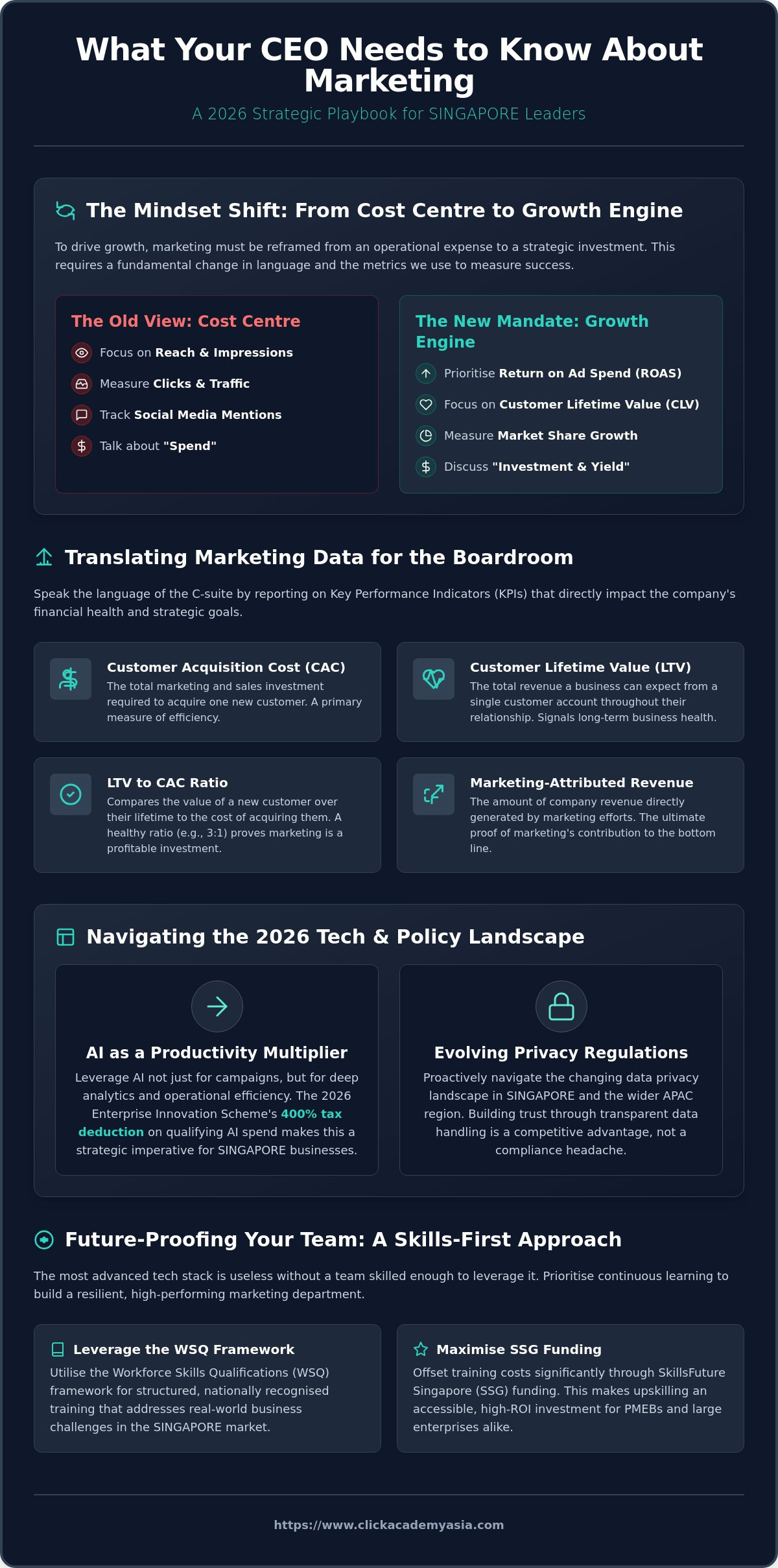
A quick win for any marketing lead is to shift the budget conversation immediately. Stop talking about 'spend' and start talking about 'investment' and 'yield'. This change in vocabulary signals a shift in accountability. It shows that the marketing team is ready to be measured by the same financial rigour as any other business unit.
ROAS over Reach: Prioritise return on ad spend rather than simple impressions.
CLV over Clicks: Focus on the long-term value of a customer rather than one-time traffic.
Market Share over Mentions: Measure success by your slice of the SINGAPORE market, not social media buzz.
Growth Intelligence: The New Marketing Mandate
Marketing teams have become the primary custodians of customer data. This isn't just about tracking clicks. It's about full-funnel visibility that allows for precise executive decision-making. By leveraging advanced analytics, teams can pinpoint which channels drive the highest quality leads and which ones are wasting resources. This level of strategic oversight is a key component of Digital Transformation for Leaders, ensuring every dollar is mapped to a business milestone.
When you have full-funnel visibility, you can stop guessing. You can see exactly how a social media post in January leads to a closed deal in March. This data allows the CEO to make informed decisions about scaling operations or entering new APAC territories. Understanding what your ceo needs to know about marketing means providing them with the intelligence required to steer the company with confidence.
Metrics That Matter: Translating Marketing Data for the Boardroom
The boardroom disconnect often stems from a language barrier. While marketers talk about impressions and click-through rates, CEOs are focused on fiscal health and market expansion. Understanding what your ceo needs to know about marketing requires you to filter out the noise of vanity metrics like likes or shares. These numbers don't appear on a profit and loss statement. Instead, align your reporting with Singapore's digital transformation strategy by focusing on metrics that demonstrate how marketing acts as a predictable revenue driver.
To capture executive attention, your reporting must prioritise these five KPIs:
Customer Acquisition Cost (CAC): The total spend required to gain one new customer.
Lifetime Value (LTV): The long-term financial contribution of a customer.
Return on Ad Spend (ROAS): The direct revenue generated from specific advertising capital.
Market Share: Your brand's percentage of total category sales in the SINGAPORE ecosystem.
Pipeline Contribution: The percentage of the sales funnel originated directly by marketing efforts.
Because the SINGAPORE customer journey is increasingly fragmented across devices and platforms, multi-touch attribution is essential. It proves that a LinkedIn whitepaper download in January contributed to a high-value contract signed in April. Without this visibility, marketing looks like a series of disconnected expenses rather than a cohesive strategy for growth.
CAC vs. LTV: The Only Ratio That Counts
For a SINGAPORE business to remain viable in 2026, the relationship between acquisition cost and customer value must be clearly defined. CAC measures the efficiency of your marketing machinery, while LTV defines the total revenue a business can expect from a single customer account. A healthy ratio for local PMEBs is typically 3:1 or higher. If your CAC is climbing without a proportional rise in LTV, your marketing strategy is scaling inefficiency rather than profit. Equipping your team with the skills to manage these complex data sets is vital, often through WSQ-certified training in marketing analytics.
The Role of Marketing Analytics with GA4
Modern leadership demands more than reactive reporting; it requires proactive forecasting. GA4 provides the predictive insights necessary for scaling by identifying patterns in user behaviour before they result in a sale. This allows your team to shift from explaining what happened last month to predicting what will happen next quarter. By mastering Marketing Analytics with GA4, you can provide the boardroom with a roadmap for future investment based on hard data rather than intuition.
The 2026 Tech Stack: AI, Privacy, and Digital Transformation
Many SINGAPORE leaders fear 'tech bloat', a scenario where software subscriptions pile up without delivering clear results. However, 2026 demands a lean but powerful digital infrastructure. AI isn't here to replace your marketing strategy; it's a productivity multiplier that requires a human at the helm. For a CEO, the focus must be on building a 'Single Source of Truth' for customer data to ensure every decision is backed by evidence rather than intuition. A unified data layer prevents the fragmentation that often plagues growing organisations.
Privacy regulations across APAC have tightened significantly. In SINGAPORE, non-compliance with the PDPA can now lead to financial penalties of up to S$1 million or 10% of annual turnover. This shift makes transparent data handling a boardroom priority rather than just a IT ticket. Understanding what your ceo needs to know about marketing tech means moving beyond the 'shiny object' syndrome and investing in systems that protect both the brand and its customers. High-level digital infrastructure must be viewed as a defensive asset.
AI Strategy: Beyond the Hype
CEOs should evaluate AI marketing tools based on their ability to drive ROI rather than their novelty. While AI can automate repetitive tasks, human oversight remains critical for maintaining brand voice and ensuring ethical compliance in SEO and content production. Strategic implementation involves combining machine speed with human insight, such as applying Advanced Keyword Research Strategies to capture high-intent traffic. This balanced approach ensures that AI enhances your team's capabilities without sacrificing the quality of your market presence. It's about augmenting talent, not replacing it.
First-Party Data: The CEO's Newest Asset
Relying on 'rented' social media audiences is a high-risk strategy in 2026. Algorithm changes can wipe out visibility overnight, making first-party data the most valuable asset in your marketing arsenal. A robust CRM strategy allows you to build direct-to-consumer (DTC) relationships that are immune to third-party platform shifts. By owning your data, you create a defensive moat around your business. This transition from external platforms to owned databases is a fundamental part of what your ceo needs to know about marketing to ensure long-term stability. Investing in owned channels is the only way to guarantee consistent access to your target audience.
Future-Proofing Your Team: The WSQ Framework for SINGAPORE PMEBs
In 2026, relying on a candidate's years of experience is a risky recruitment strategy. The digital landscape in SINGAPORE moves so fast that a decade in traditional advertising doesn't guarantee mastery of current AI-driven growth tactics. Instead, forward-thinking organisations are prioritising skills-based hiring. This ensures your team possesses the actual technical competencies required to execute a high-impact strategy. Understanding what your ceo needs to know about marketing talent involves recognising that a certified, up-to-date workforce is your most valuable competitive advantage in the APAC region.
The Workforce Skills Qualifications (WSQ) framework serves as the national gold standard for these competencies. It provides a structured way to validate that your PMEBs have mastered industry-agreed standards. By aligning your team's development with this framework, you move from hit-or-miss workshops to a reliable system of professional excellence. This systemic approach ensures that every member of your department is speaking the same strategic language.
Every modern marketing team needs these five essential competencies:
Data Analytics: Moving beyond basic reporting to predictive forecasting using GA4.
Content Strategy: Using AI to scale production while maintaining human-led brand authority.
Search Engine Optimization (SEO): Navigating AI-integrated search results to maintain local visibility.
Digital Advertising: Executing performance-led campaigns that maximise ROAS.
Strategic Planning: Aligning digital execution with high-level corporate objectives.
Leveraging SSG Funding for Corporate Excellence
Businesses in SINGAPORE can significantly optimise their training budgets by utilising SSG funding. As of June 2026, eligible Singapore Citizens and Permanent Residents can receive up to 70% in funding for WSQ-certified courses. This lowers the financial barrier for corporate upskilling, allowing you to put your entire team through structured certification tracks without overextending your budget. For instance, the WSQ Digital Marketing Strategy & Planning programme provides the high-level roadmap your managers need to lead effectively in a complex market.
Building a Culture of Continuous Learning
When a CEO actively supports upskilling, it does more than just improve technical output. It significantly boosts staff retention and morale by showing a commitment to the team's long-term career growth. This transition from one-off training sessions to a sustained professional development plan is a core part of what your ceo needs to know about marketing operations. WSQ-certified training ensures national standards of competency, giving leadership the confidence that their teams are equipped with verified, world-class skills.
Ready to future-proof your organisation? Explore our WSQ-funded training tracks to equip your team with the skills that drive 2026 growth.
Bridging the Gap: A CEO-CMO Action Plan for 2026
A high-performing marketing engine requires more than just budget; it needs structural alignment with the boardroom. For a SINGAPORE business to thrive in 2026, the CEO and marketing lead must operate from a shared roadmap. This transition from a tactical support department to a strategic growth unit is the most significant shift what your ceo needs to know about marketing right now. By synchronising marketing spend with specific business milestones, you ensure that every campaign serves a larger corporate objective.
Alignment isn't just about communication; it's about 'Smarketing', the total integration of Sales and Marketing goals. When both teams are measured against the same revenue targets and lead quality standards, the typical friction between departments vanishes. This unified front allows the company to respond faster to APAC market shifts and competitor moves. It turns your marketing data into a predictive tool for the entire executive team.
The Quarterly Strategic Review (QSR)
Establishing a formal Quarterly Strategic Review ensures that leadership remains connected to marketing's impact without getting lost in granular details. This meeting should focus on high-level trajectory rather than specific ad copy. It's also the space to protect innovation. A forward-thinking CEO understands that 'failed' experiments are simply the cost of finding new growth channels in a crowded SINGAPORE market. You must balance long-term brand health with short-term sales targets to ensure sustainable expansion.
A productive QSR agenda includes:
Pipeline Velocity: Analysing how quickly leads move from initial contact to closed revenue.
Efficiency Ratios: Reviewing the CAC to LTV health to ensure acquisition costs remain sustainable.
Market Share Gains: Tracking brand dominance within specific SINGAPORE industry segments.
The Innovation Lab: Evaluating results from pilot programmes and new tech implementations like AI agents.
Next Steps for the Forward-Thinking CEO
The first step toward transformation is a candid audit of your current team's digital capabilities. Many PMEBs possess deep industry knowledge but lack the technical mastery required for the 2026 AI-driven landscape. Suggesting a pilot programme for upskilling key marketing leads is a low-risk way to test the impact of advanced training on your bottom line. By leveraging SSG-funded initiatives, you can close the skills gap while maintaining fiscal responsibility.
Don't let your growth be limited by outdated workflows. Equip your leadership and execution teams with the expertise they need to dominate the market. Explore our comprehensive range of WSQ-certified Sales and Marketing courses to start your team's transformation today.
Mastering the Strategic Shift in SINGAPORE
The transition from a tactical marketing department to a strategic growth unit is a necessity for survival in the 2026 SINGAPORE business landscape. By shifting the focus toward acquisition efficiency and leveraging first-party data, you position your organisation to navigate APAC market shifts with confidence. Understanding exactly what your ceo needs to know about marketing allows you to secure the alignment and budget required to drive measurable revenue.
Empowering your team with the right competencies is the final piece of the puzzle. As an Official Google Certification Partner, ClickAcademy Asia offers WSQ-certified modules tailored for PMEBs that bridge the gap between theory and execution. With SSG funding available for eligible SINGAPORE businesses, there has never been a more cost-effective time to invest in your workforce's future.
Equip your team with future-ready skills by exploring our WSQ-funded training tracks today.
The future of your brand depends on the skills you cultivate today. We are ready to help you future-proof your marketing strategy and lead your industry with authority and confidence.
Frequently Asked Questions
What is the most important marketing metric for a CEO to track?
The Customer Lifetime Value (CLV) to Customer Acquisition Cost (CAC) ratio is the most critical metric for any CEO. It measures the efficiency of the marketing engine and the long-term profitability of your customer base. A healthy ratio typically sits at 3:1 or higher for SINGAPORE businesses. Tracking this ensures that marketing spend is driving sustainable growth rather than just temporary traffic.
How does the WSQ framework benefit SINGAPORE companies specifically?
The WSQ framework provides SINGAPORE companies with a nationally recognised standard for professional competency. It ensures that your PMEB workforce possesses verified, practical skills that meet current industry demands. By adopting this framework, businesses can reduce the risk of skill gaps and ensure that their marketing execution aligns with the latest regional best practices and government standards.
Is marketing still a cost centre in 2026?
Marketing has evolved far beyond being a cost centre; in 2026, it functions as a primary growth-intelligence unit. This shift is a key part of what your ceo needs to know about marketing to remain competitive. Instead of just spending budget, modern marketing teams generate the data-driven insights that inform R&D, sales forecasting, and overall corporate strategy for the entire organisation.
How can a CEO tell if their marketing team is future-ready?
A future-ready team prioritises data-backed decision-making over intuition and possesses technical certifications in emerging tools. Look for a team that has moved away from vanity metrics and is actively using AI to optimise campaign performance. If your staff are regularly upskilling through WSQ-certified programmes, they are likely equipped to handle the rapidly changing APAC technological landscape with confidence.
What role does AI play in a CEO's marketing strategy?
AI acts as a strategic productivity multiplier that allows your team to scale operations without a proportional increase in headcount. It should be used to automate repetitive tasks and analyse complex data sets to predict consumer behaviour. However, the CEO must ensure that human oversight remains central to maintain brand voice and ethical standards. AI is an execution tool, not a strategy replacement.
How much should a company invest in marketing upskilling for PMEBs?
Investment should be viewed as a strategic percentage of the total growth budget rather than a fixed overhead expense. While specific costs vary, many SINGAPORE firms allocate a portion of their annual budget specifically for upskilling to maintain a competitive edge. Leveraging government grants can significantly reduce the net out-of-pocket cost for these essential professional development programmes for your team.
How does SSG funding work for corporate marketing training?
SSG funding provides substantial subsidies for eligible SINGAPORE Citizens and Permanent Residents attending WSQ-certified courses. As of June 2026, businesses can receive up to 70% in funding support for corporate training. This makes it highly accessible for companies to equip their PMEBs with advanced skills in areas like digital strategy, SEO, and marketing analytics without straining the corporate budget.
What is the difference between tactical and strategic marketing for leadership?
Tactical marketing focuses on the execution of specific tasks, such as running a social media campaign or optimising a landing page. Strategic marketing focuses on how these activities align with broader business milestones and revenue goals. This distinction is vital for what your ceo needs to know about marketing to ensure that daily activities are actually driving toward long-term corporate expansion.



Comments