
Stop Vanity Metrics: A Guide for Singapore Marketers

Updated: Aug 8
What if the 1.2 million impressions your team just reported are the exact reason your marketing budget is being cut? It's a painful paradox for many PMEBs in SINGAPORE. You're hitting your social media targets, yet leadership still treats marketing as a discretionary expense rather than a revenue engine. If you're wondering how to stop my boss from focusing on vanity metrics, you're already ahead of the curve by recognising that superficial engagement doesn't always translate to business growth.
We understand the frustration of spending hours on reports that don't drive real decisions or align with sales objectives. You want a reporting framework that commands authority and proves tangible ROI. This guide offers a practical roadmap to shift the conversation from "likes" to lead quality and customer acquisition costs. You'll learn how to bridge the gap between creative execution and strategic business goals using frameworks recognised by the WSQ and SSG ecosystem. Let's transform your reporting from a list of numbers into a strategic asset that protects your budget and elevates your career.
Table of Contents
The Seduction of Superficial Data: Why Your Boss is Hooked on Vanity Metrics
It's easy to see why leadership gets excited about a post going viral. Raw numbers like followers or impressions provide an immediate hit of dopamine. They feel like success because they are visible and easy to brag about. This is the "Ego Trap." For many PMEBs in SINGAPORE, this creates a dangerous cycle where marketing teams are pressured to chase "The Green Arrow" syndrome. You report growth every month, yet that growth doesn't actually impact the bottom line or align with annual revenue targets. Understanding this psychological hook is the first step in learning how to stop my boss from focusing on vanity metrics.
The Psychological Trap of 'Big Numbers'
Reach is significantly easier for non-marketing executives to digest than nuanced data like conversion rates or customer lifetime value. Most bosses use these numbers for validation rather than optimisation. They look for industry benchmarks that often don't apply to your specific business model just to feel like they're keeping up. You must recognise when data is being used as a security blanket. If your reporting focuses on reach without mentioning revenue, your marketing strategy is likely untethered from the company's financial reality.
The Hidden Cost of Misaligned KPIs in Singapore Firms
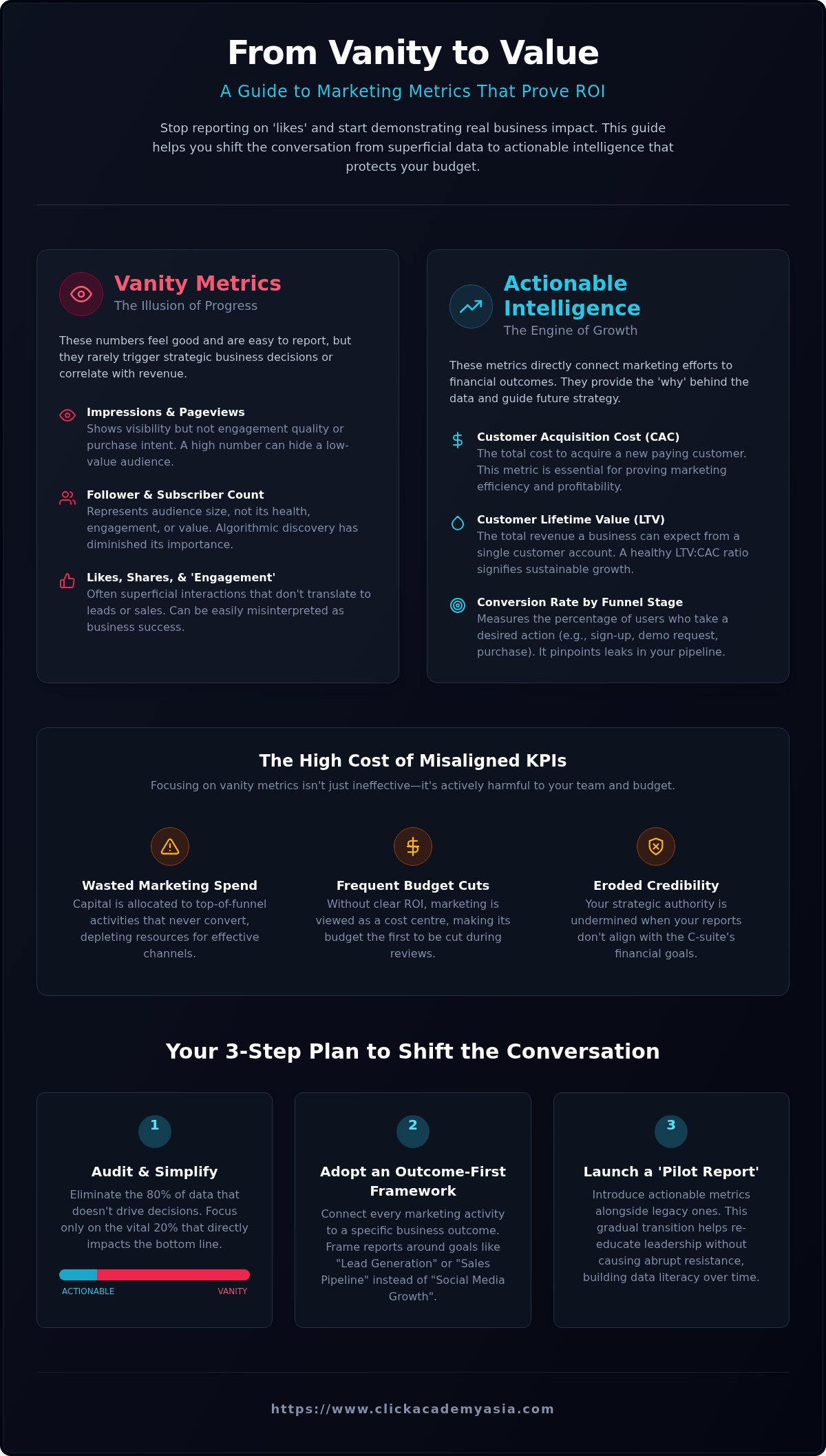
When your Key Performance Indicator (KPI) choices are misaligned, the financial consequences are severe. Wasted marketing spend on top-of-funnel activities that never convert is a common issue in SINGAPORE firms. This positions marketing as a cost centre rather than a growth engine. This lack of clear ROI proof often leads to budget cuts and high staff turnover in performance-driven teams. Without a bridge between marketing activities and sales outcomes, your authority in the boardroom remains fragile.
To fix this, you need to identify the disconnect between your daily tasks and the company's annual revenue targets. If your boss doesn't see how a Facebook like leads to a signed contract, they'll eventually stop funding the Facebook ads. You need to move beyond the surface. Start by auditing your current reports to see which metrics actually trigger a business decision and which ones are just filler. Mastering how to stop my boss from focusing on vanity metrics isn't just about better charts; it's about shifting the organisational culture toward accountability.
Cultivating the mental clarity required to drive this organisational change is a skill in itself. Some professionals turn to meditative practices like Ganhwaseon – koreanischer Zen nach Subul to help them cut through the noise of superficial data and stay focused on meaningful strategic goals.
Defining the 2026 Standard: Vanity Metrics vs Actionable Business Intelligence
In the SINGAPORE business ecosystem of 2026, raw pageviews and follower counts have lost their lustre. High-growth firms now prioritise data that triggers a specific, repeatable business decision. If you're struggling with how to stop my boss from focusing on vanity metrics, you must start by redefining what "success" looks like in your dashboard. Social media followers are now considered legacy metrics because algorithmic discovery has replaced the need for static audiences.
Actionable Metrics serve as the essential bridge between marketing effort and financial ROI.
Spotting the 'Ego Boost' Metrics in Your Dashboard
Distinguishing between volume and value is critical for any PMEB looking to maintain a budget. Raw impressions are often a distraction; qualified reach is what actually fills your sales pipeline. Many teams fall for the myth of the 'Running Total', where cumulative downloads hide monthly churn rates and stagnating growth. Similarly, ranking #1 for a high-volume keyword is a vanity win if that term lacks commercial intent and fails to drive organic conversions.
Qualified Reach: Users who match your specific ideal customer profile.
Retention Rate: Measuring the health of your existing audience over raw growth.
Conversion Intent: Prioritising keywords that lead to enquiries rather than just traffic.
Why Actionable Metrics Drive Strategic Decisions
To gain authority in the boardroom, you must speak the language of Customer Acquisition Cost (CAC) and Lifetime Value (LTV). These are the metrics that align with business outcomes and prove your department's worth. Conversion Rate Optimisation (CRO) is now the primary lever for scaling digital campaigns effectively. By using GA4 predictive metrics, you can anticipate future revenue instead of just reporting on the past.
Transitioning your reporting to these high-value data points requires a deep understanding of modern platforms. You can master these advanced techniques through WSQ Marketing Analytics & Insights training. This shift allows you to move from being a tactical executor to a strategic partner who anticipates market shifts. When you present data that predicts revenue, you'll find it much easier to address how to stop my boss from focusing on vanity metrics.
Aligning Marketing Efforts with Business Outcomes and ROI
To truly master how to stop my boss from focusing on vanity metrics, you must adopt an 'Outcome-First' framework. This involves starting with the CEO’s primary objectives, such as annual revenue growth or market share expansion, and working backwards to your marketing KPIs. If the goal is a specific revenue target, your reports should highlight the pipeline value marketing has generated rather than just the number of impressions your last campaign received. This alignment ensures that every dollar spent is seen as an investment in growth rather than a sunk cost.
Building a multi-touch attribution model is the next logical step in this evolution. It allows you to show exactly how content influences the final sale across various touchpoints. You must learn to translate 'Marketing-Speak' into 'C-Suite Language' to gain respect in the boardroom. Swapping technical jargon like 'CTR' for business-centric terms like 'Lead Quality Index' changes the perception of your team's value. Using WSQ Digital Marketing Strategy & Planning strategies helps you create a robust data governance plan that leadership can trust.
Mapping the Customer Journey to Revenue
Successful PMEBs in SINGAPORE identify the 'Micro-Conversions' that lead to a macro-business outcome. Every metric in your report must have a direct line of sight to a dollar sign. If a metric doesn't lead to a repeatable business decision, it doesn't belong in your executive summary. Content marketing plays a vital role here by nurturing leads through the middle-of-the-funnel (MOFU) stage. You must prove that your content isn't just for 'awareness', it's a tool for lead qualification and sales enablement.
Proving ROI to CFOs and Stakeholders
The 'Marketing Contribution to Revenue' formula is a calculation every manager should master. It provides the hard data needed to justify your budget during economic shifts. You should also present 'failed' campaigns as valuable data points for future cost savings rather than losses. This transparency builds trust with CFOs and other stakeholders. By leveraging GA4 insights, you can justify an increased budget for high-performing channels based on [External Link: SINGAPORE'S Q2 2026 GDP growth of 5.7%]. Showing how marketing captures this growing demand positions you as a strategic leader who understands the broader economic context.
A Step-by-Step Plan to Re-educate Leadership on Data
Changing the mindset of your leadership team requires a blend of technical data literacy and corporate diplomacy. You cannot simply stop reporting the numbers they enjoy; you must transition them toward high-value alternatives. If you are struggling with how to stop my boss from focusing on vanity metrics, start by auditing your current reporting. Identify the 80% of data currently ignored by leadership during monthly reviews. These are the fillers that distract from strategic growth and erode your credibility as a performance-driven marketer.
Every data point presented must pass the 'So What?' test to ensure it holds actual business value.
Instead of a total overhaul, implement the 'Pilot Report' strategy. This involves introducing actionable metrics alongside legacy vanity metrics for a three-month period. This dual reporting allows your boss to see the correlation between tactical wins and business outcomes without losing their familiar benchmarks immediately. Follow this with a 'Metric Audit' meeting to gain consensus on what 'success' looks like for the next quarter, ensuring everyone is aligned on the same revenue-focused goals.
Designing an Action-Oriented Reporting Framework
Your reporting structure should be highly scannable and outcome-focused. We recommend a 'Three-Tier Report' format: an Executive summary for business impact, Channel performance for tactical updates, and Insights for specific actions. This structure helps leadership focus on trends rather than isolated snapshots of big numbers that provide no context. Visualising data effectively is key to showing these trends. You can learn to build these advanced, decision-driven dashboards by following our guide on marketing analytics with GA4. This ensures your reporting remains technically sound while being strategically relevant to SINGAPORE’S competitive landscape.
The Art of the 'Data Intervention' Meeting
When you sit down to discuss metric changes, frame the conversation around 'Risk Mitigation' rather than 'Metric Correction'. Explain that relying on vanity data hides potential losses in the sales pipeline that could impact the bottom line. Ask the 'Decision Question' for every metric: "If this number goes down by 20%, what specific action will we take?" If there is no answer, the metric is likely a distraction that wastes your team's time.
Securing buy-in for a culture of experimentation is the ultimate goal. In this environment, 'learning' from a failed test becomes a valid KPI because it prevents future wasted spend. To lead this change effectively, you need the authority that comes from recognised expertise. You can gain these strategic skills through WSQ Marketing Analytics & Insights training, which provides the foundation needed to manage up and drive digital transformation in your organisation.
Mastering Strategic Analytics through WSQ-Certified Training
Professional upskilling is the most direct path to gaining the authority required for high-level leadership discussions. When you back your strategic recommendations with a recognised framework, your voice carries more weight in the boardroom. If you are struggling with how to stop my boss from focusing on vanity metrics, the solution lies in anchoring your reporting in the formal standards set by the WSQ system. This transitions you from a tactical executor to a strategic partner who understands the financial implications of every marketing campaign.
The WSQ framework is designed specifically for PMEBs in SINGAPORE who need practical mastery rather than just theoretical knowledge. It provides a structured approach to data that aligns with the needs of local industries and global best practices. By mastering these competencies, you position yourself as a 'Future-Ready' leader capable of moving beyond simple data tracking to providing actionable strategic insights. This shift is essential for protecting your marketing budget during periods of economic caution.
Bridging the Skills Gap with Marketing Analytics & Insights
Developing the ability to synthesise data from multiple sources is a core component of the WSQ Marketing Analytics & Insights programme. You'll learn how to pull disparate data from Social, Search, and CRM systems into a single, cohesive narrative that leadership respects. The goal is to move your reporting from merely describing 'what happened' to accurately predicting 'what will happen next'. This predictive capability is exactly how to stop my boss from focusing on vanity metrics, as it focuses the conversation on future revenue rather than past likes.
Data Synthesis: Integrating multi-channel data to show the complete customer journey.
Predictive Modelling: Using historical trends to forecast future business outcomes.
Strategic Visualisation: Creating dashboards that highlight ROI and lead quality over raw traffic.
Leveraging SSG Funding for Executive Upskilling
Upskilling your entire department is more accessible than many managers realise through the SSG funding ecosystem. Marketing professionals in SINGAPORE can utilise their SkillsFuture Credits to offset the costs of advanced certifications. Furthermore, corporate teams can leverage significant SSG grants to upskill departments at a fraction of the original investment. This ensures your team stays ahead of trends like AI-driven search and privacy-first data strategies.
Holding a WSQ-certified Digital Marketing Strategy qualification offers long-term career benefits that extend far beyond your current role. It signals to the market that you possess the practical skills to lead digital transformation in a performance-driven environment. As [External Link: industry study on marketing skills gap] suggests, leaders who can bridge the gap between technical analytics and business strategy are in the highest demand. By investing in these skills today, you secure your place as a vital asset in your organisation's growth engine.
Elevate Your Marketing from Execution to Strategic Leadership
Transitioning your organisation away from superficial data is a strategic necessity in SINGAPORE’S competitive landscape. By implementing the "Outcome-First" framework and re-educating stakeholders through tactical "Pilot Reports", you move from being a cost centre to a vital revenue engine. Mastering these advanced analytics frameworks provides the definitive answer to how to stop my boss from focusing on vanity metrics while ensuring your marketing efforts align with the bottom line.
You don't have to navigate this digital transformation alone. Equip your team with the strategic skills to drive real business growth with ClickAcademy Asia’s WSQ-certified training programmes. As an official Google and GA4 training partner, we offer WSQ-certified modules that provide practical mastery grounded in real-world application. Singaporeans and PRs can benefit from up to 70% SSG funding to subsidise these high-value certifications.
Take the lead in future-proofing your career and driving measurable success for your organisation. Your journey from reporting numbers to delivering insights starts with the right education.
Frequently Asked Questions
What is the simplest way to explain vanity metrics to a non-marketing boss?
The easiest way to explain vanity metrics is through the "Shop Window" analogy. Tell your boss that vanity metrics are like the number of people who stop to look at a window display; they look impressive, but they don't pay the rent. Leadership needs to understand that high engagement is only valuable if it eventually leads to a customer entering the shop and making a purchase. Focus the conversation on how many of those "looks" actually converted into sales enquiries.
Are vanity metrics ever useful in a marketing report?
How can I prove ROI if my business has a long sales cycle?
Focus on micro-conversions that indicate a prospect is moving through the sales funnel. Track high-intent actions like whitepaper downloads, webinar attendance, or time spent on your pricing page. These serve as leading indicators of future revenue in the SINGAPORE business context. By assigning a lead score to these actions, you can prove that marketing is successfully nurturing prospects even if the final transaction is months away.
Which GA4 metrics are considered actionable for MOFU content?
Actionable GA4 metrics for middle-of-the-funnel (MOFU) content include "Key Events" and "Engagement Rate." Instead of looking at raw pageviews, analyse "Average Engagement Time" to see if users are actually consuming your thought leadership. If a user spends over two minutes on a technical guide and then clicks a "Contact Us" button, that is a clear, actionable signal of commercial intent that leadership will respect.
How do I calculate Customer Acquisition Cost (CAC) accurately?
Divide your total marketing and sales expenses, including team salaries and ad spend, by the number of new customers acquired during a specific period. Accuracy requires including all operational overheads rather than just your direct media spend. This provides a transparent picture of the company's investment required to gain a single client. It is a fundamental metric for PMEBs in SINGAPORE looking to justify their annual marketing budgets.
Can I get SSG funding for marketing analytics courses in Singapore?
Yes, eligible SINGAPOREANS and Permanent Residents can access up to 70% SSG funding for WSQ-certified training. Programmes like Marketing Analytics & Insights are specifically designed to help professionals transition from tactical reporting to strategic leadership. You can also utilise your SkillsFuture Credits to further offset the remaining costs. This makes high-level analytics training an accessible investment for both individuals and corporate teams looking to upskill.
What should I do if my boss refuses to stop tracking social media likes?
Don't fight the request directly; instead, present the likes alongside a more meaningful metric like "Conversion Rate from Social." Over time, use your reports to highlight how likes can remain steady even when revenue fluctuates, proving the lack of correlation. This data-backed approach is the most effective way to address how to stop my boss from focusing on vanity metrics without creating unnecessary conflict in the boardroom.
How often should I update my marketing dashboards for leadership?
Executive dashboards should typically be updated on a monthly basis to show meaningful strategic trends. While your internal team may need weekly or even daily tactical updates for optimisation, leadership needs enough data to see a pattern rather than just statistical noise. Presenting data too frequently to a boss can lead to "knee-jerk" reactions based on minor daily fluctuations that don't actually impact long-term business goals.


Comments