
Unit Economics for Growth Marketers: A Strategic 2026 Guide for Singapore Professionals
- ClickAcademy Asia

- Jul 9
- 11 min read
Updated: Jul 11
If your marketing campaigns are hitting their targets but your bottom line is still shrinking, you aren't just facing a performance issue; you're facing a mathematical one. Most growth marketers and PMEBs in SINGAPORE are feeling the squeeze of rising CAC and the pressure to prove that every dollar spent translates into sustainable profit. It's frustrating to watch your acquisition numbers climb while your actual margins remain stagnant. Mastery of unit economics for growth marketers is no longer just a "nice to have" skill; it's the foundation of scalable success in a market where technology spending is projected to reach nearly S$28 billion in 2026.
You likely agree that aligning marketing metrics with business profitability is the biggest hurdle in modern strategy. This guide promises to help you master the financial foundations of scalable growth and show you how to optimise your marketing ROI using unit economics within the competitive SINGAPORE business landscape. We'll walk through the essential LTV and CAC frameworks that allow you to identify scalable channels and analyse your data to transform your role from a tactical executor into a data-driven strategic advisor.
Table of Contents
Why Unit Economics is the North Star for Growth Marketers in Singapore
The Core Metrics: Calculating LTV and CAC for Precision Marketing
Analysing the LTV:CAC Ratio: When to Scale and When to Pivot
Practical Implementation: Optimising Your Growth Stack with Economic Intelligence
Master Data-Driven Growth with WSQ-Certified Training at ClickAcademy Asia
Why Unit Economics is the North Star for Growth Marketers in Singapore
Unit economics measures the direct revenues and costs associated with a single business unit, which for most growth teams is a specific customer. Unit economics is the fundamental measure of a marketing campaign's profitability at the individual level. In 2026, SINGAPORE marketers can't afford to hide behind vanity metrics like impressions or click-through rates. With the digital economy contributing 18.6% to SINGAPORE'S GDP, the stakes for precision are higher than ever before. Relying on top-level traffic numbers is a legacy approach that no longer works in a mature, high-cost market where every PMEB is expected to deliver tangible results.
The Shift from Volume to Value
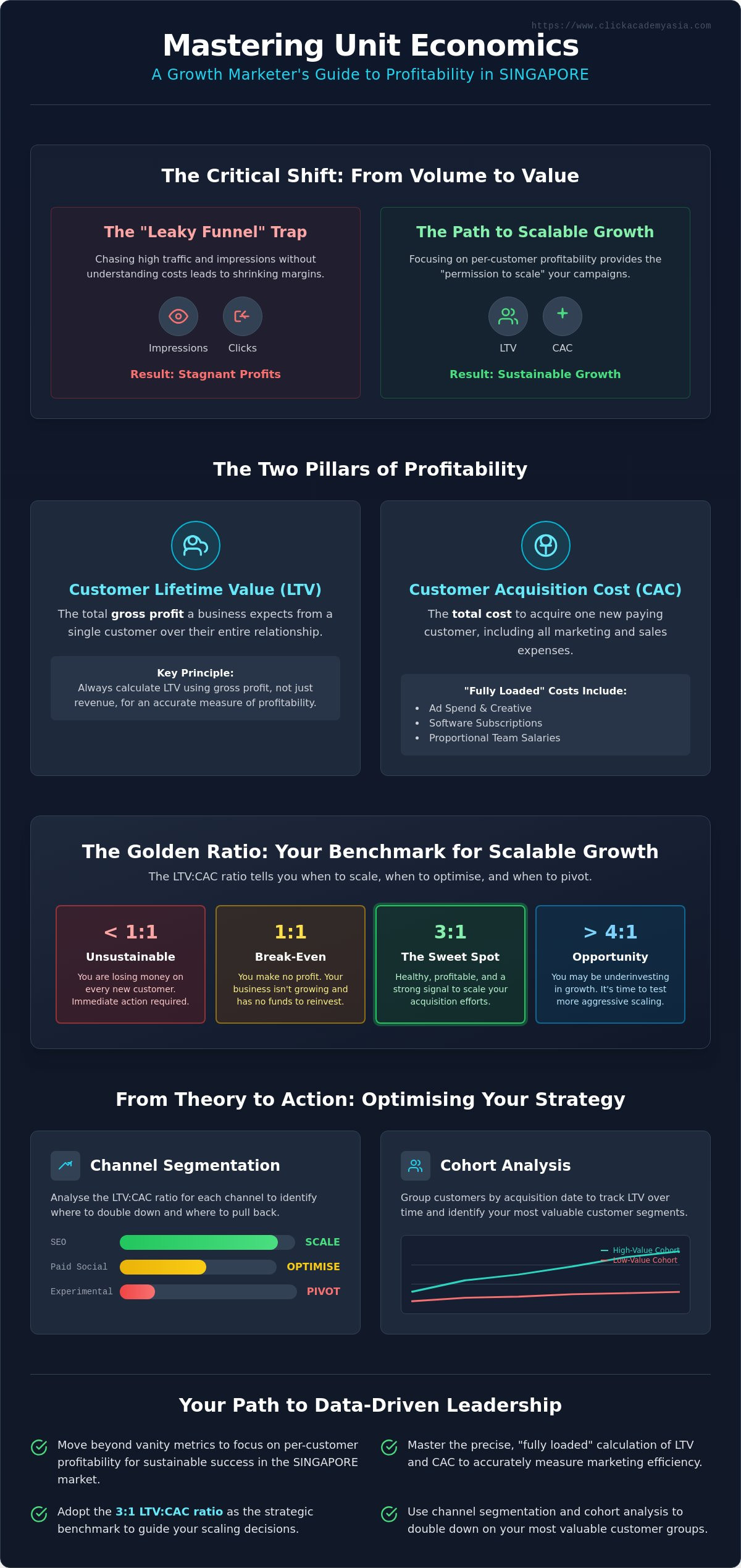
Chasing high traffic volumes without a firm grasp of unit costs often leads to the "leaky funnel" trap. You might see thousands of visitors, but if the cost to acquire them exceeds their Customer Lifetime Value, you're effectively scaling a loss. Understanding unit economics for growth marketers provides the "permission to scale" for aggressive growth experiments. When you can prove that a specific channel or campaign generates more value than it costs to maintain, you gain the leverage needed to secure larger marketing budgets from CFOs. This economic intelligence shifts the professional conversation from "how much are we spending?" to "how much value are we creating?" It empowers you to stop defending your budget and start presenting it as a profit engine, allowing you to accurately analyse which segments are worth the investment.
Defining Your Unit in a Multi-Channel World
Before you can calculate your efficiency, you must define what a "unit" actually is. In the diverse SINGAPORE business ecosystem, this definition varies significantly across different sectors and business models. For instance, an e-commerce brand on a local platform might define a unit as a single transaction. Conversely, a SaaS firm in the CBD might look at a monthly subscriber, while specialized vocational providers, such as those where you can discover Lone Star Truck Driving Academy, define their unit by student enrollment. Identifying the right unit is the first step toward building a model that reflects reality rather than just theory.
Unit economics for growth marketers requires this level of clarity to ensure that every campaign is measured against the right yardstick. Getting this definition right is a core component of the WSQ Digital Marketing Strategy & Planning framework. It helps you align your marketing spend with actual business outcomes rather than just top-of-funnel noise. By identifying whether your unit is a one-off buyer or a recurring partner, you can better allocate resources across the APAC region. This strategic alignment ensures that your growth efforts are not just loud; they are fundamentally sustainable and profitable.
The Core Metrics: Calculating LTV and CAC for Precision Marketing
Precision in marketing is impossible without a granular understanding of your core metrics. Mastering unit economics for growth marketers starts with two non-negotiable pillars: Customer Acquisition Cost (CAC) and Customer Lifetime Value (LTV). Calculating the true cost of acquisition requires more than just looking at your ad manager dashboard. You must include "fully loaded" costs like creative production, software subscriptions, and the proportional salaries of your growth team to avoid underestimating your true CAC. LTV must always be calculated as a gross profit figure, not just revenue, to be accurate.
Mastering the CAC Formula
Identify every dollar spent to move a prospect through your funnel to get a realistic CAC. This involves breaking down ad spend, creative costs, and personnel overhead. Growth marketers should distinguish between Blended CAC and Paid CAC. While a blended figure gives a general health check, Paid CAC reveals the true efficiency of your scalable channels. Isolating these costs allows you to see which platforms are actually driving profitable growth. You can use Marketing Analytics with GA4 to track acquisition sources accurately, ensuring your attribution models reflect reality. This level of detail is what separates average performance from true mastery of unit economics for growth marketers.
Forecasting LTV with 2026 Data
Predicting the future value of a customer requires looking at historical retention rates and Average Order Value (AOV). Use these data points to project future earnings while accounting for the inevitable impact of churn. In the high-competition SINGAPORE market, where loyalty is harder to earn, marketers must own the retention stage just as much as acquisition. A robust Unit Economics Strategy involves adjusting these forecasts based on current market volatility and competitor density. Focusing on gross profit rather than top-line revenue ensures your projections remain grounded in financial reality. Refining these calculations is a core component of our Marketing Analytics & Insights training, which helps PMEBs build more resilient growth models.
Analysing the LTV:CAC Ratio: When to Scale and When to Pivot
Once you've calculated your individual metrics, the next step is to understand the relationship between them. The LTV:CAC ratio is the ultimate strategic benchmark for unit economics for growth marketers, serving as a pulse check for your entire business model. The industry standard for sustainable growth is the 3:1 rule, where a customer's lifetime value is at least three times the cost of acquiring them. If your ratio sits at 1:1, you're essentially trading dollars without generating profit, which often signals a lack of product-market fit or an inefficient acquisition strategy that needs immediate attention.
Beyond the ratio itself, you must track your "Payback Period". This metric calculates exactly how many months it takes to recover your CAC from a customer's gross profit. In SINGAPORE, where cash flow management is a top priority for PMEBs, a shorter payback period (ideally under 12 months) allows for faster reinvestment into new campaigns. Many local firms use these robust data points to qualify for further SSG-supported business expansion or to justify investments in Digital Transformation for Leaders programmes. Accurate analysis of these figures provides the professional credibility needed to lead high-stakes growth initiatives.
The Danger of the "Too High" Ratio
It sounds counterintuitive, but an LTV:CAC ratio that is too high, such as 10:1, isn't always cause for celebration. A ratio this skewed often suggests you are significantly under-investing in growth. You might be leaving market share on the table in the competitive APAC territory by being too conservative with your ad bids or ignoring untapped marketing channels. Balancing high profitability with aggressive market share acquisition is a delicate art. If your efficiency is exceptionally high, it's often a signal to increase your spend until you reach that 3:1 sweet spot, ensuring you don't cede ground to more aggressive competitors.
Fixing a Broken Economic Model
If your ratio is underwater, you have two primary levers to pull: reducing your CAC or increasing your LTV. To lower acquisition costs, focus on capturing high-intent organic traffic. You can leverage Advanced Keyword Research Strategies to reduce your reliance on expensive paid auctions. Simultaneously, you can boost LTV through targeted upselling, cross-selling, and improving the overall customer experience to reduce churn. For those just starting to build these models, referencing a foundational guide to unit economics can help clarify the basic formulas. Reframing your strategy around unit economics for growth marketers ensures that every tactical change you make is grounded in financial logic rather than guesswork.
Practical Implementation: Optimising Your Growth Stack with Economic Intelligence
Moving from theoretical models to daily execution is where most growth teams struggle. In the SINGAPORE market, where competition for attention is fierce, you can't rely on monthly averages to make tactical decisions. You must integrate economic data directly into your weekly growth sprints and experimentation logs. A growth marketer should use the LTV:CAC ratio to kill underperforming ads within 48 hours of data significance to prevent budget bleed. This agile approach ensures that your growth stack is always optimised for profitability rather than just volume.
Cohort analysis is your most powerful tool for understanding long-term trends. By grouping customers based on their acquisition date, you can see how unit economics evolve over time for different segments. Perhaps your festive season shoppers in SINGAPORE have a higher CAC but a significantly lower retention rate compared to your mid-year cohorts. Identifying these patterns allows you to adjust your bidding strategies and retention efforts before they impact your quarterly bottom line. It transforms your data from a historical record into a predictive engine for future growth.
Channel-Specific Unit Economics
Not all acquisition channels are created equal. You must segment your unit economics for growth marketers by platform to identify where your "cheapest" and "best" customers actually come from. While social media might offer a lower initial CAC, high-intent channels like search often produce customers with a vastly superior LTV. You can leverage Advanced SEM Strategies to capture this high-value search intent. Comparing these economics side-by-side allows you to justify higher investments in expensive channels that pay off in the long run.
The Role of Experimentation
Every A/B test in your growth backlog should be designed to either lower your CAC or increase your Average Order Value (AOV). Whether you're testing new ad creatives or optimising your checkout flow, the goal is to shift your unit economics in a positive direction. Building a "Unit Economics Dashboard" for real-time monitoring allows you to see the immediate impact of these experiments. Reporting these improvements to senior leadership as a career-building win positions you as a strategic partner who understands the financial health of the business. Master these tactical applications by enrolling in our WSQ Digital Advertising programme to stay ahead of the curve.
Master Data-Driven Growth with WSQ-Certified Training at ClickAcademy Asia
Theoretical knowledge of unit economics for growth marketers serves as a vital foundation, but the true value lies in practical, hands-on application. Knowing the formulas for LTV and CAC is just the start. You must be able to apply these models in a live commercial environment to see real results. At ClickAcademy Asia, our WSQ Digital Marketing Strategy & Planning course is specifically designed to move you beyond simple definitions and into the complex world of economic modelling. You won't just learn the math; you'll work through real-world scenarios that reflect the current SINGAPORE and APAC market conditions.
Learning from active industry practitioners ensures that the strategies you acquire are battle-tested and ready for immediate implementation. These mentors understand the nuances of the local business ecosystem and can help you navigate the challenges of rising acquisition costs. Taking advantage of SSG funding allows you to upskill your team in marketing analytics and strategy without overextending your budget. It's an investment in professional credibility that pays dividends through more efficient campaigns and clearer business alignment.
Bridging the Skills Gap for 2026
The role of the marketer has evolved. Today's "T-Shaped Marketer" must transition into a data-literate growth leader who can speak the language of the CFO. Professional certification through a WSQ-certified programme builds immediate trust with HR and corporate decision-makers. Our intensive workshops and bootcamps are tailored for PMEBs who need to future-proof their skills. These sessions provide the structured environment necessary to master high-level strategy. You'll leave with the confidence to lead data-driven initiatives that drive tangible business growth.
Next Steps: Equip Your Team for Success
Upskilling your team is more accessible than you might think. SINGAPORE Citizens and Permanent Residents can access up to 70% in SSG funding for WSQ-certified courses. If you're a SINGAPOREAN aged 40 or above, the SkillsFuture Mid-Career Enhanced Subsidy covers up to 90% of course fees. You should also check your eligibility for the S$4,000 SkillsFuture Credit top-up to further offset costs. We also provide customised corporate training options for organisations looking to standardise their growth metrics and experimentation logs across all departments.
Actionable Summary for Growth Leaders:
Analyse your LTV:CAC ratios to identify truly scalable channels.
Implement cohort analysis to track how unit economics evolve over time.
Utilise SSG funding and SkillsFuture Credits to reduce training costs.
Upskill your team in unit economics for growth marketers to ensure every dollar spent drives profit.
Ready to lead your organisation with financial precision? Explore our WSQ-funded Digital Marketing courses to master unit economics and scale your business today.
Secure Your Strategic Edge in the SINGAPORE Market
Scaling a business in 2026 requires more than creative flair; it demands a rigorous commitment to financial logic. By shifting your focus from top-level volume to individual unit profitability, you gain the clarity needed to navigate a high-cost environment. Your LTV:CAC ratio is a strategic signal that tells you exactly when to push for market share and when to refine your acquisition funnel. Mastering unit economics for growth marketers is the definitive way to transform your marketing department into a predictable profit centre.
ClickAcademy Asia has provided over 12 years of executive education excellence across the APAC region. As an official Google Training Partner, we offer WSQ-certified and SSG-funded programmes designed to equip PMEBs with battle-tested skills. Don't let your growth strategy rely on guesswork when you can lead with data-driven precision. Master data-driven growth by enrolling in our WSQ Digital Marketing Strategy & Planning course today and start building a more resilient, scalable future for your organisation.
Frequently Asked Questions
What is a good LTV:CAC ratio for a growth marketer in SINGAPORE?
A healthy LTV:CAC ratio is generally considered to be 3:1 for sustainable growth. In the 2026 SINGAPORE business landscape, where competition is intense, a ratio below 3:1 suggests you're spending too much to acquire customers relative to their value. Conversely, a ratio above 5:1 might indicate you're under-investing and missing out on potential market share in the APAC region.
How often should I recalculate my unit economics?
You should review your unit economics at least once a month to catch tactical shifts in campaign performance. For high-spend growth experiments, weekly check-ins are essential to ensure you don't exceed your payback period targets. Strategic reviews should happen quarterly to align your findings with broader business goals and budget allocations.
Can unit economics be applied to non-SaaS businesses like e-commerce?
Yes, unit economics for growth marketers applies to e-commerce just as much as SaaS. In e-commerce, your "unit" is usually a single transaction or an individual customer's total orders over a set period. You simply compare the gross profit from those sales against the total marketing and operational costs required to acquire that customer; for example, optimizing fulfillment operations with svdirect.com can help lower these costs and increase overall unit profitability.
How do I lower my CAC without sacrificing lead quality?
Focus on improving your organic reach through SEO and referral loops to reduce your reliance on expensive paid auctions. By capturing high-intent traffic through content marketing, you can lower your blended CAC while maintaining high lead quality. Optimising your landing pages for better conversion rates also ensures you get more value from every dollar of ad spend.
What is the difference between unit economics and gross margin?
Unit economics is a broader measure that includes both the cost of goods sold and the specific marketing and sales costs needed to acquire a customer. Gross margin typically only looks at revenue minus the direct costs of producing the product. Unit economics provides a more complete picture of whether a growth strategy is actually profitable at the individual level.
Does SSG funding cover digital marketing courses that teach unit economics?
SSG funding definitely covers several of our WSQ-certified courses that teach unit economics for growth marketers. Programmes like the WSQ Digital Marketing Strategy & Planning course provide practical training on how to build these financial models. Eligible SINGAPOREANS and PRs can receive up to 70% in funding, with mid-career professionals qualifying for up to 90% subsidies.
How do I explain unit economics to a non-technical marketing team?
Explain unit economics as the "health score" of every individual customer relationship your team builds. Use the simple analogy of spending $1 to make $3; if the team understands that every lead must eventually pay for itself three times over, they'll align more easily with profitability goals. Focus on outcomes like "sustainable scaling" rather than just dense mathematical formulas.
What are the most common mistakes when calculating LTV?
The most common mistake is calculating LTV based on total revenue rather than gross profit. If you don't account for the costs of serving the customer, your LTV will be artificially inflated. Other frequent errors include ignoring churn rates or using overly optimistic retention data that doesn't reflect the competitive reality of the SINGAPORE market.


Comments