
Psychology of Selling: Master the Science of Influence in 2026

Updated: Jun 26
What if the reason your last big deal fell through had nothing to do with your price and everything to do with a single cognitive bias you didn't know you were triggering? In Singapore's hyper-competitive market, a 2024 LinkedIn State of Sales report found that 82% of B2B buyers only engage with professionals who provide insights beyond the product itself. If you've felt the sting of high rejection rates or the frustration of prospects ghosting you after a pitch, you're certainly not alone.
It's exhausting to compete in a crowded digital space where everyone is shouting for attention. You probably agree that traditional hard-sell tactics just don't work on modern, well-informed buyers anymore. By mastering the Psychology of Selling, you'll learn how to leverage cognitive biases and emotional triggers to ethically influence buyer behaviour and accelerate your sales career. This isn't about manipulation; it's about understanding how the human brain makes choices.
This guide will show you how to achieve higher conversion rates and build stronger client relationships through science-backed techniques. We'll also explore how earning a practitioner-led, industry-recognised certification can help you stand out and potentially qualify for SSG funding to future-proof your skills for 2026.
Key Takeaways
Understand why emotion drives the majority of buying decisions and how to engage "System 1" thinking for faster conversions.
Master the Psychology of Selling by applying triggers like loss aversion and social proof to ethically influence buyer behaviour in the Singapore market.
Learn to navigate the boundary between persuasion and manipulation using the "Alignment Test" to ensure your solutions truly solve client problems.
Implement a practical four-step framework using emotional mapping and mirroring to build rapid rapport and trust with every lead.
Discover why mastering human-centric influence through practitioner-led insights is the most critical skill to future-proof your career against AI automation.
Table of Contents
The Evolution of Sales: Why Logic Fails and Emotion
Wins 5 Core Psychological Triggers to Optimise Your Close Rate
Ethical Persuasion vs. Manipulation: The Professional Boundary
A 4-Step Framework for Applying Sales Psychology in 2026
Future-Proof Your Career with Practitioner-Led Sales Training
The Evolution of Sales: Why Logic Fails and Emotion Wins
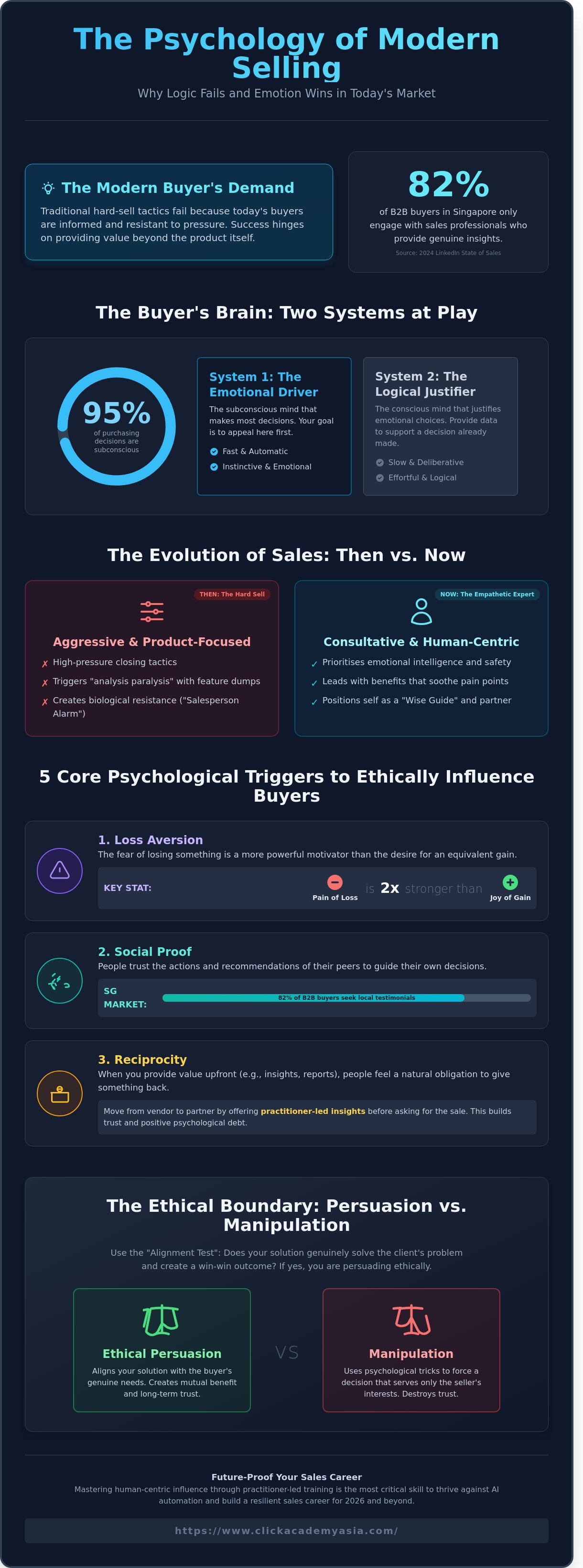
The Psychology of Selling is often misunderstood as a collection of "mind games" or manipulative tactics. In reality, it's the scientific study of why people buy, shifting the focus away from your pitch and onto the buyer's internal motivations. For professionals in Singapore, mastering this field means moving beyond the transactional and into the transformational. It's about understanding that every transaction is a human interaction first.
Modern sales theory relies heavily on the "Dual Process Theory," which divides human cognition into System 1 and System 2. System 1 is fast, instinctive, and emotional. System 2 is slower, more deliberative, and logical. While we like to think we use System 2 to make big decisions, Harvard Business School professor Gerald Zaltman revealed that 95% of purchasing decisions occur in the subconscious mind. This remains true even in complex B2B environments where procurement teams use spreadsheets to justify their choices.
This psychological reality has forced a massive shift in the sales process across the region. The "Hard Sell" era of the 1980s and 90s, defined by aggressive closing techniques and high-pressure tactics, is effectively extinct. By 2026, the dominant model is the "Empathetic Expert." This model prioritises emotional intelligence over persistence, recognising that a buyer's feeling of safety is more important than a discount. If you don't win the heart, the brain won't even look at the data.
The Death of the Logical Pitch
Dumping a list of 20 features on a prospect doesn't help them decide; it triggers "analysis paralysis." When the brain is overwhelmed with technical data, it defaults to the easiest choice, which is usually "no." This happens because of the amygdala, the part of the brain responsible for the fight-or-flight response. When a prospect feels pressured or confused, the amygdala triggers a biological resistance.
The Salesperson Alarm is a biological resistance to perceived pressure, where the brain treats a pushy pitch as a physical threat. To bypass this, you must lead with benefits that soothe the buyer's pain points rather than data that taxes their cognitive load.
The Rise of the Practitioner-Led Approach
Modern buyers in Singapore have become cynical toward traditional "reps" who only know how to read from a slide deck. They demand experts who have "been there and done that." This is why a practitioner-led approach is now essential for building trust. You must position yourself as a "Wise Guide" who helps the buyer navigate their specific challenges.
At ClickAcademy Asia, we emphasise this transition through our industry-recognised training programmes. By becoming a mentor rather than a vendor, you align yourself with the buyer's goals. This creates a partnership that transcends price wars and builds long-term loyalty in a competitive market.
5 Core Psychological Triggers to Optimise Your Close Rate
The core principles of the psychology of selling suggest that human decisions are rarely driven by pure logic. Instead, five specific triggers influence whether a prospect signs a contract or walks away. Understanding these drivers allows you to align your sales process with how the human brain actually functions.
Loss Aversion: Humans are wired to avoid pain. Research in behavioural economics indicates that the fear of losing S$1,000 is twice as intense as the joy of gaining the same amount.
Social Proof: In the Singaporean market, 82% of B2B buyers seek out local testimonials before engaging with a new vendor. They want to see that their peers have already succeeded with your solution.
Reciprocity: When you provide value first through practitioner-led insights or detailed market reports, you create a psychological "debt." The prospect feels a natural inclination to return the favour by giving you their time.
Scarcity and Urgency: This isn't about fake countdown timers. It's about highlighting genuine windows of opportunity, such as an upcoming change in SSG funding or a limited intake for a high-demand project.
Authority: Credibility is the foundation of trust. Professional certifications and industry-recognised titles act as mental shortcuts that tell the buyer you are a safe pair of hands.
Applying the Psychology of Selling requires a shift from "convincing" to "guiding." You aren't just pushing a product; you are helping a prospect navigate their own cognitive biases to reach the best possible conclusion for their business.
Harnessing Loss Aversion Ethically
To use loss aversion effectively, you must frame your pitch around the "cost of inaction." If a company is losing S$4,500 every month due to poor lead conversion, that is a much more compelling hook than promising them a potential S$4,500 gain next year. Use case studies to highlight how your clients avoided specific disasters, such as data breaches or missed regulatory deadlines. For instance, show how a local SME avoided a S$10,000 fine by implementing your compliance software. This approach positions you as a protector of their current assets rather than just another vendor asking for a budget.
The Authority Gap in Asian Business
In Singapore and the wider regional markets, professional hierarchy and formal credentials carry significant weight. If there is a perceived gap in your expertise, the sale will likely stall at the procurement stage. Earning a WSQ Digital Marketing Strategy & Planning certificate bridges this credibility gap instantly. This creates a "Halo Effect" where the prestige of the WSQ framework and SSG's rigorous standards transfer directly to you. When you lead with industry-recognised credentials, you move from being a salesperson to a trusted advisor. This authority allows you to command higher fees and shorten the sales cycle because the buyer no longer feels the need to vet your basic competence.
Key Takeaway: Successful selling is about reducing the perceived risk for the buyer. By combining authority with a clear understanding of loss aversion, you create a compelling environment where saying "yes" feels like the safest and most logical choice.
Ethical Persuasion vs. Manipulation: The Professional Boundary
Many sales professionals in Singapore worry that applying the psychology of selling feels like "tricking" prospects. This hesitation is understandable but misplaced. Manipulation involves using deceptive tactics to force a buyer into a decision that only benefits the seller. True persuasion, however, is the art of helping a prospect make a decision that is already in their best interest. In a high-trust market like Singapore, where professional reputations are built over decades, crossing this line is a career-ending mistake.
To stay on the right side of this boundary, you must apply "The Alignment Test." Before closing, ask yourself: does this solution actually solve the prospect's primary problem? According to a 2023 report by Sales Insights Lab, 50% of initial prospects turn out to be a poor fit for the product being sold. If you identify a mismatch, the ethical choice is to walk away. This transparency doesn't just protect your integrity; it actually increases your long-term closing ratio. Clients who trust that you won't sell them a "dud" solution are 3.5 times more likely to provide high-value referrals.
Building Psychological Safety
Effective selling requires creating an environment where the prospect feels safe enough to be honest about their budget and pain points. You can achieve this through active listening techniques that make the buyer feel "felt" rather than just "heard." Instead of nodding along while waiting for your turn to speak, mirror their last three words as a question. This encourages them to expand on their thoughts without feeling pressured.
You should also use "No-Oriented Questions" to reduce anxiety. Questions like "Is it a bad time to talk?" or "Are you against exploring a new WSQ-funded training programme?" are safer for the prospect than "Yes-oriented" traps. People feel in control when they say no. Additionally, you can mitigate "Blowback Risk" by being the first to mention your product's limitations. If your software requires a minimum of 10 users to be cost-effective, state that upfront. This radical honesty eliminates the prospect's fear of a "hidden catch" and builds immediate credibility.
Cognitive Biases to Watch (and Use)
Understanding the psychology of selling means recognising the mental shortcuts buyers use to make decisions. You can use these ethically to frame your value proposition more clearly:
The Anchoring Effect: The first price mentioned sets the mental benchmark for the entire conversation. If you mention a premium S$12,000 corporate package first, a subsequent S$4,500 solution feels significantly more affordable.
Confirmation Bias: Prospects look for information that supports their existing beliefs. Don't challenge their worldview; instead, align your pitch with their stated values. If they believe in "efficiency first," show how your service cuts 20 hours of manual labour per week.
The IKEA Effect: People value things more when they help create them. Don't just present a finished proposal. Ask the prospect to help you "co-create" the implementation plan. When they invest effort into the solution, they become psychologically committed to its success.
By focusing on these psychological triggers, you don't just close more deals; you build partnerships based on mutual value. This approach ensures your sales process remains a service to the buyer, not a burden. Moving forward, we will examine how these ethical frameworks apply to specific closing techniques that respect the buyer's journey.
A 4-Step Framework for Applying Sales Psychology in 2026
Success in the modern Singaporean market requires more than just a polished pitch. It demands a structured approach to the Psychology of Selling that respects the buyer's intelligence while addressing their subconscious needs. By 2026, the gap between transactional sellers and consultative partners will widen. This framework ensures you stay on the right side of that divide by focusing on human-centric triggers rather than aggressive tactics.
Emotional Mapping and Labelling
Every corporate request carries a hidden emotional payload. When a marketing manager in a local SME asks for "more robust reporting," they aren't just looking for charts; they're likely seeking job security or a way to justify their department's S$150,000 budget to a skeptical board. You must identify these unspoken drivers to truly connect. Deep discovery isn't about asking what they want, but mapping out how they feel about the problem they're facing.
Mirroring: Repeat the last three words of a prospect's sentence to encourage them to elaborate without feeling pressured.
Labelling: Use phrases like "It seems like you're worried about the implementation timeline" to acknowledge their internal state.
When you label a prospect's emotion, you're performing a vital cognitive reset. Labelling an emotion helps the brain switch from System 1, which is impulsive and reactive, to System 2, which is logical and deliberate. This shift allows the buyer to stop feeling "attacked" by a sales pitch and start viewing your solution as a rational choice. It's a technique used by top negotiators to de-escalate tension and build rapid rapport in high-stakes environments.
Building the Reality Bridge
Buyers often suffer from "status quo bias," where the pain of staying the same feels safer than the perceived risk of change. To break this, you must build a "Reality Bridge." Start by quantifying the true cost of their current situation. If their current digital strategy results in a 12% lead drop-off month-on-month, show them exactly how many thousands of SGD are leaking out of their funnel right now. This makes the "pain" of the present impossible to ignore.
Once the pain is established, paint a vivid picture of the "Place They Want to Be." Use emotive, aspirational language that highlights their future success. Instead of talking about features, describe the outcome: "Imagine your team hitting their KPIs three weeks ahead of schedule because the manual data entry is gone." This isn't just fluff; it's about making the destination feel tangible and inevitable. To make the transition feel low-risk, suggest modular rollouts or WSQ-accredited training sessions that ensure their staff can actually use the new tools.
The final step involves micro-commitments. Instead of pushing for a massive S$80,000 contract on the first call, lead the prospect through a series of small "Yes" moments. This might be an agreement to a 15-minute technical demo or a commitment to share a specific data set for an audit. Each small win builds momentum. By the time you reach the final proposal, the Psychology of Selling has already done the heavy lifting, making the final "Yes" feel like the only logical conclusion.
Mastering these psychological frameworks is essential for any professional looking to lead in the Asian digital economy. If you're ready to transform your sales approach and master these practitioner-led techniques, our expert mentors are here to guide your growth.
Future-Proof Your Career with Practitioner-Led Sales Training
Artificial intelligence is rapidly transforming the commercial sector. Tools can now draft prospecting emails or predict churn with high accuracy, but algorithms cannot replicate the deep human connection required to close complex deals. Mastering the Psychology of Selling is the ultimate safeguard for your career. It focuses on empathy, rapport, and the subtle art of persuasion that machines simply cannot simulate. While AI handles the data, the human salesperson manages the emotion.
Upskilling isn't just a recommendation; it's a necessity for survival. The World Economic Forum's 2023 Future of Jobs Report highlights that analytical thinking and emotional intelligence are among the most critical skills for the 2025 horizon. ClickAcademy Asia bridges the gap between theoretical knowledge and real-world application. We combine global frameworks with specific insights into the Asian market, ensuring you understand the cultural nuances of buyers in Singapore and across the region. This psychological edge allows you to pivot your strategy when a local lead shows hesitation that a global script might miss.
Leveraging WSQ and SkillsFuture for Your Growth
Investing in your education shouldn't be a financial burden. Singaporean citizens and Permanent Residents can access substantial SSG grants to offset the costs of professional development. Most of our sales and marketing modules are WSQ-certified. This means you receive industry-recognised credentials that accelerate your journey toward PMEB status and higher-level leadership roles.
Depending on your age and employment status, you might be eligible for subsidies that cover up to 70% of course fees. We encourage you to log in to the MySkillsFuture portal today to check your current credit balance. Using these funds for a WSQ-certified programme ensures your learning is aligned with national standards and provides a clear, documented path for career progression within the Singaporean workforce.
Your Next Steps to Mastery
The difference between a good salesperson and a master practitioner lies in their commitment to continuous improvement. We invite you to explore our Sales Leadership and Digital Marketing tracks to find the right fit for your goals. Every session we run is practitioner-led. You won't be learning from career academics. Instead, you'll gain insights from experts who are actively closing deals and managing teams in the current market.
True expertise comes from applying the Psychology of Selling in real-time scenarios. Our cohorts focus on practical workshops and case studies that reflect the actual challenges you face on the ground. Don't let your skills stagnate while the industry moves forward. Empower your professional journey by joining our next cohort and gain the psychological edge needed to dominate in modern commerce. Your path to becoming a top-tier sales leader starts with a single, informed decision to master the human element of the trade.
Lead the Market with Science-Backed Influence
Mastering the Psychology of Selling isn't about manipulation; it's about understanding the deep-seated emotional drivers that dictate every purchase decision in the Singapore market. You've already observed how logic often fails where rapport and ethical persuasion succeed. By using these core triggers to optimise your approach, you'll move beyond transactional interactions and start building high-value, long-term professional relationships.
The sales landscape is shifting rapidly. Relying on outdated tactics will leave you behind as buyers become more sophisticated. At ClickAcademy Asia, we're an official Google and Digital Marketing Institute Partner committed to your growth. Our practitioner-led workshops are specifically designed for the Asian business context, ensuring you gain skills that work on the ground here in Singapore.
You don't have to navigate this evolution alone. Our WSQ-certified courses offer up to 70% SSG funding for eligible professionals, making world-class expertise highly accessible. It's time to accelerate your career and lead with confidence.
Master the Science of Influence: Explore Our WSQ Sales Training Programmes
Your journey toward becoming a master of influence starts with a single step. We're ready to help you navigate every challenge and celebrate every win along the way.
Frequently Asked Questions
What is the psychology of selling?
The psychology of selling is the study of the mental and emotional factors that drive a customer's decision to buy. Instead of focusing solely on product features, it examines why people feel a need for a solution and how they perceive value. A 2023 study by Harvard Business School found that 95% of purchasing decisions occur in the subconscious mind. This means sales professionals must understand emotional triggers to close deals effectively.
Is sales psychology ethical?
Sales psychology is ethical when used to help customers find the right solution for their specific problems. it becomes unethical only if it's used to manipulate people into buying things they don't need or can't afford. Ethical practitioners follow a consultative approach, ensuring that 100% of the techniques used aim to align the product's benefits with the buyer's genuine goals. Professional bodies like the Digital Marketing Institute help set these standards by prioritising transparency.
How do cognitive biases affect B2B purchasing decisions?
Cognitive biases act as mental shortcuts that influence how B2B buyers evaluate risk and ROI. The anchoring effect is particularly common, where the first price mentioned sets the benchmark for all subsequent negotiations. Research from Gartner indicates that 77% of B2B buyers describe their latest purchase as very complex or difficult. Understanding these biases allows you to simplify the process and reduce the perceived friction for decision-makers.
What is the most powerful psychological trigger in sales?
Reciprocity is widely considered the most effective psychological trigger because it builds immediate trust. When you provide value first, such as a free audit or a detailed industry report, the prospect feels a natural urge to return the favour. According to Dr. Robert Cialdini, this social obligation is a universal human trait. Using this trigger correctly can increase your conversion rates by up to 20% in the initial outreach phase.
Can I use SkillsFuture credits for sales and marketing courses in Singapore?
Yes, Singaporeans aged 25 and above can use their S$500 SkillsFuture Credit to offset the costs of approved sales and marketing programmes. Many professional certifications at ClickAcademy Asia are also eligible for SSG funding, which can cover up to 70% of the course fees for eligible individuals. This makes it highly affordable for local professionals to master the psychology of selling and other digital competencies. Check the MySkillsFuture portal for the latest list of WSQ-aligned courses.
How does social proof work in the Asian market?
Social proof in Asia relies heavily on authority and community consensus rather than just individual reviews. In markets like Singapore, 88% of consumers trust recommendations from peers or industry experts over traditional advertisements. Highlighting partnerships with global brands like Google or Meta serves as a powerful signal of credibility. Showcasing local case studies with measurable results is more effective than using generic testimonials from international sources.
What is the difference between System 1 and System 2 thinking in sales?
System 1 thinking is fast, instinctive, and emotional, while System 2 is slower and more analytical. Most initial buying impulses are driven by System 1, which processes information in milliseconds. Sales experts target System 1 with storytelling and visual cues to create desire. Once the emotional connection is made, they provide the data and technical specifications needed for System 2 to justify the purchase logically.
How can I learn the psychology of selling professionally?
You can learn these skills through practitioner-led training programmes that combine theory with real-world application. ClickAcademy Asia offers industry-recognised certifications that focus on consumer behaviour and advanced persuasion techniques. These courses are designed for professionals who want to transform their sales approach and achieve consistent results. By learning from experts who have worked with major tech platforms, you gain insights that are immediately applicable to the Singapore market.


Comments