
Privacy-Enhancing Tech: 2026 Guide for Singapore Marketers

Did you know that the potential financial impact of a single data breach in SINGAPORE is projected to reach S$1.1 million by the end of 2026? As an advertiser, you're likely grappling with the reality that traditional tracking is no longer a viable strategy. Adopting privacy-enhancing technologies for advertising has become a necessity to protect both your brand and your customers. You've probably noticed your attribution accuracy declining as privacy regulations tighten; making it harder than ever to prove the ROI of your digital spend.
We understand the challenge of balancing high-performance results with strict PDPA compliance. This guide will help you master these technical shifts, transforming privacy hurdles into your brand's new strategic advantage. You'll gain a clear framework for choosing the right tools and learn how to maintain campaign performance in a cookieless world. We'll also explore how to upskill your team using WSQ frameworks and SSG funding to ensure your organisation leads the market in privacy-first innovation.
Table of Contents
The Evolution of Advertising in Singapore: Why PETs Matter Now
Decoding the Core Privacy-Enhancing Technologies for Advertising
Strategic Comparison: Selecting the Right PET for Your Marketing Objectives
A Practical Roadmap for Implementing PETs in Your Advertising Programme
Future-Proofing Your Career with WSQ-Funded Digital Marketing Mastery
The Evolution of Advertising in Singapore: Why PETs Matter Now
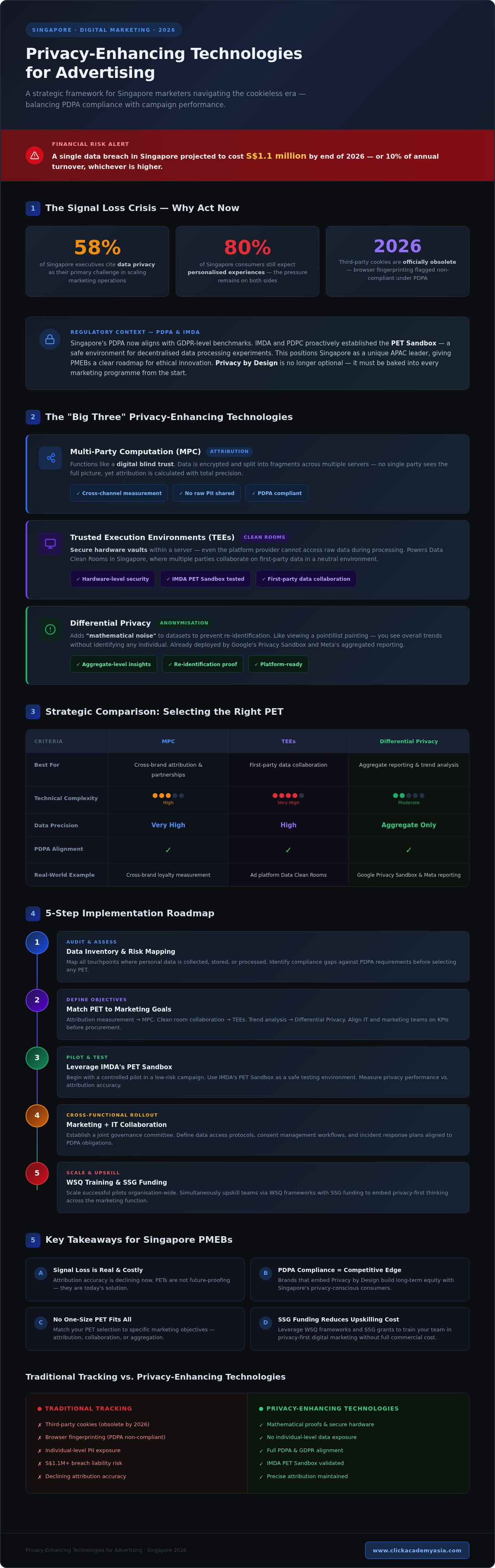
SINGAPORE marketers are navigating a massive paradigm shift. The "Signal Loss" crisis of 2026 is no longer a distant threat; it's a daily reality affecting every campaign. Research indicates that 58% of local executives now cite data privacy as their primary challenge in scaling marketing operations. As traditional tracking methods crumble, privacy-enhancing technologies for advertising have emerged as the essential toolkit for high-growth brands. These technologies allow you to maintain precise targeting and measurement without ever exposing sensitive user information.
The Infocomm Media Development Authority (IMDA) and the PDPC have been proactive in this transition. Through initiatives like the PET Sandbox, they've provided a safe environment for businesses to experiment with decentralised data processing. This local regulatory support makes SINGAPORE a unique leader in the APAC region; giving PMEBs a clear roadmap for ethical innovation that balances performance with protection.
The Death of the Third-Party Cookie
By late 2026, the third-party cookie is officially a relic of the past. While some marketers initially sought "workarounds" like browser fingerprinting, these methods are now considered high-risk and are often flagged as non-compliant under PDPA guidelines. Privacy-enhancing technologies replace the need for individual-level tracking by using mathematical proofs and secure hardware to validate ad interactions. This approach ensures your brand stays ahead of the curve while maintaining the trust of an increasingly privacy-conscious public.
Regulatory Pressure: PDPA and Global Standards
The Personal Data Protection Act (PDPA) has evolved to match global benchmarks like GDPR, but with a specific focus on the local business ecosystem. Financial penalties for data breaches can now reach S$1 million or 10% of an organisation's annual turnover, whichever is higher. This has forced a shift toward "Privacy by Design," where data protection is baked into every marketing programme from the start. Adopting privacy-enhancing technologies for advertising ensures your brand remains compliant while still delivering the personalised experiences that 80% of SINGAPORE consumers expect. By aligning with these standards, you aren't just avoiding fines; you're building long-term brand equity.
Decoding the Core Privacy-Enhancing Technologies for Advertising
Understanding privacy-enhancing technologies for advertising doesn't require a degree in data science. At their heart, these tools enable "blinded" data analysis; allowing you to derive strategic insights from datasets without ever accessing the underlying personal information. This shift is a game-changer for SINGAPORE brands that need to prove campaign performance while respecting PDPA boundaries. By moving away from individual tracking, you can focus on high-level patterns that drive real business growth.
Multi-Party Computation (MPC) for Attribution
Multi-Party Computation functions like a digital blind trust. Imagine two brands wanting to find common customers to measure a partnership's success. With MPC, the data is encrypted and split into fragments across multiple servers. No single party sees the full picture, yet the system can calculate the final attribution result with total precision. It's a quick win for cross-channel measurement where sharing raw PII is strictly forbidden under local regulations.
Trusted Execution Environments (TEEs) and Clean Rooms
Trusted Execution Environments are essentially secure hardware vaults within a server. They ensure that even the platform provider or a malicious actor cannot access the raw data while it's being processed. In SINGAPORE, this technology powers Data Clean Rooms, where multiple parties collaborate on first-party data in a neutral environment. You can explore how local firms are testing these solutions through IMDA's PET Sandbox. This hardware-level security is becoming the standard for major ad platforms looking to restore consumer trust.
Differential Privacy: Adding Noise for Anonymity
Differential Privacy adds "mathematical noise" to a dataset to prevent re-identification. Think of it like looking at a pointillist painting; you see the overall image and trends without being able to identify a single dot or individual. Google’s Privacy Sandbox and Meta’s aggregated reporting already use this to protect user identity while providing marketers with actionable cohorts. The strategic challenge lies in managing the "privacy epsilon," which is the delicate trade-off between the level of noise added and the resulting data accuracy.
Mastering these concepts is the first step toward reclaiming your marketing ROI in a cookieless world. If you're looking to lead your team through this technical transition, you can upskill in digital advertising strategy to stay ahead of the curve. These technologies are not just tools; they are the foundation of a resilient marketing programme that thrives on trust and transparency.
Strategic Comparison: Selecting the Right PET for Your Marketing Objectives
Choosing the right privacy-enhancing technologies for advertising depends on your specific business goals and technical maturity. You don't need a massive R&D budget to begin. While enterprise-grade Data Clean Rooms require significant investment, many browser-level PETs are already integrated into the platforms you use daily. Mid-sized SINGAPORE firms can start by leveraging platform-native solutions before scaling to bespoke implementations. This strategic approach ensures you aren't over-investing in tech that doesn't align with your core KPIs.
To understand how these technologies integrate with your broader data strategy, it's vital to see how marketing analytics with GA4 bridges the gap between privacy and performance. By aligning your PET selection with your measurement framework, you create a cohesive ecosystem that respects user boundaries while delivering actionable results.
PETs for Audience Targeting and Personalisation
Personalisation no longer requires moving data into a central cloud. On-device learning allows algorithms to train on a user's device without individual data ever leaving it. For example, the Federated Learning guide released by the PDPC highlights how local businesses can train AI models collaboratively without sharing raw PII. This shifts the focus from traditional individual-level tracking to Cohorts, such as the Topics API, which group users by interest. While "Lookalike" audiences will persist, they'll be built on these aggregated interest groups rather than specific user IDs.
PETs for Measurement and Conversion Lift
Accurate measurement in 2026 relies on Aggregate Reporting APIs. These tools provide a summary of campaign performance without revealing which specific user converted. Conversion lift studies are now conducted within secure environments to ensure that the results are mathematically sound yet privacy-preserving. CMOs should audit their current measurement stack using this checklist:
Audit attribution sources: Does your current model rely on high-risk methods like IP addresses or fingerprinting?
Leverage aggregate reporting: Are you utilising platform-native APIs for cross-device tracking?
Map first-party data: Have you identified which internal datasets are ready for use in a Data Clean Room?
Upskill for probabilistic data: Is your team trained to interpret aggregated trends rather than deterministic logs?
By focusing on these practical steps, you can transition your advertising programme into a more resilient, privacy-first operation that remains competitive in the APAC region.
A Practical Roadmap for Implementing PETs in Your Advertising Programme
Transitioning to privacy-enhancing technologies for advertising isn't a simple "plug-and-play" exercise. It requires a strategic alignment of your data assets, technical infrastructure, and team capabilities. For SINGAPORE brands, the journey from legacy tracking to privacy-first advertising involves a clear 5-step process designed to minimise disruption while maximising compliance. Success depends on breaking down silos between your marketing and IT departments to ensure technical execution matches strategic intent.
Step 1: Audit Your First-Party Data Readiness
PETs rely heavily on the quality of your underlying data. Before implementing any new technology, you must ensure your first-party data is consented, organised, and clean. A "Quick Win" for your team is to perform a CRM audit; removing duplicate entries and ensuring every record is linked to a valid consent marker via your Consent Management Platform (CMP). This foundation is essential because PETs like Federated Learning or Data Clean Rooms only work effectively when the input data is reliable and PDPA-compliant.
Step 2: Upskill Your Team through WSQ Training
The "Skills Gap" is often the biggest hurdle for local PMEBs looking to adopt new tech. Your team needs to understand more than just creative; they must grasp the basics of API integration and advanced marketing analytics. Utilising the WSQ framework allows your staff to gain recognised, structured skills that are directly applicable to the local market. HR leaders can significantly reduce the financial burden by tapping into SSG funding to subsidise these essential training programmes. You can enrol in a digital advertising strategy course to begin this transformation today.
Steps 3 to 5: Collaboration, Piloting, and Scaling
Once your data and team are ready, the focus shifts to cross-functional collaboration. Your IT team will handle the secure hardware requirements, such as TEEs, while marketing defines the measurement KPIs. We recommend starting with a small-scale pilot, perhaps focusing on a single high-value channel, before scaling across your entire advertising programme. This phased approach allows you to test the reliability of your PET-based attribution models without overextending your resources or risking data integrity.
Future-Proofing Your Career with WSQ-Funded Digital Marketing Mastery
Navigating the complexities of privacy-enhancing technologies for advertising requires more than just theoretical knowledge; it demands a fundamental shift in how your team approaches data strategy. ClickAcademy Asia stands as your vital partner in this transition. We provide the structured mentorship and practical frameworks needed to turn these technological challenges into tangible career growth. By bridging the gap between high-level strategy and technical execution, we empower you to lead your organisation through the most significant shift in advertising history.
Why a WSQ Certification is Essential in 2026
Industry recognition is the currency of a successful career in SINGAPORE's competitive marketing landscape. WSQ-certified professionals are increasingly sought after because their skills are grounded in real-world application rather than just abstract concepts. Our curriculum at ClickAcademy Asia is designed to be agile and results-driven. You'll gain hands-on experience with the tools that define the privacy-first era, ensuring you can implement privacy-enhancing technologies for advertising with confidence and precision. This practical mastery is what sets our graduates apart as leaders in the APAC region.
Leveraging SSG Funding for Corporate Training
Upskilling your workforce doesn't have to be a significant financial burden for your organisation. Most SINGAPORE-based companies can leverage SSG funding to claim substantial subsidies for training their PMEBs. This financial support makes high-level professional education accessible and helps future-proof your team against the ongoing "Signal Loss" crisis. Our WSQ Digital Marketing Strategy & Planning course includes modules specifically designed to address modern advertising challenges.
Maximise ROI: Use SSG subsidies to reduce out-of-pocket costs while gaining elite-level training.
Future-Ready Skills: Master the integration of PETs and advanced analytics within the WSQ framework.
Industry Credibility: Earn certifications recognised by major global platforms and local certifying bodies.
Practical Implementation: Move beyond theory with a curriculum focused on tangible business outcomes.
Starting a pilot training programme today is a decisive "quick win" for any forward-thinking leader. It signals to your clients and stakeholders that your brand is committed to privacy excellence and responsible data use. Don't wait for legacy systems to fail completely before seeking a solution. Equip your team with the skills to lead the privacy-first era and transform these technical shifts into your brand's greatest competitive advantage.
Lead the Privacy-First Advertising Revolution in Singapore
The transition toward privacy-enhancing technologies for advertising marks a turning point for every marketer in SINGAPORE. By mastering technical frameworks like MPC and TEEs; you aren't just complying with PDPA regulations; you're building a resilient strategy that thrives on consumer trust. Success in this new era depends on your team's ability to translate complex data signals into actionable growth. ClickAcademy Asia has already empowered over 30,000 professionals across APAC to navigate these industry shifts with confidence.
Our official Google and WSQ certification pathways provide the practical mastery required to lead high-performance teams. Eligible Singaporeans can access up to 70% SSG funding to offset training costs, making it the perfect time to future-proof your career. Equip your team for the cookieless future with our WSQ-funded Digital Marketing courses and secure your place at the forefront of the industry. The future of advertising belongs to those who embrace privacy as a core strength.
Frequently Asked Questions
What are the main types of privacy-enhancing technologies for advertising?
The primary privacy-enhancing technologies for advertising include Multi-Party Computation (MPC), Trusted Execution Environments (TEEs), Differential Privacy, and Federated Learning. These tools allow organisations to process data collaboratively without ever revealing sensitive personal information. By using mathematical noise or secure hardware, you can derive high-level audience insights while remaining fully aligned with SINGAPORE's evolving data protection standards. This shift ensures your marketing programme remains resilient against the deprecation of traditional tracking methods.
How does MPC differ from traditional data sharing in marketing?
Traditional sharing requires raw data exchange; which creates significant security risks and potential PDPA violations. MPC functions by encrypting and splitting data into fragments across multiple servers. No single party ever sees the entire dataset, yet the system can calculate precise results like attribution or overlap. This "blinded" approach allows brands to collaborate on first-party data securely; ensuring that user privacy is never compromised during complex measurement tasks.
Is PET adoption mandatory for businesses in Singapore?
While the PDPA doesn't name specific technologies as mandatory, it does strictly enforce data protection and consent. With the 31 December 2026 deadline for ceasing NRIC use for authentication and potential fines of S$1 million, adopting PETs is the most effective way to ensure compliance. Most high-growth organisations in SINGAPORE now view PETs as a legal necessity to avoid the financial and reputational damage associated with notifiable data breaches.
Can I still track conversions accurately using PETs?
You can maintain high accuracy; however, the methodology shifts from deterministic tracking to aggregated reporting. PETs allow you to measure conversion lift and campaign performance by analysing patterns across groups rather than individual user IDs. By using Trusted Execution Environments and clean rooms, you can still link ad exposures to sales outcomes with high confidence. This ensures your ROI remains visible without resorting to intrusive cross-site tracking.
How much does it cost to implement privacy-enhancing technologies?
Implementation costs depend on whether you use platform-native tools or bespoke enterprise solutions. Many privacy-enhancing technologies for advertising are already built into major ad platforms; meaning there's no direct licensing fee for basic use. For larger SINGAPORE-based enterprises building custom Data Clean Rooms, costs involve cloud infrastructure and technical setup. The most significant investment is often team upskilling to ensure your PMEBs can manage these new workflows effectively.
Are there government grants in Singapore for PET training?
Yes, the SkillsFuture Singapore (SSG) framework provides significant support for professional development in this area. Eligible Singaporeans and permanent residents can access up to 70% funding for WSQ-certified modules at ClickAcademy Asia. These programmes cover essential skills in Digital Advertising and Marketing Analytics; allowing your team to master PET implementation while significantly reducing the out-of-pocket training costs for your organisation.
How do PETs help with PDPA compliance for advertisers?
PETs facilitate "Privacy by Design" by ensuring personal data is never exposed or processed in a readable format. This directly addresses PDPA requirements for purpose limitation and data protection. By using these technologies, you significantly reduce the risk of a notifiable data breach; which is defined as affecting 500 or more individuals. This proactive approach protects your organisation from the projected S$1.1 million financial impact associated with data leaks in 2026.
Do I need a technical background to understand PETs in advertising?
You don't need a computer science degree to lead a privacy-first marketing team. While the underlying mathematics are complex, the strategic application is accessible to any experienced marketer. Your role is to understand which PET aligns with your campaign objectives and how to interpret the resulting aggregated data. ClickAcademy Asia provides the mentorship needed to bridge this technical gap; empowering you to make informed decisions without needing to write the code yourself.


Comments