
Mastering Mobile and Social Media: A Professional Strategy Guide for 2026

Updated: May 22
What if your daily habit of scrolling through TikTok or LinkedIn is actually the biggest obstacle to your professional growth in the Singaporean digital economy? According to the 2024 Digital Report, the average Singaporean spends 2 hours and 14 minutes daily on social platforms, yet many professionals still struggle to turn that screen time into a career asset. It's a common trap to mistake personal app usage for professional mastery, especially when you're constantly battling shifting algorithms and the pressure to prove ROI to stakeholders.
We understand that feeling "behind the curve" is frustrating, especially when you're already using these tools every single day. This guide will show you how to master Mobile and Social Media by transforming these platforms from personal distractions into a structured, future-proof marketing framework. You'll learn to move beyond basic posting to drive tangible business growth and career advancement.
We'll break down the technical intersection of mobile UX and social algorithms to ensure your strategy remains resilient in 2026. We'll also explore how gaining an industry-recognised WSQ certification can validate your skills and help you command the respect your expertise deserves in a competitive market.
Key Takeaways
Transition from passive scrolling to professional mastery by understanding the unified Mobile and Social Media landscape that drives 2026 commerce.
Discover how algorithm-driven content delivery and mobile user experience work together to capture and retain audience attention.
Master the mandatory hybrid strategy that balances organic community building with strategic paid amplification for maximum brand growth.
Optimise your conversion paths with a mobile UX audit and use AI-driven tools to accelerate content production without losing quality.
Build professional credibility in Singapore by pursuing WSQ-certified qualifications that turn theoretical knowledge into practical, practitioner-led success.
Table of Contents Beyond Scrolling: Why Professionals Must Master the Mobile and Social Media Intersection The Architecture of Attention: How Mobile Algorithms Drive Social Engagement Strategic Frameworks: Navigating the Hybrid World of Organic and Paid Social Actionable 2026 Tactics for Mobile-First Social Media Success Accelerate Your Career: Professional Certification in Mobile and Social Media
Beyond Scrolling: Why Professionals Must Master the Mobile and Social Media Intersection
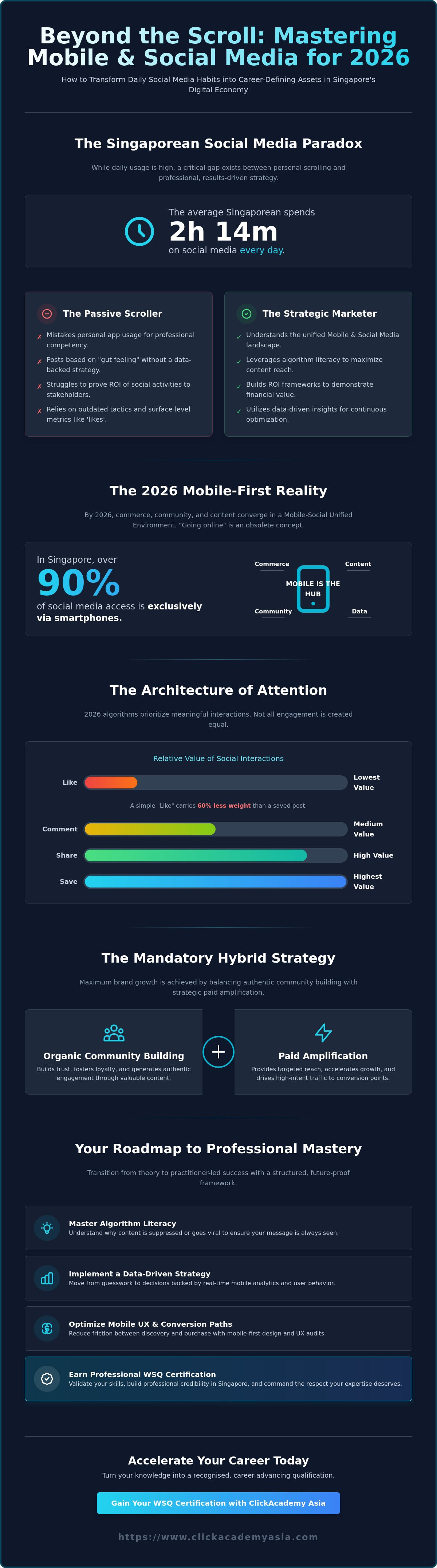
The way we interact with technology has shifted from deliberate sessions to a continuous state of presence. By 2026, the concept of "going online" is obsolete; instead, we exist within a Mobile-Social Unified Environment. This is the primary touchpoint for commerce in Singapore, where over 90% of the population accesses social platforms exclusively via smartphones. Mastering Mobile and Social Media isn't just a technical requirement; it's a fundamental business necessity for anyone serious about growth.
To better understand how this landscape is shifting, watch this helpful strategy breakdown:
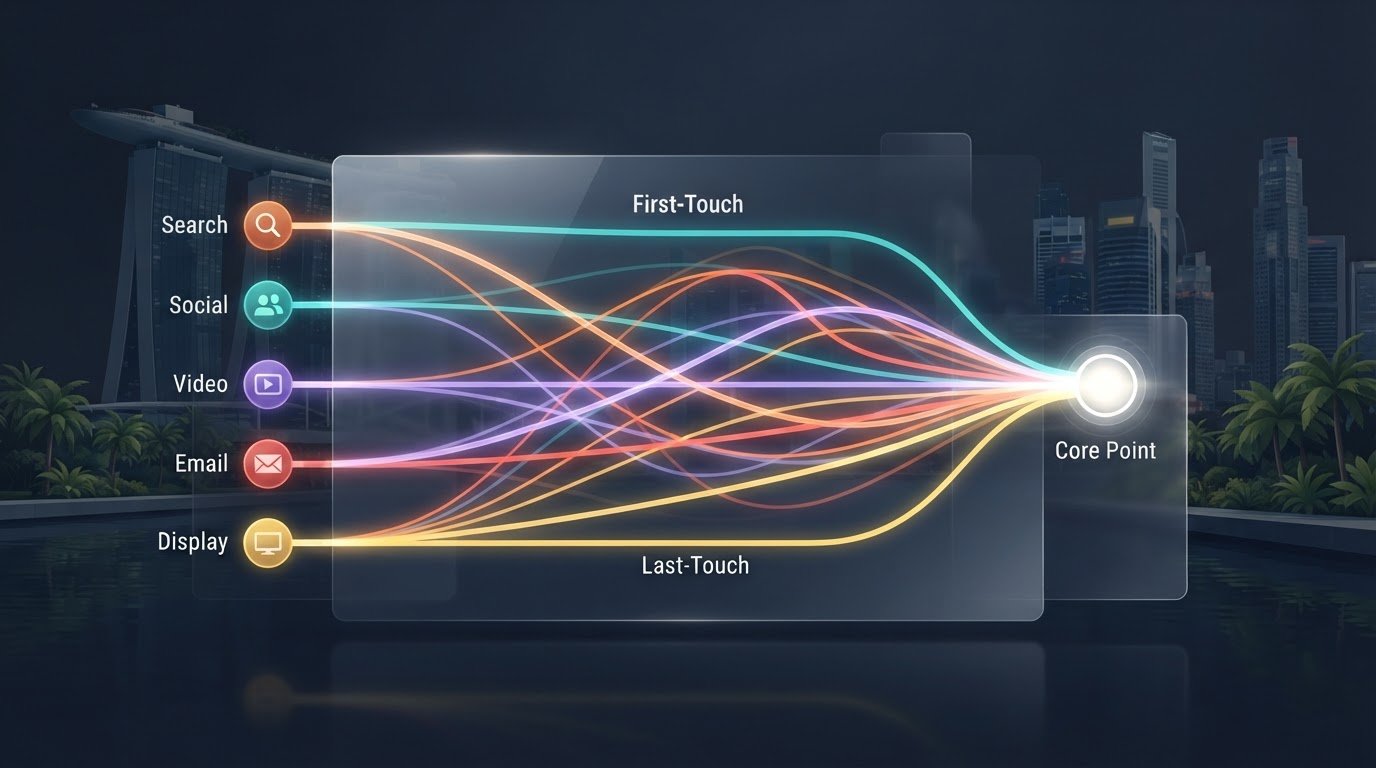
The transition from intentional internet use to constant, mobile-first connectivity means consumers are always reachable, but they're also more distracted. For a professional to cut through the noise, they must understand that personal "tech-savviness" doesn't equate to professional marketing competency. Being able to scroll through a feed or post a photo doesn't mean you can navigate the complex backend of a global ad platform or interpret multi-touch attribution data.
The Professional Gap in Mobile Competency
Many PMEBs in Singapore fail to translate their daily app usage into tangible business results. There's a significant divide between "posting" and "executing a strategic campaign." While you might know how to use a filter, do you know how to leverage business social media strategies to lower your customer acquisition cost? Structured learning is essential to keep pace with 2026 platform updates, where AI-driven targeting and privacy-first data collection have changed the rules of engagement.
At ClickAcademy Asia, we see professionals struggle because they rely on outdated tactics. To succeed, you must move beyond the interface and master the underlying mechanics. This involves:
Algorithm Literacy: Understanding why certain content is suppressed while other posts go viral.
Data-Driven Strategy: Moving from "gut feeling" to decisions backed by real-time mobile analytics.
ROI Frameworks: Proving the financial value of social engagement to stakeholders.
Commercial Opportunities in a Mobile-First World
The 2026 commercial landscape is defined by "in-app" purchasing and seamless social commerce. Mobile-first social media reduces the friction between discovery and conversion, allowing a user to see a product in an influencer's video and complete a checkout in three taps. Despite this, many businesses are currently under-utilising mobile data, failing to capture high-intent signals that occur during micro-moments of browsing.
By mastering the Mobile and Social Media intersection, you position yourself to lead this digital transformation. This guide will empower you to close the competency gap, accelerate your brand's reach, and transform your social presence into a sophisticated revenue engine. We'll start by breaking down the sophisticated algorithms that will dictate visibility in the coming year.
The Architecture of Attention: How Mobile Algorithms Drive Social Engagement
By 2026, the mechanics of Mobile and Social Media have shifted from simple engagement metrics to complex predictive modelling. Algorithms now function as sophisticated gatekeepers that prioritise "meaningful interactions" over passive consumption. This means a simple "like" carries 60% less weight than a saved post or a thoughtful comment that sparks a conversation. Mobile UX is the primary engine of this retention; if your content isn't optimised for the physical realities of smartphone usage, the algorithm will bury it before it reaches your target audience in Singapore.
Mobile-first content design is no longer optional. It requires a deep understanding of how users interact with their devices while commuting on the MRT or during short breaks. High-contrast visuals, vertical-first aspect ratios, and captions designed for "sound-off" viewing are the baseline requirements for visibility. These technical elements ensure that the algorithm identifies your content as high-quality and user-friendly, leading to wider organic distribution.
Understanding the Feedback Loop
Every action a user takes creates a data point that informs the algorithm's next move. Signals such as scroll speed, dwell time, and the speed of a share are monitored in real-time. If a user stops scrolling for more than 3.5 seconds on your post, the system flags that content as relevant to that specific demographic. To trigger these positive responses, you must hook the viewer within the first 1.5 seconds of a video or image appearing on their screen.
Algorithmic bias in a professional marketing context refers to the mathematical tendency of platforms to amplify content that mirrors a user's past behaviours and preferences, potentially creating echo chambers that marketers must strategically navigate. To break through these patterns, your strategy should incorporate insights from authoritative resources like Forbes' ultimate guide to social media marketing. This helps in aligning your creative output with the broader goals of audience identification and strategic planning.
The Rise of AI-Driven Personalisation
Artificial Intelligence now tailors social feeds to individual mobile users with surgical precision. In 2026, generic, "one-size-fits-all" content is effectively invisible. AI tools analyse millions of data points, including location-based triggers and historical interaction patterns, to serve content at the exact moment a user is most likely to convert. This level of personalisation requires brands to move away from broad broadcasting and towards hyper-segmented content buckets.
Real-time Adaptation: AI adjusts the feed based on current environmental factors, such as the user's local Singapore time or weather conditions.
Data Analytics: Understanding these patterns requires a firm grasp of performance data to identify which micro-moments drive the highest ROI.
Meaningful Engagement: Content must encourage active participation, as AI now de-prioritises accounts that generate "ghost" followers or low-value views.
Mastering these shifts in Mobile and Social Media requires a blend of technical literacy and creative agility. To stay competitive, many professionals choose to refine their skills through practitioner-led digital marketing courses that focus on real-world application. By understanding the architecture of attention, you can transform your social presence from a passive channel into a dynamic engine for business growth.
Strategic Frameworks: Navigating the Hybrid World of Organic and Paid Social
By 2026, the line between free and paid content has blurred into a single, integrated stream. Your Mobile and Social Media strategy must treat these two elements as two sides of the same coin. In Singapore, where mobile penetration exceeds 90 percent, a fragmented approach results in wasted S$ and lost opportunities. Success requires a hybrid model that uses organic content to build trust and paid ads to drive immediate scale.
Professional growth in this field is no longer optional; it's a requirement for survival. WSQ-certified training at ClickAcademy Asia equips you with the analytical tools to manage these complex frameworks. These practitioner-led courses are designed for professionals who need to apply global standards to the local Singapore market. By mastering these frameworks, you ensure your strategy aligns with SkillsFuture Singapore (SSG) standards while delivering tangible ROI.
Organic Social: Building Long-Term Brand Equity
Organic social serves as your brand's digital heartbeat. Authentic storytelling through mobile-native features like Stories and Reels creates a connection that feels personal rather than corporate. Focus on community management by responding to comments within 60 minutes. This high level of responsiveness signals to the algorithm that your content is valuable, potentially increasing your reach in a landscape where organic visibility often dips below 2 percent. When your organic engagement rate plateaus, use that data to identify which specific posts deserve a paid boost.
Paid Social: Precision Targeting and ROI
Paid social offers the precision needed to scale your message to the right audience at the right time. In 2026, programmatic buying allows for hyper-local targeting down to specific Singapore districts or business hubs. Use techniques from a Mobile Marketing Bootcamp to master A/B testing on short-form video ads. By testing different creative hooks in the first three seconds, you can often reduce your cost-per-click by 25 percent or more. This data-driven approach ensures your Mobile and Social Media spend is always optimised for conversion.
Platform Selection Checklist for 2026:
Brand Awareness: Prioritise TikTok or Instagram Reels for high-velocity reach.
B2B Lead Generation: Use LinkedIn for high-intent professional targeting.
Direct Conversion: Optimise Facebook and Instagram shop integrations for seamless mobile checkout.
Customer Retention: Build private communities through WhatsApp Channels or Telegram groups.
Real-Time Engagement: Use X (formerly Twitter) or Threads for live event coverage and PR.
Actionable 2026 Tactics for Mobile-First Social Media Success
To lead in the Singapore market, your Mobile and Social Media strategy must move from passive posting to active conversion. Start by auditing your mobile UX. If your website takes longer than 2.5 seconds to load from a social link, you will likely lose 53% of your traffic before they even see your offer. You should also integrate AI-driven tools like Adobe Firefly to scale your visual assets. This isn't about replacing your creativity; it's about accelerating production to meet the high demand for fresh content. Finally, stop measuring success by "likes." In 2026, you must track "Click-Through Rates" and "Conversion Value" to prove that your social presence actually grows your bottom line.
Step 1: Use Google PageSpeed Insights to identify bottlenecks in your social-to-site journey.
Step 2: Deploy AI tools to automate repetitive tasks like resizing assets for different platforms.
Step 3: Prioritise vertical video to align with natural mobile holding patterns.
Step 4: Set up automated alerts for brand mentions to ensure you never miss a conversation.
Step 5: Align your SEO goals with social metrics to create a unified data story.
Mastering Vertical Video and Short-Form Content
Vertical video is the primary way users consume content on mobile devices. To create high-impact videos, always film in a 9:16 aspect ratio and keep your message focused on a single takeaway. The first 3 seconds are your only chance to stop the scroll. Start with a visual hook or a direct question that addresses a specific pain point. For professional editing on your phone, use apps like CapCut or Mojo. These tools allow you to add captions and transitions that feel native to the platform, making your brand appear more authentic and accessible.
Social Listening and Real-Time Engagement
Effective Mobile and Social Media management requires you to hear what isn't being said directly to you. Use tools like Brandwatch to monitor mentions across the Singapore digital space. Speed is your greatest asset. Research shows that responding to a customer inquiry within 5 minutes increases your chances of conversion by 9 times. For a quick win, use Instagram or LinkedIn polls. These provide immediate audience data that you can use to pivot your strategy in real-time. This ensures your content always hits the mark without wasting resources on guesswork.
Ready to lead the digital transformation in your industry? You can master advanced social strategies through our practitioner-led certification programmes today.
Accelerate Your Career: Professional Certification in Mobile and Social Media
You have explored the strategies that will define the next year of digital growth. Now, it is time to lead that change. ClickAcademy Asia stands as the premier destination for regional digital education, helping professionals across Singapore bridge the gap between simply using a platform and truly mastering it. We don't just teach tools; we build the next generation of digital leaders.
Theoretical study often fails when algorithms change overnight. This is why our workshops are practitioner-led. You will learn directly from experts who manage high-stakes campaigns and multi-million dollar budgets daily. This ensures your skills in Mobile and Social Media remain sharp, relevant, and immediately applicable to your specific business challenges. You get practical insights that textbooks simply cannot provide.
Executive education should be accessible to every ambitious professional. We've structured our programmes to align with SSG subsidies, which can significantly reduce out-of-pocket costs for eligible Singaporeans and Permanent Residents. This financial support means you can focus on your professional growth and career acceleration rather than worrying about the tuition fees.
Why WSQ Certification Matters in 2026
The Workforce Skills Qualifications (WSQ) system remains the gold standard for professional credibility in Singapore. By 2026, employers will continue to prioritise candidates who can prove their skills align with national industry standards. A WSQ certification is a powerful signal to the market that you possess verified, high-level competencies that meet rigorous quality requirements.
For those looking to build a rock-solid foundation, the WSQ Digital Marketing Strategy & Planning course provides the essential framework needed to excel. These certifications carry significant weight globally, making them a vital asset for career advancement in a competitive regional market. They transform your resume from a list of tasks into a portfolio of proven expertise.
Empowering Your Future with ClickAcademy Asia
ClickAcademy Asia is committed to developing a future-ready workforce that doesn't just react to digital shifts but actively drives them. We want to help you transition from a passive user of technology to an expert strategist who commands measurable results. Whether you're looking to pivot your career or scale your current impact, the right training makes all the difference.
Stop watching the digital landscape evolve from the sidelines. Take control of your professional trajectory by joining a community of learners dedicated to excellence. Explore our upcoming Mobile and Social Media workshops today.
Future-Proof Your Strategy for the 2026 Mobile Landscape
Transitioning from a passive observer to a strategic leader requires a fundamental shift in how you view the Mobile and Social Media intersection. By 2026; success won't depend on the volume of your posts. It depends on how well you navigate algorithmic shifts and balance organic reach with paid precision. You've seen how attention is won through mobile-first design and data-driven frameworks. Now it's time to turn these insights into measurable results for your career.
Staying ahead in Singapore's competitive market means moving beyond theory. Our practitioner-led workshops offer real-world case studies that help you apply these strategies immediately. As an official Google and Meta training partner; we provide industry-recognised excellence that sets you apart. You can access these WSQ-certified and SSG-subsidised programmes to gain a competitive edge while managing costs effectively.
Take the next step to lead the digital conversation with confidence. We're here to help you transform your professional potential into reality.
Frequently Asked Questions
How is mobile marketing different from social media marketing in 2026?
Mobile marketing focuses on the specific capabilities of the device, such as location-based alerts and push notifications, while social media marketing targets the platforms where users interact. By 2026, mobile acts as the primary delivery vehicle for almost all digital content. Social media provides the engagement layer where communities are built. Understanding the technical nuances of mobile ensures your content is accessible, while social strategy dictates the creative narrative you share.
Can I use SkillsFuture Singapore (SSG) credits for social media courses?
You can definitely use your SkillsFuture Singapore (SSG) credits to offset the cost of eligible social media courses at ClickAcademy Asia. Singaporeans aged 25 and above receive an initial S$500 credit, with additional top-ups provided in 2020 and 2024 for mid-career support. This financial assistance makes it easier to master mobile and social media strategies without heavy out-of-pocket expenses. It's a practical way to future-proof your career using government-backed resources.
What are the most important mobile and social media metrics to track?
Focus on conversion rate and customer acquisition cost (CAC) rather than just vanity metrics like likes or follows. In 2026, tracking "dwell time" on mobile-specific formats and the click-through rate (CTR) on shoppable social posts is essential for measuring success. These data points provide a clear picture of how your mobile and social media efforts contribute to actual business growth and bottom-line revenue. Don't get distracted by numbers that don't lead to sales.
Is a WSQ certification in digital marketing recognised outside of Singapore?
A WSQ certification is highly regarded internationally because it aligns with the Global Skills Framework and rigorous industry standards. While it's a Singapore-based qualification, the practical skills you gain are applicable to global roles in any market. Employers in regional hubs like Hong Kong or London value the practitioner-led assessment process that defines the WSQ system. It proves you've met specific competency standards that are relevant across the digital landscape.
How long does it take to complete a Mobile Marketing Bootcamp?
Most intensive Mobile Marketing Bootcamps at ClickAcademy Asia are completed within 2 to 3 full days. This accelerated format is designed for busy professionals who need to gain practical skills quickly without taking weeks off work. You'll move from foundational concepts to advanced strategy implementation through hands-on exercises. This ensures you can apply your new knowledge to your current projects immediately after the final session concludes.
Do I need technical coding skills to succeed in mobile social media marketing?
You don't need to be a software engineer or know how to code to excel in this field. Modern marketing tools and platforms use "no-code" interfaces that allow you to build complex campaigns visually. It's much more important to understand the logic of user journeys and how to interpret data analytics than it is to write raw HTML. Focus on mastering the strategic tools that automate the technical heavy lifting for you.
What is the benefit of practitioner-led training over online self-study?
Practitioner-led training gives you direct access to mentors who are currently managing live campaigns in the Singapore market. Unlike self-study videos, these live sessions allow for real-time feedback and networking with other professionals. You get to hear about actual failures and successes from 2025 and 2026, providing insights that static online courses can't offer. It's the difference between reading a manual and learning from a seasoned expert.
How often do ClickAcademy Asia course modules get updated for new trends?
Course modules are reviewed and updated every 3 months to stay ahead of rapid shifts in the digital landscape. If a major platform like Meta or Google releases a significant algorithm update, our practitioners integrate those changes into the curriculum within weeks. This ensures you're always learning the most current strategies rather than outdated techniques. We're committed to providing education that's as agile as the industry itself.


Comments