
Mastering Account Management for Business Growth

The traditional account manager is dead; the era of the strategic growth partner has arrived. You likely feel the daily pressure of being a professional firefighter, jumping from one client crisis to the next while revenue remains frustratingly stagnant. It's a common struggle in Singapore's competitive market, where manual reporting workflows often eat up hours that should be spent on high-level strategy. You aren't alone in wanting to trade those messy spreadsheets for a seat at the C-suite table.
We're here to help you master Account Management For Growth by integrating advanced AI tools and relationship frameworks that transform service roles into powerful revenue engines. You'll learn how to move beyond basic maintenance to secure predictable, scalable growth from your existing portfolio. This guide provides a clear roadmap to using WSQ-certified credentials to accelerate your career and build the kind of influence that commands respect in any boardroom.
Key Takeaways
Shift from reactive maintenance to a proactive strategic advisory role that significantly boosts Customer Lifetime Value (CLV).
Design a scalable framework that aligns organisational KPIs with your client’s business objectives to prioritise high-potential accounts.
Master Account Management For Growth by leveraging AI-driven predictive analytics to anticipate client needs and prevent churn before it happens.
Transition from a standard vendor to a trusted advisor by implementing customer service improvement plans that eliminate friction in the client journey.
Future-proof your career with practitioner-led, WSQ-certified training designed to equip Singapore-based professionals with modern growth strategies.
Table of Contents Why Traditional Account Management is Evolving into a Growth Engine Designing an Account Management Framework for Scalable Growth Leveraging AI and Data Analytics to Predict Client Needs Building Strategic Partnerships: From Vendor to Trusted Advisor Master Account Management For Growth with WSQ-Certified Training
Why Traditional Account Management is Evolving into a Growth Engine
Gone are the days when keeping a client meant simply answering emails and resolving basic complaints. In the 2026 market, the role of Traditional Account Management has shifted from a reactive support function to a high-impact growth engine. We now define Account Management For Growth as a proactive strategy designed to maximise Customer Lifetime Value (CLV) through deep business integration. You aren't just maintaining a relationship; you're actively looking for ways to expand it by identifying gaps in your client's current operations.
To better understand how these responsibilities translate into a modern career path, watch this helpful video:
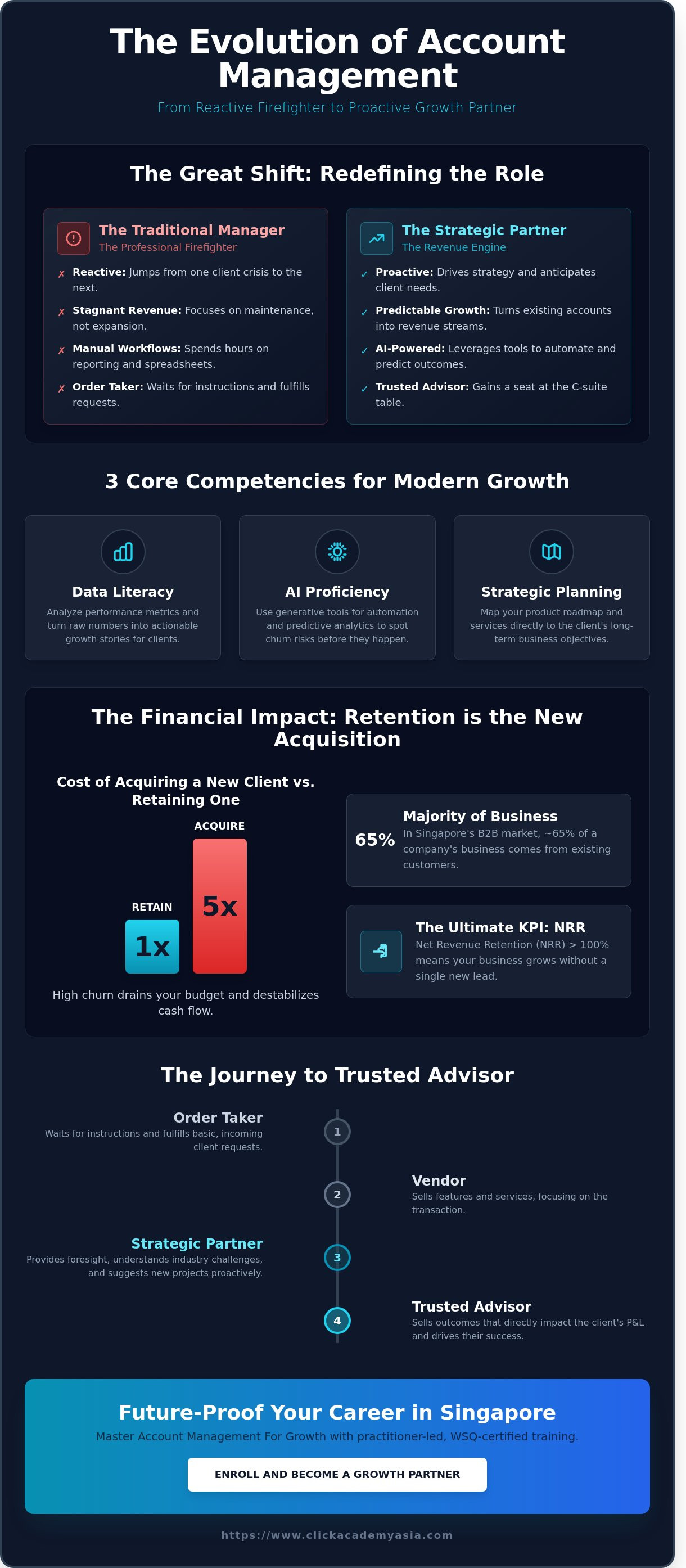
The shift from reactive "maintenance" to proactive "strategic advisory" is driven by a need for agility. Modern account managers in Singapore must move beyond the basics of client service to become indispensable partners. This evolution requires a specific set of core competencies that didn't exist a decade ago. To thrive, you need to master:
Data Literacy: The ability to analyse client performance metrics and turn raw numbers into actionable growth stories.
AI Proficiency: Using generative tools to automate reporting and predictive analytics to spot churn risks before they happen.
Strategic Planning: Mapping your product roadmap directly to the client's long-term business objectives.
The Cost of Churn vs. the Value of Growth
Acquiring a new client in the Singapore market can cost up to five times more than keeping an existing one. High churn rates don't just hurt your ego; they drain your marketing budget and destabilise your cash flow. Proactive Account Management For Growth protects your organisation’s financial bottom line by securing recurring revenue and reducing the pressure on your sales team. Modern account executives adopt a "growth mindset" by looking for untapped opportunities within their current portfolio. They don't wait for a brief to arrive; they suggest new projects that align with the client’s shifting needs.
Moving Beyond the "Vendor" Label
There is a massive difference between being an "order taker" and a "strategic partner." An order taker waits for instructions and fulfills requests, while a partner provides the foresight that helps a client avoid future pitfalls. To gain a seat at the client’s decision-making table, you must demonstrate that you understand their industry challenges as well as they do. This transition requires you to stop selling features and start selling outcomes that impact their P&L. Becoming a Trusted Advisor is the ultimate goal for any professional looking to drive sustainable business growth through relationship management.
Designing an Account Management Framework for Scalable Growth
To scale your business, you need a repeatable system. It's not enough to keep clients happy; you need a blueprint that transforms satisfaction into expansion. In Singapore's competitive B2B landscape, roughly 65% of a company's business comes from existing customers. This makes Account Management For Growth a strategic necessity rather than an administrative task. Start by segmenting your portfolio to focus your energy on high-yield accounts with the highest propensity to expand.
Setting KPIs that Actually Drive Revenue
Stop tracking activity and start tracking impact. Vanity metrics like the number of meetings held or emails sent don't pay the bills. Instead, prioritise Net Revenue Retention (NRR). If your NRR is consistently above 100%, your business is growing even before you acquire a single new lead. Successful Account Management For Growth requires more than just reactive support; it demands data-driven foresight.
Sit down with your client to co-create these KPIs. This builds mutual accountability and ensures your team's efforts align with their board-level objectives. For a Singapore-based digital agency, a KPI might be a 15% reduction in cost-per-acquisition over two quarters. In the manufacturing sector, it could be a 10% improvement in supply chain lead times through integrated software. Leveraging AI and Data Analytics helps you predict these needs and personalise every interaction before the client even identifies a gap.
The Anatomy of a Strategic Account Plan
A robust plan includes client goals, a detailed SWOT analysis, and a clear resource allocation strategy. You must perform a "gap analysis" to identify where your current services fall short of the client's long-term vision. This isn't about pointing out failures. It's about spotting opportunities where your expertise can solve their next big challenge.
Quarterly Business Reviews (QBRs) are your most powerful vehicle for presenting these opportunities. Use these sessions to move beyond troubleshooting. Present growth initiatives that align with their 2024 expansion plans in the ASEAN region. If you want to upskill your team to lead these high-level consultations, formal practitioner-led training is the best path forward.
Onboarding: Develop a standardised 30-day window to ensure the client sees immediate value.
Milestones: Set 60 and 90-day targets to track progress toward the partnership development plan.
Reviews: Schedule regular performance audits to keep the relationship focused on ROI.
This structured approach ensures every client receives the same high standard of care. Consistent delivery builds the trust required for long-term account expansion and sustainable revenue.
Leveraging AI and Data Analytics to Predict Client Needs
Artificial Intelligence is no longer a futuristic concept in Singapore's business hubs; it is a vital engine for productivity. By automating repetitive administrative tasks like data entry or meeting scheduling, AI allows account managers to redirect their energy toward high-level strategy. This shift is central to Account Management For Growth, as it moves the focus from reactive maintenance to proactive partnership. When your team isn't bogged down by manual reporting, they can spend more time listening to client challenges.
Predictive analytics enables you to identify "at-risk" accounts before a churn notice ever hits your inbox. By monitoring specific data signals, such as a 20% drop in platform logins or a delay in responding to milestone approvals, algorithms can flag accounts that need urgent care. In a market where retaining a client is significantly more cost-effective than winning a new one, these early warnings are essential for protecting your revenue base. You can then intervene with a targeted "save" strategy based on hard data rather than guesswork.
AI-driven sentiment analysis takes this a step further by scanning client communications to gauge satisfaction. These tools analyse the tone of emails and chat messages, alerting you if a client's sentiment shifts from "positive" to "neutral" or "frustrated." This real-time feedback loop ensures friction points are smoothed over immediately. Decision-making is further sharpened through real-time data dashboards, which provide a single source of truth for both the agency and the client.
AI Tools for the Modern Account Manager
Automated Reporting: Tools like Otter.ai or Fireflies.ai handle meeting summarisation, ensuring every action item is captured and assigned without manual note-taking.
Personalised Proposals: Generative AI assists in crafting tailored growth proposals by synthesising historical performance data into clear, persuasive recommendations.
The Human Element: Don't let technology replace the "coffee shop" rapport. AI should handle the data crunching, but your empathy and intuition must drive the final relationship decisions.
Data-Driven Trend Analysis
Reviewing account effectiveness requires enterprise-level monitoring tools like Salesforce or HubSpot. These platforms help you spot market trends that could impact a client’s specific industry, such as shifting consumer spending patterns in the Singapore retail sector. By identifying these shifts early, you can pivot your strategy to keep the client ahead of their competitors. Data transparency is the bedrock of this relationship; sharing live performance reports builds immense trust, as the client sees you are committed to honest, measurable results. Professionals looking to master these digital tools can explore practitioner-led training at ClickAcademy Asia to stay ahead of the curve.
Building Strategic Partnerships: From Vendor to Trusted Advisor
Moving beyond the "vendor" label requires a fundamental shift in your professional mindset. You aren't just a supplier fulfilling an order; you're a strategic extension of your client's team. High-impact Account Management For Growth focuses on shifting the relationship from transactional to transformational. This transition starts with a robust customer service improvement plan that identifies and removes friction points in the client journey. For example, a 2023 analysis of B2B relationships within a prominent national market found that resolving a client's pain point during the first interaction can increase long-term retention by up to 18%.
Value creation shouldn't stop at the initial contract. Approach "cross-selling" and "up-selling" as methods to solve emerging problems rather than just padding your revenue. If a client's data shows a gap in their digital reach, suggesting an omnichannel strategy isn't a sales pitch; it's a solution. To make this work, you must implement a consistent feedback loop. This ensures the client feels heard at every touchpoint, whether it's a formal quarterly review or a casual check-in over coffee.
Mastering Professional Sales Communication
Effective communication is built on active listening. You need to hear what isn't being said. Often, a client's hesitation about a project isn't about the cost in terms of investment but about internal stakeholder pressure. By identifying these unspoken needs, you position yourself as a problem solver. When a crisis occurs, don't shy away. Handle difficult conversations with radical transparency and clear timelines. Understanding the Psychology of Selling helps you align your communication with the buyer's actual intent. This allows you to manage expectations effectively while maintaining the trust you've worked hard to build.
Creating a Partnership Development Plan
Stop relying on a single point of contact. To secure the relationship, you must map the client's internal hierarchy and build multi-level coverage. This means engaging with the C-suite for strategic alignment while supporting the operational staff who use your services daily. A structured partnership plan should include:
Stakeholder Mapping: Identify the decision-makers, influencers, and end-users within the organisation.
Value-Add Initiatives: Provide exclusive industry insights or early access to pilot programmes that aren't available to the general market.
Strategic Reviews: Move away from "status updates" and focus on how your partnership drives their specific business KPIs.
By offering these high-value "extras," you create a partnership that's difficult to replace. You become an essential part of their success story, rather than just another line item in their annual budget. Ready to elevate your professional influence? Master the art of strategic account management with ClickAcademy Asia today.
Master Account Management For Growth with WSQ-Certified Training
Turning a standard client relationship into a long-term revenue engine requires more than just good intentions; it demands a structured framework. The ClickAcademy Asia Account Management For Growth course provides exactly that. This professional solution is designed for Singapore-based PMEBs who want to move beyond reactive service and start driving proactive business results through strategic relationship building.
One of the biggest advantages for local professionals is the WSQ-certified nature of the modules. These aren't just academic exercises. They're vetted by SkillsFuture Singapore (SSG) to ensure they meet rigorous industry standards. Because the programme is SSG-certified, eligible individuals and companies can access significant subsidies to reduce out-of-pocket costs. This makes high-level training accessible for teams of all sizes, from agile startups to established enterprises.
You won't be learning from textbooks alone. Our practitioner-led approach means your trainers are industry veterans who have managed multi-million dollar accounts in the Singapore market. They focus on real-world application, giving you the tools to solve actual business challenges the moment you return to the office. This mentorship-style delivery ensures that you gain the confidence to handle complex negotiations and high-stakes client interactions.
What to Expect from the WSQ Programme
The curriculum is designed to be intensely practical and action-oriented. You'll learn how to develop robust KPIs that actually reflect account health and monitor sales performance with precision. Instead of just listening to lectures, you'll engage in hands-on workshops where you'll apply new concepts immediately. One key exercise involves creating a comprehensive customer satisfaction enhancement plan tailored to your specific industry needs.
For those looking to broaden their expertise, this course pairs perfectly with our WSQ Digital Marketing Strategy & Planning programme. Combining Account Management For Growth skills with a holistic digital strategy ensures you can support your clients across every touchpoint of their journey. This integrated approach is essential for anyone aiming to become a versatile leader in the modern business environment.
Future-Proof Your Career in Sales and Marketing
The 2026 job market will reward professionals who can prove their value through recognised certifications. Having a WSQ-certified credential on your CV provides a distinct competitive advantage. It signals to employers that your skills are current, industry-validated, and grounded in practical excellence. Whether you're self-sponsored or your company is looking to upskill its workforce, the enrollment process is straightforward and efficient.
Don't leave your career trajectory to chance. Take the next step in your professional development and start delivering measurable value to your clients. Enrol in the Account Management For Growth course today and lead your business into its next phase of success.
Future-Proof Your Strategy for 2026
Transitioning from a reactive vendor to a proactive strategic advisor is no longer optional for Singapore professionals. By 2026, the industry will rely on AI-driven data to anticipate client needs and structured frameworks that allow for scalable expansion. Success in Account Management For Growth requires a blend of technical precision and the human touch that transforms simple transactions into lasting partnerships.
You don't have to navigate these technological shifts alone. Our practitioner-led training is designed by industry experts who bring real-world experience to every session. We offer WSQ-certified and SSG-funded programmes, making high-level professional development accessible to the local workforce. As an official partner of Google and the Digital Marketing Institute, ClickAcademy Asia ensures your certification carries weight both locally and globally.
Master the art of Account Management For Growth, enrol with ClickAcademy Asia now. Take the next step to secure your place as a leader in the digital economy. You have the tools; it's time to start building.
Frequently Asked Questions
What is the primary difference between account management and sales?
Sales focuses on the initial acquisition of new business and closing the first deal with a prospect. Account management, however, centres on nurturing that relationship to ensure long-term retention and expansion. While a salesperson often moves to a new lead once the contract is signed, an account manager stays to help the client achieve specific business goals through Account Management For Growth. This shift from transactional selling to relational partnership is what drives sustainable revenue.
How does the WSQ framework benefit my account management career?
The WSQ framework provides a nationally recognised standard for skills that employers in Singapore highly value. By completing a WSQ-aligned course, you gain practical competencies that are validated by SSG, which can lead to better career progression and higher salary benchmarks. It ensures your training isn't just theoretical; you'll master industry-standard tools and techniques that are directly applicable to your daily work. This certification serves as a powerful signal of your professional expertise to current and future employers.
Can I use SkillsFuture credits for the Account Management For Growth course?
Yes, you can use your SkillsFuture Credit to offset the fees for our practitioner-led training programmes. Singapore Citizens aged 25 and above receive an initial S$500 credit, while those aged 40 to 60 may have access to additional top-ups through the SkillsFuture Level-Up Programme. This financial support makes it much easier to invest in your professional development without significant out-of-pocket costs. Always check your current credit balance on the MySkillsFuture portal before enrolling to confirm your available subsidy.
How is AI currently being used in strategic account management?
AI is transforming the industry by providing predictive analytics that can identify potential client churn up to 90 days in advance. Account managers use automated tools to handle 40% of their administrative tasks, such as meeting transcription and CRM updates, allowing them to focus on high-level strategy. These technologies also analyse vast amounts of data to suggest personalised product recommendations. This data-driven approach ensures you're always providing relevant solutions that meet your client's evolving needs.
What are the most important KPIs for measuring account growth?
The most critical metric is Net Revenue Retention (NRR), which tracks the percentage of recurring revenue retained from existing customers over a specific period. You should also closely monitor Customer Lifetime Value (CLV) to understand the total projected worth of a client relationship. Effective Account Management For Growth typically aims for an NRR of 100% or higher, indicating that expansion revenue is successfully offsetting any losses. Other vital indicators include your Net Promoter Score (NPS) and the frequency of strategic business reviews.
What happens if a client is resistant to a strategic partnership?
If a client prefers a transactional relationship, start by delivering three immediate "quick wins" that solve their most urgent pain points. Use these small successes to build a foundation of trust before you try to introduce more complex strategic initiatives. Resistance often occurs when a client doesn't see enough tangible value, so providing a clear ROI report every quarter can help shift their perspective. It's about proving you're an essential partner rather than just another vendor on their balance sheet.
Is this course suitable for professionals outside of the digital marketing industry?
This course is highly relevant for anyone in a B2B or client-facing role, including professionals in finance, logistics, or SaaS. The core principles of relationship management and strategic planning are universal across all service-based sectors in Singapore. Our modules focus on transferable skills such as negotiation, stakeholder mapping, and long-term account planning. Whether you're managing a marketing budget or a multi-million dollar supply chain, these frameworks will help you drive more value from your existing portfolio.
How long does it take to see results from a strategic account management plan?
You'll typically start seeing measurable improvements in client engagement and communication within the first 60 to 90 days. However, the financial impact of a new strategy, such as increased upsell revenue, usually takes two full quarters to manifest in your reports. This timeline allows for the completion of at least one or two quarterly business reviews where you can demonstrate value and propose new solutions. Consistency is key, as the most significant growth comes from compounding small wins over a 12-month period.


Comments