
Marketing Mix Modeling: 2026 Singapore Leaders Guide
- ClickAcademy Asia

- 4 hours ago
- 12 min read
With 71% of businesses in the Asia-Pacific region now offering subscription-based models, the race for recurring revenue has never been more crowded. In the Singapore market, you're likely facing the triple threat of rising acquisition costs, signal loss from privacy regulations, and the headache of inaccurate attribution for long customer journeys. It's frustrating when you can't clearly demonstrate how top-of-funnel brand spend directly impacts churn or long-term retention.
We understand that securing board-level buy-in requires evidence-based strategy rather than guesswork. This guide will teach you how to apply marketing mix modeling for subscription services to accurately optimise your budget and improve your LTV to CAC ratios. You'll gain a clear framework for data-driven decision-making that respects the latest PDPA notifications while maximising every dollar of your marketing spend.
We will break down how to transition from basic conversion tracking to measuring incremental lifetime value through sophisticated, WSQ-aligned analytical techniques. By the end of this article, you'll have the insights needed to future-proof your marketing strategy and lead your team toward sustainable, scalable growth.
Table of Contents
Understanding Marketing Mix Modeling for Subscription Services
Marketing Mix Modeling (MMM) is a top-down statistical framework that quantifies the impact of various marketing inputs on business outcomes. In 2026, it has become the gold standard for privacy-safe measurement in Singapore. Unlike granular tracking, Understanding Marketing Mix Modeling involves using aggregated historical data to determine how each channel contributes to your bottom line without relying on individual user identifiers. This approach is particularly vital since the July 20, 2026, PDPA updates requiring AI-specific notifications for personal data usage.
For subscription-based businesses, traditional last-click models used by many Singaporean SMEs are dangerously misleading. These models often credit the final search ad for a sign-up, ignoring the months of brand-building that prevented a potential customer from churning before they even converted. To truly master marketing mix modeling for subscription services, leaders must shift their focus toward "Incremental Recurring Revenue". This variable measures the additional subscription value generated by marketing efforts that wouldn't have occurred spontaneously, providing a more honest reflection of long-term growth.
The Evolution of Measurement in Singapore
The local digital landscape has shifted dramatically. With 71% of businesses in the APAC region now offering subscription models, the competition for attention is fierce. PMEBs are moving away from cookie-based tracking toward econometric modelling to bypass the signal loss caused by stricter browser privacy and regional regulations. Strategic planning is no longer about following a user across the web; it's about understanding the macro-drivers of your business. Professionals looking to lead this transition often start by refining their expertise through a WSQ Digital Marketing Strategy & Planning programme, which emphasizes these high-level analytical shifts.
Why Subscriptions Demand a Specialized Model
Subscription models aren't one-off transactions, so your measurement shouldn't be either. Recurring billing cycles complicate standard "cost-per-acquisition" (CPA) math because a high acquisition cost might be justified by a low churn rate three years down the line. A specialized model helps you see these connections clearly. Consider these unique factors:
Brand-Building vs. Churn: Consistent brand presence often acts as an "insurance policy" against churn, a relationship that MMM can quantify through decay effects.
Pricing Tier Interactions: Marketing effectiveness varies across your "Basic", "Pro", and "Enterprise" tiers. Advanced modelling identifies which channels drive high-value upgrades versus low-margin trials.
Delayed Impact: Subscription decisions in the Singapore corporate sector often involve long gestation periods. Marketing mix modeling for subscription services accounts for these time lags, ensuring you don't cut budgets for channels that take months to bear fruit.
By adopting this econometric approach, you move from reactive spending to proactive investment. It's about building a sustainable engine that rewards long-term customer health over short-term vanity metrics.
Essential Data and Metrics for Subscription MMM
To build a reliable model, you need a solid data foundation. Most experts recommend at least two to three years of historical weekly data to account for seasonality and long-term trends. In the context of marketing mix modeling for subscription services, your internal data must go beyond simple media spend. You should categorise your inputs into three core pillars:
Marketing Spend: Granular weekly investment across digital and traditional channels.
Business Volume: New sign-ups, trial starts, and reactivation numbers.
Customer Health: Churn rates, renewal figures, and net promoter scores.
A critical part of the process is separating "Base" revenue from "Incremental" revenue. In a subscription model, your Base consists of existing customers who would likely renew regardless of this week's ads. Incremental revenue represents the new sign-ups or upgrades directly triggered by your marketing efforts. Distinguishing these helps in improving marketing ROI by showing where your spend actually moves the needle.
Capturing the Recurring Revenue Signal
Modelling Monthly Recurring Revenue (MRR) requires treating it as a continuous time-series variable rather than a series of isolated events. You should also account for "Expansion Revenue," which includes upsells or cross-sells to your current user base. For the purpose of statistical modelling, Customer Lifetime Value (LTV) is defined as the discounted total net profit a business expects to earn from a customer over the entirety of their relationship. Equipping your team to handle these complex datasets is a strategic priority; you can explore our WSQ Marketing Analytics & Insights course to see how SSG funding can support your upskilling journey.
External Variables and Market Factors
A robust marketing mix modeling for subscription services requires layering in external context to avoid misattributing sales growth. In Singapore, festive periods like Chinese New Year or the year-end holiday season significantly impact consumer and B2B behaviour. Local government grant cycles, such as the SkillsFuture Enterprise Credit (SFEC) deadline on 30 November 2026, also trigger surges in demand for specific services.
By layering in economic indicators like Singapore's quarterly GDP growth or consumer price index (CPI) changes, you can isolate the impact of the economy from your marketing performance. You must also model competitor pricing shifts, as a rival's discount can often look like a failure of your own marketing effectiveness if not accounted for. Using [External Link: local statistic/industry study] allows you to calibrate these assumptions against broader market realities, ensuring your model reflects the unique Singaporean ecosystem.
MMM vs. Multi-Touch Attribution: Why Subscriptions Need Both
Choosing between top-down and bottom-up measurement is often framed as a binary choice, but for 2026, it's a false dichotomy. Marketing Mix Modeling (MMM) provides the strategic, top-down view that accounts for all factors, including offline media and external economic shifts. Conversely, Multi-Touch Attribution (MTA) offers a bottom-up, tactical perspective on digital interactions. When implementing marketing mix modeling for subscription services, you must use both to avoid a skewed reality.
In the Singapore market, relying purely on MTA typically leads to overvaluing lower-funnel channels like Search or Retargeting. This happens because MTA sees the final click before a sign-up and ignores the months of brand-building that preceded it. The solution is Unified Marketing Measurement (UMM), a framework that reconciles these two signals. By using GA4 to provide granular, event-based data, you can validate the broader trends identified by your econometric model, ensuring your strategic decisions are grounded in tactical truth.
The Limitations of Digital Attribution
Last-click attribution is a relic of a simpler era. It fails to credit the typical six-month consideration period common in the SaaS and subscription sectors. If a potential customer sees your LinkedIn ads for three months before finally searching for your brand name to subscribe, MTA will erroneously give 100% of the credit to Search. This ignores the "halo effect," where your brand-building efforts are the actual drivers of those digital conversions.
To fix this, you need a robust data collection strategy. Proper event tracking and user property definitions in your analytics platform are essential for feeding high-quality data into your model. You can find technical tips on setting this up in our guide on marketing analytics with GA4, which explores how to capture the signals that matter for long-term modelling.
Triangulating for Truth
The most successful Singaporean organisations don't just trust the model; they verify it. Cross-validation involves comparing your MMM outputs against real-world experiments to ensure the coefficients are accurate. One of the most effective methods is Geo-lift testing. By running aggressive subscription campaigns in one specific Singaporean region while maintaining a baseline in another, you can measure the true incrementality of your spend.
This triangulation allows for a dynamic budget re-optimisation framework. Instead of waiting for an annual review, you can adjust your channel mix monthly based on dual signals. If your marketing mix modeling for subscription services suggests that your YouTube spend is driving long-term retention but MTA shows zero conversions, you can use incrementality tests to prove the model right before scaling your investment. This evidence-based approach is exactly what's needed to secure confidence from your board and HR decision-makers.
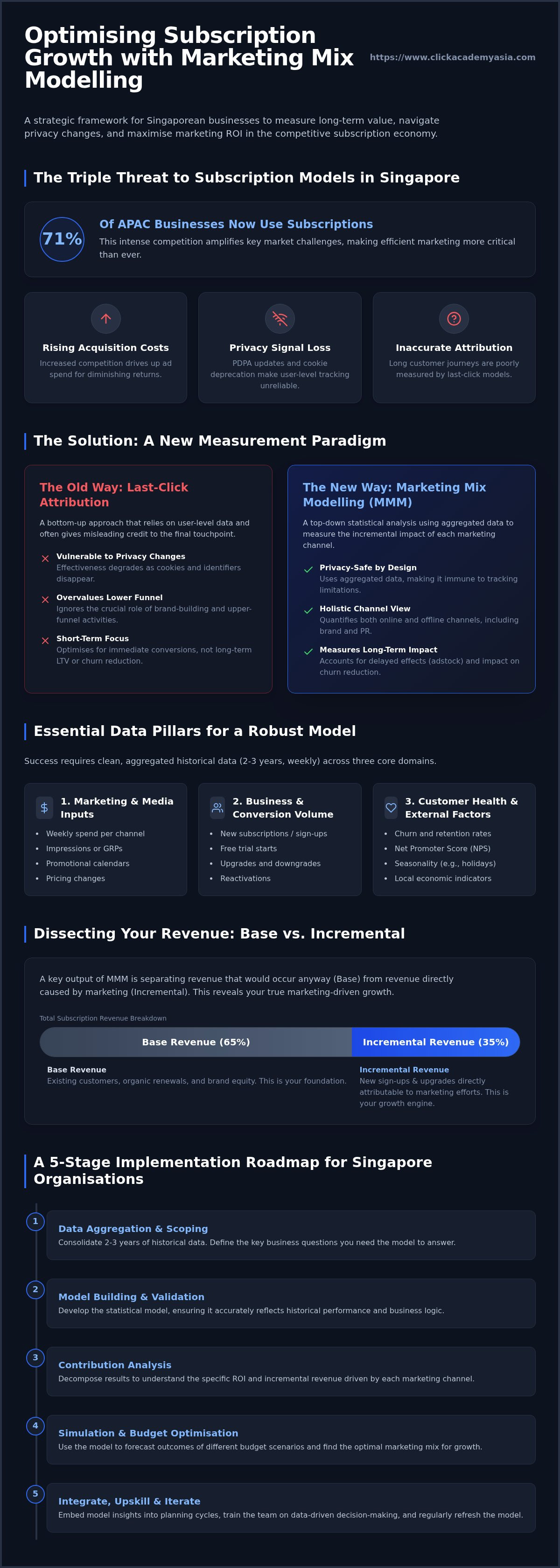
Building an Implementation Roadmap for Singapore Organisations
Successful adoption of marketing mix modeling for subscription services isn't just a technical project; it's a structural shift in how your business values its growth. Singaporean marketing leaders must first navigate the "Build vs. Buy" dilemma. While external software provides a quick start, building an in-house capability ensures your model is deeply integrated with your specific product tiers and customer health metrics. Regardless of the path, you must align Finance, Sales, and Marketing on new KPIs that prioritise incremental recurring revenue over vanity conversion counts.
The roadmap to a functional model typically follows five distinct stages:
Data Audit: Assessing the quality and availability of historical signals.
Model Design: Defining variables, including external Singaporean economic indicators.
Development: Building the statistical engine and calibrating with GA4 data.
Validation: Running incrementality tests to prove the model's accuracy.
Strategic Execution: Reallocating budgets based on high-LTV channel signals.
Stage 1: Data Audit and Governance
Data silos are the primary hurdle for Singaporean firms. Marketing spend often lives in one department, while CRM data and financial renewal logs reside in another. To ensure your model produces actionable insights, you need a consistent taxonomy across every media channel. Use this checklist to assess your readiness:
Do you have at least 156 weeks of clean, weekly marketing spend data?
Is your churn and renewal data timestamped accurately at the customer level?
Have you standardised naming conventions across LinkedIn, Google Ads, and offline events?
Can you isolate the impact of SSG-funded promotional cycles on your sales volume?
Leveraging SSG Support for Analytics
Upskilling your team is the most effective way to bridge the gap between raw data and strategic execution. Under the current 2026 guidelines, Singaporean companies can utilise SSG funding to reduce the cost of training their PMEBs in advanced measurement. WSQ-certified professionals are better equipped to maintain the model's integrity and interpret complex econometric outputs for the board. You can find the foundational strategy required for this transition in our guide on WSQ digital marketing courses in Singapore. To ensure your team is ready to lead this implementation, consider enrolling them in our WSQ Marketing Analytics & Insights programme today.
Future-Proofing Your Strategy: Upskilling in Marketing Analytics
In 2026, relying solely on automated software is a strategic risk. The true competitive edge for Singaporean organisations isn't the model itself, but the team's ability to interpret and act on its outputs. By mastering marketing mix modeling for subscription services, you transition from a tactical executor to a strategic partner capable of defending budgets at the board level. You stop being a cost centre and start being a revenue architect who understands the nuance of every dollar spent.
For PMEBs, this isn't just about technical proficiency; it's about career longevity. Obtaining WSQ Marketing Analytics certifications signals that you can navigate complex data privacy landscapes like the PDPA while maintaining aggressive growth targets. This high-level literacy allows you to translate statistical coefficients into business stories that resonate with Finance and Sales leaders alike. It's the difference between reporting on clicks and reporting on incremental shareholder value.
Bridging the Analytics Skill Gap
There's a massive demand for data-driven leaders in the APAC region who can marry creativity with econometrics. ClickAcademy Asia’s modules are specifically designed to bridge the gap between academic theory and real-world application. We don't just teach the "what"; we show you the "how" through hands-on practice with Singaporean business datasets. For those looking to master the full digital funnel, understanding advanced keyword research strategies provides the complementary skills needed to feed high-quality signals into your statistical models.
Your Next Steps: From Insight to Action
The journey toward measurement excellence doesn't have to be overwhelming. We recommend a pilot-first approach to marketing mix modeling for subscription services to build internal confidence and prove the concept before a full-scale rollout. This allows you to calibrate your variables and demonstrate quick wins to stakeholders without over-committing resources. It also provides a tangible case study to justify further investment in team-wide upskilling.
Individual PMEBs can leverage their SkillsFuture Credit for upskilling, while companies can tap into significant SSG funding to train entire departments. The current SkillsFuture Enterprise Credit (SFEC) scheme is scheduled to end on 30 November 2026, making this the ideal window to invest in your team’s future-ready capabilities. Don't let your measurement strategy fall behind the curve. Join our next WSQ Digital Marketing Strategy & Planning cohort to gain the practical mastery required to lead your organisation toward sustainable, evidence-based growth.
Mastering the Future of Subscription Measurement
The shift toward marketing mix modeling for subscription services represents more than just a technical upgrade; it's a strategic mandate for 2026. By reconciling top-down econometric signals with granular GA4 data, you can finally move beyond the limitations of last-click attribution and accurately value every touchpoint in the long customer journey. Your most significant asset isn't the software you buy, but the analytical maturity of your team.
Singaporean organisations are uniquely positioned to lead this change by leveraging local support frameworks. You can significantly reduce the barrier to entry by tapping into SSG-subsidised courses designed for practical APAC business cases. These expert-led workshops provide the practical mastery needed to turn complex datasets into board-level strategy while earning official Google and WSQ certifications.
Equip your team with advanced measurement skills through WSQ-funded training tracks at ClickAcademy Asia. We're here to help you navigate this evolving technological landscape with confidence and precision.
Frequently Asked Questions
How much historical data is needed for a subscription marketing mix model?
You typically require at least two to three years of historical weekly data to build a reliable model. This duration is necessary to capture annual seasonality and account for the long-term trends inherent in recurring revenue cycles. By using a longer timeframe, marketing mix modeling for subscription services can distinguish between short-term spikes and sustainable growth. This historical depth ensures your statistical coefficients accurately reflect how different channels influence your customer base over time.
Can MMM accurately measure the impact of marketing on customer churn?
Yes, it can quantify the relationship between marketing inputs and retention rates. Unlike digital tracking, which only sees the point of cancellation, MMM treats churn as a variable influenced by brand-building and consistent media presence. It allows you to see how sustaining awareness spend reduces the probability of a customer leaving. This helps leaders justify "always-on" brand investment as a strategic insurance policy against rising churn in the competitive Singaporean market.
Is marketing mix modeling suitable for B2B subscription services?
It is highly effective for B2B sectors where consideration periods often span several months. B2B subscriptions rarely result from a single click; they involve multiple stakeholders and complex decision-making processes. MMM excels here by looking at the aggregate impact of your efforts over these extended periods. It provides a more realistic view of how your whitepapers, webinars, and trade events contribute to long-term contract wins compared to last-click digital models.
How does MMM handle the impact of Singapore-specific seasonality?
The model incorporates Singapore-specific events as external regressors to isolate their impact on your subscription volume. Factors such as Chinese New Year, the June school holidays, and year-end festive periods are layered into the data. It also accounts for local government cycles, such as the SkillsFuture Enterprise Credit (SFEC) deadlines. By identifying these patterns, you can ensure that a natural seasonal surge isn't misattributed to your marketing spend or vice versa.
What is the difference between MMM and multi-touch attribution for SaaS?
MMM is a top-down, econometric approach that uses aggregated data, while multi-touch attribution (MTA) is a bottom-up, user-level method. MTA often overvalues lower-funnel channels like Search because it misses the broader brand influence. For SaaS leaders, MMM provides a privacy-safe way to measure ROI across all channels, including offline ones. Using both approaches together allows you to reconcile strategic budget allocation with tactical digital performance for a more holistic view.
Are there government subsidies available for marketing analytics training in Singapore?
Singaporean citizens and Permanent Residents can access significant SSG funding for WSQ-certified programmes. For example, the SkillsFuture Mid-Career Enhanced Subsidy (MCES) provides up to 90% course fee coverage for Singaporeans aged 40 and above. Eligible organisations can also utilise the SkillsFuture Enterprise Credit (SFEC) to offset out-of-pocket expenses for their employees. These subsidies make advanced analytics training accessible for teams looking to master strategic measurement without a high cost barrier.
How often should a subscription business refresh its marketing mix model?
You should aim to refresh your model at least every quarter to remain agile in the fast-moving Singaporean economy. Some organisations prefer a monthly cadence to align with their budget re-optimisation cycles. Frequent updates allow you to account for sudden shifts in competitor pricing, changes in consumer sentiment, or new regulatory updates like the PDPA. Regular maintenance ensures your model remains a living strategic tool rather than a static historical report.
Can MMM be implemented by small subscription startups with limited budgets?
Implementation is possible for smaller teams by adopting a pilot-first approach and using open-source frameworks. Startups don't need expensive proprietary software to begin their journey into marketing mix modeling for subscription services. The key is to focus on internal data literacy and governance from day one. By upskilling your current staff through WSQ-funded training, you can build a sustainable, in-house capability that grows alongside your business without relying on costly external consultants.



Comments