
Building a Winning Sales Enablement Content Strategy for Singapore Professionals in 2026
- ClickAcademy Asia

- 19 hours ago
- 11 min read
Did you know that buyers in Singapore now complete 70% of their purchasing journey before they even speak to your sales team? It's a sobering reality for PMEBs who find their marketing collateral gathering dust while sales reps struggle with inconsistent messaging. You likely agree that a disconnected engine is a major barrier to hitting your 2026 revenue targets, making a structured sales enablement content strategy more critical than ever for maintaining a competitive edge.
This guide promises to help you bridge that gap and drive measurable ROI through better team alignment. We will explore how to synchronise your departments and utilise SSG funding for WSQ-accredited training to ensure your staff are equipped for the modern buyer. From practical "how-to" insights to leveraging local upskilling frameworks, you'll discover how to transform your content into a high-performance sales tool. By focusing on practical mastery, your organisation can turn every piece of collateral into a conversion-driving asset.
Table of Contents
Aligning Sales and Marketing in the Singapore Business Ecosystem
In 2026, the traditional divide between sales and marketing is no longer just a nuisance; it's a significant financial liability. A robust sales enablement content strategy acts as a collaborative framework that ensures your teams aren't working at cross-purposes. It's about creating a unified voice that guides a prospect from curiosity to commitment without friction. Sales enablement content strategy is the bridge between brand awareness and revenue generation.
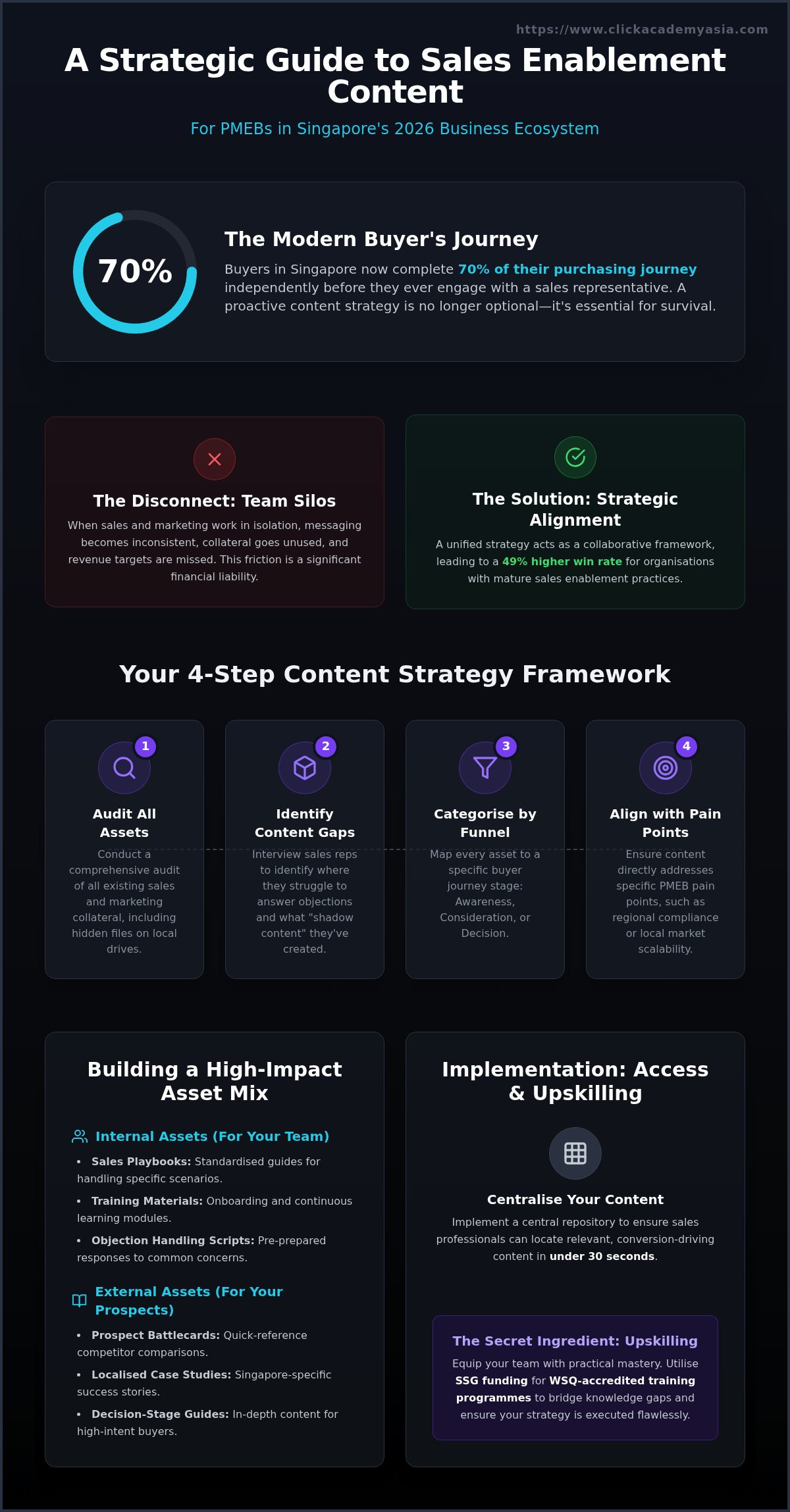
Traditional silos fail in Singapore's high-stakes corporate landscape because information moves too slowly to meet market demands. When marketing produces content without consulting the frontline, the result is collateral that reps simply don't use. Modern Sales operations now require PMEBs to act as strategic champions, ensuring every asset supports the entire funnel. Research shows that organisations with a mature strategy see a 49% higher win rate, proving that alignment is a fundamental growth lever.
To better understand this concept, watch this helpful video:
The 2026 Buyer Journey for PMEBs
Digital-first buyers in Singapore are more informed than ever before. Research from 2026 indicates they complete approximately 70% of their purchasing process before even engaging with a sales representative. This shift requires a move away from aggressive selling towards helpful, value-driven communication that respects the buyer's intelligence. Your collateral must sound authentic and human. Avoid robotic clichés that alienate savvy local professionals who value transparency and practical expertise over empty buzzwords.
Why Upskilling is the Secret Ingredient
Even the most sophisticated strategy will fail if your team doesn't know how to execute it effectively. This is where upskilling becomes the secret ingredient for success within the local business ecosystem. By enrolling in a WSQ Content Marketing Strategy programme, your team gains the practical skills needed to bridge the knowledge gap. Leveraging WSQ frameworks and SSG funding ensures your professionals are future-proofed without straining corporate budgets. Practical mastery is what separates market leaders from those who merely follow the status quo.
Auditing and Mapping Content to the 2026 Sales Funnel
Many organisations make the mistake of producing more volume when they should be focusing on relevance. A successful sales enablement content strategy starts with a forensic audit of your current collateral. It's about ensuring your sales team isn't digging through cluttered folders for assets that no longer reflect your 2026 value proposition. You need a library that is lean, updated, and ready for high-stakes interactions.
Follow these four foundational steps to bring order to your content library:
Step 1: Conduct a comprehensive audit of all existing marketing and sales assets, including "hidden" files on local drives.
Step 2: Identify content gaps where sales reps currently struggle to answer tough objections or technical queries.
Step 3: Categorise assets by funnel stage: Awareness, Consideration, and Decision to ensure full journey coverage.
Step 4: Align content with specific PMEB pain points, such as regional compliance or local market scalability.
The Content Gap Analysis
To find out what's truly missing from your arsenal, you must interview your sales team directly. Reps often create their own "shadow content" because the official marketing materials feel too detached from the reality of the Singapore boardroom. These self-made scripts and decks are goldmines for identifying what prospects actually ask during the 70% of the journey they complete alone. Focus on these practical solutions as "quick wins" to boost team confidence and drive immediate impact without reinventing the wheel.
Mapping Assets to Intent
Mapping is the strategic process of matching the right content to the prospect's current mindset. Use Decision-stage assets like localised case studies for buyers showing high-intent signals, such as searching for specific implementation details. You can apply advanced keyword research strategies to inform your content mapping and identify exactly what your prospects are looking for. Always ensure that every piece of content, from a blog post to a pricing sheet, contains a logical and actionable next step to keep the buyer moving forward.
Mastering this alignment requires a deep understanding of digital behaviour and content performance. By enrolling in a WSQ Content Marketing Strategy course, you can gain the hands-on skills needed to audit and map your assets effectively. This upskilling ensures your team can build a strategy that isn't just theoretical but is grounded in practical, real-world application.
Internal vs. External Assets: Building a High-Impact Mix
A high-impact sales enablement content strategy requires a sophisticated balance between the tools your team uses behind the scenes and the materials your prospects consume. Internal assets empower your reps with the confidence to handle complex negotiations, while external assets validate your solution in the eyes of the buyer. In 2026, achieving this balance means moving beyond static PDFs to dynamic, data-backed resources that reflect current market realities.
With 80% of Singaporean sales organisations now utilising AI for tasks like prospecting and coaching, your content mix must be agile. Success depends on using high-value descriptors that establish immediate credibility with sophisticated PMEBs. You shouldn't just provide information; you must provide strategic insights that position your team as indispensable partners rather than mere vendors.
Essential Internal Enablement Tools
Sales Playbooks: These serve as the definitive "source of truth" for your sales methodology, ensuring every team member follows a proven, scalable process.
Competitor Battlecards: Vital for the Singapore market, these should prioritise scripts that address 2026-specific objections, such as regional data sovereignty or local integration capabilities.
Training Materials: Continuous learning modules are essential for keeping the team agile, especially as 91% of local sellers report that partner selling is increasingly vital for hitting revenue targets.
Your internal library should be a living ecosystem. By integrating WSQ Content Marketing Strategy principles, you can ensure your internal playbooks are as engaging and persuasive as your external marketing. This commitment to practical mastery ensures your team remains sharp in a competitive landscape.
External Content that Closes Deals
External content must be designed to build trust quickly in a digital-first environment. Case studies should focus on regional success stories, as local trust is a primary driver for Singaporean decision-makers. Personalised one-pagers are no longer optional; 91% of sellers using AI report it helps them deepen customer understanding, allowing for hyper-tailored value propositions. Interactive demos provide an experiential layer that static content cannot match, allowing prospects to interact with the solution before committing.
While AI-driven personalisation is a powerful tool, it's crucial to maintain a human touch. Your external collateral should use authentic language that reflects a supportive mentor relationship. This approach ensures your brand remains relatable while leveraging the efficiency of modern technology to drive higher win rates and quota attainment for your organisation.
Implementing Your Strategy: Tools, Training, and SSG Funding
Execution is where most plans falter. You need a central repository that allows your team to locate high-impact assets in under 30 seconds. A winning sales enablement content strategy is useless if the collateral remains buried in obscure email threads or outdated folders. Reps who can't find what they need will simply stop looking and revert to using outdated materials.
Your rollout plan must be deliberate. It should include collaborative training sessions where marketing explains the strategic intent behind each asset. Simultaneously, sales reps must provide real-world feedback for further optimisation. This feedback loop ensures the content stays relevant to the 2026 buyer and strengthens the partnership between both departments.
Singaporean government support acts as a powerful catalyst for these corporate upskilling initiatives. By leveraging SSG funding, you can significantly offset the costs of professional development. HR decision-makers should view this training not as a mere expense; it's a strategic investment in the organisation's revenue-generating engine.
Utilising WSQ Frameworks for Strategy Execution
The WSQ Content Marketing Strategy course provides a ready-made framework that simplifies the implementation process. Having a certified professional lead your enablement project ensures that your strategy aligns with national competency standards. This structured approach helps you build a sustainable internal ecosystem that survives personnel changes. You can enrol your team in our WSQ-accredited training to begin this transformation and ensure your sales enablement content strategy is built on a solid foundation.
For a deeper look at the available options, refer to our guide on WSQ digital marketing courses in Singapore. These programmes are designed to turn theoretical knowledge into practical mastery for PMEBs.
Maximising SSG Funding and SkillsFuture Credits
Eligible Singaporean companies can claim substantial subsidies for WSQ-accredited courses. Small and Medium-sized Enterprises (SMEs) often receive up to 90% funding, while larger corporations typically qualify for a baseline subsidy of up to 70%. For employees aged 40 or above, the Mid-Career Enhanced Subsidy (MCES) provides up to 90% coverage regardless of company size. This co-payment mechanism makes high-level training accessible for corporate cohorts of all scales.
Time is of the essence for those looking to utilise the SkillsFuture Enterprise Credit (SFEC). This one-off S$10,000 credit covers up to 90% of out-of-pocket expenses but is currently scheduled to end on 30 November 2026. A new digital wallet model for SFEC is set to launch in the second half of 2026, which will allow for immediate cost offsetting. Additionally, organisations can claim Absentee Payroll (AP) funding at a rate of S$4.50 per hour, capped at S$100,000 per organisation per calendar year. These financial levers allow you to upskill your team while maintaining healthy cash flow.
Future-Proofing Your Strategy with ClickAcademy Asia
Building a robust sales enablement content strategy involves more than just adopting new software; it's about aligning your people and processes with the 2026 buyer. ClickAcademy Asia acts as your strategic mentor, guiding Singaporean PMEBs through the complexities of a digital-first marketplace. We focus on the practical application of knowledge, ensuring your team moves beyond theory to master the tools that drive revenue. Building your sales enablement content strategy is the first step toward a future-ready workforce.
Why Choose WSQ-Funded Training?
WSQ certifications are the gold standard for professional development in Singapore, offering both prestige and practical utility. Our programmes are led by expert trainers who possess deep roots in the APAC business landscape and real-world regional experience. You won't just learn about strategy; you'll learn how to navigate the specific cultural and economic nuances that define our territory. This commitment to excellence ensures your staff aren't just keeping pace but are actively shaping the future of their industries.
Your Next Steps to Sales Excellence
Transformation begins with a clear-eyed assessment of your current state. Start by reviewing your existing collateral to pinpoint the biggest gaps that cause friction during the sales cycle. Once you've identified these weaknesses, equip your team with the specific skills required to execute a high-level strategy. This proactive approach turns your content library from a passive archive into a dynamic engine for growth.
To ensure your success, keep this actionable summary at the forefront of your planning:
Audit: Evaluate every existing asset for relevance, accuracy, and 2026 compliance.
Map: Align your content with buyer intent and the specific stages of the sales funnel.
Upskill: Enrol in a WSQ Content Marketing Strategy course to master modern techniques.
Optimise: Use sales feedback and data analytics to refine your approach continuously.
By following this structured path, you'll create a unified sales and marketing engine that delivers consistent results. Don't let your team struggle with outdated methods when the tools for mastery are within reach. We encourage you to equip your team with future-ready skills through our WSQ-funded training tracks today. Developing a world-class sales enablement content strategy is the most effective way to secure your organisation's success in the years to come.
Empowering Your Team for the 2026 Boardroom
Success in Singapore's competitive landscape now hinges on your ability to provide the right value at the exact moment a prospect needs it. By auditing your assets and aligning your sales and marketing functions, you transform static documents into powerful conversion tools. A structured sales enablement content strategy ensures that your team remains agile, consistent, and deeply relevant to the modern digital buyer. Practical mastery is the only way to move from simply managing a pipeline to dominating your market territory.
ClickAcademy Asia stands ready to support your transformation as a WSQ-accredited training provider and official Google Certification Partner. With over 12 years of executive education excellence in Singapore, we help PMEBs navigate technological shifts with confidence. Equip your team with a future-ready sales enablement content strategy through our WSQ-funded training programmes. Take the lead today and build a workforce that is not just prepared for the future, but is actively defining it.
Frequently Asked Questions
What is the difference between content marketing and sales enablement content?
Content marketing focuses on building brand awareness and attracting leads through educational or entertaining material. In contrast, sales enablement content is specifically designed to help your reps move prospects through the funnel and close deals. It includes internal playbooks, battlecards, and personalised decks that address specific objections. While marketing starts the conversation, enablement content provides the technical depth and social proof required to secure a final commitment from a buyer.
How do I know if my sales enablement content strategy is working?
You track metrics like content usage rates by sales reps, win rates on deals where specific assets were used, and the length of the sales cycle. If your sales enablement content strategy is effective, you'll see a reduction in the time reps spend searching for materials. Successful strategies often lead to a 49% higher win rate on forecasted deals. Regularly auditing these KPIs ensures your collateral remains a high-performance tool for your team.
Can I use SkillsFuture credits for sales enablement training in Singapore?
Yes, individual Singapore Citizens can use their SkillsFuture Credit to offset out-of-pocket expenses for WSQ-accredited courses. For employers, the SkillsFuture Enterprise Credit (SFEC) provides a one-off S$10,000 credit to cover up to 90% of remaining costs after other subsidies. This makes upskilling your team in content strategy highly affordable. Note that the current SFEC scheme is scheduled to conclude on 30 November 2026, making this a priority for HR leaders.
What are the most effective types of sales enablement content for B2B?
The most impactful B2B assets include localised case studies, competitor battlecards, and personalised one-pagers. In 2026, interactive demos and digital sales rooms are also becoming standard for managing complex cycles. These tools address specific PMEB pain points and provide the social proof needed to build trust. Effective content focuses on providing value and solving problems rather than aggressive selling, which reflects the preferences of modern, digital-first buyers in Singapore.
How often should we update our sales enablement assets?
You should review your core sales enablement assets at least once every quarter to ensure they reflect current market trends and product updates. High-stakes documents like competitor battlecards may require monthly updates if your industry moves quickly. A successful sales enablement content strategy includes a feedback loop where sales reps report which materials are no longer landing with prospects. This ensures your library stays lean and relevant to the 2026 business ecosystem.
Who should own the sales enablement content strategy: Sales or Marketing?
While marketing typically produces the assets, the strategy should be a shared responsibility between both departments. Marketing brings the brand expertise, but sales provides the frontline insights into buyer objections. Many successful organisations appoint a dedicated enablement lead to act as a bridge. This collaborative approach prevents the creation of "shadow content" and ensures all collateral is actually used by the reps during the sales cycle to drive revenue.
What is a WSQ certification and why does it matter for my team?
The Singapore Workforce Skills Qualifications (WSQ) is a national credentialing system that provides modular, competency-based training. It matters because it ensures your team is trained to rigorous national standards developed by SSG. For PMEBs, a WSQ certification in Content Marketing Strategy offers prestige and practical utility. It also allows companies to access significant funding, such as the 90% subsidy available for eligible SMEs and workers aged 40 or above through the MCES scheme.



Comments