
Corporate Training Needs Analysis Template for Marketing: A 2026 Strategic Guide

Your marketing team might be working harder than ever, but if they are still relying on 2022 tactics, they are effectively invisible to your 2026 customers. According to the 2024 Salesforce State of Marketing report, 72% of marketers say their current skill sets won't meet future business needs. To bridge this gap effectively, you need more than a generic HR form; you need a dedicated corporate training needs analysis template for marketing that addresses technical competencies like programmatic advertising and conversion optimisation.
It's frustrating to watch your digital performance plateau because your team lacks the specific technical skills to navigate new algorithms or analytics platforms. You know that a one-size-fits-all approach to professional development doesn't work in Singapore's competitive market. This guide will show you how to master the art of identifying high-impact skills gaps and use a professional template to align your team with 2026 digital growth goals. We'll explore a clear roadmap for team development that provides the evidence-based justification you need to secure your next training spend and improve performance in SEO, SEM, and Analytics.
Key Takeaways
Identify the specific skills your team needs to hit 2026 growth targets by bridging the gap between current capabilities and technical marketing requirements.
Master a professional corporate training needs analysis template for marketing to build a robust competency matrix that addresses digital volatility.
Follow a structured five-step framework to execute your analysis, incorporating stakeholder interviews and practitioner-led observations for maximum accuracy.
Evaluate the best training pathways for your budget, comparing the benefits of intensive digital bootcamps against SSG-funded WSQ certification tracks in Singapore.
Move from assessment to action by partnering with expert mentors to deliver practitioner-led training that ensures immediate workplace application.
Table of Contents What is a Corporate Training Needs Analysis for Marketing? Core Components of a Professional Marketing TNA Template How to Execute a Training Needs Analysis: A 5-Step Framework Evaluating Training Solutions: From Bootcamps to WSQ Certifications Implementing Your Marketing TNA with ClickAcademy Asia
What is a Corporate Training Needs Analysis for Marketing?
Marketing moves too fast for guesswork. If you're still choosing workshops based on what looks interesting on LinkedIn, you're likely wasting your budget. A Training needs analysis (TNA) is a structured diagnostic process. It helps you identify the exact distance between your team's current skills and your 2026 business goals. In a Singaporean context, where the digital economy is expected to contribute S$24 billion to the GDP by 2030, staying ahead isn't optional.
To better understand this concept, watch this helpful video:
Using a dedicated corporate training needs analysis template for marketing is different from general HR assessments. Marketing is uniquely volatile. While foundational management skills stay relevant for decades, technical marketing knowledge often expires in less than 24 months. A TNA moves your strategy away from "gut-feeling" decisions. It ensures every dollar spent on upskilling is a data-backed investment in your company's future performance. This is how you future-proof your workforce against AI-driven disruptions by identifying where machines should take over and where human creativity must be sharpened.
The 2026 Marketing Skills Gap
The shift to GA4 and the "privacy-first" era has turned traditional tracking on its head. Teams that don't master first-party data strategies now will find their ROAS plummeting as third-party cookies vanish. AI literacy has also shifted from a "bonus skill" to a non-negotiable competency. By 2026, marketers who can't effectively use generative AI for workflow automation and data analysis will struggle to remain competitive. We're seeing a rapid decay rate in traditional SEO and social media tactics. This requires a fresh audit of your team's technical stack through a practitioner-led lens at ClickAcademy Asia.
Strategic Alignment with Business KPIs
A marketing TNA isn't just about learning; it's about revenue. You must map training needs directly to drivers like lead quality and conversion rate optimisation. If your 2025 goal is to increase market share in Singapore, your team needs localised programmatic advertising skills, not just a general digital overview. This alignment turns professional development into a retention tool. LinkedIn's 2023 Workplace Learning Report found that 94% of employees stay longer at companies that invest in their growth. Distinguishing "nice-to-have" skills from "business-critical" competencies ensures your corporate training needs analysis template for marketing delivers a measurable ROI.
Core Components of a Professional Marketing TNA Template
A professional corporate training needs analysis template for marketing acts as a strategic roadmap for your department's evolution. It moves beyond simple "wish lists" to identify where specific skill gaps directly hinder your S$ revenue targets. At its centre lies the Competency Matrix. This tool evaluates your team against specific benchmarks, ensuring every dollar spent on development delivers a measurable return.
You shouldn't treat every skill equally. An effective template assigns weights to competencies based on their strategic impact. For example, if your 2025 goal is to reduce cost-per-acquisition by 20%, technical SEM skills carry more weight than general brand awareness. You can follow this guide for conducting this analysis to ensure your weighting system remains objective and data-driven.
Technical Marketing Competency Mapping
Divide your technical requirements into four critical pillars: SEO, SEM, Content Strategy, and Marketing Analytics. Within your template, include a dedicated row for WSQ Digital Marketing Strategy & Planning. This ensures your team aligns with Singapore's national standards for digital excellence and remains eligible for relevant SSG funding. Assess your staff using a clear proficiency scale:
Awareness: Understands basic concepts and terminology.
Functional: Can perform daily tasks with some supervision.
Advanced: Executes complex campaigns independently and optimises performance.
Expert Practitioner: Capable of setting departmental strategy and mentoring others.
Soft Skills for Digital Transformation
Technical prowess alone won't drive growth if your team cannot communicate value. Data storytelling is now a non-negotiable skill. Marketers must translate complex analytics into clear, actionable insights for senior management. Stakeholder management and cross-functional collaboration are equally vital, especially when navigating large-scale digital shifts that involve IT and sales departments.
Modern marketing requires an agile mindset. Incorporating agile project management into your corporate training needs analysis template for marketing helps teams execute high-intensity marketing bootcamps without burnout. These sprints require rapid iteration and constant feedback loops. If you are looking to bridge these gaps quickly, exploring a practitioner-led training programme can provide the hands-on experience your team needs to master these nuances.
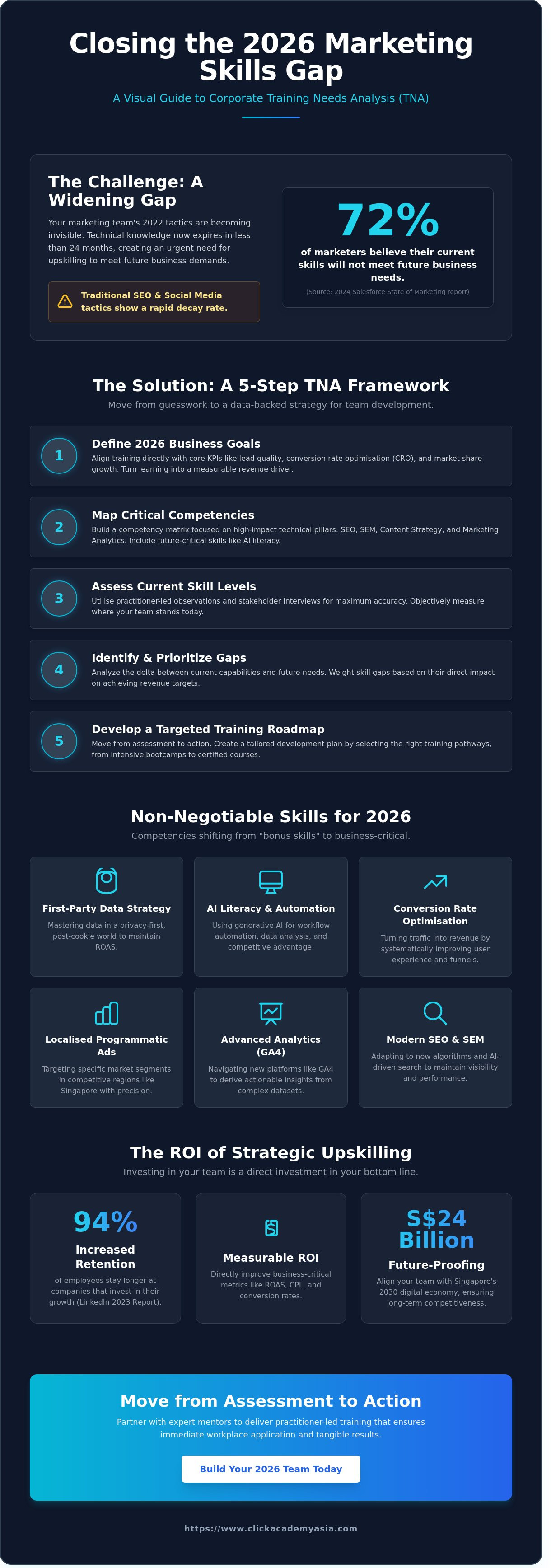
How to Execute a Training Needs Analysis: A 5-Step Framework
Step 1: Define Your Marketing North Star
Start by identifying the specific business challenges that training must solve. If your organic reach dropped by 22% in the last six months, your analysis should focus on SEO and content strategy rather than generic digital marketing. You must align the TNA with your 2025 marketing plan and current budget. This ensures that the learning outcomes you set are not just academic but are designed to hit specific KPIs. Setting measurable goals, such as "improving lead quality by 15% through better targeting," allows the entire department to see the value of upskilling.
Step 2: Data Collection and Skills Inventory
Gathering accurate data is the most critical part of the process. Don't rely solely on what employees say they know; self-assessments are often skewed by confidence levels rather than actual competence. Use a mix of surveys, one-on-one stakeholder interviews, and practitioner-led observations. Dig into your GA4 insights to identify where technical knowledge gaps are costing the business money. For instance, if your conversion rate is 1.5% lower than the Singapore industry average, it might signal a need for intensive conversion rate optimisation training. Using a corporate training needs analysis template for marketing helps you standardise this data across different sub-teams.
Step 3: Gap Analysis and Prioritisation
Once you have your data, visualise the "Gap" between your current state and the required 2026 proficiency levels. Not every gap needs to be filled immediately. Use an "Urgency vs. Impact" matrix to decide which skills to tackle first. Focus on "quick wins" that can be addressed through intensive workshops or practitioner-led bootcamps. These short, sharp interventions can often fix immediate performance issues while you plan for longer-term certifications. Synthesise these findings into a cohesive roadmap that shows exactly how each training module moves the needle for the business.
Key Takeaway: A successful TNA balances subjective feedback from staff with objective performance data from your marketing platforms. This dual approach ensures your training plan is both supportive of employee growth and ruthlessly focused on business results.
Evaluating Training Solutions: From Bootcamps to WSQ Certifications
Once you have gathered data using your corporate training needs analysis template for marketing, you must select a delivery format that aligns with your business goals. Short, intensive bootcamps are ideal for rapid upskilling before a major campaign or product launch. These sessions focus on immediate application, allowing your team to master specific technical tools in as little as 48 hours.
Long-term certification pathways are better suited for building foundational mastery and strategic thinking. We strongly advocate for practitioner-led training over purely academic courses. Digital algorithms change weekly, and a practitioner who manages active S$100,000 monthly ad spends offers insights that a textbook cannot replicate. This approach ensures your staff receives "just-in-time" learning that solves current problems rather than "just-in-case" theory.
The Role of WSQ and Google Certifications
Industry-recognised certifications provide a measurable ROI by standardising excellence across your department. In Singapore, Workforce Skills Qualifications (WSQ) courses are particularly valuable because they align with national standards and often qualify for significant SSG funding. These programmes ensure your team meets global benchmarks while remaining cost-effective for the organisation.
For performance marketing teams, securing a Google Ads Search Certification is a vital milestone. You should integrate these formal certifications directly into the Individual Development Plans (IDPs) of your staff. This creates a clear roadmap for career progression and ensures every team member can execute high-level search strategies with confidence.
Customised Corporate Group Training
While public workshops are excellent for individual growth, bespoke group training is the best choice when you need to align an entire department. Private sessions allow trainers to use your company's actual data and specific regional case studies. This ensures the curriculum is 100% relevant to the Singaporean market and your specific industry challenges.
Choosing bespoke training offers several strategic advantages for marketing leadership:
Unified Marketing Language: Ensures everyone from junior executives to CMOs uses the same terminology for KPIs and reporting.
Regional Tailoring: Content is adapted to Southeast Asian consumer behaviours rather than generic Western examples.
Practical Problem Solving: Teams can work on real internal blockers in a confidential environment with an expert mentor.
Ready to bridge your team's skill gaps with expert guidance? Explore our practitioner-led corporate training programmes today.
Implementing Your Marketing TNA with ClickAcademy Asia
Once you've completed your corporate training needs analysis template for marketing, the real work begins. Identifying skill gaps is only half the battle; closing them requires a partner who understands the nuances of the Singapore market. ClickAcademy Asia steps in as your strategic guide to transform those analytical insights into tangible workplace skills. We don't just teach theory. Our courses are practitioner-led, meaning your team learns from experts who spend their days running real-world campaigns for global brands. This ensures that every lesson can be applied to your specific business challenges the very next morning.
ClickAcademy Asia is a regional leader in executive education, having trained thousands of professionals across Southeast Asia. We handle the logistical heavy lifting, allowing your marketing leadership to focus on strategy rather than scheduling. By partnering with us, you're not just buying a course; you're investing in a future-ready workforce. Our curriculum evolves as fast as the platforms we teach, ensuring your team stays ahead of the curve in an industry that never stands still.
Leveraging SSG and WSG Subsidies
Training budgets shouldn't be a barrier to excellence. For Singapore-based companies, the financial burden is significantly lightened through SkillsFuture Singapore (SSG) and Workforce Singapore (WSG) funding. Depending on your company's profile, you can often reduce training costs by up to 70% for eligible employees. For Small and Medium Enterprises (SMEs) under the Enhanced Training Support for SMEs scheme, these subsidies can cover a vast majority of the course fees, making high-level professional development incredibly accessible.
The process of applying for these subsidies involves selecting WSQ-accredited modules that align with the National Infocomm Competency Framework. This is where ClickAcademy Asia adds immense value. ClickAcademy Asia assists in navigating these grant frameworks, ensuring your organisation maximises its S$ investment while minimising administrative stress. We help you identify which modules qualify for funding so you can stretch your training budget further without compromising on the quality of education.
Your Next Steps to Marketing Excellence
A well-executed TNA is the bridge between your current performance and your 2026 growth targets. With the rapid rise of generative AI, predictive analytics, and shifting data privacy regulations, staying stagnant is the biggest risk any marketing team faces. Moving from analysis to action immediately ensures your brand remains competitive and your staff feel empowered to innovate.
Don't let your corporate training needs analysis template for marketing sit in a folder. Use it as a definitive roadmap to transform your department into a high-output, digital-first powerhouse. The transition from identifying a gap to mastering a new skill is the most critical phase of professional growth. We're here to make that transition seamless, effective, and measurable.
Ready to turn your analysis into results?
Contact ClickAcademy Asia for a bespoke corporate training consultation and let us help you build a training roadmap that drives real ROI.
Future-Proof Your Marketing Team Today
Building a resilient marketing department requires more than just reactive hiring. It demands a proactive strategy to identify and bridge specific skill gaps before they impact your bottom line. By implementing a structured corporate training needs analysis template for marketing, you've taken the first step toward aligning your team's capabilities with the 2026 digital landscape. Focus on identifying high-impact areas like programmatic advertising and omnichannel strategy to ensure your training budget delivers a measurable return on investment.
As an official Google and WSQ training partner, ClickAcademy Asia has supported PMEBs across more than 30 countries to master these complex shifts. Our practitioner-led workshops are designed for immediate application, ensuring your staff don't just learn theory but gain the confidence to execute. We've seen firsthand how the right certification can transform a career path in the Singapore market.
Download our 2026 Marketing Training Needs Analysis Template to begin your team's transformation. You've got the vision; we're here to provide the roadmap to help you achieve it.
Frequently Asked Questions
What is the difference between a general TNA and a marketing-specific TNA?
A general TNA focuses on broad organisational competencies like leadership or soft skills. A marketing-specific TNA drills down into technical proficiencies such as data analytics, SEO, and marketing automation. Using a corporate training needs analysis template for marketing ensures you're measuring the exact skills that drive revenue and brand growth rather than just general workplace efficiency.
How often should a marketing department conduct a training needs analysis?
You should perform a comprehensive analysis every 12 months, though quarterly reviews are better for fast-moving digital roles. Digital platforms like Meta and Google update their algorithms constantly; a 2024 report suggested that marketing skill requirements shift every six months. Regular check-ins prevent your team's knowledge from becoming obsolete before the year ends.
Can I use a TNA to justify a larger marketing budget to the board?
Yes, a TNA provides the objective data you need to turn a gut feeling into a solid business case. By showing the board exactly where skill gaps are hindering your ROI, you move the conversation from "spending" to "investing." Presenting a corporate training needs analysis template for marketing proves that your request is backed by a strategic plan to improve the company's bottom line.
What are the most critical digital marketing skills to include in a 2026 template?
Focus on AI-driven content orchestration, predictive data modelling, and privacy-first tracking protocols. By 2026, manual campaign execution will be less important than the ability to manage automated systems and interpret complex data sets. Your template must also prioritise omnichannel strategy and ethical data usage to stay ahead of evolving Singapore regulations.
How do I measure the ROI of a training program after the TNA is complete?
Compare specific performance metrics from the 90 days before training to the 90 days after completion. Look for tangible wins like a 10% increase in conversion rates or a significant reduction in time spent on manual reporting. Linking training directly to these KPIs proves the financial value of your professional development initiatives.
Is a training needs analysis necessary for small marketing teams?
It's actually more vital for small teams because every individual's impact is magnified. In a team of three, one person lacking modern SEO skills means 33% of your department is underperforming. A TNA helps you build a "T-shaped" team where everyone has a broad understanding of marketing but specialises in a high-value niche.
What role does AI play in a modern training needs analysis?
AI acts as a predictive engine that identifies skill gaps you might miss through manual surveys. You can use AI tools to analyse your team's current campaign performance data and suggest specific learning paths. It helps match your team's current capabilities against real-time industry benchmarks in Singapore, ensuring your training is always relevant to the market.
How can I access SSG or WSQ subsidies for my team’s training in Singapore?
You can access these subsidies by choosing courses from Registered Training Providers that are aligned with the SkillsFuture Singapore (SSG) framework. These grants can cover a large portion of course fees, often up to 70% or 90% for eligible Singapore Citizens and Permanent Residents. Always check the MySkillsFuture portal for specific course codes and ensure your company is registered on the SSG Gateway to process claims.


Comments