
Connected TV (CTV) Advertising Measurement in Singapore: A Practical Guide

A CTV campaign can report strong reach and completed views without proving that it changed a business outcome. For Singapore marketers, that gap matters: platforms may define exposure differently, attribution windows can vary, and a viewer who sees an advert on television may convert later on a phone or laptop. Measurement skills matter whether you’re applying lessons from a digital advertising course singapore professionals take or assessing a live campaign.
Reach, completion rates and attributed conversions offer a quick read on performance, but they answer different questions. Treating them as equivalent evidence can lead to misplaced confidence or missed opportunities. Assess exposure, outcomes and incremental impact separately.
This guide shows you how to match measurement methods to campaign objectives, compare platform evidence fairly and interpret cross-device results without overstating what they prove. You’ll also learn how to build a measurement plan for Singapore campaigns, so you can evaluate your next CTV investment with greater clarity and make better decisions.
Table of Contents
What CTV advertising measurement can, and cannot, tell Singapore marketers
How CTV measurement connects delivery, audience, and outcomes
Comparing CTV advertising measurement methods and their trade-offs
Build a practical CTV measurement plan for a Singapore campaign
Build CTV measurement capability through structured digital advertising learning
What CTV advertising measurement can, and cannot, tell Singapore marketers
A CTV dashboard can show that an advert was delivered, but that alone doesn’t establish whether the campaign reached its intended audience or influenced a business result. For Singapore marketers, CTV advertising measurement means evaluating delivery, audience exposure and campaign outcomes across connected television. Its value depends on understanding what each piece of evidence can support and where its limits begin.
Set the campaign objective before selecting metrics. A brand-awareness campaign and a response-focused campaign need different evidence. Treating one dashboard number as a complete verdict can lead to poor decisions.
For a visual overview of the channel, watch this explanation of CTV advertising:
CTV, OTT, and streaming: where measurement begins
Connected TV describes the television viewing experience on an internet-connected screen. This may be a Smart TV connected directly to the internet or a television using a connected streaming device. A Smart TV provides a useful device-level starting point for understanding connected viewing, which you can explore further through specialized digital advertising and analytics learning resources.
OTT, or over-the-top, describes how video content is delivered over the internet rather than through a traditional television distribution route. Streaming is the viewing or delivery of content over a network. The terms overlap, but they aren’t interchangeable: OTT video can be watched on a phone or computer, while CTV refers to viewing on a connected television screen.
The device, platform and advertising inventory can affect which exposure and outcome data are available. Clarify reporting definitions and limits before comparing dashboards for a Singapore campaign.
Which questions should a CTV measurement plan answer?
Separate three questions: was the campaign delivered as planned, who was exposed, and did the activity contribute to the intended outcome? Delivery metrics describe how advertising ran. Audience measures help assess who may have seen it. Business-outcome measures examine actions such as enquiries or purchases, where suitable data is available.
Awareness: Did the campaign deliver exposure to the intended audience?
Consideration: Is there evidence of a change in audience response or interest?
Response: Were relevant actions recorded, and how were they attributed?
A delivery metric can show that an advert was served or viewed according to its reporting definition. On its own, it cannot prove incremental impact or that the advert caused a conversion. No single metric can answer every campaign question. Professionals developing their skills through a digital advertising course singapore—including comprehensive ClickAcademy Asia WSQ Digital Advertising training tracks—can practise matching metrics to objectives and interpreting evidence carefully.
How CTV measurement connects delivery, audience, and outcomes
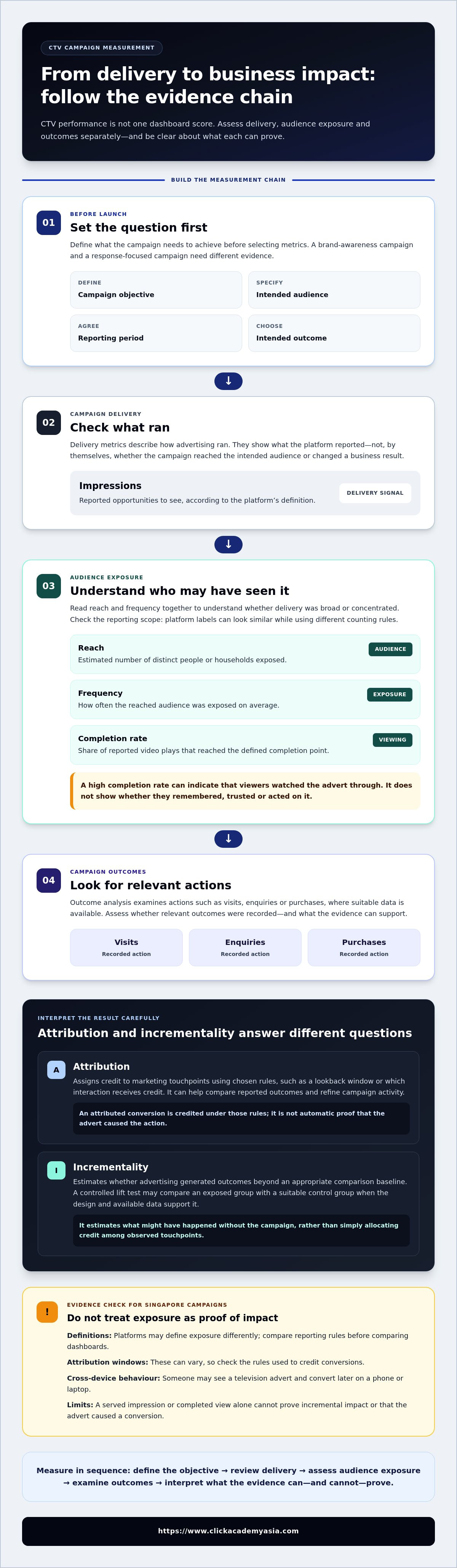
CTV measurement works best as an evidence chain, not a single dashboard score. Before launch, define the campaign objective, audience, reporting period and intended outcome. During delivery, review exposure signals. Afterwards, assess whether relevant outcomes were recorded and what conclusions the evidence supports.
Each stage answers a different question. Delivery reporting describes what ran, audience measures summarise exposure, and outcome analysis looks at actions such as visits, enquiries or purchases. Clear definitions help teams compare these stages without treating a served impression as proof of a business result.
What delivery and audience metrics reveal
Impressions count served opportunities to see, according to the platform’s reporting definition. Reach estimates the number of distinct people or households exposed, while frequency indicates how often those reached were exposed on average. Read together, reach and frequency can show whether delivery was broad or concentrated.
Impressions: How many times an advert was reported as served.
Reach: How many distinct people or households were estimated to have been exposed.
Frequency: How often the reached audience was exposed on average.
Completion rate: The share of reported video plays that reached the defined completion point.
A high completion rate can indicate that viewers watched the advert through, but it doesn’t show whether they remembered, trusted or acted on it. Check metric definitions and reporting scope before comparing figures across platforms. Similar labels may represent different counting rules.
How attribution and incrementality differ
Attribution assigns credit to marketing touchpoints according to a chosen model and rules, such as the lookback window or which interaction receives credit. It can help teams compare reported outcomes and refine campaign activity. However, an attributed conversion is an outcome credited under those rules, not automatic proof that the advert caused the action.
Incrementality estimates whether advertising generated outcomes beyond an appropriate comparison baseline. A controlled lift test may compare outcomes for an exposed group with a suitable control group, where the design and available data support that comparison. It estimates what might have happened without the campaign, rather than simply allocating credit among observed touchpoints.
For example, a shopper may see a CTV advert and later purchase through a mobile device. Attribution rules may credit the campaign if the purchase falls within the defined window and can be connected to the exposure. A lift analysis asks a different question: were additional purchases observed compared with the baseline or control?
Reported exposure and attributed outcomes are different evidence: one describes contact with the advert, while the other assigns credit for an observed action. Use attribution to inform optimisation, and use an appropriate comparison design when the decision depends on causal lift. Developing this judgement through a digital advertising course singapore professionals take can complement practical campaign planning and marketing analytics. Explore [Internal Link: digital advertising and analytics learning] to develop the skills needed to evaluate campaign evidence.
Comparing CTV advertising measurement methods and their trade-offs
No single CTV measurement method gives a complete account of campaign performance. Platform reports, attribution analysis and controlled lift testing answer different questions. Choose a method based on the decision you need to make, the campaign objective and the evidence available to you.
Platform reporting versus independent measurement
Platform reporting helps you understand delivery within that platform’s reporting environment. It can show campaign activity and the metrics the platform makes available, but its definitions, scope and attribution rules may differ from those used elsewhere. Figures with similar labels aren’t always directly comparable across platforms.
Independent measurement may provide another perspective, depending on the method, campaign and available data. It isn’t universally comprehensive: coverage and methodology vary. Before relying on a report, clarify what it measures, how it defines exposure or outcomes, and which parts of the campaign it includes.
Attribution models versus lift studies
Attribution allocates credit. Its output depends on the selected model and choices such as which interactions count and the period in which an outcome is considered. It can support consistent reporting and optimisation, provided the team understands the assumptions behind the result.
Lift testing uses comparison-based logic. It estimates whether outcomes differ between an exposed group and an appropriate baseline or control, rather than distributing credit across touchpoints. The strength of the conclusion depends on the test design, the quality of the comparison and the evidence available. A poorly matched comparison can make results difficult to interpret.
Match the method to the decision. Use platform reporting to monitor delivery, attribution to examine credited outcomes, and controlled testing when the key question concerns incremental impact and a suitable design is feasible. Confirm each platform’s current measurement options and methodology before planning or publishing a comparison.
Combining methods can strengthen interpretation by bringing different evidence together, but it doesn’t guarantee certainty or remove each method’s limitations. Building confidence in these distinctions is part of broader advertising and analytics capability. Explore digital advertising and analytics learning to develop the practical judgement needed to evaluate campaign evidence.
Build a practical CTV measurement plan for a Singapore campaign
A defensible measurement plan starts before the first advert runs. Agree what the campaign needs to achieve, what evidence will indicate progress, and how the team will interpret results. This gives marketing, analytics and business stakeholders a shared basis for decisions, even when reports come from different platforms.
Set objectives, baselines, and measurement criteria
Translate the business goal into observable indicators before selecting a method. An awareness objective may focus on exposure among a defined audience, while a response objective may track a relevant action. Record the baseline, campaign dates and reporting period so later comparisons have context, and agree metric definitions with stakeholders in advance.
1. State the objective: Define the business outcome the campaign is intended to support, such as awareness, consideration or response.
2. Define the audience: Document who the campaign is intended to reach and how audience reporting will be described.
3. Set the baseline and period: Record relevant pre-campaign conditions and specify the dates or time window for evaluation.
4. Choose indicators: Select delivery, audience and outcome measures that correspond to the objective. Distinguish observed results from measures intended to estimate incremental impact.
5. Agree the rules: Note each data source, metric definition, attribution model and attribution window. Record known gaps, including limits in cross-device matching or platform reporting.
These analytics foundations apply beyond CTV. A structured approach to defining measures and interpreting reporting is explored in Marketing Analytics with GA4: A Strategic Guide for 2026 Professionals.
Reconcile reports and turn findings into decisions
After launch, use a consistent comparison period and label every source clearly. If two reports show different figures, don’t average them or choose the more favourable result. First check whether they use the same audience definition, reporting scope, attribution window and metric rules.
Then connect the evidence to a decision. A delivery change may justify reviewing placement or pacing. An outcome pattern may prompt further analysis, but it doesn’t automatically prove the campaign caused that result. Document what the evidence supports, what remains uncertain, and what the team will test or adjust next.
Clear measurement depends on both campaign planning and analytics judgement. Teams can strengthen those capabilities through WSQ Digital Advertising and Marketing Analytics training.
Build CTV measurement capability through structured digital advertising learning
Reliable CTV decisions depend on more than knowing what a metric means. Teams need to connect campaign objectives to media choices, interpret the available evidence and use it to guide optimisation without overstating what results prove. Build these capabilities in stages: understand measurement concepts, apply them in campaign planning, then evaluate outcomes carefully.
Advertising strategy, digital advertising and marketing analytics work together. Strategy sets the objective; digital advertising translates it into campaign choices; analytics helps assess what happened and what the evidence supports.
Which professional skills support better CTV decisions?
Build capability in four connected areas: objective setting, media evaluation, measurement literacy and clear reporting. A marketer planning paid media, for instance, should be able to explain why a placement fits the audience and goal, what its reporting can show, and where interpretation has limits. For a broader view of paid-media planning, explore advanced SEM strategy learning.
Set objectives: Define the business question before choosing campaign indicators.
Evaluate media: Assess placements against the intended audience and campaign role.
Interpret evidence: Distinguish reported exposure, attributed outcomes and evidence of incremental impact.
Report clearly: Explain definitions, assumptions and limitations so stakeholders can make informed decisions.
Stronger analytics interpretation supports responsible optimisation. It helps teams identify what they can adjust based on observed evidence and when further testing or context is needed before drawing a broader conclusion.
Turn measurement knowledge into team capability
Shared definitions make campaign reviews more productive. When marketing, analytics and leadership teams use the same terms for audiences, reporting periods and outcomes, they can discuss findings without confusing a platform’s reported results with proof of business impact. Capture those definitions in a simple measurement brief and use it during planning and review.
Structured learning helps professionals build complementary skills over time. In Singapore, WSQ learning provides a framework for developing practical workplace capabilities. SSG funding may support eligible training, helping organisations plan team development through relevant WSQ courses. Explore broader upskilling pathways in WSQ digital marketing courses in Singapore.
If you’re comparing a digital advertising course singapore professionals can use to strengthen campaign planning and measurement skills, consider how it fits alongside analytics learning and your team’s development needs. Build these capabilities through digital advertising training.
Put stronger CTV measurement into practice
Make measurement a shared capability, not a reporting task left to one specialist. For your next campaign, agree the objective, align on how results will be evaluated, and record what the evidence supports before deciding what to change. A digital advertising course singapore professionals pursue can help strengthen the planning and analytics skills behind those decisions.
For a practical next step, identify the skills your team needs to plan campaigns and interpret results, then build a development plan around them. Consider relevant WSQ training tracks and applicable SSG support when planning team learning.
Equip your team to make more confident digital advertising decisions. Explore [Internal Link: ClickAcademy Asia WSQ Digital Advertising training tracks] and take the next step towards stronger measurement capability.
Frequently Asked Questions
What is the difference between CTV and OTT advertising?
CTV describes advertising viewed on a connected television screen, while OTT refers to video content delivered over the internet. The distinction matters for planning: an OTT service may be watched on a television, phone or computer, but only viewing on a connected TV screen is CTV. When reviewing a campaign, check whether a report groups results by content service, device or screen, as each describes a different aspect of exposure.
Can CTV advertising measurement track conversions across devices?
It can sometimes connect a television exposure with a later action on another device, but that connection depends on the data, matching approach and reporting setup available. For example, someone might see an advert on a TV and later visit a website on a mobile phone. Treat a reported match as an attributed relationship, not automatic proof that the TV advert caused the visit or purchase.
How can marketers measure CTV campaigns when platform reports disagree?
First compare what each report counts, rather than combining figures immediately. Check the reporting period, audience definition, exposure rules, attribution window and whether the report covers the same inventory. A Singapore campaign team can keep a source-by-source record of those details, then compare like with like. If definitions remain different, show the results separately and explain the discrepancy in stakeholder reporting.
Is CTV campaign reach the same as the number of people who saw an advert?
No. Reach is generally a reported or modelled estimate of distinct people or households exposed, depending on the platform’s definition. It isn’t necessarily a verified count of individuals who consciously watched the advert. A shared television screen, for instance, may be used by several people, while reporting may count a household or device. Read reach alongside its methodology and avoid presenting it as an exact headcount.
What does an incrementality test show in CTV advertising?
Can GA4 measure the full impact of a CTV advertising campaign?
No. GA4 can help analyse activity on a website or app after a viewer responds, but it doesn’t by itself capture every CTV exposure or establish the campaign’s full contribution. A QR code visit or tagged website link may provide a trackable response signal, while untracked or cross-device journeys can remain outside that view. A digital advertising course Singapore marketers consider should build analytics understanding alongside broader campaign evaluation skills.


Comments