
Advanced Schema Markup: 2026 Singapore Guide
- ClickAcademy Asia
- 1 day ago
- 12 min read
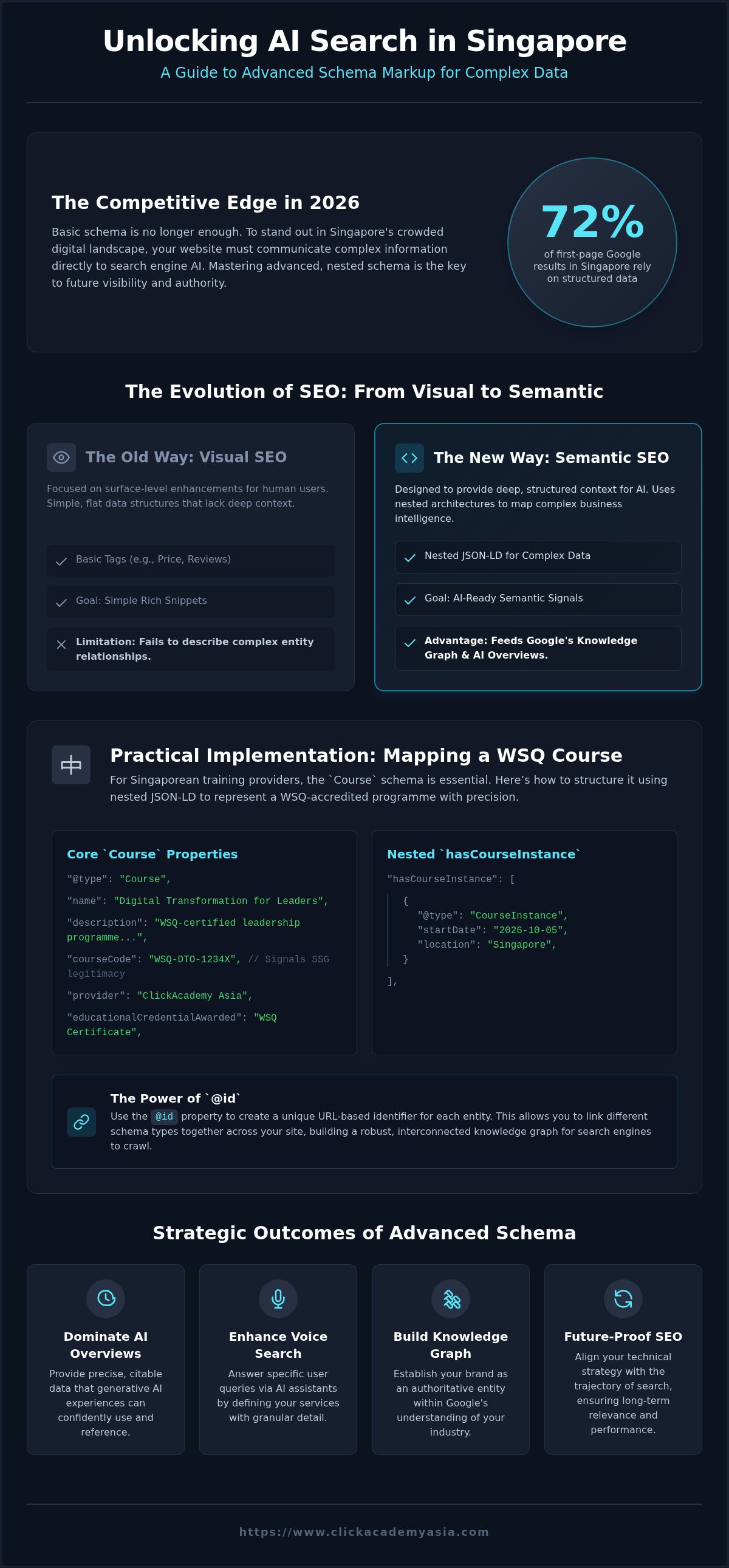
Did you know that as of early 2026, 72% of first-page Google search results in Singapore now rely on structured data to maintain their competitive edge? While basic tags are common, the real advantage lies in mastering advanced schema markup for complex data types. It's the semantic glue that translates your intricate business structures into machine-readable intelligence for the AI-search era.
You've likely felt the frustration of wrestling with JSON-LD nesting syntax or the fear of a Google penalty due to improper implementation. It's a common hurdle for PMEBs who need to map complex hierarchies to Schema.org types without breaking their site's technical foundation. We understand that moving beyond the basics can feel like navigating a technical minefield.
This guide will show you how to transform your business information into high-performing rich snippets and AI-ready signals. We'll outline a clear path to align your technical SEO with WSQ-certified standards, ensuring your website is future-proofed for the evolving digital ecosystem. By the end of this article, you'll have the practical insights needed to achieve rich results for even your most complex entities.
Table of Contents
The Strategic Importance of Advanced Schema Markup for Complex Data Types in Singapore
Singapore's status as a premier APAC digital hub means your competitors are already doing the basics. Standing out in 2026 requires a strategy that speaks directly to machine learning algorithms. This is where advanced schema markup for complex data types becomes your most potent technical asset. It's no longer just about getting a star rating; it's about defining the very DNA of your business for search engines. By using nested JSON-LD, you can describe intricate relationships between entities that simple tags simply can't capture.
When we ask What is Schema.org?, we're looking at a universal language designed to help search engines understand the context of web content. For Singaporean PMEBs, this language is best expressed through nested architectures. This method allows you to describe how a specific corporate training module fits within a broader leadership programme, or how a local branch relates to a global headquarters. These structured signals feed directly into Google's Knowledge Graph, ensuring your brand is represented with precision and authority.
Beyond Rich Snippets: Schema as Business Intelligence
Search has shifted from matching strings to understanding things. We've moved past 'visual' SEO where the goal was merely to display prices or review stars. Today, 'semantic' SEO is the priority. Google's AI Overviews and generative search experiences rely on these deep semantic signals to provide accurate citations. If your data is nested correctly, AI assistants can confidently recommend your services. This clarity doesn't just improve visibility; it builds trust with both the algorithm and the end user.
Voice search and conversational AI also benefit from this level of detail. When a professional in Singapore asks an AI assistant for a specific type of WSQ-certified training, the system looks for the most clearly defined entity. Websites that haven't adopted advanced schema markup for complex data types will likely be overlooked in favour of those providing machine-readable intelligence.
Aligning Technical SEO with Singapore's Digital Goals
The Singapore government, through SSG, continues to champion technical upskilling as a pillar of national growth. This is why the WSQ framework prioritises technical digital literacy for modern leaders. Mastering these nuances is a core component of the Digital Transformation for Leaders programme. It's about moving from a surface-level understanding to practical mastery of the tools that drive business growth.
Consider how a local firm might scale. By implementing nested schema, a Singaporean consultancy can clearly define its regional experts, specific service datasets, and industry partnerships. This level of technical sophistication has allowed many local brands to dominate regional APAC search results. It proves that SEO isn't just a back-end task, it's a strategic business function that aligns with Singapore's broader digital transformation goals.
Mapping Complex Data Types: From Course Entities to Datasets
While many businesses stick to basic product tags, Singapore's competitive education and tech sectors require a more granular approach. Implementing advanced schema markup for complex data types allows you to define high-value entities like professional certifications and proprietary research data with surgical precision. It's about moving beyond surface-level visibility to create a detailed digital map of your business assets.
The Anatomy of Course Schema in a WSQ Context
For providers of SSG-funded programmes, the Course type is indispensable. You aren't just listing a class; you're defining a formal educational unit. Key properties from the official Schema.org vocabulary include provider, courseCode, and educationalCredentialAwarded. Using the specific WSQ reference number in the courseCode field signals immediate legitimacy to both search engines and prospective learners.
Managing multiple intakes requires the use of hasCourseInstance to nest specific dates and Singapore-based locations. This prevents duplicate content issues while providing clear signals for local search intent. Additionally, implementing offers within the course markup allows you to reflect per-participant enrolment fees, providing immediate transparency in search results. This level of detail is exactly what AI-driven search engines use to rank your programme above generic competitors.
Managing Large Datasets and Research Data
Data-driven organisations in Singapore often overlook the Dataset schema. If your firm produces market reports or technical whitepapers, this markup helps you appear in Google Dataset Search. Essential properties like variableMeasured and citation build a semantic web of credibility. Being transparent about isAccessibleForFree also maintains trust with Google's crawlers, ensuring your data is indexed correctly.
Handling these intricate hierarchies requires more than just a standard plugin. It often necessitates specialised technical SEO training to ensure your team can implement these nested structures without errors. This practical mastery ensures that your big data assets are not just stored, but are actively working to improve your brand's digital authority.
For conglomerates or multi-branch firms in Singapore, the Organization schema should use the subOrganization property. This clearly maps the relationship between a parent group and its specialised subsidiaries. Similarly, for recurring professional workshops, the Event schema remains vital. Ensure you use the eventStatus property to keep your search results current, especially for bootcamps that run on a monthly cycle across the APAC region.
Implementing Nested Architectures and Linked Data
Mastering advanced schema markup for complex data types requires moving beyond flat, isolated scripts. In the competitive Singaporean digital space, search engines need to understand the relationships between your brand, your experts, and your offerings. By implementing nested architectures, you create a semantic map that allows Google to see your business as a cohesive entity rather than a collection of disjointed pages.
This approach aligns with W3C's Data on the Web Best Practices, which emphasises the importance of persistent identifiers for machine-readable data. When your code is structured logically, you reduce ambiguity and increase the chances of your content being featured in high-intent search results. It's about building a foundation that is both robust and scalable for future SEO requirements.
The Logic of Nesting: Parent vs Child Entities
Nesting is the hierarchical embedding of one Schema type within another. Think of it as a tree structure where a parent entity provides the context for its children. For instance, you don't just list a review on a page; you nest the Review within a Product or Course. Similarly, a Place can be nested within an Event to define exactly where a Singapore-based workshop is held.
For a Singaporean head office, your JSON-LD might start with an Organization type. Within that, you nest contactPoint, address, and founder. This hierarchy tells search engines that these details aren't just random facts; they're specific attributes of your primary business entity. This level of clarity is vital for PMEBs who manage multi-faceted corporate structures and need to maintain brand consistency across the APAC region.
Linked Data: Connecting the Dots with @id
The @id property is perhaps the most underutilised tool in a technical SEO's arsenal. It acts as a unique digital identifier, essentially a "fingerprint" for every business entity you define. By assigning a specific @id to your Organization, you can reference it across multiple pages without redefining the entire script every time. This prevents data duplication and ensures search engines don't get confused by minor variations in your business name or address.
Brand Authority: Link your WebSite schema to your Organization schema using @id to establish a clear line of ownership.
Cross-Platform Consistency: Use the same @id in your schema that you use across social profiles and professional directories.
Author Credibility: Link an Article to a specific Person (the author) and an Organization (the publisher) simultaneously to boost E-E-A-T signals.
Avoiding "Schema Bloat" is equally important for site performance. You don't need to nest everything on every page. Use nesting when entities are directly related on a specific page, but use separate scripts with matching @id tags when you need to connect disparate pieces of information across your site. If your team finds these nuances challenging, upskilling through a WSQ-certified SEO programme can provide the hands-on practice needed to implement these architectures with confidence.
Strategic Optimisation for AI and Rich Results
Implementing advanced schema markup for complex data types isn't just a technical exercise; it's a strategic priority for high-intent conversion. In the 2026 search landscape, your data must be instantly digestible for both human users and AI systems. We've already explored the technical nuances of nesting; now we must focus on the "why" of performance. By prioritising the entities that matter most to your PMEB audience, you ensure your brand appears in the right place at the right time.
Success in modern SEO is measured by how effectively your structured signals influence AI-driven snapshots. These AI Overviews rely heavily on the semantic clarity you provide. If your markup is vague, you risk being omitted from the very summaries your target leads are reading. Monitoring these interactions in Google Search Console is essential for refining your strategy over time.
Schema for GA4 and Marketing Analytics
Structured data provides a rich source of information that can significantly enhance your tracking precision. By integrating schema insights with custom dimensions in GA4, you can attribute conversions to specific content types or entities more accurately. This allows you to measure the ROI of your marketing analytics with GA4 efforts with unprecedented clarity. You can even automate the extraction of this data to streamline your monthly marketing reports, saving your team hours of manual work.
This integration bridges the gap between technical SEO and business intelligence. When your schema correctly identifies a "WSQ Course" as a specific entity, your analytics can track how users interact with that entity across different sessions. This level of granular data is invaluable for HR decision-makers and corporate leaders looking to justify training budgets based on tangible engagement metrics.
Future-Proofing for AI Search
The 2026 search environment has decisively shifted from keywords to entities. AI models prefer structured data over raw HTML because it provides explicit context without the noise of surrounding design elements. When you use advanced schema markup for complex data types, you're essentially providing a direct feed for AI to understand your brand's authority. This preparation ensures your technical stack remains resilient as search automation continues to evolve.
To truly future-proof your organisation, you must move beyond static implementation. Your technical SEO strategy should be agile enough to adopt new Schema.org releases as they happen. If you want to master the intersection of data and search visibility, we recommend exploring our WSQ Marketing Analytics & Insights programme to sharpen your team's competitive edge.
Technical SEO: WSQ Framework at ClickAcademy Asia
Mastering the nuances of advanced schema markup for complex data types requires more than just reading documentation. While theory provides a foundation, the real breakthrough happens when you apply these concepts to live environments. Hands-on training is the only way to ensure your nested JSON-LD scripts are error-free and ready for the 2026 AI-driven search landscape. At ClickAcademy Asia, we bridge the gap between high-level marketing strategy and technical execution through practical, results-driven learning.
Learning from a strategic advisor with deep APAC experience provides insights that generic tutorials simply cannot offer. Our trainers bring years of experience in navigating Singapore's unique digital ecosystem, from PDPA compliance to local search intent patterns. This practical expertise ensures you're not just learning code; you're understanding how to use that code to drive tangible business outcomes. It's about empowering your team to take full control of your brand's semantic footprint.
Mastering Technical SEO via WSQ Modules
Our WSQ Search Engine Optimization (SEO) course is designed for Singaporean professionals who need to move beyond basic tags. We conduct intensive workshops focused on implementing and validating structured data using real-world business scenarios. You'll learn how to communicate technical requirements to developer teams effectively, ensuring your semantic SEO goals aren't lost in translation. By the end of the module, you'll earn official certifications that validate your expertise to global industry standards.
These modules cover the technical implementation of nested architectures, teaching you how to build robust scripts that search engines trust. We focus on quick wins that you can implement immediately, such as fixing common nesting errors or optimising existing entity identifiers. This hands-on approach builds the confidence needed to manage complex site migrations or large-scale data deployments without fear of Google penalties.
Securing Your Future in Singapore's Digital Economy
The demand for technical SEO specialists in Singapore has never been higher as organisations race to optimise for AI Overviews. Position yourself as a strategic asset by mastering the semantic glue that powers modern search. Thanks to SSG funding available in 2026, Singapore Citizens and Permanent Residents can receive up to 70% of course fees. SMEs can benefit even further, with subsidies reaching up to 90% through the SkillsFuture Enterprise Credit, making high-level technical training highly accessible for PMEBs.
Don't let technical complexity hold your brand back from its full potential in the APAC region. Investing in your team's digital literacy is a long-term strategy for resilience and growth. Equip your team with advanced SEO skills through our WSQ-funded training programmes and lead your organisation's digital transformation with confidence. Mastering advanced schema markup for complex data types is the definitive way to future-proof your career and your company's digital footprint in Singapore.
Future-Proof Your Digital Authority in Singapore
The transition to entity-based search in 2026 demands that Singaporean businesses move beyond basic tags. You've seen how nested JSON-LD and unique @id identifiers build the semantic clarity AI models require to recommend your brand. Implementing advanced schema markup for complex data types isn't just a technical task; it's a strategic move to secure your visibility in the APAC digital hub.
Practical mastery is the only way to ensure these intricate structures perform as intended without technical errors. Our WSQ-certified training offers a supportive environment to sharpen these skills under the guidance of Google Certified Trainers. With SSG funding available for eligible Singaporeans, there's never been a better time to invest in your professional development.
Enroll in ClickAcademy Asia's WSQ SEO Course to master advanced schema implementation and lead your team toward digital excellence. Your journey to technical SEO leadership starts here.
Frequently Asked Questions
What are complex data types in Schema.org?
Complex data types refer to Schema.org entities that describe intricate relationships, such as Course, Dataset, or EducationalOccupationalCredential. Implementing advanced schema markup for complex data types allows you to nest these entities, providing search engines with a clear hierarchy of your business information. This is essential for Singaporean firms listing multi-intake WSQ modules or proprietary research datasets.
How do I test nested schema markup for errors?
You should use Google's Rich Results Test and the Schema Markup Validator to identify syntax errors or missing properties. These tools provide real-time feedback on your JSON-LD scripts, ensuring your nested structures are technically sound. Regular testing is a practical step that prevents your rich results from disappearing due to minor coding oversights or outdated properties.
Does advanced schema markup directly improve search rankings in 2026?
Advanced schema markup acts as an indirect ranking signal that significantly boosts visibility through rich snippets and AI citations. While it doesn't guarantee a specific rank, websites with proper implementation often see click-through rates 20-30% higher than standard listings. In 2026, it serves as a critical trust signal that helps AI-driven search engines verify your brand's authority.
Can I implement advanced schema without knowing how to code?
While plugins can handle basic tags, manual implementation is recommended for advanced schema markup for complex data types to ensure absolute precision. Tools like the Merkle Schema Generator can help create the initial code, but a fundamental understanding of JSON-LD is vital for troubleshooting. Technical SEO training can empower your team to manage these scripts without relying solely on external developers.
What is the difference between JSON-LD and Microdata for complex types?
JSON-LD is a standalone script that sits in the page header, while Microdata is embedded directly into the HTML tags. JSON-LD is the universally recommended format in 2026 because it's easier to maintain and doesn't interfere with your site's visual design. It's particularly superior for complex nesting where Microdata often becomes cluttered and prone to implementation errors.
How does schema markup impact AI-driven search results like SGE?
AI-driven search results use structured data to verify facts and establish brand authority within generative summaries. By providing a machine-readable map of your entities, you increase the likelihood of being cited as a primary source in AI Overviews. This semantic clarity helps AI systems understand the context of your content far more effectively than simple keyword matching.
Is there WSQ funding available for technical SEO training in Singapore?
Yes, SSG provides significant funding for WSQ-certified technical SEO training to support professional upskilling. As of 2026, eligible Singapore Citizens and Permanent Residents can receive up to 70% funding, while SMEs can access up to 90% through the SkillsFuture Enterprise Credit. ClickAcademy Asia's programmes are specifically designed to help PMEBs master these technical skills through subsidised pathways.
How often should I update my website's schema markup?
You should update your schema markup whenever your business information changes, such as new intake dates, price adjustments, or office relocations. It's also wise to review your scripts following major Schema.org updates, like the version 30.0 release in March 2026. Keeping your data fresh ensures that search engines and AI assistants always provide the most accurate information to your audience.