
WSQ vs University Marketing Cert in Singapore: 2026 Guide

WSQ vs University Certificate for Marketing in Singapore: 2026 Guide
Choosing a marketing credential is easier when you start with the capability you need next. In Singapore, the wsq vs university certificate for marketing decision often comes down to whether you want structured, skills-focused learning or a university programme with a particular academic focus.
Neither route is automatically right for every professional. Compare the specific syllabus, assessment and credential awarded, then consider how each option fits your career goal and workplace needs.
Table of Contents
WSQ vs University Certificate for Marketing in Singapore: What Are You Comparing?
The decision often starts with a practical question: do you need a job-focused WSQ course, or a certificate issued by a university? The answer depends less on the label than on what the specific programme teaches, how it assesses learning and what credential you receive.
That distinction matters when weighing the wsq vs university certificate for marketing. Neither credential guarantees employment, promotion or acceptance by every employer. Treat it as one part of your professional profile, alongside relevant experience and evidence of what you can do.
For another perspective on the value employers may place on certifications, watch this video:
At a glance
Skills-focused professional training: A programme designed to build or assess workplace capabilities. WSQ courses sit within Singapore’s workforce skills system.
University-provided study: A programme offered by a university, with content, assessment and award determined by that institution and course.
What does a WSQ marketing course represent?
WSQ, or Workforce Skills Qualifications (WSQ), refers to Singapore’s workforce-skills framework. A WSQ marketing course may focus on applying skills to work-related tasks, but its syllabus, learning format, assessment and credential can vary. Don’t assume every course covers the same competencies or leads to an identical award.
For example, ClickAcademy Asia offers WSQ Digital Marketing Strategy & Planning as an option for structured, applied upskilling. Before enrolling, check the course’s stated learning outcomes and the exact credential wording. If SSG funding matters to your decision, confirm current availability and your eligibility for that specific course.
What does a university marketing certificate represent?
Universities may offer marketing certificates with different subject coverage, teaching formats, assessment methods and entry requirements. Some programmes may develop conceptual or strategic understanding; others may focus on specific professional skills. Review the syllabus rather than assuming the university name tells you how practical or advanced the learning will be.
A certificate is not the same as a degree, and the two shouldn’t be treated as equal awards. Check which institution issues the certificate and what credential you’ll receive on completion. For a fair comparison, weigh the learning outcomes and assessment against your career goal, then verify how relevant employers view that specific qualification.
How WSQ and University Marketing Certificates Differ in Learning and Outcomes
Compare the course itself, not just the credential label. In the wsq vs university certificate for marketing decision, focus on what you’ll learn, how you’ll demonstrate it and who awards the credential. These are typical comparison points, not guarantees about every programme.
SkillsFuture Singapore describes WSQ as a national credential system aligned with workforce skills needs. That framework doesn’t tell you exactly what a particular marketing course covers, so read its published outcomes and assessment details before deciding.
Which route is more practical for marketing work?
Practicality is about fit, not the provider category. Compare the syllabus with tasks in your current role or target responsibilities, such as planning a campaign, developing content or interpreting marketing results. If a course includes applied assignments, check whether they let you practise those tasks and receive feedback. Don’t infer this from “WSQ” or “university” in the title.
How do depth, duration and assessment compare?
Depth and study time vary by course and certificate. Review module outlines, prerequisites, published duration and assessment expectations side by side. Ask the provider to clarify anything not stated, especially what you’ll submit or complete and what credential you’ll receive. Sample learning outcomes can reveal more than a broad course title.
If you’re exploring an applied WSQ pathway, browse WSQ digital marketing courses in Singapore and compare their stated outcomes with your skills priorities.
Which Marketing Certificate Fits Your Career Goal and Experience?
The best fit depends on the capability you need next, not on a credential label alone. For the wsq vs university certificate for marketing decision, start with your goal: improve performance in your current role, prepare for a role change, build academic understanding or develop your team’s capabilities.
When might a WSQ marketing course be a stronger fit?
A WSQ course may suit professionals looking for structured, skills-focused development tied to workplace needs. Identify a specific gap first, such as turning business goals into a marketing plan or strengthening digital execution, then check whether the course outcomes address it. For example, someone considering ClickAcademy Asia’s WSQ Digital Marketing Strategy & Planning can assess whether its stated outcomes align with a planning gap. It’s an option to evaluate, not a universal recommendation.
When might a university certificate be a stronger fit?
A university certificate may suit learners who prioritise a university learning environment or want to study a particular academic subject in greater depth. Review the programme’s content, assessment and awarding institution, and confirm the exact credential issued. A certificate is not a degree, and a university name alone doesn’t establish that an employer will prefer it. If the provider is a private education institution, consult the Ministry of Education’s guidance on the regulation of private education institutions as part of your checks.
Match the route to your next step
Improve current performance: Look for outcomes that address a clear task in your role. A focused, applied course may fit if you want to practise a relevant skill.
Change roles: Compare each syllabus with the responsibilities in target job descriptions. Prioritise demonstrable capabilities you still need to build.
Deepen theory: Consider a university programme if its subject coverage and learning approach match the depth you’re seeking.
Develop a team: Map capability gaps across roles, then assess whether a shared skills-focused programme or more specialised study better supports those needs.
Your experience, available study time and preferred learning style matter too. If you learn best by applying concepts to work tasks, look for stated practical assignments. If you prefer structured academic study, examine the teaching and assessment format. Don’t assume the course label tells you how much time a programme requires. Check published details and ask the provider to clarify anything missing.
Employer recognition varies by organisation and role. If a specific credential matters for a promotion, hiring process or development plan, confirm its relevance directly with the employer. Choose a WSQ option when its outcomes fit your immediate skills gap; consider a university certificate when its academic focus, structure and award better match your learning goal.
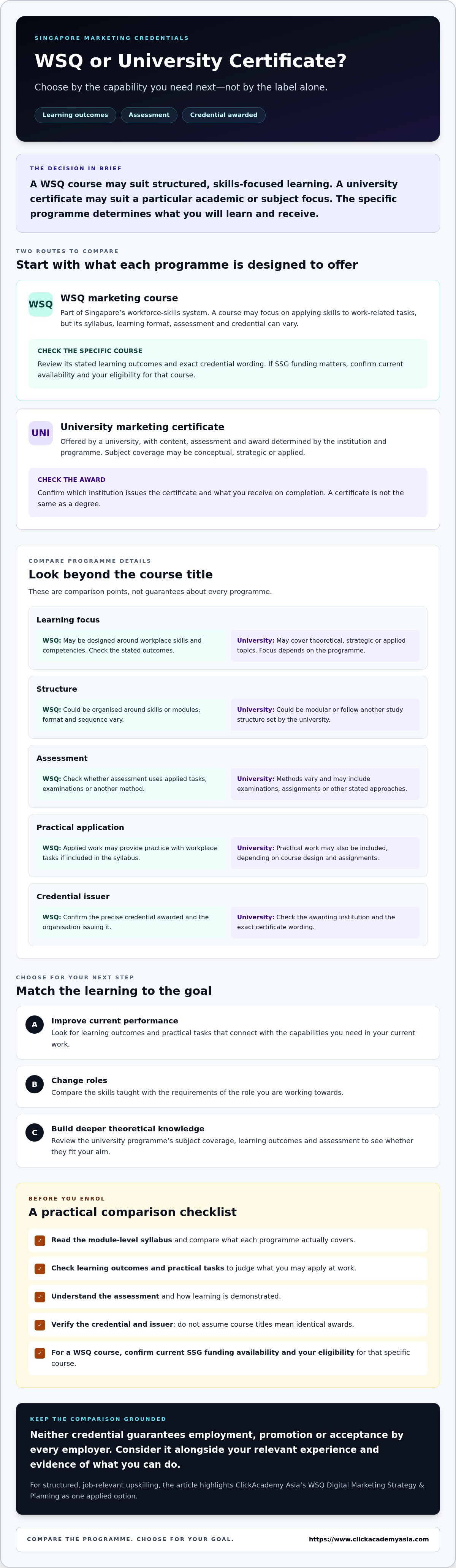
How to Evaluate a Marketing Certificate Before You Enrol
A course title can sound right but still leave a gap between what you study and what your role requires. Use this checklist to compare programme details before deciding between a WSQ course and a university certificate.
1. Define your goal. Identify the capability you want to build, such as planning campaigns, strengthening SEO knowledge or developing broader strategic understanding. Be clear about how you’ll use it at work.
2. Compare the syllabus. Review module-level learning outcomes, topics and stated prerequisites. Match them against your current responsibilities or target role rather than relying on the course title or provider marketing.
3. Verify assessment. Check whether you’ll complete applied tasks, examinations or another assessment method. Ask what successful completion requires and whether the assessment reflects the skills you want to demonstrate.
4. Confirm the credential. Find out who awards it and the exact wording you’ll receive on completion. Don’t assume the provider and awarding institution are the same.
5. Check funding. For courses in Singapore, confirm current SSG funding eligibility for the specific course and your circumstances. Ask the provider to clarify any applicable co-payment and the amount you would need to pay, using current information.
Questions to ask the training provider
Request current details in writing, especially if they aren’t clear on the course page. Ask: Who awards the credential? What exactly will I receive after successful completion? What are the learning outcomes, assessment format and course requirements? Does funding apply to this specific course and my circumstances, and what co-payment should I expect?
For a funding check, use current SkillsFuture information alongside the provider’s course details. You can also review ClickAcademy Asia’s marketing training options as part of your comparison.
How to compare value without relying on prestige alone
Weigh the programme against the work you want to do. Are the skills relevant to your target role, and can you apply them to a workplace project? Compare the published time commitment and your total learner contribution using verified, course-specific information. Avoid choosing on the basis of unverified salary, promotion or return-on-investment claims.
This makes the wsq vs university certificate for marketing decision more concrete. Compare outcomes, assessment, credential and confirmed funding details side by side, then choose the programme that best matches your goal and constraints.
Build Your Marketing Skills with a Credential That Matches Your Next Step
Choose the credential that fits the capability you need next. Compare each programme’s learning outcomes, assessment and awarded credential against your career goal rather than relying on the provider label alone.
For applied marketing upskilling, ClickAcademy Asia offers WSQ Digital Marketing Strategy & Planning. Assess it against your skills priorities and review the course details before deciding.
A quick decision checklist for Singapore marketing learners
Name the gap. Identify the skill or role requirement you want to address.
Shortlist by outcomes. Compare relevant learning outcomes and assessment details.
Verify before committing. Confirm the credential issuer, entry requirements and current SSG funding eligibility for the course and your circumstances.
Turn the comparison into a practical upskilling plan
Focus on one immediate workplace skill gap instead of collecting credentials without a clear purpose. If training supports a business objective, discuss the team’s capability needs with HR or your manager and compare programmes against those priorities.
Ready to build your team’s marketing capabilities? Explore WSQ Digital Marketing Training and consider WSQ-funded training tracks that fit your team’s needs. Confirm current course details, funding availability, eligibility and any co-payment before enrolling.
Choose Your Next Marketing Learning Step with Confidence
The right choice in the wsq vs university certificate for marketing decision depends on the capability you need, the programme’s learning outcomes and assessment, and the credential awarded. Look beyond the provider label: check the course details and confirm whether the qualification is relevant to your career goal or your employer’s requirements.
If applied marketing upskilling is your priority, ClickAcademy Asia offers WSQ Digital Marketing Strategy & Planning. The academy supports professional learning for individuals and corporate teams. Before enrolling, verify current course details and check SSG funding eligibility and any co-payment that applies to your circumstances.
Ready to explore a practical next step? Explore WSQ Digital Marketing Training and review the available options for your goals. For team development, discuss capability needs with HR or your manager, then confirm current funding details before choosing a WSQ training track. With a clear goal and careful checks, you can make your next learning investment count.
Frequently Asked Questions
Is a WSQ marketing certificate better than a university certificate?
Neither is automatically better; the right option depends on your learning goal and the specific programme. A WSQ course may suit you if you want structured, skills-focused development, while a university certificate may fit if you value that learning environment or a particular academic subject. Compare the syllabus, assessment and credential issuer. If employer recognition matters, ask the relevant employer how they view that specific qualification.
Can a WSQ certificate help me get a marketing job?
A WSQ certificate can support evidence of relevant learning, but it can’t guarantee a job. Its value depends on the skills covered, your experience and the role’s requirements. Compare the course outcomes with current job descriptions, such as requirements involving campaign planning or marketing analytics. If the credential’s recognition could affect your application, ask potential employers or recruiters how they regard that specific award.
What is the difference between a WSQ certificate and a university certificate?
WSQ is Singapore’s workforce-skills framework, while a university certificate is awarded for a specific programme by a university. Course content, structure, assessment and credential wording can differ within both categories. Don’t assume the labels are equivalent or interchangeable. Before enrolling, check the awarding body, published learning outcomes and exact credential you’ll receive, then consider how the programme fits your career or skills-development goal.
Is a university certificate equivalent to a degree?
Not necessarily. A certificate and a degree are different credential types, and the status of a certificate depends on the programme and awarding institution. Check the university’s official description, entry requirements and assessment details. If an employer or further-study provider requires a particular qualification, contact them directly to ask whether that specific certificate meets the requirement. Don’t infer equivalence from the institution’s name alone.
Can I use SkillsFuture Credit for a WSQ marketing course?
SkillsFuture Credit eligibility depends on current rules, the particular course and your circumstances. Don’t assume every WSQ marketing course qualifies or that credit will cover the full fee. Check current official SkillsFuture information and confirm the course’s eligibility with its provider before enrolling. Ask what learner contribution applies and whether there are conditions relevant to you, so you can assess the actual cost before committing.
How do I choose between a WSQ course and a university marketing certificate?
Start by naming the skill or career goal you want to address. Compare each programme’s learning outcomes, assessment method, practical components, credential issuer and time commitment. If a specific employer’s recognition matters, check directly with that employer. For the wsq vs university certificate for marketing decision, select the programme whose verified details best match your requirements rather than relying on broad claims about either credential type.
Does a WSQ marketing course include practical projects?
It depends on the individual course, so check its current syllabus and assessment information. Look for clearly described assignments, case studies, workplace applications or projects, and ask the provider how learning is assessed. Don’t assume practical work is included simply because a course is WSQ. If you want to apply learning at work, compare the stated activities with tasks you need to perform in your role.


Comments