
2026 Marketing Scenario Planning for Singapore PMEBs

What if your marketing plan could adapt before changing market conditions force a rushed decision? For Singapore PMEBs, scenario planning for marketing in uncertain times offers a structured way to prepare for several plausible futures, set decision triggers and explain marketing investment to the C-suite.
When budgets are under scrutiny and AI is reshaping marketing practice, a single forecast can leave teams with few options if assumptions shift. A repeatable planning framework helps you test those assumptions, connect responses to business priorities and make considered choices.
This article explains how to identify critical uncertainties, build useful scenarios, monitor signals and put plans into action across your organisation. It also covers how WSQ Digital Marketing Strategy & Planning and eligible SSG support can help teams strengthen their strategic capability.
Table of Contents
Navigating the Volatile 2026 Marketing Landscape in Singapore: scenario planning for marketing in uncertain times
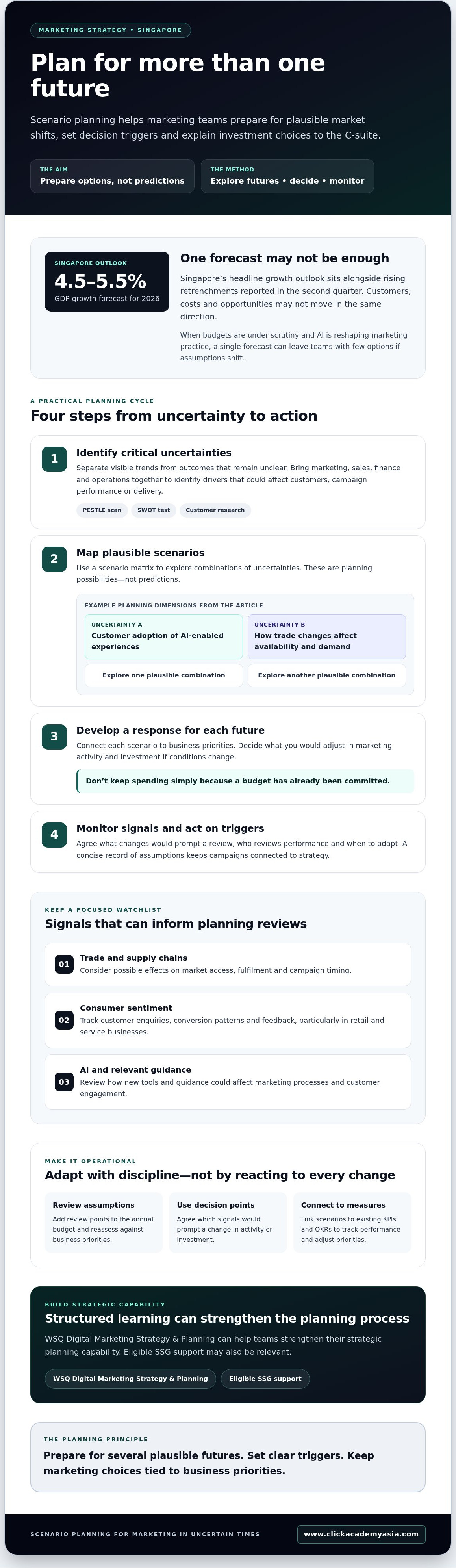
Singapore’s 2026 outlook combines strong headline growth with uneven conditions across sectors. The Ministry of Trade and Industry forecast GDP growth of 4.5% to 5.5% for the year, while the Ministry of Manpower reported rising retrenchments in the second quarter. For marketing leaders, the practical question is how to plan when customers, costs and opportunities may not move in the same direction.
Several broader drivers deserve attention: AI’s rapid development and related guidance, changes in trade and supply chains, and shifts in consumer sentiment. These factors can affect how teams reach audiences, time campaigns and respond to changes in product availability or demand. The aim is not to predict every turn, but to identify developments that could challenge your plan.
For a foundational overview of the method, explore scenario planning. To hear a concise introduction, watch this video:
Move from Static to Dynamic Planning
An annual budget remains useful for setting direction, but it can become a constraint if treated as fixed despite changing conditions. Add review points where teams can reassess assumptions and adjust activity against agreed business priorities. This is disciplined adaptation, not a series of reactive pivots.
Without regular oversight, campaigns can drift away from their original objectives. Keep a concise record of each campaign’s assumptions, who reviews its performance and what would prompt a change. This makes it easier to spot when activity no longer supports the strategy.
Identify the Market Drivers That Matter
Build a short watchlist around the drivers most relevant to your organisation:
Trade and supply chains: Consider how changes could affect market access, fulfilment or campaign timing.
Consumer sentiment: Track customer enquiries, conversion patterns and feedback, particularly in retail and service businesses.
AI and guidance: Review how new tools and relevant guidance could affect your marketing processes and customer engagement.
Use the watchlist to inform planning reviews. The next step is to turn important uncertainties into structured scenarios and decide how your team would respond.
The Core Framework: How to Execute Strategic Scenario Planning
Scenario planning is a structured way to explore several plausible futures and decide how your organisation would respond to each. It doesn’t aim to predict which future will happen. Instead, it helps marketing leaders challenge assumptions, prepare options and make decisions before a shift becomes urgent. MIT Sloan Management Review describes it as a tool for strategic thinking that can help counter overconfidence and tunnel vision.
For scenario planning for marketing in uncertain times, keep the process practical: identify critical drivers, build a scenario matrix, develop strategies for each future, then monitor indicators that may call for a change in course. You don’t need specialist software to get started. A cross-functional workshop, credible data and clear decision rules can give your team a useful first framework.
Step 1: Identify Critical Uncertainties
Separate trends, where the direction is reasonably visible, from uncertainties, where the outcome or impact remains unclear. For a business in Singapore, trends might include the continued use of digital channels. Uncertainties could include how quickly customers adopt AI-enabled experiences or how changes to trade affect product availability and demand.
Bring marketing, sales, finance and operations colleagues together to identify drivers that could affect customer behaviour, campaign performance or delivery. Use PESTLE to scan political, economic, social, technological, legal and environmental influences. Then apply SWOT to test how each scenario could expose a weakness or create an opportunity. Ground the discussion in customer research, campaign results, sales feedback and relevant external signals, rather than gut feeling alone.
Step 2: Build the Scenario Matrix
Rank uncertainties by their potential impact and how difficult they are to predict. Select the two most consequential, then place each on an axis with contrasting outcomes at either end. The result is a four-quadrant matrix of plausible futures, not a set of best-case and worst-case predictions.
Name each scenario: Choose a short, memorable label that helps colleagues discuss it clearly.
Write its narrative: Describe what customers, competitors and operating conditions might look like, and explain the assumptions behind that picture.
Next, develop a response for each quadrant. Identify what to protect, pause or scale, and which marketing activities could work across several futures. Then set trigger points: observable signals, such as a sustained change in conversion rate or lead quality, that prompt a review. Agree on the data source, review owner and action in advance. Set thresholds that fit your team’s baseline and objectives.
Monitor those signals at regular planning reviews and update scenarios when the evidence changes. To build your team’s capability in structured marketing strategy, explore digital marketing strategy training.
Agile Adaptation vs. Rigid Forecasting: Choosing Your Marketing Approach
Forecasting and scenario planning serve different purposes. Forecasting uses historical performance and current assumptions to estimate likely outcomes, making it useful for setting targets and allocating resources when conditions remain relatively stable. Scenario planning asks how your strategy might hold up if those assumptions change. The goal isn’t to abandon forecasts, but to avoid treating one projection as your only plan.
This distinction matters when an unexpected event changes customer demand or disrupts a campaign’s core assumptions. Historical data can provide a baseline, but it may not show what happens under conditions the business hasn’t faced before. Relying on one “most likely” outcome can leave teams without a considered response when reality diverges from the plan.
Why Forecasting Can Fall Short in Digital Marketing
Digital channels and customer behaviour can shift faster than annual plans are revised. A campaign that performs well in one period may lose relevance if audience needs, platform conditions or product availability change. Strategic myopia is the inability to see beyond current trends and assumptions when assessing future risks and opportunities.
Scenario planning helps counter that blind spot by giving teams more than one route forward. It also makes it easier to challenge sunk-cost thinking: past spend is not, on its own, a reason to keep funding activity that no longer meets its objectives. Set review criteria in advance, then use current evidence to decide whether to continue, adapt or stop a campaign.
Build Agility into Your Planning
Agility doesn’t mean changing direction at every wobble. It means agreeing on what to monitor, who can recommend a response and how decisions will be evaluated. This builds preparedness into planning instead of leaving teams to improvise after performance has weakened. Singapore’s wider focus on adapting economic strategies offers relevant context, as discussed in The Straits Times’ coverage of a strategic advantage in an uncertain world.
In 2026, strategic optionality means preserving viable choices. For example, test a channel before committing more budget, or prepare an alternative message in case customer priorities shift. Marketing analytics can help assess which scenario appears to be unfolding. Track indicators such as qualified leads, conversion rates and customer acquisition trends against agreed baselines. Look for sustained signals rather than reacting to one unusual result.
Link these reviews to your planning cycle and brand objectives so changes in activity remain deliberate and explainable. For a structured foundation in strategic marketing planning, explore WSQ Digital Marketing Strategy & Planning.
Implementing Scenario-Based Strategies in Your Singapore Organisation
A scenario plan only earns its place when people know how to use it. Give your marketing team clear ownership, agreed decision rules and a simple way to connect each possible future to current KPIs and OKRs. This turns scenario planning for marketing in uncertain times from a workshop exercise into a working management tool.
Align Teams and Stakeholders
Bring Finance, HR, sales and operations into the planning process early. Finance can test budget assumptions, HR can identify capability or capacity gaps, and customer-facing teams can contribute market signals. A cross-functional “war room” doesn’t need to be permanent. It can be a named group that convenes when a pre-agreed trigger is reached.
Present what-if budgets as conditional choices, not competing predictions. Show the baseline plan, explain what evidence would prompt a change, and outline what the team would scale, pause or reallocate in response. This helps the CFO assess exposure and options without mistaking preparedness for indecision.
Connect each scenario to the KPIs and OKRs it could affect, such as qualified leads, conversion rate or customer retention.
For each KPI, record its data source, review owner and agreed trigger for action.
Use suitable analytics tools, including GA4 where relevant, to review campaign performance and check whether signals are sustained before changing course.
Share a concise decision log with HR, Finance and marketing so teams understand what changed, why it changed and who owns the next step.
Start with Quick Wins, Then Build Team Capability
Demonstrate value early with work that improves visibility without requiring a major restructure. Audit active campaigns against the assumptions they depend on. Create a one-page trigger dashboard from existing reports, then identify one adaptable campaign element, such as a message or channel allocation, that could change if customer response shifts. These quick wins make the plan tangible and give leaders a basis for reviewing progress.
Execution also depends on people. A future-ready team can interpret data, challenge assumptions and translate a scenario into practical marketing decisions. Identify skill gaps through a short review: can team members explain performance changes, distinguish a temporary fluctuation from a meaningful signal and recommend an evidence-based response?
Continuous learning gives employees a clearer way to build those capabilities and understand their role as priorities evolve. WSQ-aligned learning can support practical, competency-based development. Explore WSQ Digital Marketing Strategy & Planning training to strengthen your team’s strategic execution skills.
Future-Proofing Your Marketing Leadership with WSQ-Certified Training
Strong scenario plans depend on people who can interpret evidence, test assumptions and turn strategic choices into marketing actions. For Singapore PMEBs, structured upskilling can build those capabilities while giving teams a shared approach to planning. ClickAcademy Asia is a training academy specialising in executive education, digital marketing strategy and analytics.
The WSQ Digital Marketing Strategy & Planning course is a relevant starting point for teams that want to strengthen their planning discipline. Its focus aligns with the skills scenario planning calls for: assessing the market, setting strategic direction and connecting decisions to marketing outcomes. For professionals, WSQ learning can provide a formal way to develop and demonstrate job-relevant competencies. For organisations, a shared framework can support more consistent planning across roles.
The WSQ Advantage for PMEBs
WSQ training is competency-based, helping teams focus on applying knowledge to workplace tasks rather than learning concepts in isolation. ClickAcademy Asia’s intensive workshops cover digital marketing, strategy and analytics. This makes the learning relevant to practical planning work, such as reviewing performance, evaluating assumptions and preparing responses to changing conditions.
Eligible course fees may receive SkillsFuture Singapore (SSG) support, with co-payment requirements and funding depending on the learner, employer and course eligibility. As rates and conditions can change, HR teams should confirm current details before budgeting. Assess the investment against the capability gap it addresses and the value of improving team decisions. Training does not guarantee a particular marketing result.
Choose Training That Supports Your Planning Goals
HR managers can begin by identifying which roles contribute to marketing strategy, where their skill gaps lie and how learning will be applied afterwards. Agree how the team will use its new capabilities, such as documenting scenario assumptions, reviewing trigger indicators or presenting options to Finance. Check applicable SSG funding and co-payment details as part of the training approval process.
For deeper tactical development, choose learning that complements strategic planning, such as SEO or marketing analytics, based on your team’s needs. Equip your team to plan with greater confidence and respond with purpose. Explore WSQ Digital Marketing Strategy & Planning training as a practical step towards building capability for scenario planning for marketing in uncertain times.
Build a Marketing Team Ready to Adapt
For marketing leaders, a resilient roadmap isn’t built on one perfect forecast. It comes from identifying critical uncertainties, preparing practical responses and agreeing on the evidence that should prompt a change in direction.
Make scenario planning for marketing in uncertain times part of your team’s regular strategic practice. Connect each scenario to clear KPIs and decision triggers, review performance data before reallocating spend, and build the skills your people need to act with confidence.
ClickAcademy Asia offers WSQ-accredited digital marketing training, including WSQ Digital Marketing Strategy & Planning. Eligible modules may receive SSG funding, subject to current criteria. The academy also offers official Google certification programs and training for professionals from over 30 countries.
Frequently Asked Questions
What is the difference between scenario planning and traditional contingency planning?
Scenario planning explores several plausible futures to test how a strategy might perform under different conditions. Traditional contingency planning usually prepares a response to a specific disruption, such as a supplier issue or channel outage. A marketing team could use scenarios to compare possible changes in demand, then create a contingency plan for a particular operational risk. Use each method for its purpose: broaden strategic choices with scenarios and define practical steps for known risks.
How often should a marketing team update its scenarios in 2026?
Review scenarios at regular strategy check-ins and whenever reliable evidence challenges a key assumption. The right cadence depends on your sector, campaign cycles and exposure to change. Set event-based review triggers, such as a sustained shift in lead quality or customer demand, so the plan can be revisited between scheduled reviews. Don’t revise scenarios in response to every fluctuation. First assess whether the signal is meaningful and relevant to your business.
Can small businesses benefit from scenario planning, or is it only for MNCs?
Small businesses can use scenario planning without building a large planning function or buying specialist software. Start with one decision that carries meaningful uncertainty, such as whether to prioritise a customer segment or channel. Sketch a few plausible conditions, agree what evidence to monitor and assign someone to review it. Keeping the exercise focused makes it easier to use the results in budget discussions and day-to-day marketing decisions.
What are the most common mistakes marketers make when planning for uncertainty?
Common mistakes include treating scenarios as predictions, relying on a single expected outcome and failing to decide what action follows each scenario. Plans can also become disconnected from available data or from the teams responsible for budgets and delivery. Keep assumptions visible, involve relevant stakeholders and assign an owner to each response. A useful plan makes decision-making clearer. It doesn’t attempt to eliminate uncertainty.
How does WSQ certification help in mastering scenario planning for marketing?
WSQ training can strengthen the marketing strategy and planning skills that support scenario planning. Its competency-based approach helps learners develop capabilities they can apply to workplace decisions, while a shared framework can help colleagues use consistent planning language. Certification alone doesn’t guarantee strategic results. The value comes from practising the skills, applying them to real organisational challenges and reviewing how decisions perform.
What kind of SSG funding is available for marketing strategy courses?
Eligible WSQ courses may receive SkillsFuture Singapore (SSG) course fee support, subject to the course, learner and employer meeting current criteria. Funding information provided for 2026 lists standard course fee support of up to 70% for eligible Singapore Citizens and Permanent Residents, with enhanced support of up to 90% for eligible SMEs. Confirm the latest terms and any co-payment requirements with the training provider before making a budget decision.
How do I identify “trigger points” in my digital marketing analytics?
Choose indicators that would reveal a change in an assumption behind your plan. For example, if a scenario depends on stable demand from a customer segment, monitor relevant enquiries, conversion patterns or sales feedback. Establish a baseline from your own reporting, name the data source and decide who reviews it. Set a threshold for reassessment that suits your objectives, and check for a sustained signal before changing course.
Is scenario planning compatible with AI-driven automated marketing platforms?
Yes. Automation can help manage campaign activity, while scenario planning guides the strategic choices behind it. Define the objectives, assumptions and review conditions that should govern automated activity, then assess whether platform recommendations still fit those priorities as circumstances shift. Keep human oversight for interpreting results and deciding whether to adjust budgets, audiences or brand direction. This helps teams use automation without mistaking operational efficiency for strategic judgement.
Put the framework into practice: clarify the assumptions behind your plan, assign owners to monitor the evidence and build the skills needed to act on changing signals. Explore WSQ Digital Marketing Strategy & Planning training, with funding subject to current eligibility and criteria.


Comments