
War Gaming for Competitive Marketing Strategy in Singapore

What if your competitor’s next move could be tested before it disrupts your campaign? In Singapore’s competitive market, even a well-researched plan can feel uncertain when rivals, customer responses and channel performance don’t follow expectations. War gaming for competitive marketing strategy gives your team a structured way to test assumptions and practise making decisions under pressure.
Experience can inform a marketing decision, but it can’t show exactly how a competitor will respond. A simulation lets your team explore possible moves and countermoves in a risk-free setting, then identify which assumptions need stronger evidence.
This guide explains what marketing war gaming can test, how to choose between strategic and tactical formats, and how to turn the exercise into practical actions. It also shows how a debrief can reveal the strategy, planning and analytical skills your team may need to strengthen next.
Table of Contents
What is war gaming for competitive marketing strategy in Singapore?
A marketing team in Singapore is preparing a product launch or campaign, but a rival could respond with a competing offer, a sharper message or increased visibility in the same channels. The team can’t know which response will happen. It can examine plausible reactions before committing to a plan.
Marketing war gaming is a facilitated simulation in which a team explores possible competitive moves and responses to test strategic choices. It isn’t a forecast of what a competitor will do or a campaign plan for what the organisation will execute. Instead, it gives the team a structured way to challenge assumptions, compare alternatives and identify decisions that need stronger evidence.
In war gaming for competitive marketing strategy, participants work through a scenario from different perspectives. They consider how a move might affect competitors and customers, and how those responses could influence the team’s next choice. The exercise helps leaders prepare for uncertainty without mistaking a plausible scenario for a known outcome.
What decisions can a marketing war game help teams explore?
A useful simulation starts with a decision the team may actually need to make. For example, a hypothetical Singapore brand could test whether to lead a launch with a price-focused message or a product benefit, then explore how a competitor might counter either position.
Teams can also test whether to prioritise search, social media or another channel, and how to adjust if a campaign receives less customer attention than expected. Make the scenario’s assumptions visible: what the team believes about competitor priorities, customer preferences and market conditions. Treat these as questions to examine, not facts about a rival’s intentions or actual Singapore market results.
How is marketing war gaming different from ordinary competitor analysis?
Competitor analysis gathers and interprets information, such as public messaging, product positioning or search results. A simulation uses that evidence to explore what different players might do next and what the team could do in response. Analysis builds the foundation; role-play puts decisions under pressure.
A static comparison can leave assumptions untested. In a facilitated exercise, one group might represent the organisation, while others consider plausible competitor or customer perspectives. Participants respond to each turn and explain the reasoning behind their choices. These roles are scenario tools, not claims about what actual competitors or customers think.
Search-intent evidence can help make a scenario more grounded. If customers appear to seek comparisons, pricing information or specific product benefits, test how different messages might answer those needs, while noting where the evidence is incomplete. For further guidance on leveraging data, participants often look to specialized programs at ClickAcademy Asia to refine their planning approach.
How does war gaming test competitive marketing decisions?
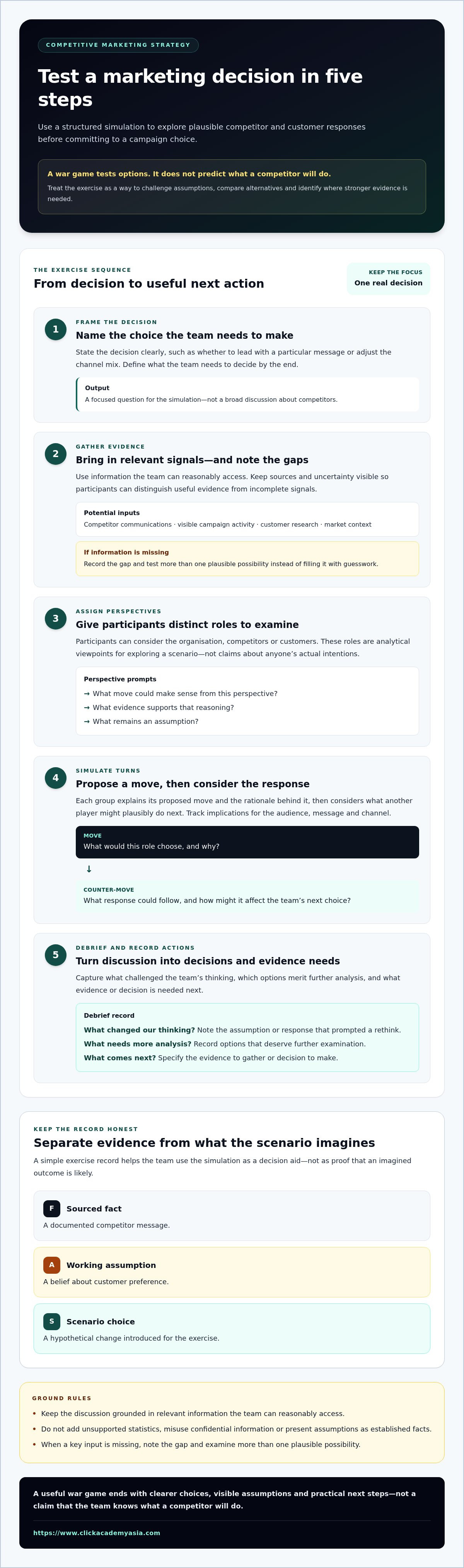
A useful war game turns a strategic question into a disciplined sequence. The team starts with a decision it needs to make, then uses evidence and role-based turns to explore how different choices might play out. A war game tests strategic options against plausible responses; it doesn’t predict which response will happen.
Frame the decision. State the choice clearly, such as whether to lead with a particular message or adjust the channel mix. Define what the team needs to decide by the end.
Gather evidence. Bring together relevant competitor communications, campaign activity, customer insights and market context. Record gaps as well as useful signals.
Assign perspectives. Give participants roles that help them consider how the organisation, competitors or customers could respond. These are analytical viewpoints, not claims about anyone’s actual intentions.
Simulate turns. Each group proposes a move, explains its rationale and considers what another player might do next.
Debrief and record actions. Capture what challenged the team’s thinking, which options merit further analysis and what evidence or decision is needed next.
Keep a simple exercise record that separates sourced facts from working assumptions and scenario choices. A documented competitor message is a sourced fact; a belief about customer preference is an assumption; and a hypothetical change in the scenario is a scenario choice. This distinction helps the team use the simulation as a decision aid, not as proof that an imagined outcome is likely.
What information should teams bring into the simulation?
Use relevant information the team can reasonably access, such as competitor communications, visible campaign activity, customer research and market context. For each input, note its source, date and confidence level where available. This makes it easier to distinguish current evidence from older or uncertain signals.
Keep the exercise grounded: don’t add unsupported statistics, misuse confidential information or present assumptions as established facts. If a key input is missing, record the gap and test more than one plausible possibility rather than filling it with guesswork.
How do teams model competitor moves and counter-moves?
Run the discussion in turns. Each role explains its proposed move, why it might make sense from that perspective and what response it considers plausible. Track the implications for the audience, message, channel and strategic objective so the conversation stays connected to the decision at hand.
Record alternative outcomes, too. A competitor might ignore a campaign, respond with a similar message or compete on a different dimension. These are scenario branches, not forecasts. Comparing them helps the team identify which choices remain robust across possibilities and which depend on an assumption that needs testing.
Strong simulations rely on clear thinking as well as facilitation. Teams looking to strengthen the strategy and planning skills behind evidence-based decisions can explore marketing strategy and planning training.
Which marketing war-gaming format fits the decision?
Not every strategic question needs a large, elaborate simulation. Choose a format that gives the team enough structure to examine its decision without adding unnecessary complexity. For a Singapore marketing team, that could mean exploring a broad market shift, testing a strategic choice or practising a response to one campaign scenario.
Choose the format according to the uncertainty you need to explore and the decision you’re testing. Use this comparison to scope the exercise before assigning roles or preparing materials.
When should a team use a landscape game or a strategy test?
Choose landscape exploration when the team needs to understand how possible market shifts and stakeholder interactions could affect its choices. Use a strategy test when a particular marketing direction is already on the table and leaders want to pressure-test it against plausible responses. Neither format is universally better: one widens the field of view, while the other examines a defined choice in greater depth.
When is focused role-play enough for a marketing question?
Focused role-play suits a narrow question, such as how an audience might interpret a campaign message or how the team could respond to a competitor’s hypothetical communication. Keep the scenario and participant perspectives proportionate to the decision. This format can surface options and assumptions, but it can’t establish actual customer behaviour or prove what a competitor will do.
If a focused exercise raises broader questions about positioning, channel choices or measurement, the team may need wider strategic analysis before acting. Building that foundation through WSQ digital marketing strategy training can help teams connect simulation insights to structured planning, without treating training as a substitute for evidence or the exercise itself.
How can Singapore marketing teams run a useful war-gaming exercise?
A well-run exercise needs more than lively debate. For a Singapore marketing team, it should stay anchored to a real decision, use relevant evidence and end with clear follow-up actions. Keep the process proportionate to the question: a focused campaign decision doesn’t need an elaborate simulation.
Set the decision. Phrase one choice the team needs to examine, such as whether to change a campaign message if a competitor responds with a similar offer.
Define the boundaries. Agree what the scenario covers, which audiences and channels are in scope, and what the team won’t attempt to resolve.
Prepare the evidence. Gather relevant customer insight, campaign information and competitor communications. Label sourced facts, working assumptions and scenario-specific choices distinctly.
Assign roles. Give participants perspectives that help them explore the scenario, and clarify that roles represent possibilities rather than actual competitor intentions.
Facilitate turns. Ask each group to explain its move, reasoning and possible next response. Keep discussion tied to the evidence, scenario and decision question.
Debrief and assign actions. Capture what the team learned, what needs validation and who will take each next step.
How should the team set the scenario and ground rules?
Make the starting brief specific enough to guide discussion. For example, a team could examine how to protect a campaign’s message if a rival launches a similar promotion. State the decision to be made, the relevant audience and channels, and what sits outside the scope, such as broader brand repositioning. Agree how participants will label facts, assumptions and hypothetical developments, then challenge ideas and evidence rather than criticising competitors.
A facilitator should manage the pace and bring the group back to the agreed question if discussion drifts into speculation. Useful prompts include: “What evidence supports that view?”, “What else could happen?” and “What would change our response?” This helps quieter participants contribute and keeps confident opinions from being mistaken for stronger evidence.
What should the debrief capture after the simulation?
Close by recording the plausible responses explored, the strategic vulnerabilities or opportunities they surfaced, and the assumptions that most influenced the team’s choices. Turn useful insights into actions that can be tested or investigated, each with an owner and a clear next step. Also list evidence gaps and follow-up questions so scenario possibilities aren’t mistaken for guaranteed outcomes.
For actions involving campaign performance, decide in advance which signals the team will monitor and how those measures relate to the original objective. Relevant marketing analytics and measurement training can help teams build the skills to interpret results and refine plans. War gaming for competitive marketing strategy is most useful when the debrief informs disciplined decisions, not when the scenario is treated as a prediction.
How can strategic training turn war-game insights into stronger marketing plans?
A simulation can reveal possible responses, expose assumptions and generate options. It can’t determine which option is right without further analysis. Teams still need to connect insights to business objectives, understand their audiences, select suitable channels and decide how to assess the marketing actions that follow.
Strategic capability helps make the exercise useful beyond the workshop. Take a scenario insight, such as a message that may be vulnerable to a competitor’s response, and ask what evidence would validate it, which audience it matters to and what outcome a revised plan should support. War gaming for competitive marketing strategy works best as an input to evidence-led planning, not a substitute for it.
What capabilities help teams apply war-game findings?
Three connected capabilities help teams move from discussion to a stronger plan:
Strategic alignment: Connect each option to the marketing objective and clarify the audience it is intended to reach.
Evidence interpretation: Separate substantiated customer or market insight from assumptions raised during the simulation.
Measurement planning: Define what to monitor after taking action, and how the evidence will inform the next decision.
WSQ Digital Marketing Strategy & Planning is relevant training for developing a foundation in structured marketing decisions and planning. It supports the capabilities needed to evaluate simulation insights, while the war-game exercise remains a separate activity. Teams can explore WSQ Digital Marketing Strategy & Planning training to strengthen their planning approach.
Who may qualify for the stated SSG/WSQ course subsidy?
Eligible Singaporeans and PRs may claim up to 70% subsidy on qualifying courses. Subsidy is subject to eligibility and shouldn’t be treated as automatic. The stated criteria are:
Age 21 years and above; Level 2 basic computer literacy.
GCE N, O, or A Level, NITEC, or a diploma; minimum 2 years work experience.
English proficiency of GCSE N/O pass, WPLN Level 5, IELTS 5.5, or TOEFL iBT 46-59.
Bring a personal laptop.
To discuss course selection, email TeamSG@clickacademyasia.com or call or WhatsApp 9388 8755. The team responds within 1-2 working days. With the right strategy, analysis and measurement skills, teams can turn simulation questions into considered marketing actions and improve their decisions as evidence develops.
Build the skills to act on competitive insight
Make strategic learning part of how your team works. After a simulation, choose one insight to examine more deeply: identify the evidence needed, connect it to a marketing objective and decide how you’ll assess any action taken. This creates a clear bridge from scenario thinking to decisions your team can review and refine.
Developing those habits takes more than a single exercise. Relevant strategy and planning training can strengthen the analysis, audience understanding and measurement skills that help teams turn uncertain possibilities into considered marketing plans. ClickAcademy Asia’s practitioner-led, AI-integrated curriculum supports professional upskilling, with 30,000+ professionals upskilled, 6,000+ companies and teams trained, and 3,000+ 5-star Google reviews.
Equip your team to make stronger, evidence-aware decisions with WSQ Digital Marketing Strategy & Planning. Build on war gaming for competitive marketing strategy by developing the capabilities to assess options, act with purpose and keep learning as the evidence develops.
Frequently Asked Questions
Can war gaming predict exactly what a competitor will do?
No. A war game helps a team consider possible responses, but it can’t reveal a competitor’s actual plans or guarantee which scenario will occur. Treat each outcome as a hypothesis to prepare for, not a forecast to rely on. For example, if a rival could respond to a launch with a similar offer or a different message, plan how you’d assess each possibility rather than assuming one is certain.
Is marketing war gaming the same as scenario planning?
No, though the approaches can complement each other. Scenario planning develops possible future conditions and considers what they could mean for the organisation. A marketing war game adds interactive decision-making: participants take perspectives, make moves and respond to developments as the exercise unfolds. A team might use scenario planning to frame possible changes in customer demand, then war game how its campaign choices could hold up under different conditions.
How can a team keep a war game evidence-led rather than speculative?
Set a clear evidence standard before discussion begins. Ask participants to identify whether a point comes from a documented source, an interpretation or a hypothetical scenario, and note what would strengthen an uncertain claim. If someone suggests customers will reject a message, record that as an assumption unless research supports it. This keeps plausible ideas in play without giving them the weight of verified findings.
What should a marketing team do if the simulation produces conflicting recommendations?
Don’t force consensus before understanding the disagreement. Compare each recommendation against the same criteria, such as its fit with the marketing objective, the quality of supporting evidence and the risks if the underlying assumption is wrong. If one option works across several scenarios, it may be more robust; if the choice depends on missing information, assign a follow-up test or research task before deciding.
Can war gaming be useful when competitor information is incomplete?
Yes. Limited information is a reason to explore several plausible responses, not to present guesses as facts. Define what’s known, identify the gaps, then consider different branches, including a minimal response, a direct counter-move or no visible reaction. The exercise can help the team decide which information would change its plans and what it can prepare without knowing a competitor’s intentions.
Who should facilitate a competitive marketing war game?
Choose someone who can guide structured discussion, manage time and challenge assumptions without steering participants towards a preferred answer. The facilitator should understand the decision being tested, keep the group within the agreed scenario and make sure different perspectives are heard. They don’t need to represent a competitor; their role is to help the team examine its reasoning and capture where evidence or further analysis is needed.
Can eligible learners receive an SSG/WSQ subsidy for digital marketing training?
Potentially, if the learner and course meet the applicable requirements. The eligibility criteria, including age, qualifications, work experience, English proficiency and the personal-laptop requirement, are set out in the training section above. Review those details before planning enrolment, as meeting the stated criteria doesn’t make support automatic. The subsidy applies only to qualifying courses and eligible Singaporeans and PRs.



Comments