
Strategic Thinking & Planning for Singapore Managers: 2026

Strategic Thinking and Planning for Managers in Singapore: 2026 Strategic thinking was ranked the most important leadership capability by 63% of Singapore business leaders in a survey reported by Singapore Business Review. Yet urgent operational demands can leave managers with little time to decide what matters next. Strategic thinking and planning for managers means using evidence to make clear choices, then aligning people, time and resources behind them.
If your plans feel disconnected from what your team can deliver, or changing conditions make every priority seem temporary, you’re not alone. The answer isn’t a longer document or a perfect forecast. It’s a practical process that links organisational goals to evidence, focused priorities and accountable action. A useful strategy makes its assumptions visible and matches its priorities to your team’s capacity.
This guide shows you how to assess the situation, make deliberate trade-offs, translate decisions into team actions and measures, and review progress so you can adjust when needed. The result is a repeatable planning habit that keeps your team coordinated and helps you respond thoughtfully to change in Singapore’s business environment.
Table of Contents
Strategic Thinking and Planning for Managers in Singapore: Why It Matters
A Singapore manager can start the day focused on delivery targets, customer requests and team issues, then realise there’s been little time to consider whether the team is working on the right priorities. That tension makes strategic thinking and planning for managers a practical leadership responsibility, not a task reserved for annual reviews or senior executives.
Strategic thinking means interpreting the context around your team and choosing a direction. Planning turns that direction into action. Managers connect organisational priorities to their teams’ day-to-day decisions while keeping customer needs and changing conditions in view.
To see why a clear direction matters as much as a list of actions, watch this short explanation:
What strategic thinking looks like in a manager’s role
Strategic thinking starts before you commit people, time or budget. Question the assumptions behind a proposed action: what problem are we solving, what evidence supports this choice, and what might we be overlooking? Then compare signals from customers, competitors and within the organisation. A shift in customer feedback, for example, may matter more than an internal preference for continuing with a familiar process.
Suppose a team is asked to increase engagement with a service. Rather than immediately adding promotional activity, its manager could examine customer questions, competitor messaging and the team’s workload. Those signals may point to a need to clarify the offer or improve the customer journey first. The value comes from making a reasoned choice, not assuming one response fits every situation. For professionals looking to build these capabilities, structured practical digital strategy learning at ClickAcademy Asia provides valuable frameworks for daily management.
How strategic thinking differs from strategic planning
Strategic thinking explores the options; strategic planning turns a chosen option into action. Thinking tests assumptions, identifies opportunities and risks, and helps determine where to focus. Planning specifies what the team will do, who owns each action, what resources are needed and how progress will be measured.
The two activities work best together. A plan without thoughtful choices can organise effort around the wrong priority; thinking without a plan can leave useful insight unused. The distinction is also explored in a broader overview of the concept on Wikipedia.
Planning isn’t a promise to follow the same route regardless of what happens. If customer needs shift, an assumption proves inaccurate or operating conditions change, managers can revisit actions while keeping the intended outcome in view. This helps teams adapt deliberately rather than treating every new demand as a reason to abandon direction.
Strategic responsibility therefore reaches beyond the executive team. Senior leaders may set organisational direction, but managers translate it into practical team choices: what to prioritise, what to defer and how to respond when new evidence emerges. That’s where strategy becomes part of everyday work. For managers in hands-on clinical and practice-based settings balancing client care with business goals, dedicated advisory resources like theclinicproject.com demonstrate how tailored strategic consulting can keep day-to-day execution aligned with the bigger picture.
A Practical Strategic Planning Process Managers Can Use
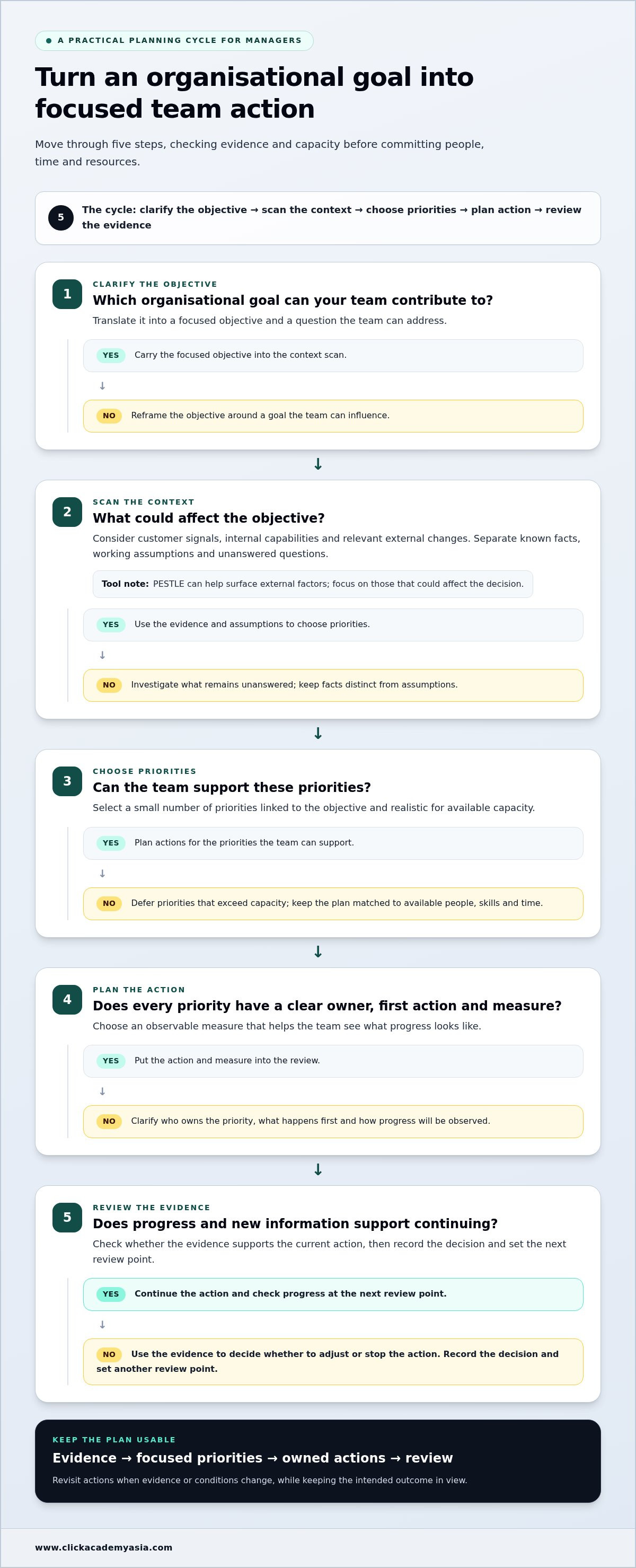
A strategy becomes useful when the team can see how its goals connect to everyday decisions. This five-step cycle keeps analysis focused, clarifies trade-offs and helps everyone move from organisational objectives to coordinated action.
Start with objectives, evidence and assumptions
Begin with a focused question that translates an organisational goal into something the team can influence. Separate what you know from what you’re assuming and what still needs investigation. Use customer feedback, internal capability and relevant external changes to inform the discussion, rather than collecting information for its own sake. PESTLE can help surface external factors, provided the team focuses on those that could affect its decision.
Clarify the objective. Decide which organisational goal the team can contribute to. The output is a focused objective and a question the team can address, such as how to make an existing service easier for customers to use.
Scan the context. Identify which customer signals, internal capabilities and external changes could affect the objective. Summarise the evidence, distinguishing known facts, working assumptions and unanswered questions.
Choose priorities. Decide where the team should focus and what it will defer. Set a small number of priorities linked to the objective and realistic given available capacity.
Plan the action. Decide who will do what first and what progress should look like. Give each priority an owner, an initial action and an observable measure.
Review the evidence. Decide whether progress and new information support continuing, adjusting or stopping an action. Record the decision and set a review point for the next check-in.
Turn priorities into owned actions and measures
Keep the plan usable by limiting priorities to what the team can support with its people, skills and time. Give every priority a clear owner, a first action and a measure the team can observe. For digital work, choose measures that help answer the strategic question, not simply metrics that are easy to collect. ClickAcademy Asia’s guide to Marketing Analytics with GA4: A Strategic Guide for 2026 Professionals is a related resource for thinking about evidence and measurement.
A simple planning canvas can capture the logic in one place:
Objective: What organisational goal will the team support?
Assumptions: What are we treating as true, and what needs validation?
Priority: What will we focus on, and what will we defer?
Owner: Who is accountable for the next action?
Measure: What observable evidence will indicate progress?
Review point: When will the team revisit the evidence and decide whether to adjust?
For a manager, strategy is a cycle: clarify the goal, test the context, make choices, assign action and review the evidence. Reuse the canvas as conditions change, and use [Internal Link: ClickAcademy Asia practical digital strategy learning] to strengthen how your team interprets evidence and turns priorities into action.
Which Strategic Planning Framework Should Managers Use?
The right framework depends on the decision in front of you. For strategic thinking and planning for managers, a tool should sharpen the question, make relevant evidence easier to discuss and help the team decide what to do next. SWOT, PESTLE and the Balanced Scorecard serve different purposes, so using all three for every issue can create more paperwork than insight.
SWOT and PESTLE: understanding position and context
Use SWOT to examine the factors that matter to a specific objective, not to catalogue everything about the organisation. Strengths and weaknesses concern internal factors; opportunities and threats concern external ones. PESTLE broadens the external scan, helping the team consider which political, economic, social, technological, legal or environmental developments could influence its choices.
Neither framework is useful as a box-ticking exercise. A long list of unsupported claims can look like analysis without helping anyone choose. Ask the team to support important points with evidence, rank them by relevance, then state which decision each point informs. If a factor won’t affect the objective or the team’s response, it may not belong in the discussion.
Balanced Scorecard: connecting priorities with measures
The Balanced Scorecard helps managers consider whether a strategy is reflected in more than one dimension of performance. Alongside financial results, its perspectives include customers, internal processes, and learning and growth. This can reveal whether a proposed priority affects customer experience, how work gets done or the capabilities a team needs to build.
Choose a small set of meaningful measures. An outcome measure shows whether the intended result is taking shape, while an activity measure records work completed along the way. Both can be useful, but counting activities alone doesn’t show whether they contribute to the objective. Choose measures that fit the decision, then use the evidence to guide review rather than chasing every available metric.
Combine frameworks around the decision
Imagine a Singapore team deciding whether to adapt a service for a changing customer need. It could use PESTLE to identify relevant external shifts, then SWOT to assess whether its capabilities and constraints support a response. Once it chooses a priority, the Balanced Scorecard can help connect that choice to customer, process and capability measures.
Frameworks organise the discussion; managers still make the decisions, and no framework guarantees results. Select one based on the question, the available evidence and how far ahead the decision reaches. Use another only when it adds a distinct perspective, not simply because it is familiar.
How Managers Can Put Strategy into Practice Without Losing Focus
Strategy can feel abstract when customers need answers, deadlines are close and operational issues keep arriving. The answer isn’t another lengthy meeting. Build a brief review around a real decision, use evidence the team already has and make the trade-offs clear so daily work supports agreed priorities.
Build a realistic team planning rhythm
Use an existing team meeting or a decision point in the work cycle to review one strategic priority. Ask contributors to bring relevant customer feedback, delivery information, risks or opportunities rather than broad updates. Keep the discussion centred on a practical question: what choice does the team need to make, and what information would help?
Close by recording the decision, action owner, measure of progress and next review point. A short written record gives the team a shared reference when urgent requests compete for attention. It also makes deferred work visible, so postponing an activity is a deliberate trade-off rather than an unspoken change of direction.
Separate priorities from urgent tasks
Urgent work matters, but it doesn’t automatically outrank every strategic priority. When a new request arrives, assess its impact against the team’s objectives, capacity and existing commitments. If the team takes it on, agree what will move back, who needs to know and whether the priority or timing should change.
For example, a team working to improve a digital customer journey may receive a request for a one-off campaign. The manager can weigh the campaign’s immediate value against the time needed for the planned journey work. If it takes precedence, make the consequence explicit and update ownership or timing, rather than expecting the team to absorb both unchanged.
Review progress and adjust without losing direction
At each review, compare what the team observed with its assumptions and intended outcome. If progress is off track, identify the likely cause before changing course: was the action not completed, did operating conditions shift, or did the original assumption prove inaccurate? Each explanation points to a different response.
Execution issue: clarify the next action, remove a practical obstacle or confirm ownership.
Changed conditions: reassess the impact, resources and order of priorities.
Incorrect assumption: update the rationale and decide whether the action still supports the objective.
Keep the underlying objective visible while changing the route. This helps the team distinguish a sensible adjustment from abandoning direction in response to every new demand. Managers practising strategic thinking and planning can make reviews more useful by documenting what changed, why the decision changed and what evidence to check next.
When digital priorities are central, relevant learning can help managers build the capability to assess options and guide execution. Explore WSQ digital marketing courses in Singapore to develop your team’s digital strategy skills alongside workplace practice.
Build Strategic Capability Through Practice and Relevant Training
Strategic judgement develops through use. After a planning discussion or review, record which assumptions held, what evidence changed the decision and where the team could have asked a sharper question. Invite colleagues to share what they observed, then apply those lessons the next time you assess priorities. Engaging in executive and career development coaching through resources like growwithrainy.com can also provide external perspective and targeted feedback. This reflection, feedback and practice loop helps make strategic habits part of work, not an occasional exercise.
What structured learning can add to workplace practice
Workplace experience gives managers valuable context; structured learning can add concepts and tools to apply to relevant challenges. ClickAcademy Asia’s practitioner-led, AI-integrated curriculum connects leadership development with digital strategy, supporting managers as they develop their approach to decision-making, planning and team alignment. Learning works best alongside workplace application, where managers can test ideas, reflect on their choices and discuss how to guide their teams.
Relevant options include WSQ Leadership & Management Courses and WSQ Digital Marketing Strategy & Planning. The first supports managers developing leadership and team-planning capability; the second is relevant to managers making decisions about digital marketing direction and priorities. ClickAcademy Asia has upskilled 30,000+ professionals, has 3,000+ 5-star Google reviews and has trained 6,000+ companies/teams.
Check course eligibility and choose a next step
Eligible Singaporeans and PRs can claim up to 70% subsidy on qualifying courses. Eligibility requirements are:
Age: 21 years and above.
Computer literacy: Level 2 basic computer literacy.
Education and experience: GCE N/O/A Level or NITEC or diploma plus 2 years work experience.
English proficiency: GCSE N/O pass, WPLN Level 5, IELTS 5.5, or TOEFL iBT 46-59.
Equipment: Learners must bring a personal laptop.
To explore the learning path that fits your team’s development needs, review the relevant WSQ training options. For course-selection assistance, text WhatsApp/phone 9388 8755; a consultant will respond within 1-2 working days. You can also email TeamSG@clickacademyasia.com.
Build strategic capability through reflection, feedback and structured practice. Explore relevant WSQ-funded training to help managers apply strategic thinking and planning at work with clearer decisions and stronger team alignment.
Make Strategic Capability a Habit for the Year Ahead
A plan earns its value through the decisions people make after the planning session. Choose one priority your team can act on, bring it into the next relevant discussion and notice what new evidence changes your view. This steady practice helps managers keep direction visible while responding thoughtfully to shifting needs.
Strategic thinking and planning for managers is not a one-off exercise. It’s a capability teams can strengthen through reflection, shared learning and practical application. Identify where your managers would benefit most, whether that is leading people, aligning teams or making informed digital strategy choices.
ClickAcademy Asia’s practitioner-led, AI-integrated learning provides a structured way to develop these capabilities alongside workplace practice. Equip your managers with relevant WSQ-funded learning and give them more tools to turn priorities into coordinated action. Explore ClickAcademy Asia’s WSQ training and strengthen your team’s strategic capability.
Start with one decision, one shared priority and a team ready to learn. Each thoughtful review builds a stronger foundation for what comes next.
Frequently Asked Questions
Can managers learn strategic thinking, or is it an innate leadership trait?
Yes, managers can develop strategic thinking through deliberate practice. Try it with a live decision and keep a brief decision log: note the belief behind your choice, the evidence you considered and what result would make you reconsider it. Reviewing that note later can reveal recurring assumptions and sharpen your judgement. This gives strategic thinking and planning for managers a practical starting point grounded in real work.
Is strategic planning only for senior executives?
No. Managers can shape how organisational priorities are carried out, even if they don’t set the overall direction. If you spot a risk or opportunity outside your remit, frame it clearly: explain what you’ve observed, why it matters and what options or support could help. A concise recommendation gives senior leaders useful operational insight and helps your team’s experience inform wider decisions.
How can a manager think strategically when there is little time for planning?
Start with a decision the team already needs to make, rather than setting up a separate planning exercise. For instance, use a regular delivery discussion to ask whether current work still supports the intended outcome. Keep the conversation focused on the choice, the evidence needed and who will follow up. A small, well-framed discussion can make strategy part of existing work without adding a new meeting.
What should managers do when a strategic plan stops matching changing conditions?
First check whether the objective is still relevant, then examine what has changed around it. A delayed action may call for clearer ownership, while a shift in customer needs may require a different response. Tell the team which parts of the direction remain in place and which actions are changing. Explaining the reason for an adjustment helps people adapt without mistaking every change for a complete reset.
Can strategic thinking help managers make better decisions with incomplete information?
Yes. It helps managers distinguish evidence from uncertainty instead of waiting for perfect information. For a decision that can be tested safely, consider a limited, reversible next step and agree what observation would inform the next choice. For decisions with wider consequences, identify what missing information could materially change the options. This makes uncertainty visible and supports proportionate action without implying that outcomes can be predicted.
How can managers encourage their teams to contribute to strategic planning?
Make it easy for people to contribute before the discussion, especially those who need time to organise their views. Share one clear question in advance and invite examples from customer interactions, recurring process issues or day-to-day work. During the discussion, ask whose perspective has not been heard. After deciding, explain how the input shaped the choice so contributors can see that their observations had a meaningful role.


Comments