
VoC Implementation Guide: Strategic Growth in Singapore 2026
- ClickAcademy Asia

- Aug 6
- 11 min read
Updated: Aug 9
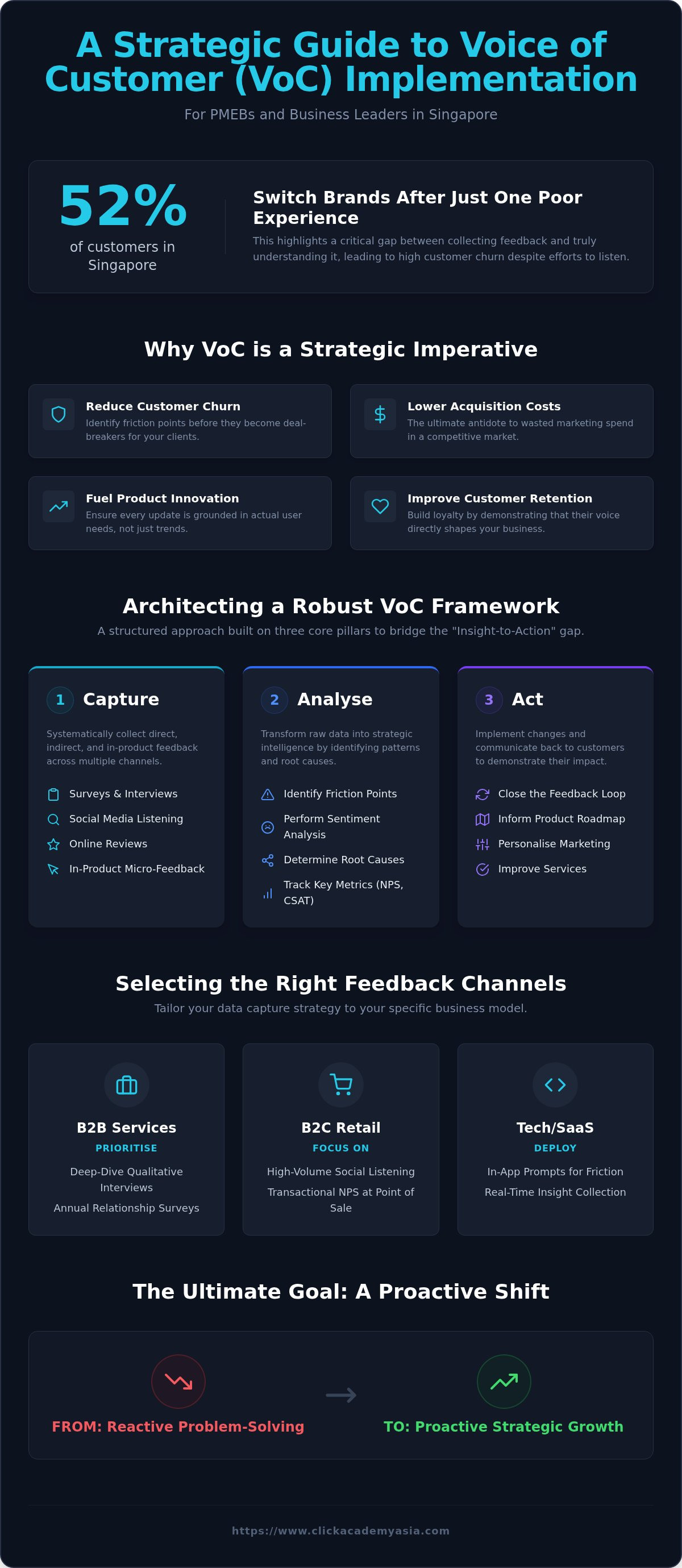
Did you know that 52% of customers in Singapore would switch brands after just one poor experience? It's a sobering reality for many PMEBs who find themselves drowning in raw survey data without a clear path to actionable insights. You've likely felt the frustration of high churn despite your constant efforts to listen; it's a common gap between collecting feedback and actually understanding it.
This voice of customer (voc) implementation guide is designed to help you move past the noise and master the art of strategic listening to scale your business impact. We'll provide you with a clear roadmap for building a robust programme that improves retention and aligns your products with what your clients actually need. We'll also examine how to bridge the skills gap by using WSQ-aligned analytical frameworks to ensure your feedback loop drives tangible ROI.
Table of Contents
Why Voice of Customer (VoC) Implementation is Vital for Singaporean Businesses in 2026
Architecting Your VoC Framework: From Data Capture to Actionable Insights
Essential Tools and Methodologies for a Robust VoC Programme
A Step-by-Step Guide to Launching Your VoC Initiative in Singapore
Bridging the Skills Gap: WSQ-Funded Training for VoC Excellence
Why Voice of Customer (VoC) Implementation is Vital for Singaporean Businesses in 2026
VoC is the systematic collection and analysis of customer feedback to drive strategic decisions. Implementing a comprehensive Voice of the Customer (VoC) framework allows organisations to move beyond mere survey collection and into the realm of predictive intelligence. In Singapore, where customer acquisition costs continue to climb, listening to the customer serves as the ultimate antidote to wasted marketing spend. It's not just about hearing what they say; it's about understanding the intent behind the interaction.
This voice of customer (voc) implementation guide highlights a critical shift in the local market. We are moving rapidly from aggregate data to individual sentiment analysis. This evolution aligns perfectly with Singapore's national focus on digital excellence and the Smart Nation initiative. By understanding the "why" behind customer actions, PMEBs can pivot from reactive problem-solving to proactive strategy. This approach ensures that your business remains agile in a landscape where consumer preferences change overnight.
The Strategic Advantage: Retention and Revenue
VoC reduces churn by identifying friction points before they become deal-breakers for your clients. Many Singaporean firms fail because of the "Insight-to-Action" gap; they possess the data but lack the internal skills to execute meaningful changes. Closing this gap is essential for maintaining a competitive edge in the APAC region. A well-executed VoC programme fuels product innovation and service design by ensuring every update is grounded in actual user needs. This direct link between feedback and development is what separates market leaders from those who simply follow trends.
VoC in the Age of AI and Personalisation
The rise of AI-first customer journeys in 2026 means that your AI agents require high-quality, structured customer data to function effectively. Without a clear voice of customer (voc) implementation guide, your automation efforts may lack the empathy required to retain loyal clients. Sentiment analysis plays a pivotal role here, allowing for hyper-personalised marketing campaigns that resonate on an emotional level. To capture these behavioural "voice" signals accurately, mastering tools like Google Analytics (GA4) Training is no longer optional for modern marketing teams. Integration with CRM systems ensures that these insights are accessible to every department, from sales to support, creating a unified front that prioritises the customer experience.
Architecting Your VoC Framework: From Data Capture to Actionable Insights
Building a successful VoC programme isn't about purchasing the most expensive software; it's about establishing a rigorous structure. Without a roadmap, your team will likely end up with a mountain of digital dust rather than a strategic asset. This voice of customer (voc) implementation guide relies on a three-pillar architecture: Capture, Analyse, and Act. Mastering the bridge between data capture and actionable insights is what differentiates a high-performing Singaporean firm from one that simply reacts to complaints. For PMEBs, data without a framework is just noise that leads to analysis paralysis.
Cross-functional alignment is the glue that holds this framework together. Marketing, Sales, and Product teams must share a single source of truth to avoid working in silos. You need a "Closed-Loop" feedback system where every piece of criticism or praise triggers a specific internal response. When you close the loop, you don't just solve a ticket; you demonstrate to the client that their voice directly shapes your business. This level of engagement is vital for retaining the 52% of Singaporean consumers who are ready to switch brands after a single bad experience.
Selecting the Right Feedback Channels
Direct feedback like surveys and interviews gives you the "what," while indirect feedback from social listening and reviews provides the "unfiltered why." In-product micro-feedback is the gold standard for real-time insights, especially for the growing SaaS and E-commerce sectors in Singapore. Use this checklist to choose channels based on your business model:
B2B Services: Prioritise deep-dive qualitative interviews and annual relationship surveys.
B2C Retail: Focus on high-volume social listening and transactional NPS at the point of sale.
Tech/SaaS: Deploy in-app prompts to identify friction points the moment they occur.
Analysing Sentiment with Marketing Analytics
Raw data is only useful if it's categorised into meaningful themes. Use text and sentiment analysis to turn thousands of open-ended comments into clear, prioritised action items. You can learn to build these sophisticated dashboards and master data visualisation through specialized training that bridges the technical gap. It's also wise to weight your feedback based on Customer Lifetime Value (LTV). This ensures that your most loyal and profitable clients have a significant influence on your product roadmap, ensuring your resources are always allocated where they generate the highest ROI.
Essential Tools and Methodologies for a Robust VoC Programme
Selecting the right metrics is a foundational step in any voice of customer (voc) implementation guide. You've likely utilised the Net Promoter Score (NPS) to measure long-term loyalty; in Singapore, e-commerce benchmarks typically range from 30 to 50. While NPS tracks the big picture, the Customer Satisfaction (CSAT) score is more effective for immediate transactional feedback, where a score above 80% is the local gold standard. For firms managing digital platforms, the Customer Effort Score (CES) is vital because it pinpoints exactly where users encounter friction in their journey.
Beyond these metrics, PMEBs should leverage Customer Advisory Boards (CABs) for high-value B2B segments. These boards provide a strategic platform for your most significant clients to influence your long-term roadmap, fostering a sense of partnership. Integrating this feedback into your existing CRM tech stack, such as Salesforce or HubSpot, ensures that every department has access to the same insights. This prevents the common trap where Singaporean service representatives must navigate more than four different systems to resolve a single customer issue.
Quantitative vs Qualitative Data Collection
Surveys provide the scale needed to identify broad market trends, but qualitative interviews offer the depth required to understand underlying motivations. Singaporean consumers are increasingly prone to "survey fatigue," so it's best to keep digital prompts short and highly relevant. You shouldn't rely solely on what people say; use Google Analytics (GA4) Training to validate feedback against actual user behaviour. If a client claims your checkout process is seamless but your data shows a high abandonment rate, you've identified a critical "say-do" gap that requires immediate attention.
Integrating VoC into Your Tech Stack
Your VoC data should directly inform your search strategies to ensure your brand remains visible where it matters. Use the specific terminology and pain points mentioned in customer reviews to optimise your SEO and SEM campaigns. When collecting these insights, strict adherence to PDPA compliance is a non-negotiable requirement for any business operating in Singapore. Managing these complex data flows requires specialised skills that go beyond basic marketing. You can equip your team with these competencies through WSQ Marketing Analytics & Insights courses. These modules are designed to help you turn raw feedback into a structured, strategic asset that drives measurable growth.
A Step-by-Step Guide to Launching Your VoC Initiative in Singapore
Launching a successful initiative in Singapore's high-stakes environment requires more than just a survey tool; it requires a methodical approach. This voice of customer (voc) implementation guide outlines the five essential steps to ensure your programme doesn't just collect data, but generates revenue. You'll need to move from strategic alignment to technical execution, and finally, to organisational upskilling to see real results. Following a structured roadmap allows PMEBs to navigate the complexities of local consumer sentiment without getting lost in the noise.
Step 1: Define clear, measurable objectives like reducing churn by 10% or improving your product NPS.
Step 2: Identify key customer segments and personas relevant to the Singapore ecosystem, such as tech-savvy Gen Z shoppers or corporate decision-makers.
Step 3: Design your listening architecture using multi-channel touchpoints, including the 80% of local customers who still prefer direct phone interactions.
Step 4: Establish a cadence for reporting and a process for 'Closing the Loop' with respondents to prove you've heard them.
Step 5: Upskill your team to interpret and act on the data effectively through certified training.
Phase 1: Objective Setting and Stakeholder Alignment
Getting buy-in from the C-suite is easier when you link VoC directly to bottom-line results, such as customer lifetime value. In a Singaporean SME, the 'Owner' of the programme is typically the Head of Marketing, while in an MNC, it may sit within a dedicated Customer Experience department. You should set SMART goals for your initial pilot programme to demonstrate quick wins. For example, aim to increase survey response rates by 15% within the first three months to validate your methodology.
Phase 2: Execution and Continuous Optimisation
Start by launching a pilot survey to a small, loyal customer segment to test your questions and delivery channels. Use the early response rates to iterate on your design; if engagement is low, you might need to adjust the timing or the incentive. To build a high-level roadmap that aligns your team with these objectives, consider enrolling in our WSQ Digital Marketing Strategy & Planning course. This programme provides the strategic framework needed to lead digital initiatives with confidence. Remember that upskilling is your greatest asset here; Singaporean citizens and PRs can access SSG funding to offset the costs of mastering these essential analytical skills.
Bridging the Skills Gap: WSQ-Funded Training for VoC Excellence
A strategic VoC programme often stalls not because of poor software, but because of a talent gap. If your team lacks the analytical muscle to interpret complex sentiment or identify data patterns, even the most comprehensive voice of customer (voc) implementation guide won't deliver ROI. Implementation fails when PMEBs cannot bridge the distance between hearing a customer and acting on their needs. ClickAcademy Asia provides the essential WSQ-certified modules that empower your staff to turn raw feedback into a structured growth engine.
By following this voice of customer (voc) implementation guide and investing in certified training, you ensure your business remains agile in 2026. Continuous upskilling is the ultimate competitive advantage in the Singaporean market. It allows your organisation to build an "insights backbone" that can handle the shift toward AI-first customer journeys and hyper-personalisation. Equipping your team with these skills ensures that your VoC initiative remains a permanent strategic asset rather than a one-off project.
Leveraging SSG Funding for Professional Development
Training your internal team is far more cost-effective than relying on expensive external consultants who may not understand your unique brand voice. Singaporean citizens and PRs can leverage significant SSG funding to offset the costs of professional development. These grants make high-level expertise accessible to businesses of all sizes across the island.
SMEs: Small and Medium-sized Enterprises can receive up to 90% in course fee subsidies under the Enhanced Training Support for SMEs (ETSS).
Mid-Career Professionals: Singapore Citizens aged 40 and above qualify for the SkillsFuture Mid-Career Enhanced Subsidy (MCES), which covers up to 90% of fees.
Large Organisations: Corporate leaders can typically secure up to 70% funding for their workforce upskilling initiatives.
Additional Support: Sponsoring employers can benefit from Absentee Payroll, receiving up to 95% of an employee's hourly basic salary while they train.
Mastering Insights with ClickAcademy Asia
Our WSQ Marketing Analytics & Insights track is specifically designed for practical mastery. We move beyond academic theory through hands-on workshops that focus on immediate workplace implementation. Your team will learn to navigate the complexities of data visualisation and sentiment analysis using the latest industry tools. We also offer specialised Google Analytics (GA4) Training to help you validate qualitative customer feedback with hard behavioural data. Contact us today to discuss customised corporate training tracks that align with your specific VoC objectives and digital transformation goals.
Master the Future of Customer Engagement
Implementing a robust voice of customer (voc) implementation guide is the most direct path to sustainable growth in Singapore. You've seen how a structured framework and the right tech stack can transform raw sentiment into actionable revenue. The final piece of the puzzle is ensuring your team has the practical mastery to lead these initiatives with confidence and precision.
Upskilling through WSQ-certified training providers allows you to bridge the internal skills gap while significantly reducing out-of-pocket costs through SSG funding. Whether you're a corporate leader or a PMEB looking to future-proof your career, mastering these analytical frameworks is a strategic opportunity to stay ahead of the competition. It's about moving from theory to real-world application to ensure your business remains agile.
Equip your team with WSQ-funded Marketing Analytics skills at ClickAcademy Asia today. Our SSG-funded modules for PMEBs and official Google Certification programmes provide the results-driven education you need to shape the future of professional expertise in your industry. Your journey toward customer-centric excellence starts here.
Frequently Asked Questions
What is the primary goal of a Voice of Customer implementation guide?
The primary goal of a voice of customer (voc) implementation guide is to provide a structured roadmap that transforms fragmented feedback into actionable business intelligence. It bridges the gap between simply collecting data and making strategic decisions that drive retention. By following a guide, PMEBs ensure their business remains aligned with evolving client needs while scaling their market impact effectively.
How much does it cost to set up a VoC programme for a Singaporean SME?
Costs for a VoC programme vary depending on your chosen tech stack and the scale of your operations. However, Singaporean SMEs can significantly offset these expenses by leveraging the Productivity Solutions Grant (PSG), which can reimburse up to 70% of qualifying technology investments. Additionally, using SSG funding for internal team training reduces the need for expensive external consultants, making the programme much more sustainable. For organizations that value a structured professional setup, you can explore Project-Based Consulting and Workshop Fees from Elevar Studios to see how their expertise can clarify your strategy.
Which VoC metric is most important: NPS, CSAT, or CES?
No single metric is superior; they serve different strategic functions within a robust programme. Net Promoter Score (NPS) measures long-term brand loyalty, while Customer Satisfaction (CSAT) tracks immediate reactions to specific interactions. Customer Effort Score (CES) is vital for identifying friction points in digital journeys. A balanced approach uses a mix of all three to gain a 360-degree view of the customer experience.
Can I use GA4 for Voice of Customer analysis?
Yes, GA4 is a powerful tool for capturing the "implicit voice" of your customers by tracking their actual behaviour on your site. While surveys tell you what customers say, GA4 shows you exactly what they do, such as where they drop off in a checkout funnel. Validating qualitative feedback against this hard behavioural data is essential for a high-performing voice of customer (voc) implementation guide.
Is there SSG funding available for VoC-related training in Singapore?
Yes, extensive SSG funding is available for Singaporeans and PRs who enrol in WSQ-certified modules related to marketing analytics and digital strategy. For instance, those aged 40 and above can receive up to 90% course fee coverage through the SkillsFuture Mid-Career Enhanced Subsidy. These programmes equip your team with the analytical competencies required to run a successful VoC initiative without the high overheads of outsourcing.
How do I avoid survey fatigue when collecting customer feedback?
To avoid survey fatigue, you should pivot from long, generic questionnaires to short, contextual micro-surveys triggered by specific actions. Keep your interactions punchy and relevant to the customer's current journey stage. In the Singapore market, respect for the customer's time is paramount; ensuring that every survey feels like a quick win rather than a chore will significantly improve your response rates.
What is the difference between VoC and traditional market research?
Traditional market research is often project-based and focuses on broad market trends or potential customers. In contrast, VoC is a continuous, systematic process focused on the feedback and sentiment of your existing client base. The hallmark of VoC is its "closed-loop" nature, where individual feedback directly triggers internal actions to resolve issues or improve products in real-time.
How long does it take to see results from a VoC initiative?
You can often identify "quick wins" and immediate friction points within just a few weeks of launching a pilot programme. However, seeing significant strategic ROI, such as a measurable reduction in churn or improved product-market fit, typically takes between 3 to 6 months. Consistency is key; the most successful initiatives are those that treat listening as a permanent competency rather than a one-off project.


Comments