
Using AI for Predictive Marketing Analytics to Target Customers

Better targeting starts with better signals, not more messages. Using AI for predictive marketing analytics means applying machine learning to historical and current data to forecast likely customer actions, such as making a purchase, engaging with a campaign, or leaving. Marketers can use these predictions to prioritise audiences and choose messages that may be relevant to them.
It is reasonable to expect AI to make targeting more precise, but a model is only as useful as the data and decisions behind it. Predictive analytics estimates likely outcomes; it does not guarantee them. Clean, well-organised customer data and regular performance reviews help marketers assess whether predictions are leading to meaningful results.
This guide explains how predictive AI works, how marketing teams can use it for customer segmentation, campaign timing, and retention, and which data quality issues to address. You will also learn how to start with a focused use case, compare results with actual campaign performance, and refine your approach as customer behaviour changes. The aim is practical: make better-informed targeting decisions without treating a forecast as certain.
Table of Contents
Customer targeting, segmentation, and budget allocation
AI predictive analytics can forecast conversions, revenue, churn, and customer lifetime value. It uses transaction histories, campaign interactions, channel engagement, and customer attributes to estimate likely behaviour.
Unified Customer Profiles
A customer data platform brings information from separate touchpoints into a unified customer profile. This gives marketers a clearer view of each person’s journey across channels instead of treating every interaction as unrelated. Where available, combine purchase history, email responses, website activity, and social engagement. The resulting profile can support personalised messages and more relevant audience segments.
For example, a profile could connect a website visit with a later email interaction and purchase. One campaign example identifies email engagement within 48 hours of a website visit as a behaviour linked to higher purchase likelihood. These connected points help teams move from broad demographic groupings towards segments based on observed customer behaviour.
Useful inputs include transaction records, responses to previous campaigns, browsing activity, and channel preferences. Consistent identifiers help connect those records to the same profile, while clear event definitions make comparisons more meaningful. If systems record purchases differently, the profile may misrepresent the customer journey.
Segmentation becomes more actionable when it reflects predicted intent, not just past purchases. Marketers can distinguish customers likely to convert, existing customers at risk of leaving, and people who need more information. A campaign example reports a 15% conversion rate for emails targeting IT decision-makers. Treat such figures as scenario-specific, then assess results against your own campaign data.
The same logic can guide budget allocation. Compare predicted audience value with campaign performance before shifting spend between channels or segments. Relevant measures include return on ad spend (ROAS), customer acquisition cost (CAC), conversion rate, and revenue. A segment with strong engagement but few conversions may need a different offer or landing page, not a larger budget.
Churn Prediction and Retention Campaigns
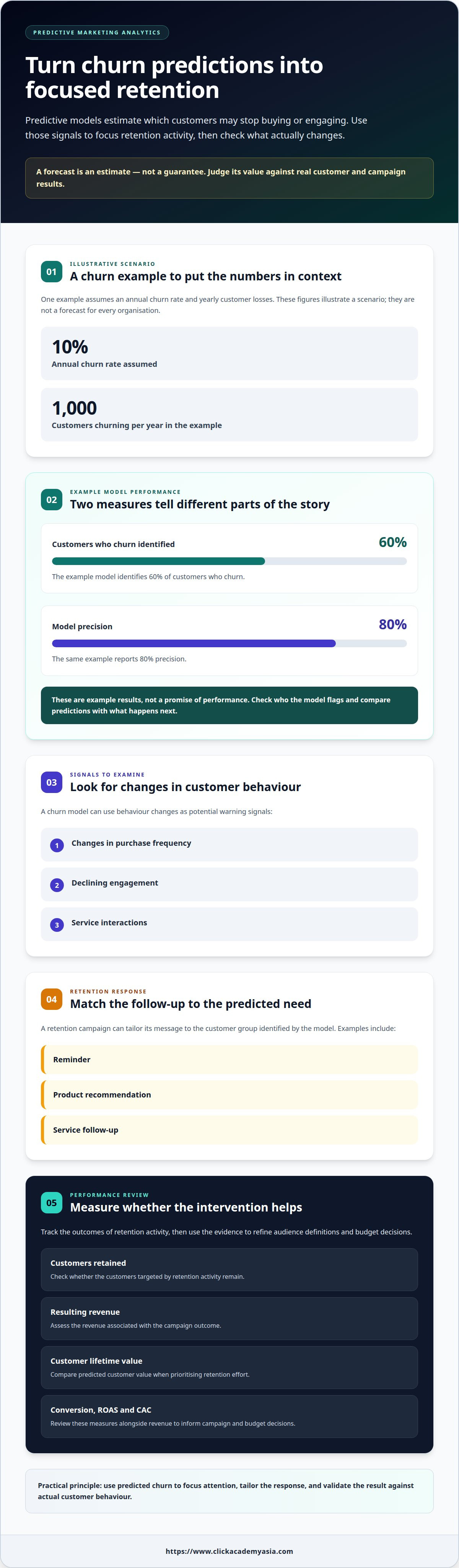
Churn prediction estimates which customers are more likely to stop buying or engaging, so retention campaigns can focus on relevant groups. A model can use changes in purchase frequency, declining engagement, or service interactions as potential signals. One example assumes a 10% annual churn rate and 1,000 customers churning per year. These figures illustrate a scenario, not a forecast for every organisation.
For campaign planning, examine who the model identifies and whether those customers respond to retention activity. One example model identifies 60% of customers who churn, with 80% precision. A retention campaign can then tailor its message to the predicted need, such as a reminder, product recommendation, or service follow-up. Track retained customers and resulting revenue to assess whether the intervention is useful.
Customer lifetime value helps marketers compare this effort with acquisition priorities. If predicted value differs between segments, they can prioritise retention messages for customers whose potential future contribution merits attention. Review conversion, revenue, ROAS, and CAC together: a campaign may attract inexpensive leads but generate little long-term value. Use these measures to refine audience definitions and budget decisions.
What is AI-Powered Marketing Analytics?
Predictive marketing analytics uses historical data to estimate likely campaign outcomes and customer responses. AI can find patterns across data and help marketers refine targeting, timing, and messages.
Predictive Models for Campaign Optimisation
A predictive model uses past campaign and customer data to estimate which choices may lead to stronger outcomes. Marketers can apply these estimates when selecting audiences, channels, creative, or send times. For example, a model might compare responses to earlier email campaigns and recommend a different audience for the next send. This makes optimisation data-informed rather than based only on broad averages.
Models also help organise campaign testing. Teams can compare predicted responses with actual engagement and conversions, then adjust the next campaign based on the difference. An illustrative analysis found that IT managers at mid-sized manufacturing companies were 40% more likely to download technical whitepapers when contacted on Wednesday afternoons. Such a pattern can inform a test, while results from the campaign determine whether it holds for a specific audience.
Engagement and Conversion Patterns
Analytics can show how customer behaviour differs across campaign stages, channels, and audience groups. A campaign might attract email opens but few landing-page visits, or generate visits without purchases. Separating these outcomes helps marketers identify where the journey loses momentum. Comparing engagement and conversion patterns offers a more useful diagnosis than treating total clicks as proof of success.
Segment-level analysis adds context. An illustrative campaign scenario reports manufacturing email engagement rates 40% higher than retail. That comparison can guide a fresh test of industry-specific messaging, but it doesn’t explain why the difference exists. Marketers should examine audience needs, offer relevance, and the next conversion step before changing the campaign.
Personalised Timing and Messaging
Personalised timing means choosing when to reach an audience based on observed response patterns. An illustrative example reports that AI-guided timing for email sends and social media posts improves engagement rates by 28%. Marketers can use this kind of recommendation to test send windows, then compare responses against their campaign objectives.
Message relevance matters too. For cart abandonment, United Colors of Benetton’s web push strategy achieved a 4.8% conversion rate in the example. A reminder can reflect the shopper’s unfinished journey, while a discount campaign should be assessed for both conversions and its effect on revenue. The useful application is matching the message to the behaviour, then measuring the outcome.
Monitoring Recommendations Against Results
Monitoring means comparing AI recommendations with campaign results, then using any gaps to improve the next decision. A digital marketing manager can review predictions regularly, comparing expected engagement with actual responses and conversions. If a recommendation misses the mark, examine the audience, timing, and message before adjusting the model or campaign. This learning cycle ties decisions to outcomes instead of treating a prediction as a final answer.
Track the same success measures across each review, such as engagement, conversions, and revenue. Separate results by audience and channel so strong performance in one segment doesn’t conceal weaker outcomes elsewhere. For marketers building these skills, practical marketing analytics training can help connect campaign data with sound optimisation decisions.
Data quality, governance, and class imbalance
Implement predictive analytics by defining a marketing use case, preparing relevant data, testing a model, and reviewing its recommendations against campaign outcomes. Key risks include poor data quality, biased or unbalanced samples, changing customer behaviour, and privacy concerns.
Training Data Quality and Model Accuracy
Training data quality means the accuracy, consistency, and relevance of the examples used to teach a model. It matters because an algorithm can learn misleading patterns from incomplete or outdated records. Start with a clear use case, such as predicting repeat purchases, then check that historical campaign and transaction data use consistent definitions. Clean, validate, and update datasets before training.
Next, separate data into training and testing sets. Use the first to train the model and the second to assess whether it can identify patterns in data it has not seen. Compare predictions with actual outcomes, then refine the model if errors cluster around a particular audience or channel. Data governance should also define ownership, access controls, and processes for correcting records across marketing platforms.
Privacy belongs in the implementation plan, not as a final technical check. According to the European Union, GDPR Article 22 requires meaningful information about the logic involved in automated decisions. Document what data informs a recommendation, how teams use it, and who can review the resulting action. Keep data access relevant to the marketing purpose and make decision processes understandable to the people responsible for them.
Data Diversity, Bias, and Class Imbalance
Data diversity means training examples represent the customer groups and behaviours to which a model will be applied. If one segment dominates the records, predictions may be less reliable for other groups. Review performance across relevant customer segments, channels, and campaign types. For example, a model trained mainly on email responses may miss the behaviour of customers who engage through social media.
Class imbalance creates a related problem when an important outcome appears rarely in the data. In a fraud example, fraudulent transactions make up 0.1% of records. A model predicting every transaction as non-fraudulent could still reach 99.9% accuracy while detecting no fraud. The lesson for marketing is to assess whether the model identifies the target behaviour, not just its overall accuracy. Review relevant errors and segment-level performance.
Customer behaviour can also change after training. For example, patterns associated with churn in 2023 may no longer predict churn in 2026. A separate data-drift illustration shifts from customers averaging 35 years to a later group averaging 50 years. Monitor inputs and outcomes over time, investigate meaningful changes, and refresh the dataset before relying on outdated intelligence to guide campaign action.
What Is AI Predictive Analytics & How Does It Work?
AI predictive analytics uses machine learning to study historical and current data, then estimate likely future outcomes. For marketers, those estimates can shape audience segments by predicted value, interests, and next-best content.
Segmentation by Predicted Lifetime Value
Segmentation by predicted lifetime value groups customers according to their estimated future contribution. It helps marketers distinguish audiences with different long-term potential instead of treating every past purchase as equal. A model can use purchase frequency, product categories, and engagement history to estimate which customers may continue buying. Those signals help guide decisions about where to focus content and retention efforts.
Consider an online retailer whose customers buy homeware, gifts, or everyday essentials. A customer who makes repeat purchases across several categories may belong in a different value segment from someone who bought once during a promotion. The model estimates likely future value from the available history, while marketers decide which offers and content suit each segment.
Dynamic segments change as new behaviour emerges. If an occasional buyer starts browsing regularly and placing repeat orders, updated data may move that person into another predicted-value group. A marketer can then adapt the customer journey, shifting from introductory product information to relevant cross-category recommendations. This keeps audience decisions tied to current signals rather than fixed labels based only on past activity.
Predicted value helps with prioritisation, but it is not a promise about an individual customer. Marketers can compare outcomes by segment and refine definitions when actual purchases differ from model estimates. For example, a high-value segment that responds to educational content may need a different campaign from customers who mainly engage with product launches.
Audience Segmentation and Content Affinity
Content affinity describes the topics or formats a customer is more likely to engage with. Predictive segments combine those preferences with behavioural signals, helping marketers match content to audience interests. For example, a travel company might distinguish customers who read destination guides from those who browse family travel packages. The resulting insights can guide relevant content choices.
Models can identify patterns across content views, searches, downloads, and purchases. A customer who repeatedly explores beginner guides might receive foundational material, while someone engaging with advanced product comparisons may be ready for detailed specifications. These examples show how observed interest can shape a personalised journey, not how to make assumptions about everyone in a segment.
To apply content affinity, map each asset to a clear topic and campaign purpose. Then connect those labels to customer interactions, such as visits to a particular guide or product category. Predictive analytics can use these signals to group audiences by likely interest and suggest relevant next content.
Predictive segments become more useful when teams turn model outputs into specific decisions. For instance, a marketer can test whether a product tutorial or customer story better supports the next step for an audience interested in a particular category. Compare engagement and conversions by segment, then adjust content assignments as new behaviour reveals changing trends.
AI predictive analytics in marketing
Using AI for predictive marketing analytics helps teams turn campaign and customer data into actionable forecasts. Machine learning can examine sales history, seasonal signals, and customer interactions to estimate likely demand or response. Marketers can use those estimates to prioritise audiences, channels, or messages, then compare forecasts with actual campaign outcomes.
The value of using AI for predictive marketing analytics lies in its ability to reveal patterns across large datasets. A predictive AI model can process millions of data points in minutes, helping teams explore relationships that manual review may miss. The analysis still needs a clear business question, such as which product category to feature or which audience may respond to a campaign.
For example, an online retailer planning a seasonal promotion could analyse past sales alongside product-page activity. A forecast might indicate which categories are attracting attention and help shape the campaign plan. Actual engagement, conversions, and revenue then show whether that emphasis was useful.
Predictive analytics can also combine contextual data, consumer sentiment, and online content to identify emerging trends. If customer comments and online interest point to a product theme, marketers can develop relevant content and observe audience responses. This turns a signal into a testable marketing action.
Recommendation engines offer another application. An online shop can use purchase history and lifestyle information to suggest products aligned with a shopper’s interests. Predictive analytics can also assess marketing options for someone browsing a website and select an option in real time, based on the visitor’s observed behaviour.
Beyond campaign selection, predictive AI can analyse sales data, seasonality, and non-financial factors to help assess demand, pricing choices, and market trends. A retailer could use these signals to decide which product themes deserve more campaign focus, then compare that decision with later sales and engagement. In specialised retail sectors such as fine jewelry, publications like jewelryecommerce.com explore how businesses apply these digital commerce platforms and data-driven strategies in practice.
To make this approach practical, begin with a defined marketing objective and the data relevant to it. Use the forecast to guide a focused campaign decision, review engagement and conversions, then refine the next application. This keeps artificial intelligence connected to measurable marketing priorities.
Strengthen your ability to turn predictive insights into campaign decisions with marketing analytics and insights training.
ClickAcademy Asia
ClickAcademy Asia helps marketing professionals build the strategic and analytical skills to turn campaign data into informed decisions. If your team is exploring predictive analytics, a practical grounding in measurement, audience strategy, and campaign planning can help connect model outputs with marketing objectives.
Relevant learning options include WSQ Marketing Analytics & Insights and WSQ Digital Marketing Strategy & Planning. For teams refining how they create audience-focused material, WSQ Content Marketing Strategy can support that work. These programmes suit professionals looking to strengthen their ability to interpret marketing signals and apply insights to planning.
To discuss how ClickAcademy Asia’s marketing programmes could support your learning goals, contact ClickAcademy Asia.
Turn predictive insight into your next marketing decision
The next step is to connect predictive analysis to a decision your team can act on. Choose a clear business objective, identify the relevant data and skills, then build a review process that links forecasts with campaign outcomes. Using AI for predictive marketing analytics is more valuable when professionals can interpret model outputs and apply them thoughtfully to real marketing plans.
ClickAcademy Asia supports this development through WSQ Digital Marketing Strategy & Planning, WSQ Content Marketing Strategy, and WSQ Search Engine Optimization (SEO). These learning options can help professionals strengthen the strategic foundations behind audience choices, content decisions, and digital marketing activity.
Build your team’s capability by equipping them through WSQ-funded training tracks. Take the next step with Contact ClickAcademy Asia to explore practical learning options for your team.
Frequently Asked Questions
What is predictive marketing?
Predictive marketing uses customer and campaign data to estimate likely future outcomes, such as repeat purchases, responses to offers, or disengagement. It helps teams move from reporting what happened to planning an action. For example, a subscription business could analyse renewal history to identify accounts that may need a timely service message, then compare renewals with its usual campaign approach.
How accurate are AI marketing predictions and how should results be measured?
Accuracy varies with the data, model, and behaviour being forecast, so no prediction should be treated as certain. Check whether model estimates align with actual outcomes for the audience and campaign in question. For example, compare predicted purchase likelihood with completed purchases, then assess whether the model ranks higher-intent customers ahead of lower-intent groups. Track business outcomes alongside model performance.
How does predictive analytics compare with traditional marketing analytics?
Traditional marketing analytics often describes past performance, while predictive analytics estimates what may happen next. A campaign report might show which subject line earned more clicks; a predictive model could estimate which customer group is more likely to respond to a future message. Teams can use both: historical reporting provides context, while forecasts inform planning and campaign tests.
What are the privacy and PDPA requirements for AI marketing analytics in Singapore?
Singapore organisations using personal data for predictive marketing need to account for their obligations under the Personal Data Protection Act (PDPA). Before deploying a model, document what personal data it uses, the purpose, who can access it, how it is protected, and when it should be deleted. Assess whether the proposed use matches the purpose communicated to individuals, and include the use case in privacy governance reviews.



Comments