
How to plan a go-to-market strategy for a new product launch

A product can be ready to ship and still miss the market. A go-to-market strategy for new product launches connects your offer with the customers who need it, a message that resonates and channels that can reach them.
Launching a new product takes more than a campaign calendar. You need a clear view of the customer problem, your product’s value, how it stands apart, and how sales and marketing will work together. Without that alignment, even strong launch activity can struggle to turn attention into adoption.
This guide explains what a go-to-market strategy does and how to build one around your product and customers in Singapore. You’ll work through the key decisions, from defining your target market and positioning to choosing channels, setting success measures and coordinating the launch. You’ll also learn how to spot common pitfalls early and build a plan grounded in customer needs and practical execution.
Table of Contents
What is a go-to-market strategy, and why do you need one?
A go-to-market strategy is a decision framework for taking an offer to customers and learning from their response. For a new product launch, it helps teams agree on scope, priorities and trade-offs before execution begins.
Decide whether a full launch plan is needed. Use a go-to-market strategy when introducing a new product, entering a new segment, repositioning an offer, changing monetisation or launching a major feature tied to adoption or revenue. Each can change customer expectations or business goals. A minor feature update with no adoption or revenue objective may need only a simpler release plan.
Plan Marketing and Sales ChannelsChoose the role each channel should play in the customer’s decision instead of treating every channel as a separate campaign. If customers need to understand a complex product before considering it, prioritise explanations that address their specific questions. Check that the channel mix suits the launch objective and your team’s capacity. A go-to-market strategy for new product launches should show why each channel deserves a place.
Set the Promotion StrategySet promotion priorities according to the main barrier to customer action. If customers doubt that a new service fits their workflow, focus on practical proof and use cases. If awareness is the barrier, prioritise reaching the intended audience. Before spreading effort across tactics, identify what customers need to understand or believe to take the next step.
Define the launch boundaries. Record what the launch includes, which customers it serves first and what would trigger a pause or change. A phased release, for example, can limit exposure while the team learns whether onboarding instructions are clear. A defined scope helps colleagues separate planned launch work from later enhancements and avoid last-minute additions that distract from the launch’s purpose.
Agree how the team will make trade-offs. Before work starts, decide how to handle competing requests, late product changes and shifts in customer feedback. A brief decision record can capture the rationale, owner and impact of each significant change. It gives the team a shared reference when priorities shift and helps protect the launch objective without treating the original plan as fixed despite new evidence.
What Is Go-To-Market Launch?
A go-to-market launch is the stage when a product becomes available to customers. Shape it around evidence about your target market, the people involved in buying and the questions they need answered.
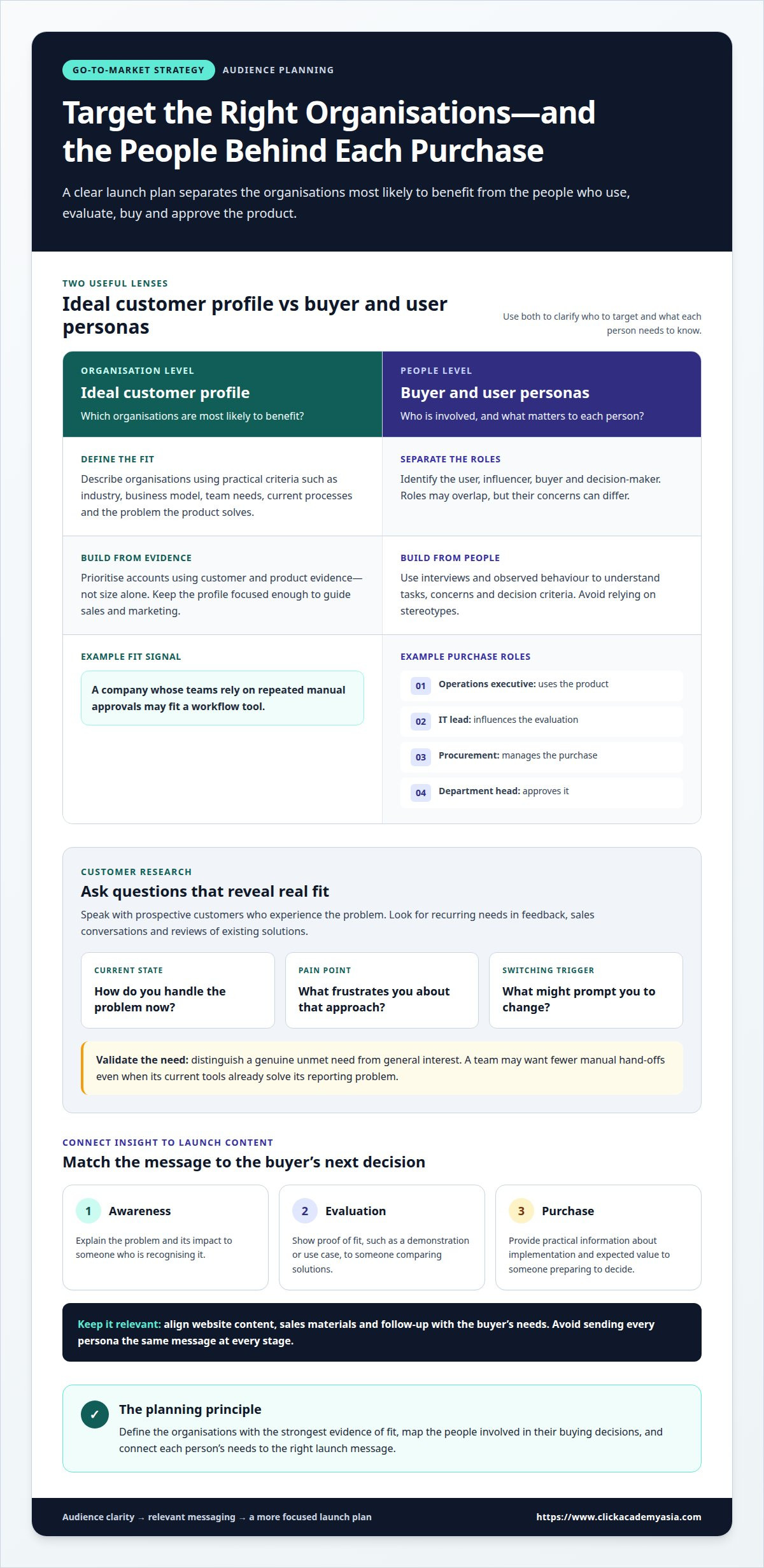
Research the Target MarketInterview prospective customers who experience the problem your product addresses. Ask how they handle it now, what frustrates them and what might prompt them to switch. Look for recurring needs in customer feedback, sales conversations and reviews of existing solutions. Distinguish a genuine unmet need from general interest. An operations team, for example, may want fewer manual hand-offs even though its current tools already solve its reporting problem. That distinction sharpens your target market and prevents broad, unfocused messaging.
Define Ideal Customer ProfilesDescribe the organisations most likely to benefit using practical fit criteria. An ideal customer profile (ICP) can specify industry, business model, team needs, current processes and the problem your product solves. For a workflow tool, a good fit might be a company whose teams rely on repeated manual approvals. Prioritise accounts using customer and product evidence, not size alone. Keep the profile focused enough to guide sales and marketing decisions.
Map Buyer and User PersonasIdentify the user, influencer, buyer and decision-maker separately. In a software purchase, an operations executive might use the product, an IT lead influence the evaluation, procurement manage the purchase and a department head approve it. Roles may overlap, but their concerns differ. Ask users about daily tasks, influencers about fit and risks, buyers about purchasing requirements, and decision-makers about business outcomes. Build personas from interviews and observed behaviour, not stereotypes.
Map the Buyer JourneyMatch messaging and content to the buyer’s next decision. Someone recognising a problem needs a clear explanation of its impact; someone comparing solutions needs proof of fit, such as a demonstration or use case. A buyer preparing to decide needs practical information about implementation and expected value. Map these needs across awareness, evaluation and purchase, then align website content, sales materials and follow-up. Avoid sending every persona the same message at every stage.Turn interview insights into audience-specific content with a content marketing strategy that supports the launch.
A useful plan identifies users, influencers, buyers and decision-makers, then connects their problems, tasks and triggers to adoption. Interviews can reveal pain points and reasons to switch.
Product, target market, customer problem, and launch approach
Connect customer evidence, product strengths and market conditions before committing to a launch plan. Then test the offer, message and support process with a focused audience.
Identify Customer Problems and Target AudiencesInterview prospective customers and examine feedback, sales conversations and workarounds. Ask what problem they face, how they solve it now and what would prompt them to switch. A team struggling with manual approvals, for example, may value a faster workflow more than additional reporting features. Validate that the problem is frequent and important to your intended audience before shaping product messaging.
Analyse Customers, Company, and CompetitionCompare customer needs with your company’s capabilities and competing offers. Note where alternatives perform well, where customers still face friction and which product strengths your team can credibly deliver. Use those findings to position the product around a meaningful difference, not a feature competitors already promote. In Singapore, include relevant product-category requirements, advertising claims and grant eligibility in launch planning; these depend on the product and programme.
Define Value Propositions and Target CustomersState who benefits, which problem the product solves and why its approach is useful. A value proposition for a small business might focus on reducing approval delays, while a larger organisation may prioritise clearer oversight across teams. Validate the message through customer interviews or a mini-launch with a focused audience. Repeated questions, objections and usage patterns can show whether the offer fits customer needs.
Set and Test Launch PricingSet pricing by weighing customer willingness to pay, competitor prices and how well the offer addresses a market gap. Compare equivalent features, packaging and payment models rather than matching a competitor’s headline price without context. Test proposed options with target customers and assess their responses alongside unit economics. Use the evidence to refine positioning and pricing; discounts or bundles should serve a clear commercial purpose.
Prepare customer service before expanding promotion. Give support and sales teams clear product information, troubleshooting guidance and an escalation route for issues raised during a mini-launch. Track enquiries, customer feedback and product usage, then assign owners to resolve recurring problems. Use those findings to adjust onboarding, messaging or the offer before a broader release. A content marketing strategy can help turn validated customer questions into launch content.
Go-to-market strategy definition and purpose
Build a go-to-market strategy as the operating plan connecting business goals to market choices and launch execution. Use it to align teams on what will reach customers, why it matters and how success will be measured.
Set the strategic direction. Define the business outcome the product must support, such as entering a new segment or growing adoption. Connect that goal to a target audience, a clear position and a route to market. Launching an existing product in a new market, for example, may require different messaging, sales support and distribution from a release to current customers.
Bring the essential decisions together. Document the product’s value, target customers, competitive context, marketing and sales approach, and success measures. Treat these as connected choices: premium positioning needs a customer case and sales narrative to support it. A shared plan helps product, marketing, sales, communications and customer success work from the same decisions instead of making conflicting assumptions.
Separate the strategy from the launch. The go-to-market strategy covers the full process of bringing a product to market. The go-to-market launch is the phase when the product is made available to customers. For a software product, the strategy includes audience selection, positioning, channel planning and readiness; the launch is the coordinated release and customer-facing announcement.
Make execution responsibilities visible. Assign owners to decisions and hand-offs across product, product marketing, sales and customer success. Product defines what is built, why it matters and who it serves; product marketing shapes how the story reaches the market. Sales and customer success carry that story into customer conversations, adoption and retention. A responsibility map helps teams resolve gaps before campaign activity begins.
Connect measures to the business goal. Select indicators that show progress from discovery to lasting customer value. Track acquisition and activation to see whether the target audience is responding, then examine adoption, revenue, retention and expansion. For an app, downloads alone won’t show whether people use it; pair them with account creation, repeat usage and conversion. Review results alongside sales feedback and product usage, then refine the next version of the plan.
Check whether each choice traces back to the business goal: the selected market and customers, the product’s position, the teams’ execution and the success measures should reinforce one another. This keeps the strategy focused on connecting intent with action, rather than treating market selection, positioning, delivery and measurement as separate activities. Considered together, these elements help teams judge whether their approach supports the goal it was designed to achieve.
Common product launch pitfalls
Launch problems often begin before promotion. Use these checks to uncover weak assumptions, unclear ownership and readiness gaps while the team can still address them.
Test whether the product is ready. Confirm that its core function works for the intended customer and that the team can explain its value. A polished campaign cannot compensate for a product that fails in a basic demonstration. Run a mini-launch or controlled release, gather user feedback and address recurring issues before expanding promotion.
Challenge the pricing logic. Compare the proposed price with customer needs, competitor offers, packaging and your unit economics. CB Insights reports that 15% of startups are beset by pricing issues. Treat that as a reason to test assumptions: unclear bundles or a price unsupported by the product’s value can weaken conversion and future growth.
Build a timeline with room for change. Map dependencies such as product readiness, campaign assets, sales preparation and customer support. Ask owners to identify risks before fixing dates, then plan for delays and pivots. If a landing page depends on final product details, set a decision date for those details instead of letting revisions stall other launch tasks.
Set decision rights before production. Name who approves positioning, product claims, pricing and final materials. Without clear owners, sales, product and marketing can make conflicting changes late in the process. Record the approver and hand-off for each deliverable so a disputed headline or feature description has a clear route to resolution.
Validate messaging with the people who will use it. Share draft claims and sales materials with customer-facing teams before launch. Ask sales and customer success to flag language customers might misunderstand, then revise it using product evidence. Unvetted messaging can create mismatched expectations, while last-minute collateral changes can disrupt campaign timing and leave teams using different versions.
Brief every launch team before promotion starts. Give product, sales, support and marketing the same launch information, customer questions and escalation process. Check that each team knows what is changing, where to find approved materials and how to report feedback. A final readiness review should resolve remaining tasks, not uncover basic gaps that should have been addressed earlier.
Strengthen campaign planning and measurement skills with practical digital marketing training for your launch team.
ClickAcademy Asia
ClickAcademy Asia helps professionals build the marketing skills to turn launch plans into coordinated execution. If your team needs to strengthen strategic planning, content development, channel selection or measurement, targeted training can help connect those decisions across the customer journey.
Relevant courses include WSQ Digital Marketing Strategy & Planning, WSQ Content Marketing Strategy, WSQ Search Engine Optimisation (SEO) and WSQ Search Engine Marketing (SEM). They support professionals looking to apply marketing strategy and channel knowledge to real business priorities.
Build your team’s launch capabilities through focused learning. Contact ClickAcademy Asia to discuss the skills your team wants to develop.
Prepare your team for the next launch
A launch plan becomes useful when your team can put it into practice, learn from customer response and adapt. Build those capabilities before your next product reaches the market, so strategy, content and channel decisions stay connected as priorities change.
To strengthen these skills, ClickAcademy Asia offers WSQ Digital Marketing Strategy & Planning, WSQ Content Marketing Strategy and WSQ Search Engine Optimisation (SEO). These courses can help professionals sharpen campaign planning, create relevant content or improve how customers discover a product.
Make your go-to-market strategy for new product launches a practical capability your team can keep developing. Contact ClickAcademy Asia to discuss your launch and equip your team through WSQ-funded training tracks that build the skills to move forward with confidence.
Frequently Asked Questions
Can a GTM strategy be applied to both new and existing products?
Yes. Use a go-to-market strategy for a new product, an existing product entering a new market, or a major repositioning. For an established product, review what has changed: customer needs, competition, pricing, distribution or adoption goals. Introducing a product to a new customer segment, for example, may require different proof points and sales support even if the product itself stays the same.
What are the 4 Ps of GTM?
The 4 Ps are product, price, place and promotion. Product covers the offer and its customer value; price includes the payment model and packaging; place refers to where and how customers buy; promotion covers how they learn about it. Apply them together. A premium product sold through specialist partners, for example, needs pricing and messaging that support that position.
What are the 5 pillars of GTM?
There isn’t one universal five-pillar model, but teams can use these practical pillars: customer and market insight, product positioning, pricing and packaging, channel strategy, and measurement. Together, they connect audience needs to commercial execution. Use them as a review framework, checking that each pillar has clear decisions, an owner and supporting evidence before launch activity is approved.
What sections should you include in a GTM strategy?
Include the business objective, target market, customer problem, competitive context, value proposition, pricing and packaging, sales and distribution model, marketing plan, launch timeline, team responsibilities and success measures. Add customer support and post-launch learning so the plan covers adoption, not just announcement day. For a regulated or technically complex product, include relevant readiness and approval work in the timeline.
What are the key components of a go-to-market strategy for a new product launch?
Start with a defined customer problem and audience, then set the product’s positioning, price, route to market and launch objectives. Prepare sales materials, marketing content, customer support and internal hand-offs before release. Choose measures that reflect the intended outcome: a product seeking trial needs different early indicators from one focused on renewals. Make the components work as a single plan, not separate departmental documents.
How do you choose launch channels, sales models, and distribution partners?
Choose channels based on how customers prefer to evaluate and buy, as well as the support each route requires. Direct sales suits offers that need consultation; self-service suits clear, easy-to-assess purchases; partners can extend reach through relevant relationships. Compare channel fit, customer experience, fulfilment responsibilities and the ability to gather feedback. A partner route, for example, needs clear ownership of enquiries and post-purchase support.
Which launch marketing tactics and channels drive awareness, trial, and conversion?
Match tactics to the customer’s next action. Use announcement content, social posts, public relations or paid advertising to build awareness; demonstrations, samples or trial access can encourage evaluation. To support conversion, make sure the landing page, product details and sales follow-up answer practical objections. Track each stage separately: attention does not prove trial, and trial does not show whether customers complete a purchase.
What are common new product launch risks and how can teams reduce them?
Common risks include weak customer demand, unclear positioning, unsuitable pricing, delayed assets and teams working from different product information. Reduce them by testing the offer with prospective customers, assigning decision owners, briefing customer-facing teams and leaving time to resolve launch dependencies. Set up a process for capturing feedback after release so recurring questions or product issues lead to specific changes instead of guesswork.



Comments